Showing posts with label soil destruction. Show all posts

Thursday, January 2, 2020

Wild Free and Happy Sample 29


[Note: This is the twenty-ninth sample from my rough draft of a far from finished new book, Wild, Free, & Happy.  I don’t plan on reviewing more books for a while.  My blog is home to reviews of 202 books, and you are very welcome to explore them.  The Search field on the right side will find words in the full contents of all rants and reviews, if you are interested in specific authors, titles, or subjects.] 

Goats

Cattle and sheep cannot thrive on depleted grazing land, but goats are especially capable of being hardcore survivalists.  They can live on barren lands, and keep them barren.  Simon Fairlie wrote that goats are popular in India, because they can survive on the same wastes that cattle consume.  While cows are sacred, goats are not, so it’s perfectly OK to eat them.  While a goat is being raised, it can devour ten acres (4 ha) of vegetation.  They do not gently nibble on the grass, they can hungrily rip it out by the roots.  They kill young trees.  Goats can be a disaster.

Paul Shepard wrote that goats are smarter than cattle or sheep, and they are blessed with interesting personalities.  They can learn to follow instructions from their master.  They are smaller than cattle, so losses to predators are less costly to the herder.  Goats get high grades in sex education classes, and are able to produce numerous offspring.  Rustlers love them because they are easier to steal than cattle.  Goats are known as the “poor man’s cow.”  A goat can produce more milk than a sheep.

Shepard imagined that in the coming years, when our reckless turbocharged joyride of decadence runs out of gas, and glides into the misty realm of embarrassing memories, our faithful companions amidst the ruins will be goats, the “avatars of poverty.”  They have given us a 5,000 year lesson in environmental catastrophe.  He was no fan of any type of domesticated livestock.  He called them “hooved locusts.”  A primary objective for many pastoralists is maximizing wealth (larger herds), not a loving, long-term, predator tolerant, ultraconservative relationship with their ecosystems.

The Earth Policy Institute (EPI) reported that ever growing numbers of livestock are working hard every day to diminish the health of world grasslands.  The EPI has been tracking livestock population trends, nation by nation.  They report that when goat numbers are rising faster than those for cattle or sheep, this is an indicator of deteriorating grassland. 

Not fussy eaters, goats are the livestock most associated with overgrazing.  As vegetation is gobbled up, less greenery survives to absorb periodic rainfall.  Consequently, more rain runs off the land, which can lead to destructive flooding.  In addition to depleting the forage, their sharp hooves also pulverize the soil surface, making soil particles more susceptible to erosion via wind or water.  Stripped landscapes led to massive floods in Pakistan in 2010.

The EPI noted that between 1970 and 2009, while the global cattle population increased by 28 percent, goat numbers more than doubled (100+ percent).  The goat trend line began rising quickly around 1980.  The Sahel region, south of the Sahara in Africa, is becoming a dustbowl.  Every year, 867,000 acres (350,862 ha) of rangeland and cropland are being lost to desertification.  Another dustbowl is rising in central Asia, western Mongolia, and western China.

John Livingston noted that only two animals create habitats: goats and humans.  Goats create deserts.  Humans create ecological train wrecks.  Sheep and goats don’t know any better but, in theory, there are some humans who are capable of making intelligent choices.  History is clear on one thing, we excel at repeating the same mistakes, century after century.  As long as they satisfy immediate needs, self-destructive habits are devilishly difficult to shake.

Daniel Hillel didn’t resent goats, because goats weren’t the problem.  The problem was pastoralists who allowed their herds to get too big.  When goats were herded on overgrazed rangeland, they ate whatever they could find, because they had no other choice.  They were far better survivalists than cattle.

Of course, stepping back even further, and using perfect hindsight, it’s not hard to see a pattern that associates animal domestication with deforestation, soil destruction, and desertification.  Wild and free animals do not have a reputation for being desert makers or forest exterminators. 

Back when all critters were wild, wolves were simply ordinary neighbors, not demonic enemies.  Their role in the ecosystem was to dine on herbivores, which helped limit the herd size, which helped keep the land healthy.  Wolves have never suffered from obnoxious beliefs about owning other animals, and gaining personal status by forcibly controlling as many as possible.  Unfortunately, herders have zero toleration for non-human predators.

Cedars of Lebanon

Lebanon is located on the east shore of the Mediterranean, just north of Israel.  It has a narrow coastal plain, and a mountainous interior.  Big Mama Nature originally clothed Lebanon with grasslands and forests, and they absorbed precipitation and kept the springs flowing — a healthy ecosystem.  The cedars of Lebanon were described in older sources as a legendary forest, a sacred land (“the cedars of god”).  Originally, the forests covered almost 2,000 square miles (5,180 km2).  That was prior to the arrival of the Phoenicians.

Tom Dale wrote that, in the early days, the Phoenicians were likely nomads who herded goats.  This could have been a low impact mode of living, as long as the population of goats and humans had remained modest, via mindful self-restraint.  Agriculture required far more hard work than goat herding, so smart folks shunned it whenever possible.  As the human population grew, feeding the growing mob became more challenging.  Consequently, farming expanded across the coastal plains, and then began spreading up into the hills.

The agriculture practiced in early civilizations, like Egypt and Mesopotamia, was enabled by irrigation.  Folks at the east end of the Mediterranean, like the Phoenicians, were the first to attempt large scale rain fed agriculture on steeply sloped land (up to 34°).  They received heavy winter rains, followed by fairly dry summers, the pattern we call a Mediterranean climate (like California).

Over time, experiments in self-restraint (if any) eventually failed.  By 2500 B.C., a civilization emerged in Phoenicia.  It had an impressive merchant fleet, communities of skilled artisans, and good ports at Tyre, Sidon, and Beirut.  The biggest threat to their prosperity was insufficient food production (i.e., insufficient family planning).  As hillside agriculture intensified, stone terraces had to be built on the slopes to keep the soil from washing away.  Constructing and maintaining stepped terraces took lots and lots of hard work.  An increasingly pissed off Big Mama Nature sometimes conjured intense cloudbursts to suddenly wash them away. 

King Solomon sent 150,000 men to Lebanon to cut and haul lumber back to Palestine, where it would be used for building temples, palaces, and trophy homes for fat cats.  Mesopotamia, Anatolia, and Egypt were also growing rapidly, and needed lots of lumber.  Wood was traded for food, but the food imports were not enough.  So, the Phoenicians created a number of colonies along the Mediterranean coast from which they could extract resources.  Their civilization peaked between 1200 and 800 B.C., and blinked out in 332 B.C., when Alexander the Great conquered them, and crucified 2,000 upper class folks in Tyre.

Dale wrote that by then, most of the forests were already history.  Over the next few centuries, Greeks and Romans finished off what remained, with a few exceptions (four small groves).  Topsoil had largely washed off the hillsides, and silted up the harbors.  Clogged river deltas became malarial marshlands.  The damage was so severe that the land could not recover and allow another thriving civilization to rise from the ruins.

Anyway, over time, almost all of the cedars of Lebanon got mowed down.  Green vegetation emerged amidst the stumps, and herds of goats hungrily chewed it up.  Lebanon’s cedars don’t produce their first cones (seeds) until they are about 40 years old.  There were almost no inaccessible rocky crags where goats could not eat new trees, as fast as they appeared.  Consequently, the forests were doomed.  Deforestation, hungry goats, and winter rains were the prime causes of massive erosion that turned Lebanon into “a well-rained-on desert.”  It will take many, many thousands of years for nature to replace the lost soil.

Trendy societies destroyed their ecosystems as fast as possible, in order to soar off into a giddy high called decadence (sort of like glue sniffing kids today).  For centuries, a series of Mediterranean civilizations took turns rising and falling, conquering and being conquered.  Raiders and pirates worked hard to snatch whatever they could, whenever possible, by any means necessary. 

Writing in 1955, Dale wrote that today, Lebanon, Crete, Turkey, Palestine, Tunisia, Algeria, Spain, Italy, Sicily, Yugoslavia, and Greece were far more torn and tattered than in the good old days.  All had lived way too hard, something like a long intense binge of oblivion drinking (…and then cometh the excruciating hammer blows of a merciless permanent hangover).  In the twenty-first century, we (the most “educated” generation ever) knowingly continue repeating the same stupid mistakes, all around the world, on a vastly more destructive scale, at a much faster rate.

In 1938 and 1939, Walter Lowdermilk toured North Africa and the Middle East to learn about how ancient civilizations destroyed themselves.  He discovered that only four small groves of Lebanon cedars still survived.  The largest one was home to about 400 trees, of which 43 were old ones.  One grove was saved because a monastery was built in it, and it was surrounded by a fence to keep the goats out.  Lowdermilk took a photo of the walled grove — a modest group of trees surrounded by a vast barren mountainous moonscape.

Land of Milk and Honey

Palestine was just south of Phoenicia.  It was home of the Israelites.  Like the Phoenicians, the Israelis were pastoralists.  Both were Semitic people, and they likely had common ancestors.  “Goat” appears in the Bible 132 times, and “sheep” 188 times.  Moses helped his people escape slavery in Egypt.  They spent 40 years wandering in the wilderness.  Their destination was the Promised Land, located on the far shore of the River Jordan.  It was “a land that floweth with milk and honey,” a phrase that appears in the Bible 20 times.

Before they got there, they were blocked by the warriors of seven nations, the Amorites, Perizzites, Canaanites, Hittites, Girgashites, Hivites, and Jebusites.  All were slain in a single day, with miraculous divine assistance.  Their deity instructed the Israelites to burn the chariots of their exterminated opponents, and hough their horses.  Hough?  It means to slash the tendons of the hind legs, to cripple the animals.  Wading through the blood and guts, they finally crossed the Jordan.

Lowdermilk’s tour of the Middle East also made a stop in the Jordan Valley.  He snapped a photo of a heavily damaged hilly landscape, and wrote: “This is a present-day view of a part of the Promised Land to which Moses led the Israelites about 1200 B.C.  A few patches still have enough soil to raise a meager crop of barley.  But most of the land has lost practically all of its soil, as observed from the rock outcroppings.  The crude rock terrace in the foreground helps hold some of the remaining soil in place.”

“We found the soils of red earth washed off the slopes to bedrock over more than half the upland area.  These soils had lodged in the valleys where they are still being cultivated and are still being eroded by great gullies that cut through the alluvium with every heavy rain.”

“What is the cause of the decadence of this country that was once flowing with milk and honey?  As we ponder the tragic history of the Holy Lands, we are reminded of the struggle of Cain and Abel.  This struggle has been made realistic through the ages by the conflict that persists, even unto today, between the tent dweller and the house dweller, between the shepherd and the farmer.  The desert seems to have produced more people than it could feed.”

Mongolian Desertification

Kathleen McLaughlin described how grasslands in Mongolia are currently being degraded by climate change, and by overgrazing the variety of goats that produce cashmere wool.  Soft cashmere was formerly used to make expensive clothing.  Today, better technology for knitting in China, combined with the fast fashion trend, has moved cashmere products from the luxury class to the mass market.  Because herders make a decent income from raising goats, they are now more than half of Mongolia’s grazing livestock.  Unfortunately, goats are the most destructive grazers, because they not only eat the roots of plants, but also the flowers that produce seeds for new grasses.

The harsh winter of 2017–2018 killed hundreds of thousands of grazing animals.  The Mongolian steppe is twice the size of Texas, and it’s slowly turning into a desert.  About 70% of the grazing lands are degraded.  A number of lakes and rivers have dried up.  Overgrazing is a primary factor in grassland deterioration. 

In the 1990s, the former communist government set quotas on grazing animal numbers.  Quotas are gone now, and grazing livestock have increased from 20 million to 61.5 million.  Dead areas are growing, and soil erosion is rising.  Native grasses are being displaced by exotic species that are toxic.  Grassland degradation is also a growing threat to wildlife species.

Thursday, May 12, 2016

Burning an Empire


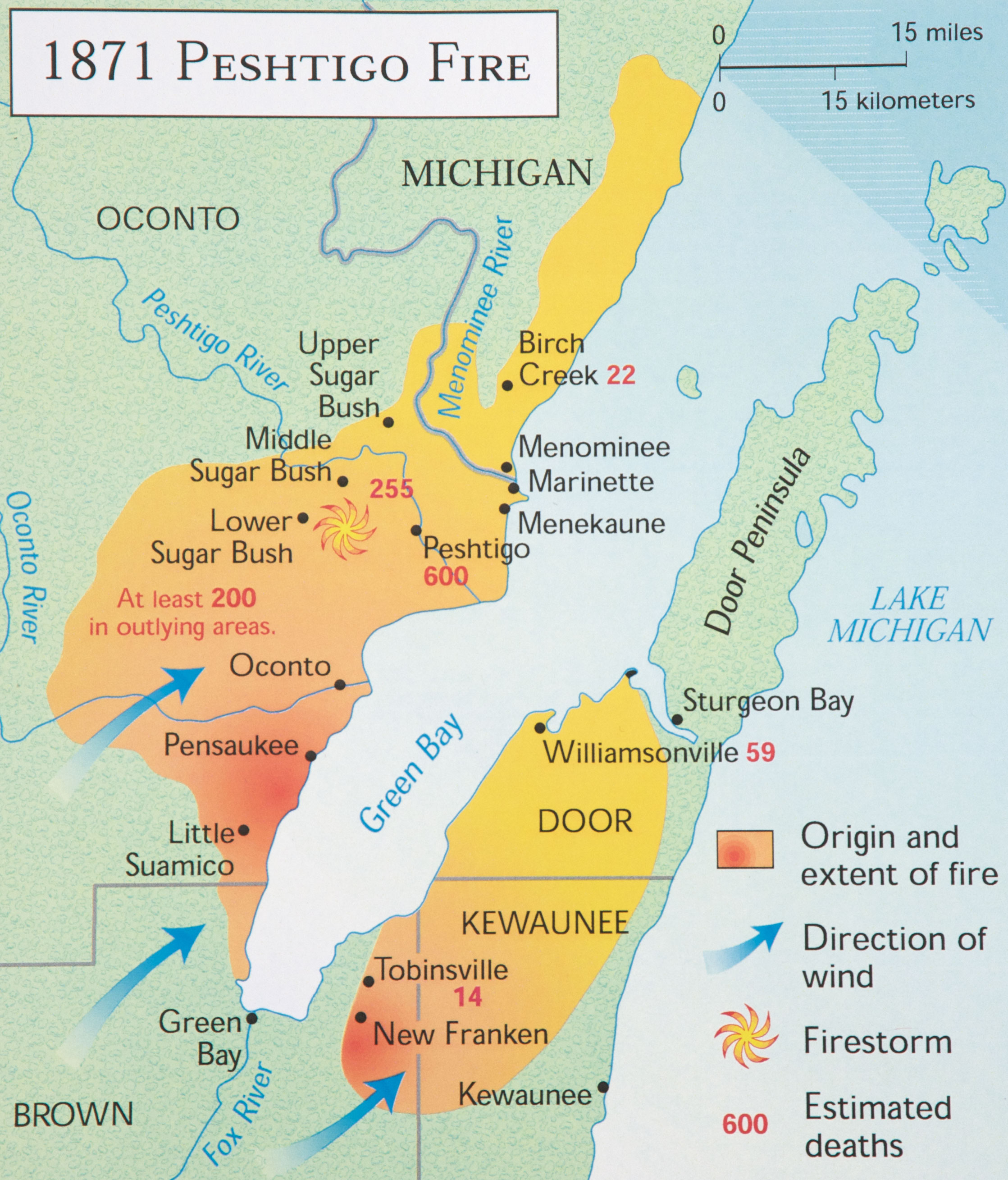
Long, long ago, around 1910, writer Stewart Holbrook met John Cameron, an old logger who had many stories to tell.  Cameron had witnessed the great fire at Peshtigo, Wisconsin (map) which began on October 8, 1871.  The town was a booming metropolis of 2,000 souls on the banks of the mighty Peshtigo River, and a hub for enterprises related to forest mining and wood products.

There had been little snow the previous winter, and just one rain between May and September.  Streams were shallow, and swamps were drying up.  Logging operations left large amounts of slash in the woods (piles of discarded limbs and branches).  Slash piles were eliminated by burning, even when it was very hot, dry, windy, and stupid.  Sparks and cinders would float off the huge bonfires onto a tinder dry landscape, where they frequently ignited other fires.  At Peshtigo, there had been small forest fires in the area during the preceding weeks, but these were commonplace, nobody worried.

The morning of October 8 was hotter than anyone could remember, and the air was deadly still.  At noon, the sun disappeared.  By nightfall the horizon was red, and smoke was in the air, making their eyes run.  At 9 P.M., Cameron heard an unusual roaring sound.  The night sky was getting lighter by the minute.  A hurricane force wind howled through.  Suddenly, swirling slabs of flames were hurtling out of nowhere and hitting the dry sawdust streets.

In a flash, Peshtigo was blazing — maybe five minutes.  The firestorm roared like Niagara Falls.  It was a seething, searing hell.  Forty people sought shelter in a (wooden) company boarding house, where they were promptly incinerated.  Others ran to the bridge, where they met a mob fleeing from the other side, as the bridge burst into flames.

Holbrook wrote that Cameron and others “saw things they never forgot.  Never.  They saw horses and cattle, yes, and men and women, stagger a brief moment over the smoking sawdust streets, then go down to burn brightly like so many flares of pitch-pine.  Forty years afterward, [Cameron’s] voice choked as he told of watching pretty Helga Rockstad as she ran down a blazing sidewalk, her blond hair streaming, and of seeing the long blond hair leap into flame that stopped Helga in her tracks.  Looking at the spot the next morning, he found two nickel garter buckles and a little mound of white-gray ash.”

The river was the safest place that night.  People kept their heads underwater as much as possible, so the great sheets of flame wouldn’t set their heads on fire.  Flaming logs floated down the river into the crowd.  Within an hour, the town was vaporized.  Big lumberjacks were reduced to streaks of ash, enough to fill a thimble.  At least 1,150 died, and 1,280,000 acres (518,000 ha) went up in smoke.

This is a condensed version of how Holbrook described the Peshtigo firestorm in his book, Burning an Empire.  In 1942, Holbrook met an old man who had lived in Peshtigo in 1871.  Before the fire, enormous pines grew close to the tracks between the town and the harbor.  But now there was nothing along the tracks except some brush and reeds.  The fire had erased the ancient forest, and the subsequent fires had destroyed the soil.

Holbrook’s book is a collection of stories describing the great forest fires of North America, from the Miramichi River valley in New Brunswick, Canada in 1825, to the Bandon, Oregon fire of 1936.  Readers learn about other big fires in Minnesota, Wisconsin, Michigan, Oregon, Idaho, and Montana.

The Peshtigo fire gets little attention in our history, because October 8, 1871 was also the date that Mrs. O’Leary’s cow knocked over a lantern, igniting the great fire of Chicago, a city made of wood.  Five times more people died in the Peshtigo fire, but Chicago was a major U.S. town.  Its fire destroyed more than 17,000 structures.  Also on October 8, 1871, numerous big fires raged across the state of Michigan, where it had not rained in two months.  These fires destroyed 2.5 million acres (1 million ha) — three times more timberland than Peshtigo.

Nobody knows how the Peshtigo fire started.  The sparks that ignited the firestorm may have come from twenty different fires.  While loggers were often blamed for triggering infernos, settlers were equally careless, and lit far more fires.  The Homestead Act provided land to anyone who would clear it and build a shack.  The quick and easy way for a settler to clear the trees was to start a fire.  Billions of feet of timber were simply burned.

Year after year, across the nation, clearing fires burned unattended throughout every summer and fall, causing far more damage than the mighty firestorms — “these friendly little blazes were burning an empire.”  Not surprisingly, this was an era of countless forest fires.  For example, in just the state of Wisconsin, tremendous fires destroyed huge areas in 1871, 1880, 1891, 1894, 1897, 1908, 1910, 1923, 1931, 1936.

The granddaddy of ecology was George Perkins Marsh.  In his 1864 masterpiece, Man and Nature*, he described how forests kept the land cooler in summer and warmer in winter.  Forests absorbed and conserved moisture.  When they were cleared, springs dried up, water tables fell, and rivers became more shallow and narrow.  Today, the Amazon Basin is painfully discovering the link between deforestation and severe drought.

Holbrook was an outstanding storyteller, a joy to read.  But he was the son of a logger, and he worked as a logger when young.  He witnessed the great fire at Tillamook, Oregon in 1933, and he later oversaw fire prevention efforts in the state of Washington.  I doubt he read Marsh.  Holbrook noted that during the logging binge in Minnesota, water tables dropped, and lake levels were up to eight feet lower.  He thought that this was the result of excessive swamp draining.

He didn’t understand that deforestation and drought are directly related.  He blamed the great fires on human carelessness.  Between 1933 and 1937, fires burned an average of 36 million acres (14m ha) each year in the U.S., and only eight percent were caused by lightning.  Today, progress, carelessness, and arson continue to be, by far, the primary cause of fires.

Holbrook was a proud American.  He admired growth and prosperity.  The timber industry was cool, except for its fire booboos.  He didn’t think like an environmental historian, who would perceive deforestation itself to be an act of carelessness.  He wrote, “Cutting a forest does not destroy it.”  Twenty-first century ecologists would never say that, because forests are far more complex than just a bunch of trees.  Nor would they endorse aggressive fire suppression, as Holbrook did.

Importantly, Holbrook reminds us about what life was like in simpler times.  At Peshtigo, there was no railroad line to the outer world, only a six-mile track from town to the harbor.  Prior to the fire, the telegraph line to the outer world had been cut by an earlier fire.  They had no radio, telephones, or internet.  They had no automobiles, fire engines, or water bomber airplanes. 

In the coming decades, as we move beyond the cheap energy bubble, the world is going to return to a similar state of simplicity, one way or another.  At the same time, climate change and foolishness are going to weaken or eliminate many of the forests alive today.  We live in interesting times.  Be careful with matches!

Holbrook, Stewart H., Burning an Empire, Macmillan Company, New York, 1943.

*George Perkins Marsh’s book, Man and Nature, is a free download away.  A scanned version (huge file) can be downloaded from here.  Amazon offers a free Kindle download (tiny file) of the 1874 edition, The Earth as Modified by Human Action, here.  Free software for reading Kindle books on your computer, tablet or phone can be downloaded (click the link below the book cover).

Monday, April 9, 2012

Dirt: The Erosion of Civilizations

Professor David Montgomery’s book Dirt provides a fascinating discussion about an extremely precious substance that we can’t live without, but treat like dirt.  He begins with an intimate explanation of what dirt is, how it’s formed, and how it’s destroyed — in plain, simple English. 
Then, he proceeds to lead us on an around-the-world tour, spanning many centuries, to examine the various methods that societies have devised for mining their soils, and diminishing their future via agriculture.
The book is impressively thorough, and it’s likely to blow more than a few minds, but the voice is a bit soft.  A neutral tone is mandatory for textbooks, and this may encourage casual readers to be less concerned about the future than they should be.  Connect the dots.
From a human perspective, soil is a non-renewable resource, because new soil is created very slowly, a process often measured on a geological timeframe.  For example, the soils of the Mediterranean basin were largely destroyed by 2,000 years ago, and they remain wrecked today.  They are quite likely to remain wrecked for many, many thousands of years.  Much of the region that once fed millions is a desert today.
If smoking a single pack of cigarettes reliably caused a painful death by cancer within weeks, nobody would smoke, because it’s clearly not smart.  But cancer normally takes decades to become apparent, and by the time you learn about the tumor, it’s too late to make smart decisions.  Life does not have an undo button.
It’s a similar story with societies that take up the dirty habit of agriculture, which is almost always fatal.  Once you get started, it’s nearly impossible to quit, because it’s unbelievably addictive.  Yet we continue to act like it’s a cool thing to do, because it’s a clever way to acquire trade trinkets and status, and all the other cool societies are doing it, too.  The disease often advances so slowly, over the course of generations, that nobody realizes the mistake.  But once the soil is ruined, it’s too late to become smart.  There is no wonder cure.  Game over.
Eventually, Montgomery’s world tour brings us to the United States, where the white invaders imported their dirty habit.  In Europe, many farmers were quite careful to do what they could to slow erosion, and improve fertility, using time-proven techniques, because starvation was the alternative.  American settlers promptly threw these prudent practices overboard, because they were time-consuming, and because there was an unbelievable supply of fertile soil that was readily available.  In the New World, dirt was a disposable commodity.
Settlers could get rich quick by raising tobacco and cotton.  A field of rich virgin soil could support three or four crops of tobacco, and then it would be abandoned.  It was cheaper to pack up, move on, and clear new fields than it was to manure the fields they had already cleared.  This careless attitude fueled an explosion of erosion and deforestation.  One gully near Macon, Georgia was 50 feet deep, 200 feet across, and 300 yards long.  Soil exhaustion was a primary driving force behind the westward expansion of the colonists.  Rape and run agriculture seems to have set the mold for the emerging American mindset.
In the twentieth century, when farmers bought millions of big, powerful machines, the 10,000 year war on soils mutated into a new and horrifying form.  Erosion rates skyrocketed to levels never before believed to be possible, leading to catastrophes like the Dust Bowl.  Montgomery says it like this: “Continued for generations, till-based agriculture will strip soil right off the land as it did in ancient Europe and the Middle East.  With current agricultural technology though, we can do it a lot faster.”
Here’s a line that made me jump: “Everything else — culture, art, and science — depends upon adequate agricultural production.”  Like air and water, food is essential for our survival.  Without food, our entire techno-wonderland turns into fairy dust and blows away.  We can’t live without it, but at the same time we are rapidly destroying what makes food possible — because profits today are more important than existence tomorrow.  Sorry kids!
On a bright note, Montgomery gives us a quick tour of Tikopia, a society on a tiny island that is one of the few exceptions to the rule.  They seem to have devised a sustainable form of agriculture that majors in agroforestry (food-producing trees).  They combined this with a draconian method for maintaining a sustainable population, which was far less painful and destabilizing than the effects of over breeding. 
Looking toward the future, Montgomery foresees a large number of serious problems.  Explosive population growth continues.  We are moving beyond the era of cheap and abundant energy, and this will continuously drive the price of everything upward.  Climate change is likely to deliver unwanted surprises.  Widespread destruction of soils continues, and simply converting to organic farming will not fix this.  Nor will no-till technology, which will eventually be forced into extinction by rising energy costs, or herbicide-resistant weeds.  We are running out of tricks for increasing productivity.  The end of the chemical fertilizer game is inevitable, and it will largely be replaced with recycled sewage — a priceless treasure that we are now throwing away via expensive, energy-guzzling treatment plants.
Our current system is simply not up to the task of feeding the world in the coming decades, because it’s a design that self-destructs.  We try to force the ecosystem to adapt to our food production technology, and this doesn’t work.  Instead, we need to make farming adapt to the needs of the ecosystem.  In short, we need a serious revolution in the way we do agriculture — a new philosophy that gives top priority to the health of the land, not to maximizing income by any means necessary.  How likely is this?  Don’t hold your breath.
The subject of this book centers on soil erosion.  In the good old days of muscle-powered organic agriculture, soil destruction took a thousand years to ruin a civilization, on average.  Industrial agriculture is much quicker.  It now keeps seven billion people alive by using soil to convert fossil energy into food.  But the clock is running out on cheap energy, and industrial agriculture has an expiration date.  This will give birth to a new agricultural revolution — the return to muscle-powered farming, on severely depleted soils, fertilized once again by nutrient-rich sewage.  Farm productivity will plummet.  We are close to peak food production now.

Montgomery, David R., Dirt: The Erosion of Civilizations, University of California Press, Berkeley, 2007.
NOTE: If you find this subject interesting, the first edition of Topsoil and Civilization (1955) is available for free online as a PDF download.  It follows a parallel course, but provides a different banquet of information, while coming to similar conclusions: