Showing posts with label bipedal. Show all posts

Wednesday, January 2, 2019

Wild Free and Happy Sample 06

[Note: This is the sixth sample from my rough draft of a far from finished new book, Wild Free & Happy.  I don’t plan on reviewing more books for a while.  My blog is home to reviews of 199 books, and you are very welcome to explore them.  The Search field on the right side will find words in the full contents of all rants and reviews, if you are interested in specific authors, titles, or subjects.] 

Bipedal Locomotion

Baboons survive today because their ancestors evolved a successful approach for living on the savannah.  They did this by organizing into powerful bad ass gangs.  Like all other non-human animals, baboons still survive by living in the manner for which evolution has fine-tuned them, free from addictions to crutches like fire or complex weapons.  They stayed in their tropical homeland, and could possibly remain there for another million years, if the human turbulence in their ecosystem mercifully mellowed out.

Unlike baboons, our ancestors took a radically different approach to surviving on tropical savannahs.  They quit knuckle walking, evolved an upright posture, and became bipedal — standing, striding, and sprinting on two legs, not four.  This transition reduced or eliminated their ability to quickly scamper up trees, where they were less vulnerable to predators.  So, a new category of primates was born: hominins — bipedal ground-dwelling primates. 

The earliest bipedal primate is the subject of controversy.  It may have lived as early as 6 million years ago.  By about 4 million years ago, our ancestors’ feet had become less useful for grasping (climbing trees), and more attuned for walking smoothly.

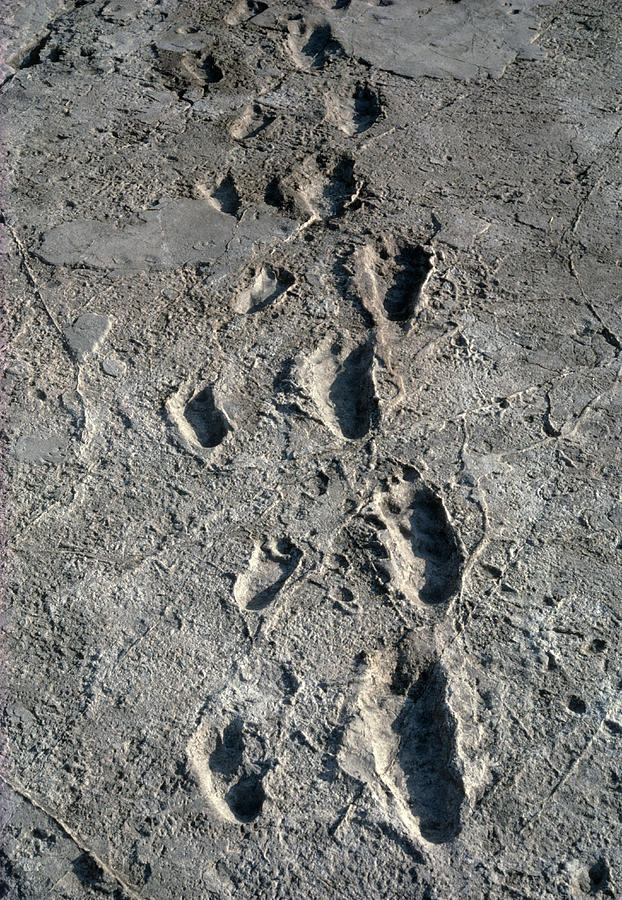
In Tanzania, 3.6 million years ago, two bipedal ancestors left their footprints in wet volcanic ash.  In 1978, at the Laetoli site, scientists discovered 70 of their fossilized footprints, in a sequence that was 88 feet long (27m).  These ancestors were probably Australopithecus afarensis.

Why the shift to bipedal travel?  Over time, as climate change expanded grassland, the distance between groves of trees increased.  Knuckle walking is OK for short trips, but striding is more comfortable and energy efficient for longer journeys.  Standing upright provided a better view of the surroundings.  It also made them more visible to hungry predators.  It freed up their hands for carrying things like food, water, infants, embers, and tools.

For brief high-speed getaways, hominins were far slower than galloping chimps.  Alfred Crosby noted that bipedal striding is like walking on stilts, and it increases the odds for falling down.  Four-legged critters (quadrupeds) like canines, cats, or horses move in a manner that is far more graceful, stable, and speedy.

On the savannah, evolution typically selected for prey animals that were better high speed escape artists.  Consequently, it also selected for the predators that were more effective at killing them.  If prey gradually got larger, predators gradually got larger.  If prey got faster, so did the predators.  If prey got too good at surviving, they would overgraze the savannah and starve.  If predators got too good at hunting, they would eliminate their prey and starve.  The ecosystem was an endless bloody evolutionary soap opera.

With regard to our ancestors, evolution advanced an unusual mutation.  Instead of size or speed, it selected for heat tolerance and long distance running.  Compared to four-legged critters, standing upright exposed less of their bodies to hot sunbeams, and their bushy hairdos provided extra heat protection.  Their nearly furless bodies, equipped with three million juicy sweat glands, allowed them to shed body heat better than other savannah mammals. 

Tree-dwelling primates enjoyed a diet majoring in fruit, which grew all around them, all year long.  On the savannah, there was less fruit, so foraging required travelling farther, and finding other things to eat.  Some believe that our ancestors became bipedal to improve their success at scavenging — beating competitors to fresh carcasses.  Bernd Heinrich wrote that at Yellowstone Park, dead animals are reduced to a pile of bones in just seven hours.  In Africa, hyenas devour the bones too.

The person you see in the mirror has a body that is optimized for running, not walking.  Your toes and heel tendons provide a bounce when your foot hits the ground, improving energy efficiency.  Your legs and spine are fine-tuned for jogging, keeping your head and eyes steady.  Skilled runners gracefully glide along, lightly skimming across the land.

The shift to bipedal locomotion resulted in some radical changes in our ancestors’ skeletons.  Notably, the pelvis got narrower, which reduced the size of the birth canal — the passageway through which fetuses pass during birth.  This challenge was dealt with in two ways.  (1) Birth occurred earlier, when brains were smaller and less mature.  This extended the duration of childhood, the spacing between births, and the need for extended parental oversight.  (2) Since bipeds no longer slept in the trees, they could grow heavier and bigger.  Increased size was an asset for hunting and defense.  Longer legs enabled longer strides, which boosted running speed.  Larger bodies retained water better, delaying dehydration.

Bipedal locomotion was an unusual evolutionary experiment.  Few if any humans still live in the manner for which evolution fine-tuned us, a practice known as persistence hunting.

Persistence Hunting

On the savannah, predators made speedy attacks, and their prey attempted quick getaways, but both soon had to find shade and chill out, because bursts of high exertion promptly led to overheating.  Consequently, predator attacks were resolved quickly.  If a charging lion failed to promptly take down its target, the attack ended, and the prey might live to see another day. 

Our ancestors gained the ability to engage in steady long distance running, hour after hour, in the oven-like midday heat of tropical savannahs.  Once a chase began, the prey animals immediately scattered.  The hunter quickly selected an animal that was less strong and speedy, and began trotting after it.  Even when the prey was miles ahead, the hunter would doggedly follow its trail, reducing its ability to rest and cool off.

Persistence hunting requires no weapons.  Hunters must possess a deep understanding of animal behavior, great skill in the art of tracking, an intuitive mind, a healthy body, and sufficient water and nutrients for a long run.  Kalahari people had exceptional tracking skills.  Women were as good as men, or better, at interpreting spoor.  At the end of a successful pursuit, the prey might collapse from exhaustion or heat stroke, or simply stop running.  If the hunter found it still alive, he could suffocate it or bonk it on the head. 

Liebenberg was maybe the first civilized person to participate in persistence hunting (he nearly died from heat stroke).  He observed a six and a half hour chase that covered 21.7 miles (35 km), on a day when the temperature ranged between 89°F and 107°F (32°C and 42°C). 

He noted that tracking encouraged wild people to develop heightened abilities for intuitive thinking, because the tracks of their prey were rarely clear and complete.  Knowledge of animal behavior helped to fill in the blanks and suggest the most likely escape route.  The mental process was fast, automatic, effortless, and often unconscious.  Intuition also enhanced social relationships.  Wild people were far more sensitive to each other than folks in the modern world, whom Liebenberg saw as being severely handicapped by shallow or dysfunctional relationships.

Maybe our ancestors learned persistence hunting from hyenas, who hunt in packs, using their super-sensitive noses to follow animals until they are exhausted.  Or, maybe they first learned by chasing small, slow moving critters.  Somehow, maybe several million years ago, our hominin ancestors learned the clever trick of using overheating and exhaustion as deadly weapons — and the keys to survival.

Every gardener who has experienced backaches or sore knees, is painfully aware that evolution did not fine tune hominins for spending long hours on their knees or bent over, engaged in tedious repetitive movements — digging, cultivating, planting, weeding, picking, threshing, grinding, and so on.  What you see in the mirror is a body optimized for long distance pursuits across hot African savannahs — a meat-loving hunter and forager.

Bears have never forgotten their identity, consequently they confidently continue to live like bears, which is why they remain perfectly sane, and have no need for psych meds.  The same can be said for all the wild animals alive today.  The glaring exception is a super large mob of modernized persistence hunters who have become extremely disoriented by memory loss.

Young children, even in the deepest darkest McMansion suburbs, are fascinated by bears, lions, horses, bunnies, piggies, and others.  They play with teddy bears, pretend to be horses, and love looking at animals in picture books.  The kids are animals, and their hominin ancestors have been fascinated by animals for six million years.  Sadly, most will spend their lives in a reality where most of the animals they’ll closely experience will be thoroughly domesticated critters purchased for companionship or status display.

Jung said that we still retain unconscious memories of our arboreal past, when falling out of trees caused big fear.  Many of us have suddenly awakened with a gasp when a dream included a sudden plunge.  Nightmares commonly involve being chased or attacked by dangerous predators.  In crowded movie theaters, when the woman is about to be stabbed by a psycho killer, the hall explodes with loud squeals and screams, like our primate ancestors in a distant rainforest.

Over the last six million years, every species of bipedal primate has gone extinct, except one — and almost all of us have abandoned persistence hunting as a routine component of basic survival.  Don’t worry.  Close your eyes and imagine what humans might become if we spent the next 200,000 years sitting on couches, staring at glowing screens, washing down greasy pizza with fizzy sugar water.

Running Goes Global

By and by, as hominins spread far beyond the savannahs of tropical Africa, so did persistence hunting.  It spread around the world, because it works, and because evolution fine-tuned us for doing it.  For almost the entire hominin saga, we lived on our feet.  Running was a key factor in our ancestors’ survival, until we got wheels, four legged slaves, and other weird and troublesome things.

Tim Flannery reported that the Aborigines of Western Australia would pursue an individual kangaroo until it was overheated and exhausted.  The chase could take several days.  Johann Kohl wrote that the Ojibway would often run down elk, especially in the winter, when deep snow soon wore out the animal.  Hunters on snowshoes could pursue the animal for hours.  Kohl also mentioned a Sioux hunter who chased a bear to exhaustion.

Bernd Heinrich wrote about the Penobscot tribe chasing down moose, and the Navajo and Paiutes wearing out pronghorn antelopes.  In Southern Africa, hunters chased steenbok, gemsbok, wildebeest, zebras, and others.  Wendell Bennett wrote about the Tarahumara people of Mexico pursuing deer and turkeys until they collapsed.  

Peter Nabokov noted that some Tarahumara lads could run 170 miles (273 km) without stopping.  Mexicans would hire them to capture wild horses, sometimes chasing them for two or three days, until the horses could run no more — while the men remained fresh.  Nabokov quoted a Hopi man: “Long ago when the Hopi had no sheep, no horses, no burros, they had to depend for game-capturing on their legs.”

Nabokov provided numerous accounts of Indian messengers traveling great distances.  One ran 50 miles in six hours.  A Mojave lad ran 200 miles (322 km) in 24 hours.  Seven days a week, a Tarahumara man ran a 70 mile (112 km) route, carrying a heavy mailbag.  After running 15 miles (24 km), Zuni runners still had a slow heart rate and no signs of fatigue.  Men in their seventies continued to have tremendous endurance, as well as low blood pressure.

For wild people in open country, running was essential for communication, warfare, hunting, ceremonies, and rituals.  Apache boys of 8 to 12 years old regularly ran to improve their endurance and pain tolerance.  They ran carrying big loads, and they ran up mountains.  Apache warriors were much stronger and braver than the U.S. Army lads sent to exterminate them.

Nabokov wrote that 4-year old Navajo boys had to get up before sunrise every day and run four miles before having breakfast.  Speed and strength were essential when attacking enemies, or being attacked.  No one will help you in this world, you must run to get strong.  Your legs are your friends.

I spent many years sitting indoors at school desks, learning reading, writing, and arithmetic, loading my brains with the ideas necessary to be an obedient, punctual, productive cog in the industrial society that’s pounding the planet to pieces.  Wild Native Americans, during the years of their youth, were being taught to be strong, brave, and extremely healthy.  They learned the skills needed to survive in their ecosystem, in a low impact manner.  During their entire lives, they sent nothing to landfills.

Thursday, May 4, 2017

Indian Running


For at least four million years, our ancestors have been bipedal, they moved around on two legs.  This ability evolved on the African savannah, tropical grassland.  Being upright exposed less of their bodies to hot sunbeams, and their bushy head hair provided extra protection.  Their nearly furless bodies, combined with three million sweat glands, allowed them to shed body heat better than other savannah mammals.

Being bipedal prohibited lightning fast bursts of speed, but it enabled steady long distance running in roasting temperatures.  Other mammals could make quick getaways, but they soon had to find shade and chill out.  Our ancestors were able to chase large animals in the heat of the day, hour after hour, until their prey collapsed from exhaustion or heat stroke.

The person you see in the mirror has a body that is optimized for running, not walking.  Your toes and heel tendons provide a bounce when your foot hits the ground, improving energy efficiency.  Your legs and spine are fine-tuned for jogging, keeping your head and eyes steady.  Skilled runners seem to move with elegant smoothness, effortlessly gliding along, lightly skimming across the land.

As I learned more about long distance running, I kept discovering fascinating tidbits about persistence hunting.  Aborigines would eventually outrun kangaroos.  The Penobscot tribe chased down moose, and the Navajo and Paiutes would subdue antelopes.  The Tarahumara pursued deer and turkeys.  In Southern Africa, game included steenbok, gemsbok, wildebeest, zebras, and others.  Peter Nabokov’s book, Indian Running, blew my mind.

The book was born in 1980, when Nabokov covered a five-day footrace in New Mexico.  Hopi, Navajo, and Zuni runners covered more than 375 miles (603 km).  The event celebrated the 300-year anniversary of the Pueblo Revolt.  Santa Fe was “the first and only white man’s city to be conquered and occupied by North American Indians.”

In 1680, Spaniards had been building missions in the region for 90 years, and they displayed remarkable gifts for behaving like class-A tyrants.  Natives from up to 300 miles (483 km) away coordinated their attack to expel the illegal aliens, and defend the American way of life.  Churches went up in smoke, their hated bells were smashed, documents were burned, 21 detested priests were sent to their just rewards, along with 380 of their Spanish and Mexican Indian associates.  Good triumphed over evil (for 12 years).  Joy!

The outline of Nabokov’s book includes five chapters that provide commentary on the five days of the 1980 race.  Throughout the text, he inserted passages about other tribes and eras, with regard to running, and these passages include some mind-altering gems.  By the end of the book, my perception of what it means to be human had been significantly updated and clarified.

Every morning, I step outdoors and wince at the rumbling thunder of thousands of motorized wheelchairs.  We consider this normal, but limited energy reserves guarantee that this silliness can have no long-term future.  When the last Toyota croaks, an extremely bloated population is not going to return to travelling by horse.  By the 1890s, industrial cities had become filthy, stinking, unhealthy nightmares of horse manure, urine, and thick clouds of flies (read THIS).

A mere 5,500 years ago, horses were domesticated in Kazakhstan.  Like the atom bomb, this event radically altered the course of the human saga.  With horses, the ferocious Mongols rapidly created the biggest contiguous empire in all history.  Mounted warriors dominated warfare for centuries, until guns and cannons came to the battlefield.  Plains Indians didn’t acquire horses until the eighteenth century, at which point their way of life promptly experienced turbulent changes, but that’s another story.

Nabakov’s story is about running.  For essentially four million years, running meant survival.  A Hopi man said, “Long ago when the Hopi had no sheep, no horses, no burros, they had to depend for game-capturing on their legs.”  Running was also vital during conflicts — for chasing despised enemies, and for speedy exits when despised enemies came to visit.  Running could be crucial for escaping the claws and jaws of man-eating predators, and other bummers.

He noted that many civilizations used runners to deliver messages — Greeks, Romans, Chinese, Persians, Aztecs, Incas, Mayans.  With fresh runners ready at stations placed several miles apart, messages could move through the Inca world at 150 miles (241 km) per day.  In Greece, the “marathon” race refers to 490 B.C., when a soldier ran 25 miles (40 km) from Marathon to Athens, bringing news of the Athenian victory over the Persians — and then he collapsed from exhaustion and died.

Nabokov provides numerous accounts of Indian messengers traveling great distances.  One ran 50 miles in six hours.  A Mojave lad ran 200 miles (322 km) in 24 hours.  Seven days a week, a Tarahumara man ran a 70 mile (112 km) route, carrying a heavy mailbag.  Another report noted that some Tarahumara lads could run 170 miles (273 km) without stopping.  Mexicans would hire them to capture wild horses, chasing them for two or three days, until the horses could run no more — while the men remained fresh.  After running 15 miles (24 km), Zuni runners still had a slow heart rate and no signs of fatigue.  Men in their seventies continued to have tremendous endurance, as well as low blood pressure.

Ceremonial running was done after planting to bring rain, and ensure a good harvest.  For Navajo and Apache women, a four-day rite of passage ritual was held to honor their first menstruation.  Young ladies would run each day, to become strong in body and soul.  Many other tribes practiced forms of puberty running.

When he was just four years old, Navajo lad Rex Lee Jim was awakened before sunrise each day, and sent outside to run four miles before breakfast.  In winter, he might take a freeze bath, rolling in the snow before running.  Geronimo and the Apaches were infamous bad asses.  By the age of 8, boys were being taught to increase their strength, endurance, and tolerance of pain.  They ran up mountains.  They ran carrying loads.  They punched trees.  Apache warriors were far stronger and tougher than the U.S. cavalry soldiers sent to exterminate them.

I spent many years sitting indoors in school desks, learning reading, writing, and arithmetic, loading my brains with the ideas necessary to be an obedient, punctual, productive cog in the industrial society that’s pounding the planet to pieces.  Wild Native Americans, during the years of their youth, were being taught to be strong, brave, and extremely healthy.  They learned the skills needed to survive in their ecosystem, in a low impact manner.  During their entire lives, they sent nothing to landfills.

In the Boston Marathon, participants are running for themselves, individuals in a vast mob of folks motivated to beat records and gain fame.  When Indians run in races, they do so as members of their tribe.  They have a sense of belonging, of community, of one enduring culture, that white people never experience.  When natives run, the message is about peace, harmony, and uniting as a people.  Race time is not important.

Fame tends to result in bigheads bloated with pride, an unwelcome irritant in tribal communities.  Excellent native runners are more likely to pump gas than become famous celebrity athletes on national TV.  There’s no place like home.

Nabokov, Peter, Indian Running, 1981, Reprint, Ancient City Press, Santa Fe, New Mexico, 1987.

For more info on running and tracking, see my two previous reviews, The Art of Tracking, and The Origin of Science.  Other interesting books include Why We Run, by Bernd Heinrich, and The Tarahumara, by Wendell Bennett and Robert Zingg.

Wednesday, April 12, 2017

The Art of Tracking


Right now, your eyes are following a track of squiggly scratches, and your mind is comprehending meaning from them.  This morning, my mental processes created those tracks, and they contain specific meaning for those who have learned the ability to interpret them.  The farther you are able to follow my tracks, the more you will learn.

Similarly, animals leave behind tracks and other signs as they move across the land, and folks who are skilled at reading this information can accumulate pieces of a story.  The indigenous trackers of the Kalahari Desert in Botswana can perceive a fantastic amount of information by studying spoor — footprints, urine, feces, saliva, blood, fur bits, feeding signs, smells, sounds, and so on.  Spoor provides clues about the animal’s species, gender, size, behavior, direction of travel, time of passage, and so on.

There are large regions of the Kalahari that are quite flat, an endless landscape having no notable landmarks for a white boy like me, who would quickly become hopelessly lost, and turn into cat food.  Hunter-gatherers, on the other hand, always know exactly where they are, because they orient themselves by the layout of plant communities, noting their size, shape, position, and unique features.  They know the face of their land as well as they know the faces of their family.

Louis Liebenberg is a South African lad who has spent years with Kalahari trackers, learning their art.  He calls himself a citizen scientist, not a professional, and he has special gifts for thinking outside the box.  His work has impressed famous academic heavyweights at Harvard.  In 1990, he published The Art of Tracking.

After our primate ancestors moved out of the trees, they eventually evolved for bipedal travel — walking upright on two legs.  In Tanzania, 3.6 million years ago, two bipedal ancestors left their footprints in wet volcanic ash.  In 1978, scientists discovered 70 of their fossilized footprints, in a sequence that was 88 feet long (27m).  [Image]  These ancestors were probably Australopithecus afarensis.

Today, our living primate relatives are quadrupeds, four legs.  Chimps can sprint much faster than humans, but we excel at running long distances.  Moving on two legs is more energy efficient than on four.  Evolution optimized our feet and legs for the spring-like mechanics of running, not walking.  Over time, we lost our fur coats, and developed the ability to sweat profusely, so we excelled at shedding body heat.  Standing upright gave us a better view of the surroundings.

Many game animals can move much faster than humans, for short bursts, then they must stop to cool off.  The desert is especially hot at midday.  Humans are unusual because we can run for hours in the heat of the day.  We can doggedly follow the tracks of speedy prey, not giving them a chance to rest, until heat stroke brings them down, and often kills them.  Hunters also carried spears or clubs, to finish the job, if needed.  HERE is a 7-minute video.

This is called persistence hunting, and Liebenberg was apparently the first civilized scientist to participate in this (he nearly died from heat stroke).  In other regions, this method has been used to hunt reindeer, kangaroos, deer, and pronghorn antelope.  Our ancestors have likely practiced persistence hunting for two million years or more.  It played a central role in the evolution of the person you see in the mirror.

Gorillas are vegetarians, spending long hours stuffing their faces at the salad bar.  They have evolved large guts in order to digest this bulky fibrous diet.  In addition to plant foods, chimps, bonobos, and baboons also eat meat, an excellent source of nutrients and calories.  They are good at predation, killing small animals without weapons.

In the early days, our bipedal ancestors likewise killed small critters with their bare hands.  Eventually, they became hunters.  Early hunters used pointed sticks, stones, and clubs to stun small mammals and birds.  By and by, the ancestors learned how to kill large game, via persistence hunting, javelins, spears, bows and arrows, and so on.  Meat maybe provided forty percent of their calories.

In addition to predation and hunting, our ancestors also acquired meat by scavenging.  Large carnivores often kill large game, devour as much as possible, and then abandon a partially eaten carcass.  On the Kalahari, hunters always note vultures circling in the distance.  They indicate the location of a dying animal, or a yummy carcass.  With luck, our ancestors’ running abilities sometimes enabled them to beat the hyenas to lunch.  Hyenas are not as good at shedding heat.  They periodically need to stop and pant to cool off.

Because game animals can move faster than humans, for limited distances, the success of persistence hunting largely depended on tracking skills — following the spoor of their chosen prey who might be out of sight.  Kalahari people had exceptional tracking skills.  Women were as good as men, or better, at interpreting spoor.  Everyone in a band, both men and women, could observe human tracks, and accurately identify the individual person who made them.

One time, Liebenberg asked some trackers if they could actually recognize the spoor of an individual antelope.  “They found it very amusing that I should ask them such a stupid question.  To them it is difficult to understand that some people can not do it.”  Liebenberg described three levels of tracking strategies.

(1) Simple tracking is just following the prey’s footprints, under ideal conditions, when the prints are clear and easy to follow.

(2) Systematic tracking is used when the spoor trail is less than complete.  Using reasoning and deduction (inductive-deductive reasoning), the tracker can then develop a hypothesis of what the prey was doing, and the most likely direction of its escape route.  This is solely based on real evidence.  Then, the hunter proceeds in the prey’s probable direction, in hope of picking up the track again. 

(3) Speculative tracking is the most advanced and creative.  “Anticipating the animal’s movements, by looking at the terrain ahead and identifying themselves with the animal on the basis of their knowledge of the animal’s behavior, the trackers may follow an imaginary route, saving much time by only looking for signs where they expect to find them (hypothetico-deductive reasoning).  By predicting where the animal may have been going, the trackers can leave the spoor, take a shortcut, and look for the spoor further ahead.”

Like vervets, baboons, jackals, and most other species, our ancestors learned ways of communicating with each other, via sounds and gestures.  Some birds make one warning call for lions, and a different one for snakes.  Many species, including humans, pay careful attention to the vocalizations of other species.  It’s good to know when a lion is approaching, long before it can be seen.

At some point, nobody knows when, the ancestors developed complex language.  As social animals, they lived in small bands.  Each member collected and shared information, and the group developed a body of wisdom.  Language made it easier for them to relay accumulated wisdom to the next generation.

Biological evolution (genes) moves at a snail’s pace, but cultural evolution (knowledge) can boogie like gazelles on meth.  With spears and javelins, the ancestors didn’t need to spend hundreds of thousands years evolving claws and fangs.

A few million years of scampering through the rainforest canopy, followed by a few million years of persistence hunting and tracking, fundamentally directed the evolution of our bodies and minds.  Today, we have abandoned our ancient way of life; it’s nearly extinct.  Imagine what we’d look like after 500,000 years of sitting on couches, entranced by glowing screens, chugging sugar water.

I’ve now given you a wee whiff of this book.  When I write reviews, I usually select a few subjects that especially interest me.  This one was especially interesting from one end to the other.  It carries readers off to a sacred mountaintop, where we can get a better view of the big picture.  If we want to live sustainably for hundreds of thousands of years, simple living is the only option.  What good are all our amazing gizmos if they require an insanely unsustainable flash-in-the-pan culture?

In every way, the wild people of the Kalahari were completely in tune with their ecosystem.  In my world today, I observe the opposite — a society that could not possibly be more alienated.  Recent DNA mapping strongly suggests that the hunter-gatherers of the Kalahari are the ancestors of all humans now on Earth.  You and I carry their genes.  Liebenberg pulls back the curtains of modernity and provides readers with a mind-expanding peek into distant corners of our family tree — the ancestors we have forgotten, and would be wise to remember.

In 2013, Liebenberg published The Origin of Science, which furthers his discussion of our Kalahari relatives.  My review is HERE.  There is some subject matter overlap between the two books, and my two reviews.  Sorry!  Take your anxiety meds.

Free PDFs of two Liebenberg books can be downloaded HERE.  YouTube has many Kalahari documentaries.

Liebenberg, Louis, The Art of Tracking, David Philip Publishers, Claremont, South Africa, 1990.

Saturday, February 11, 2017

Cradle of Humankind


East Africa is called the Cradle of Humankind because it’s where our ancestors originated.  As noted in an earlier post, two to four million years ago, the region became cooler and dryer.  Forests shrank.  The ancestors of baboons and humans moved out of the forest and adapted to savannah ecosystems (grasslands with scattered trees).

In this new habitat, male baboons evolved large canine teeth, to better deflect predator attacks.  All baboons retained the physique for scampering up trees.  Baboons still live sustainably, as they have for millions of years, because they continue to live in the manner for which evolution fine-tuned them.  They adapted to their ecosystem without altering it.  They did not make weapons and hunt animals larger than they were but, on happy days, they could mob a leopard and disassemble it.

Our ancestors evolved into critters that stood on two legs (bipedal).  They became furless, sweaty, long distance runners who, in a hot climate, could chase animals until they collapsed from exhaustion.  Heavy sweating kept them cool whilst jogging for hours.  With these traits, evolution created a new mode of offense, but it was weirdly stingy about providing defensive assets like speed, strength, teeth, or claws.  These ancestors were less agile at zooming up trees.  Over the eons, many species of bipedal apes have evolved, but only one still survives.

In the early days, the ancestors acquired new abilities very slowly, via evolution.  At the same time, other species were also busy evolving new abilities for countering our advances, and maintaining the balance.  For large animals like apes, genetic evolution can take thousands of years to stabilize a new and improved trait.  Evolution does not always mean progress.  We’re discovering that big brains can be more trouble than they’re worth.

With our transition to tool making, we began gaining new abilities by inventing them, a much faster process.  Spears enabled our ancestors to impede the man-eating predators that had kept their populations neat and tidy.  This rubbished the laws of nature.  Imagine rabbits inventing tools that allowed them to overpower foxes.  With spears, we could also kill large game, acquire abundant meat, and feed more bambinos.

By becoming tool freaks, our ancestors stumbled into the dangerous juju of cultural evolution, a painful experiment that has achieved enormous momentum and speed.  There are now seven-point-something billion of us.  We are the best-educated generation ever, the most destructive, we know it, and don’t seem to care much.  There is an important lesson here, summed up by Orgel’s Second Rule: “Evolution is cleverer than you are.”

Here’s a happy idea.  Genetic evolution is the result of a process that constantly generates billions of random mutations in every species of flora and fauna.  Most mutations are maladaptive and promptly blink out.  When mutations survive and continue, we call this natural selection.  William E. Rees reminds us that cultural evolution is also subject to something like natural selection.  Maladaptive cultural mutations, like soil mining or forest mining, are unsustainable.  Natural selection has no mercy for cultures that refuse to learn the dope slap lessons of repeated mistakes.  In the long run, the family of life will always trump self-destructive cultures, in a messy and merciless manner.

Rainforests are a paradise for biodiversity, providing a pleasant home for huge numbers of species.  Savannahs support far less biodiversity, but provide excellent habitat for many large animal species.  A square mile of rainforest contains tons of biomass in its trees, far more biomass than a square mile of grassland, but grassland can produce more new biomass every year, primarily during the wet season.  This nutritious vegetation grows close to the ground, a convenient location for grazing animals.

The biological productivity of grasslands (savannahs, prairies, and steppes) enabled the emergence of large herbivores and their predators in Africa, Eurasia, Australia, and the Americas.  For grassland herbivores, size and speed are evolutionary assets, because they discourage predators.  Lions scatter when menaced by uppity elephants.  Elephants live longer than bunnies.  Size matters.  Bigger is better.

Some species use simple tools like sticks, stones, or blades of grass, but our ancestors took the fabrication and use of tools to new levels.  They learned how make blades, projectile tips, scrapers, and axes by chipping flakes off stones.  Confronted with an organized gang of hungry apes with spears, giant size lost its advantage, and became a serious handicap.  Cultural evolution trumped genetic evolution.

In addition to getting extremely clever with tools, our ancestors also learned how to make and use fire, an ability that helped keep man-eating predators at bay.  Fire allowed us to inhabit the entire planet, and disrupt the balance of ecosystems wherever we went.  Cooked foods were easier to digest, so we could extract more nutrients.  Cooking also enabled us to digest formerly inedible materials.  Thus, our food resources were greatly expanded.

Stephen Pyne is the world’s expert on fire history.  He described excavations at Swartkrans Cave in South Africa.  At the oldest layers, the pre-fire level, no charcoal is found.  There are complete skeletons of big cats, and the scattered gnawed bones of the critters they ate, including hominids — cats were the top predator.  Charcoal is found in newer layers, the fire age.  Here are found complete hominid skeletons, and the scattered bones of the critters they gnawed, including big cats — hominids had become the top predator in the cave.

Pyne concluded, “Without fire humanity sinks to a status of near helplessness, a plump chimp with a scraping stone and digging stick, hiding from the night’s terrors, crowding into minor biotic niches.”  Combined with fire, our ability to make spears, javelins, hammers, choppers, baskets, nets, and so on propelled our blastoff into outer space, far beyond Africa.  Maybe fire and tool making are the reason that evolution didn’t bother enhancing our defenses.

Baz Edmeades is a specialist in megafauna extinction, and he notes that our ancestors were not masters of sustainable living.  Africa was loaded with megafauna species at the dawn of the Pleistocene 1.8 million years ago, but many were gone by 1.4 million years ago.  At the Olduvai Gorge site in Tanzania, in 1.8 million year old deposits, they have found the butchered bones of rhinos, hippos, elephants, antelopes, and buffalo.  Elsewhere, evidence suggests that our ancestors were tending fires 1.6 million years ago.

In the good old days, Africa had nine species of big cats (three today), nine species of elephants (one today), and four hippos (one today).  There were giant antelopes, giant hyenas, giant pigs, giant monkeys, and giant baboons — all gone.  Primary suspects include an Australopithecus species and Homo erectus.  Homo sapiens emerged much later, maybe 100,000 years ago.

Edmeades emphasizes that during this wave of extinctions, there were not corresponding extinction blips in Siberia, Europe, Australia, or the Americas.  In these other regions, most megafauna species thrived for another million years — including many species that blinked out in Africa and South Asia.  If climate change was the primary cause of megafauna extinction, the northern hemisphere should have been hammered harder, because it was the region most affected by glaciation.

Lars Werdelin is a specialist in the evolution of mammalian carnivores.  He ponders the current efforts to designate a new era of geologic time, the Anthropocene, the period when humans began causing irreversible impacts.  When did it start?  Some think 1945, or the Industrial Revolution.  Others say the dawn of soil mining and animal enslavement.  Paleontologists like Werdelin observe reality from a perspective that embraces a much broader sweep of time.

He notes that between 3.5 million years ago, and 2 million years ago, the number of large carnivore species in Africa was reduced by half.  Today, only two percent of the African large carnivore species still survive.  This transition does not correspond to what is known about climate patterns — similar extinctions did not occur in other regions at this time.  A more likely suspect is the appearance of an early species in the Homo genus.  With regard to the kickoff date for the Anthropocene, Werdelin notes, “Humans have had the ability to affect ecosystems on a major scale for the past two million years.”

Björn Kurtén was an expert on the fauna of Pleistocene Europe.  The megafauna included varieties of mammoths, rhinos, horses, aurochs, reindeer, giant hippos, giant deer, giant musk ox, giant hyenas, giant bears, giant cheetahs, giant cave lions, saber-tooth cats, leopards, antelopes, goats, and many others.  Many of these species survived in Europe until the Late Pleistocene (which ended 10,000 years ago), but are now gone.

Kurtén concluded, “The mass death can hardly be ascribed to climatic causes alone, for there was no similar mass extinction in earlier interglacials.  It seems fairly certain that modern man has played a dominant role in the wiping out of many species, although perhaps by indirect influence as much as by actual hunting.”

Edmeades notes that, in Europe, warmth-loving megafauna species, like the straight-tusked elephant, hippos, and woodland rhinos, went extinct by 25,000 years ago, around the time of the last glaciation.  There were many glaciations during the Pleistocene, and some were more severe than the last one.  The last glaciation corresponds to the time when Homo sapiens colonized Eurasia.  Cold-tolerant mammoths and wooly rhinos survived in Western Europe until 12,000 years ago.

In North America, prior to human colonization, Edmeades says the ecosystem remained comparable to Africa 1.8 million years ago.  There were condor-like birds with 16-foot wingspans (4.8 m), mammoths, and mastodons.  In addition to cheetahs, “No less than five other kinds of big cat were living on an extravagant assortment of camel, llama, deer, horse, musk ox, bison, goat and sheep species.  With its giant bears, giant beavers, giant armadillo-like species, giant tortoises, and its giant ground-sloth species, North America was, without exaggeration, a super-Serengeti containing many more big-animal species than present-day Africa.”

“The population of every organism on Earth,” he writes, “is limited by collisions with the wall of limited resources.”  Baboon numbers are limited by the availability of nutrients they can acquire with their bare hands.  Specialized meat eaters like lions are limited by the availability of prey animals.  Both lions and baboons live as evolution fine-tuned them.  Food may be abundant one season, and scarce the next.  When abundant, populations increase.  Starvation is perfectly normal and natural.

Our ancestors had the added benefit of being omnivores.  When hunting was bad, they could dine on roots, nuts, and fruits.  This dietary safety net provided a huge strategic advantage over specialized meat eaters.  Of course, even omnivores can experience mass starvation.  All life requires nutrients, and all nutrients are finite.

The ancestors also benefitted by having cutting edge technology like fire, javelins, lances, harpoons, nets, snares, boats, and warm clothing.  Modern humans have blindsided the planet by converting many wild ecosystems into freaky food production plantations, dramatically increasing their nutrient resources — as long as the soil remains fertile, and pests, viruses, droughts, deluges, and frosts don’t nuke the plan.

Everyone agrees that, once upon a time, many species of megafauna inhabited every continent, and that most are now extinct.  Everyone agrees that the extinctions did not occur at the same time, around the world.  There were not major spasms of extinctions in places where our ancestors had not yet arrived.  The extinct species had previously survived multiple eras of global and local climate swings, which were sometimes sudden and severe.  Climate shifts do alter the flora and fauna of affected ecosystems, and this contributed to regional extinctions, like the hippos of London.

When it comes to success at long-term sustainability, the chimps, bonobos, baboons, and every other non-human species, get high scores.  When the food supply in their ecosystem declines, they starve and die.  Our lineage took a different path.  Instead of starving, they increased their food supply via innovation.  Wild and free chimps, without technology, would struggle to survive beyond their current habitat.  They live where evolution fine-tuned them to live.

The creature you see in the mirror has the body of a meat-eating hunter.  It is bipedal, designed to be a long-distance runner in a hot climate.  Its hands, arms, and shoulders are fine-tuned for hurling projectiles (killing from a distance), and making and using tools.  Our ancestors were hunters more than a million years before Homo sapiens appeared.

Daniel Quinn wrote Ishmael, a best-selling novel that defined two classes of human societies, Takers (naughty) and Leavers (nice).  The fall of humankind was the transition to agriculture and civilization.  The book torpedoed sacred cultural myths and blew my mind.  Hunter-gatherers certainly have far less impact than civilized folks, but the history of megafauna extinctions is important. 

So is the fact that plant and animal domestication emerged independently in several regions.  Some groups of hunter-gatherers chose to increase their food supply rather than rely completely on the fickle luck of the hunt — or become masterful at family planning.  They cleverly began displacing the wild ecosystem to produce plant and animal foods — a transition that had Earth-shaking unintended consequences.

Worse, by producing far more food, their population bloated.  There is strength in numbers.  For thousands of years, mobs of hungry dirty farmers and herders have been steamrolling wild societies, helpless deer in the headlights of progress.  This is a real pisser!  High impact societies routinely trump low impact ones.  Consumer culture has become a monster factory where students are entranced by dark juju sermons on Sustainable Development™.  This feels like the Mother of All Predicaments.

The good news is that Big Mama Nature will not allow this tragic game to continue forever.  Highly educated consumers are consuming nonrenewable resources at a growing rate, blissfully ignorant of the existence of limits — a wall that they will slam into.  At the same time, centuries of progress are destabilizing the climate that has enabled the existence of civilization.  Wildlife populations are severely depleted and plummeting.  We are getting very close to the peak of our batshit crazy joyride of turbocharged foolishness.  An era of healing is coming.

Meanwhile, on the rainforest sidelines, are the chimps and bonobos, our closest living relatives, who have lived in the same place for millions of years without leaving scars on the habitat.  Imagine that!  Humans are animals, an extremely embarrassing fact that most of us adamantly deny.  I have no brilliant solutions to offer today.  My humble suggestion is to think like an animal.  Thinking like a consumer is pushing us toward the coffin of humankind.  All the best!

Edmeades, Baz, Megafauna — First Victims of the Human-caused Extinction, 2013.  This fascinating manuscript has been withdrawn from its home location (megafauna.com) for updates.  An earlier version is available HERE.

Kurtén, Björn, Pleistocene Mammals of Europe, Aldine Publishing Company, Chicago, 1968.

Pyne, Stephen J., Fire: A Brief History, University of Washington Press, Seattle, 2001.

Rees, William E., Is Humanity Fatally Successful?, Vancouver Institute, British Columbia, 2003 (Download).

Werdelin, Lars, Hominids, Carnivores, and the Origin of the Anthropocene, Swedish Museum of Natural History, 2015 (50 min video).

Sunday, September 13, 2015

Man the Hunted


Not long ago, I came across a book that looked interesting, Man the Hunted: Primates, Predators, and Human Evolution, written by two anthropologists, Donna Hart and Robert Sussman.  Almost half of the book discussed the many varieties of man-eating predators who for millions of years have enjoyed transforming our delicious ancestors into steaming feces.  Would it shed light on the drastic reduction in man-eating predators?  Would it explain why we plunged into our disastrous experiment with tool making, which has brought us to the brink of planetary disaster?  It did not, but it was both interesting and odd.

In the deepest, darkest auditoriums of academia, the wizards of primatology are engaged in a yowling catfight over the primary factor that influenced the course of human evolution.  The choices are: (a) being hunters, or (b) being prey.  Apparently, (c) all of the above, is rewarded with a dunce cap and a paddle whack.

The authors believe that the general public, and a sizable mob of halfwit professors, have been stupefied by the trendy Man the Hunter myth.  It proclaims that our ancestors were bloodthirsty hunters, and hunting encouraged us to become aggressive, violent, sociopathic killers, and monstrous oppressors of women.  Folks entranced by this myth also believe that their human ancestors were never eaten by predators, because they were far too smart to be killed by lions, leopards, or wolves.

The authors are on a mission from God to torpedo the Man the Hunter myth and illuminate readers with the shining truth — Man the Hunted.  Our ancestors were slow, weak, and lacked fierce teeth, sharp claws, and long horns.  On the ground, they were easy prey.  Thus, our evolutionary journey was largely influenced by being yummy meatballs in a hungry cathouse.  This encouraged us to live in groups, pay close attention to reality, cooperate with one another, and become smart, lovable, feminist hominids.

Readers discover that it was impossible for our ancestors to consume meat prior to the invention of cooking, because we lack the teeth and digestive system of carnivores.  Well, actually, we’re omnivores, like our chimp, bonobo, and baboon relatives, all of whom eat both plant and animal foods, uncooked.  Maybe our smaller teeth evolved following the invention of cooked food. 

It’s impossible to accurately determine when we began manufacturing spears, controlling fire, cooking food, or using complex language.  These interesting and unusual innovations had enormous unintended consequences.  They unlocked the entrance to a fantastically dangerous path.

I’ve always been fascinated by the fact that bonobos and chimps, our closest living relatives, have managed to inhabit the same ecosystem for two million years without trashing it.  They wisely avoided the temptation to fool around with technology beyond sticks and stones.  The book revealed an even more astonishing success story, the crocodiles, critters that have a special fondness for inattentive humans.  Today’s crocs are nearly identical to the crocs that lived in the dinosaur era, 200 million years ago.  They live in the water, floating close to the surface, and patiently wait for a thirsty critter to stop for a drink — a simple and awesomely brilliant strategy.

Bonobos and chimps provide us with an important lesson.  Their territories are separated by the Zaire River, so they’ve never met.  The bonobos are like free love hippies, whilst the chimps sometimes act like brutal biker gangs.  Why the difference?  The two species are almost genetically identical, and they inhabit the same ecosystem.  But in bonobo country, there are no chimps, baboons, or gorillas.  So, they have more food, less competition, and life is grand.  In chimp country, it doesn’t pay to be a gentleman.  The most aggressive male is always first in line at the buffet, as well as the primary sperm pump.

The authors lash out at Demonic Males, by Richard Wrangham and Dale Peterson, a gospel of Man the Hunter.  It discusses species that kill their own kind, like orangutans, chimps, gorillas, and humans.  For these species, aggressive behavior could provide some benefits, so this trait has not been discouraged by natural selection.  This infuriates Hart and Sussman, because blame is shifted to the females, who shamelessly burn with desire for demonic males, and then give birth to cute little baby demons.

All parties agree that bonobos were dealt an unbeatable hand and won the jackpot.  If humans had been dealt a similar hand of luxurious abundance, we’d probably be running around naked in an African paradise, having sex ten times a day.  Instead, we got a crap hand — the queen of technology, the joker of excess cleverness, and the ace of self-destruction.

All parties agree that, in theory, humans could mindfully choose to outgrow their rough habits, and transform into adorable sweeties.  Our unpleasant behavior is learned, not genetic.  The Pygmies, Bushmen, and other hunter-gatherers were generally good-natured.  Hunting doesn’t automatically turn us into monsters.

All parties agree that humans are not crazy-violent by nature.  Competition, crowding, scarcity, and anxiety trigger our belligerence.  So, what the heck is this argument about anyway?  Certainly, the demonic male meme has the pungent funk of Judeo-Christian juju, the crabby old sky god who never tires of exterminating city dwellers and other despicable deviants.  Where’s the science?  Well, the science of human evolution provides us with a few hundred pieces of a 100 billion-piece puzzle, and numerous versions of the story are continuously being rewritten, hence the hissing primatologist catfights.

With brains substantially larger than Homo sapiens, Neanderthals managed to live on this planet for maybe 200,000 years without leaving permanent scars.  Scientists sneer at their embarrassing lack of technological innovation (dullards!), and disregard their stunning success at sustainable living (who cares?).  Scientists are quirky folks obsessed with stuff like space colonies and computer-driven electric cars.  (I was surprised to learn that Neanderthals may have gone extinct because they ate too much meat.)

The book is about genetic evolution, not cultural evolution.  Cultural evolution is what has blown the human journey off the rails, ignited the turbo thrusters, and sent us skyrocketing into the dark unknown.  Cultural evolution provided shortcuts that gave us spears and hammers far faster than genetic evolution could enhance our anatomical assets.  Today, the pace of techno-innovation has grown to furious hurricane force.  So, does the hunter vs. hunted catfight really matter?  The planet is not being destroyed by naughty genes.  Wouldn’t it be wiser to yowl and hiss about our toxic culture instead?

Humans evolved in a healthy, wild, natural world.  Our ancestors’ lives were highly adapted to the ecosystem they inhabited.  Survival required being constantly alert to the ever-changing sights, sounds, and smells.  Humankind still exists because our ancestors were acutely aware.  Infants born today have genes that evolved during our hunter-gatherer era, genes fine-tuned for thriving in a tropical savannah amidst hungry leopards, hyenas, snakes, and crocodiles.

But look at us.  We now live in a brutally lobotomized ecosystem where being eaten is no longer a normal everyday possibility.  We live amidst crowds of strangers.  We hunt and forage in supermarkets.  We spend the last years of our lives filling diapers.  Imagine what we’d look like if we spent the next 100,000 years sitting on our butts, staring at glowing screens, and guzzling soda pop.

Many species of bipedal hominids have evolved over seven million years.  Humans are the last of the line.  Few of our bipedal cousins survived as long as the chimps have; they flamed out.  The happy ending here is that a perfect storm of manmade predicaments seems destined to yank the rug out from under our culture.  We won’t have to spend the next 200 years having loud catfights over climate change, contraceptives, or evolution.  Humankind will be dealt a very different hand of cards.  Will we be lucky?

Hart, Donna and Sussman, Robert W., Man the Hunted — Primates, Predators, and Human Evolution, Westview Press, New York, 2005.

Wrangham, Richard and Peterson, Dale, Demonic Males: Apes and the Origins of Human Violence, Houghton Mifflin Company, New York, 1996.

Wrangham, Richard, “Out of the Pan, Into the Fire: How Our Ancestors’ Evolution Depended on What They Ate,” Tree of Origin, Harvard University Press, Cambridge, 2001.