Showing posts with label meat. Show all posts

Thursday, April 2, 2020

Wild Free and Happy Sample 35


[Note: This is the thirty-fifth sample from my rough draft of a far from finished new book, Wild, Free, & Happy.  I don’t plan on reviewing more books for a while.  My blog is home to reviews of 203 books, and you are very welcome to explore them.  The Search field on the right side will find words in the full contents of all rants and reviews, if you are interested in specific authors, titles, or subjects.] 

The Curse of the Soil Molesters

If you are a lucky one, and your high school education provided you with a competent understanding of environmental history, you would probably be bored out of your mind by now, reading my tiresome jabber about stuff that every teen should know.  But, if you have been institutionalized for years in a more typical school system, there’s a chance that you’re stumbling through some uncharted territory here.  If so, it’s time we had an embarrassing “birds and bees” talk about soil molesters — the naughty things they do in their fields, and how their actions harm the region, the nation, the generations yet to be born, and the long term health of the planet’s ecosystem.

The birds and bees talk I got at age 15 had to do with boys, girls, sex, and reproduction.  The primary objective was to help kids avoid unintended and unwanted pregnancies.  With regard to my relationship with soil, I never got a similar talk, I had to figure it out on my own.  If we want to avoid ignorantly creating unwanted wastelands, the safe and effective prevention is abstinence — never, never, never engage in invasive and abusive forms of intercourse with highly fertile ecosystems.  Remember how our wild ancestors lived.  Think!

At the dawn of agriculture in Mesoamerica, folks majored in growing corn, beans, and squash.  They used techniques that were similar to other regions of the world where plant domestication emerged.  Their farm equipment was digging sticks and hoes, so the first places they molested were often along shorelines, rivers, wetlands, and flood plains, where the soils were soft and moist.  When the planters first rammed their digging tools into fertile virgin soil, the initial harvests could be impressive.  But with every year, when a field was replanted, the nutrients in the soil were a bit more diminished, and the harvest was a bit smaller. 

Depending on soil quality, a field could produce decent autumn harvests for up to maybe six years.  When “evil spirits” (nutrient depletion) eventually reduced yields, the field was abandoned, and a new one was cleared.  The abandoned field might be given a rest for maybe 10 or 20 years, to recharge its soil a bit.  Then, it might be cleared again, and returned to production for a while.  This cycle might be repeated a few times, sometimes for several generations, but not forever.  There is no free lunch.  Long term agriculture is a progressive and terminal pathology.

In Mesoamerica, this was called the milpa system, in other regions similar practices were called slash and burn, swidden, or shifting agriculture (milpa means corn field).  Milpa is the opposite of wild and free.  Big Mama Nature adores healthy soil, and strives to protect it.  Where rainfall is generous, she clothes the land with forest.  Where rain is more modest, she covers the soil with grassland.  Wild and free has three huge benefits.

(1) Protected soil retains moisture better than bare naked soil that is exposed to the sun and wind.  Consequently, wetter soil encourages a wetter ecosystem, promoting the existence of springs, streams, ponds, wetlands, and a greater abundance of many forms of life.  Magnificent swamps are home to far more biodiversity than deserts.  Both forests and wild grasslands send roots deep into the ground, so they can better retrieve nutrients and water, hold the soil in place, and continuously improve soil health and fertility with each passing century. 

In the milpa system, the primary crops are annuals, plants that live just one season and then die.  Trees and many grassland plants are perennials, plants that have longer lifespans.  Annuals have to be replanted every year, after the farmer first pulverizes the soil surface.  This disturbance encourages some of the precious carbon stored in the soil to be released into the atmosphere.  It also encourages the moisture in the soil to evaporate, which makes annuals more vulnerable to drought.

(2) Protected soil is held in place by the green blanket of vegetation, which prevents it from being blown away by the wind, or washed away by rain or snowmelt.  Bare naked sloped land is especially prone to water erosion, which can rip deep gullies into hillsides over time.  Earlier, I mentioned the catastrophic erosion in the Yellow River watershed that created gullies 600 feet deep (183 m).  Paul Shepard noted that massive erosion in the watershed of the Tigris and Euphrates Rivers dumped so much soil into the Persian Gulf that 35,000 square miles (90,650 km2) of salt marsh was created.

Once upon a time, on a lovely Sunday in June, Wes Jackson was driving through Mennonite country in Kansas.  He stopped to observe a Mennonite’s field, which had recently been planted.  During the previous night, a hard rain had dumped up to five inches (12 cm) in some places, a normal event in that region.  Mennonites devote extra effort to being good stewards of the land.  Compared to industrial agriculture, their methods have lower impact.  Looking at the field, Jackson observed that the rain had washed the seeds away, and the ditches were clogged with rich black mud.  It was a wipeout. 

Then, Jackson went to inspect a prairie not far away.  It was not damaged at all.  In fact, it had been invigorated by the refreshing rain, and none of its soil had run away.  Prairies can absorb 14 times more moisture than tilled cropland.  Forests and prairies can be fairly eternal, but cropland has an expiration date.  Sooner or later, the soil is depleted, and the cropland becomes wasteland.  This can take many generations, it’s not an immediate house-on-fire threat, so it’s easy to pretend that all is good.  But the damage caused is cumulative and almost always irreparable.

Richard Manning noted that a healthy wild prairie can absorb 5 to 7 inches (13-18 cm) of rain in an hour with no runoff.  A field of corn or soybeans can absorb 0.5 to 1.5 inches (1.3-3.8 cm) in an hour, and the excess water runs off almost as fast as from a parking lot.  This difference explains the catastrophic 2008 floods in the U.S., following several days of generous rainfall.

(3) Protected soil is often an ongoing miracle of continuous improvement.  Several thousand years ago, as the glaciers melted, Iowa’s soil was exposed to warm sunbeams for the first time in ages.  Vegetation recovered and, with each passing century, the happy prairie created an ever growing layer of tremendously fertile black topsoil.  Before settlers arrived in the nineteenth century, the soil was remarkably deep in places.  Because the sod layer was so healthy, thick, and rugged, native people with corn seeds could not rip it open with digging sticks or hoes — much to the delight of the prairie, and Big Mama.

The Iowa Association of Naturalists became freaked out by soil erosion in Iowa.  In 1999, the state was losing 240 million tons of its “black gold” every year.  This incredible treasure of soil had been created over thousands of years by a thriving tallgrass prairie.  Half of it had been lost since 1848, as the settlers launched a full-scale war on the soil, armed with the insanely destructive steel moldboard plows manufactured by a demon-possessed madman named John Deere.

Jared Diamond once visited Iowa, and observed a church in corn country that was more than 100 years old.  He said that the churchyard was like a table, a plateau elevated ten feet (3 m) above the surrounding fields, which had been savagely molested by the radicalized fanatics of the Deere cult.

Geologist Walter Youngquist noted that half of Iowa’s topsoil had been flushed down the Mississippi River, and dumped into the Gulf of Mexico.  On some Iowa hills, streaks of the ancient tan and gray marine clays, which had long been buried under the black gold, were beginning to see the light of day once again.  He wrote, “The great enemy of soil and, therefore, civilization, is civilization itself as we know it — the human-induced accelerated rate of erosion.”  From a human timescale, topsoil is a finite nonrenewable resource.  Destroying it is foolish.

The Danse Macabre

The emergence of plant domestication in both the Old World and the Americas typically triggered a devastating chain reaction of consequences — increased food production, deforestation, soil destruction, ballooning population, technological innovation, social stratification, bloody warfare, patriarchy, empire building, civilization, megalomania, ridiculous decadence, collapse, and ruins.  Then, if anything was left of the ecosystem, folks dusted themselves off, regrouped, and repeated the same mistakes, again and again, until the land was absolutely and permanently wrecked.

The transition to domestication, in multiple regions, was an extreme shift away from maybe two million years of the traditional hunter-gatherer way of life.  Our wild ancestors rocked the boat far, far less.  They were lucky to enjoy a very long era of wild, free, and happy — the calm before the storm (or the wellbeing before the epidemic).

William McNeill wrote that both plants and animals can become hosts to diseases.  Some microparasites simply enjoy an ongoing free ride on their hosts, snatching some nutrients, but not too many.  Others seriously weaken their hosts and kill them.  McNeill imagined that, in addition to plants and animals, there was a third category of hosts — ecosystems.  Over time, some human societies became foolishly clever, and mutated into macroparasite (large predator) roles, attacking and degrading healthy ecosystems.  McNeill thought that the relationship between these rogue societies and the family of life came to resemble “an acute epidemic disease.” 

When agriculture escaped from Pandora’s Box of powerful evils, it created something like a devastating infection in the family of life.  This reminded me of a meme from the era of bubonic plague epidemics: the dance of death.  Everyone was sick and dying, especially the priests, who visited the sick.  Why didn’t God even protect his own special agents?  Hello?  Many lost their faith.

Johannes Nohl reported that during plague years, a number of communities in Europe engaged in country dances, in order to dispel depression.  In 1424, a Scottish lad named Maccaber arrived in Paris.  Folks believed he had supernatural powers.  He initiated an ecclesiastic procession, the Maccaber Dance (Danse Macabre) — the Dance of Death.  Every day, for months, crowds of men and women danced in the cemetery.  Folks wore scary masks to drive away the evil spirits.

The notion of a dance of death is sort of a fitting description for how ecosystems were impacted by the emergence and expansion of agriculture.  Let’s sketch out a generic pattern for how agriculture triggered its own whirlwind of evil spirits.  The horror began with clearing and planting in soft moist soils.  This led to more food, more people, and tired soil.  This led communities to gradually expand the size of the milpa, until it reached the limits of prime locations to deflower.  Then, planting began to move up slopes.  If forests covered the slopes, as they often did, the tree people were chopped down.  This led to more food, more people, more soil depletion, and more erosion and gullying.

As communities expanded their realms, at some point they were likely to bump into other communities, and generate some friction and sparks.  The survival of each settlement required folks to protect their stores of corn and beans — precious treasures that opponents were eager to swipe or destroy.  Consequently, many Native Americans surrounded their communities with tall and sturdy wooden palisades.  Dean Snow wrote that corn spread into Iroquois country around 1350 to 1400.  Population grew, villages got larger, longhouses got longer, and most villages had double or triple palisades.  This defensive strategy was similar to the Old World practice of building fortifications, moats, and walled cities.

In the conflict game, the cardinal rule is strength in numbers.  At first, a village might be managed by a tribal chief.  Then, multiple villages would unite, and live under the protection of a warlord.  Later, these alliances merged together into kingdoms or empires.  Communities that prepared for conflict were more likely to survive than communities that attempted to avoid the mother of conflict via family planning — reproductive taboos.  By and by, civilizations appeared, and initiated full-scale warfare on ecosystems.

Big shots in lofty power centers got very big headed and heavy handed.  Their minds floated in a giddy dream world, soaring with grandiose infantile visions of full dose megalomania.  One day, in an online encyclopedia, I was looking at a discussion of pre-Columbian (before 1492) civilizations in the New World.  I was suddenly walloped by a mind expanding dope slap.  SMACK! 

My eyes scanned a series of photos of ancient Mesoamerican ruins.  They were strangely similar in many ways — huge pyramids, elevated temple platforms, sculptures, palaces, streets, and plazas.  It was spooky how these New World images resembled the ruins created by the early civilizations in the Fertile Crescent and the Mediterranean basin.  Civilizations around the world, totally isolated from each other, clearly exhibited symptoms of the same acute disease — the curse of cleverness, domination, patriarchy, and self-glorification.

Why were so many people forced to spend their lives engaged in monumental construction projects that survived centuries longer than the brief explosion of decadence and egomania that created them?  What could be more ridiculous?  Well, (blush!) today’s industrial civilization has succeeded in boosting human foolishness and mindless destruction to levels never before believed to be possible.  No generation has created more and bigger ruins than the voracious mob alive today.

Beginning around 1200 B.C., a series of New World civilizations appeared here and there, aggressively devoured their resource base, enjoyed a giddy orgasm of debauchery, and then plummeted into oblivion.   The parade included the Olmecs, Mayans, Aztecs, Toltecs, Oaxacans Incas, Mixtecs, Zapotecs, and so on.  This pattern of growth and collapse was also the norm in many regions of the Old World — Uruk, Babylon, Phoenicia, etc.  Like fireflies, they blink on for a moment, then off.  In unsustainable cultures, what goes up must come down, no exceptions.

Old World civilizations were fuelled by junior grade propellants like wheat, barley, and rice.  New World civilizations were turbocharged by two highly potent propellants: corn and potatoes.  Clive Ponting noted that in A.D. 600, wheat powered Rome was home to 50,000.  At that time, in the Valley of Mexico, corn powered Teotihuacán was home to 100,000 (others say 150,000).  It is located about 18 miles (30 km) northeast of Mexico City. 

The Old World had many powerful things that Mesoamerica did not — livestock, horses, wheels, ships, and advanced metallurgy.  Maybe the Romans were handicapped by their inferior food, or by the persistent barbarian attacks, or by the waves of infectious diseases nurtured by animal domestication, or by their soils depleted by several centuries of wheat farming, or by their lead pipe water distribution system.

In 600, hungry dirty Europeans were struggling to survive in what we now call the Dark Ages, while Teotihuacán was a state of the art masterpiece of monumental architecture (look at online images).  There was the Street of the Dead, the Pyramid of the Sun, and the Pyramid of the Moon.  Aztecs ominously referred to Teotihuacán as “the place where men became gods.”  The society was destroyed in about 650, and everything flammable was burned.  By 900, it was an abandoned ghost town.

Much later, in 1521, when Spaniards arrived, the Aztec civilization of Tenochtitlán (Mexico City) was one of the biggest cities in the world, with a population of about 200,000 (some say 250,000), which was five times larger than London.  The invaders were amazed to see a big city in which the streets were not stinky and slippery with deep horse shit.  Aztecs are also known as the Mexica.

In an effort to recycle soil nutrients, the Aztecs fertilized their fields with human poop.  Imagine how much poop 200,000 people can plop every day.  Imagine continuously moving that poop out to the cornfields — without the benefit of wheeled carts or (nonhuman) beasts of burden.  Despite challenges, their population was soaring to new heights — until Old World diseases rumbled into town like a mega-death steamroller.

Several of the Spanish invaders wrote down accounts of what they observed, including the Aztec rituals of human sacrifice.  Prisoners were taken to the top of the temple-pyramid, where they were cut open, their beating heart removed and offered to the sun, and their corpse kicked down the steps.  Several Spaniards estimated that the number of folks sacrificed was maybe 20,000 per year.  On one especially sacred occasion in 1487, according to Aztec sources, the dedication of the main pyramid in Tenochtitlán was even bloodier, possibly more than 80,000.

Michael Harner focused his attention on the human sacrifices.  What was their purpose?  He noted that scholars tended to consider the practice shocking, but sacrifices were not unique to Mesoamerica.  Old World cultures had their own tradition of bloody mass murders that were inspired by periodic outbursts of holy hysteria and rabid intolerance.

Harner contemplated the notion that there was more to the rituals than good old fashioned religion.  Long before the rise of the Aztec culture, the deer in central Mexico had been hunted to scarcity.  Tenochtitlán was built on a manmade island on the western shore of Lake Texcoco.  The lake was too shallow and salty for fish to live in, so the meat department majored in domesticated turkeys and hairless dogs (Chihuahuas).

In the Andes, the Incas also performed sacrifices, but on a much smaller scale.  Their meat department was more generous, including llamas, alpacas, and guinea pigs.  Because long distance travel was extremely difficult, the people of the Andes didn’t acquire turkeys or Chihuahuas from Mexico, but they did get corn.  On the other end, Mesoamerica did not acquire llamas, alpacas, guinea pigs, or potatoes from the Andes.

While it’s possible to be fairly well nourished on a diet majoring in corn and beans, it takes some luck.  Both have to be consumed during the same meal, in adequate portions, in order to assemble essential proteins.  Adding some meat to their diet could help compensate their protein requirements.

John Reader noted that fat is essential for the absorption, transport, and storage of vitamins A, D, E, and K.  Growing children especially need two types of fat.  Arctic folks can enjoy excellent health on a diet of blubber and raw meat, but Aborigines would abandon a kangaroo that had too little fat.

Reader noted that we need to consume 40 to 50 nutrients, including carbs, fat, protein, 14 vitamins, and 15 minerals.  The building blocks of proteins are 22 types of amino acids.  From the food we eat, we can assemble 12 types of amino acids.  We cannot assemble the other 10 types, they must be consumed readymade.  These are called “essential” amino acids.  All 10 are present in plant foods, but not in the ideal proportions.  When our diet is missing just one essential amino acid, protein assembly ceases. 

It is possible to get by on a combo of cereals and beans, but this option was not practical until the era of agriculture.  For non-farmers, meat is an essential component of a healthy diet.  Different types of animal foods provide proteins, but we need to reassemble them into forms that our bodies need.  Reader said that the one and only animal food that provides the exact mix of required proteins readymade is human meat.  Full scale cannibal cultures are impossible, because the rate of consumption would far exceed the rate of reproduction.

Harner proposed the theory that the Aztec sacrifices had two roles, one was religious, and the other was about reducing malnutrition.  Aztecs often raided their neighbors, and brought back prisoners.  They did not annex their land, but they left behind survivors to breed replacements that could be captured during future raids.  Prisoners who were not eaten on the battlefield were taken back home, where they were kept in sturdy wooden cages, in which they were fattened up for an upcoming sacrifice.

Bernal Díaz was a Spaniard who was an eyewitness to sacrifices.  He wrote:  “Moreover every day they sacrificed before our eyes three, four, or five Indians, whose hearts were offered to those idols and whose blood was plastered on the walls.  The feet, arms, and legs of their victims were cut off and eaten, just as we eat beef from the butcher’s in our country.”

In the sacrifice process, the heads were also removed.  In Tenochtitlán, their skulls were displayed on a rack near the temple.  Two soldiers were assigned the job of estimating the number of skulls on the rack.  They concluded about 136,000 skulls (not including the ones on the towers).  Sacrifices were also normal events in other Aztec cities.

As school children, we were taught that civilization was an outstanding achievement, a great leap forward.  We also learned that our wild ancestors, who had far less eco-impact, were primitive, stupid, and pitiable.  Their lives were “nasty, brutish, and short.” 

Thursday, December 6, 2018

Wild Free and Happy Sample 04


[Note: This is the fourth sample from my rough draft of a far from finished new book, Wild Free & Happy.  I don’t plan on reviewing more books for a while.  My blog is home to reviews of 199 books, and you are very welcome to explore them.  The Search field on the right side will find words in the full contents of all rants and reviews, if you are interested in specific authors, titles, or subjects.] 
 

Orangutans

Our orangutan cousins in Sumatra spend about 90 percent of their time in the trees, where they are safe from hungry tigers.  Living in low density, often solitary, they enjoy a peaceful life, free from the emotional aggravation of living in an anxious crowd.  Of all the apes, they are the least noisy, usually silent.  They move through the trees at a leisurely pace, never in a hurry.  There is always something to eat in the rainforest.  On average, females give birth every eight years, a longer spacing than any other mammal.

Orangutans are very intelligent.  Researcher Biruté Mary Galdikas said, “I’ve had this feeling, ever since I was very young, that the tropical rainforest represents the original Garden of Eden.  Our ancestors left the garden, but orangutans never did.  They maintained a childlike innocence that humans lost a long, long time ago.”

Sadly, a mob of palm oil tycoons are furiously replacing the rainforest with palm plantations, mostly in Borneo and Sumatra.

Chimpanzees

Chimpanzees can grow to a standing height of 5.5 feet (1.7 m), weighing up to 130 pounds (60 kg).  Males are larger and more robust than females.  Chimps spend most of their time in the trees.  Because of their size, they are less speedy and graceful at leaping through the tree canopy, compared to smaller primates.  So, when they want to visit somewhere not close by, they go to the ground and knuckle walk.

Humans evolved for living on the ground, and are optimized for long distance running.  While chimps are smaller than humans, their arboreal lifestyle has made them far stronger.   One experiment found that the arm strength of male chimps is five times that of humans.  Big heavily muscled human wrestlers cannot hold a chimp still, even a young four year old. 

Frans de Waal warns that “Having a chimp in your home is like having a tiger in your home.”  When chimps feel threatened by a human, the human is in danger, and if he attempts to defend himself, the chimp will be even more brutal.  Outdoors, when humans appear to be harmlessly passing through, chimps generally ignore them.

Chimp bands are dominated by an alpha male, who is often backed up by one or more alpha wannabes.  From time to time, the alpha is challenged by lower status males, one of which will eventually dethrone the cocky king of the harem.  When the alpha is defeated, the new alpha often kills the infants of nursing females, so they will become fertile sooner, and produce offspring having his superior genes.  An alpha tends to be abrasive to everyone, to intimidate them, and assert his control.  When male strangers make an appearance, they are welcomed with teeth, fists, clubs, and stones.  In skirmishes to defend territory, chimps are sometimes beaten to death.

Bonobos

Bonobos and chimps live close to each other, but their rainforest habitats are separated by the Zaire River.  The two species have never met in the wild, because neither can swim.  They look a lot alike, and until 1929 were thought to be a single species.  Chimps far outnumber bonobos, and their territory is much larger.  Male bonobos can weigh up to 86 pounds (39 kg), and females up to 68 pounds (31 kg).

The bonobo culture is strikingly unusual for primates.  Their groups are matriarchal.  Males are second-class.  Females determine how food is shared, and they eat while the males wait.  Chimps have sex only when a female is fertile.  Bonobos have sex almost anytime, several times a day, with anyone interested, young or old, in every imaginable way.  Because of this, it’s impossible to know who your biological father was.  So, no youngsters are deliberately killed.

Bonobos are incredibly lucky.  They live in a habitat with abundant food, and no serious competitors in their ecological niche, an ideal situation that does not encourage competition.  Chimps live in leaner lands, and compete for food with gorillas and baboons.  They feel the squeeze of crowding, and they reduce this pressure by infanticide, and by killing or driving away competitors.

Primate Diets

The first primates evolved from small nocturnal insectivores that gobbled bugs during the dinosaur era.  Today, all primates are omnivores, consuming both plant and animal foods.  None are vegetarians, but gorillas are primarily leaf eaters (folivores).  Most primate species are mainly fruit eaters (frugivores).  Tropical forests typically provide a year round supply of fruit, so most primates live close to them.  Fruit is 75 percent of a chimp’s diet, and sugar is rapidly converted to energy.  It’s interesting that human babies have a preference for things that taste sweet, a relic of our tree dwelling days.

Protein is an essential nutrient for primates, and it is mainly acquired by consuming animal foods, and certain types of leaves.  The primary source of animal protein is insects.  When insects are abundant, they can provide up to 90 percent of a healthy primate’s diet.  Meat is a high quality source of protein, far superior to plant sources.  It takes less effort for our digestive systems to utilize the protein from meat.  Some primates are good at predation, killing small animals.  Some are scavengers, dining on the leftovers of carcasses abandoned by carnivores.

While plant foods are most of their diet, bonobos also eat caterpillars, earthworms, shrews, reptiles, bats, flying squirrels, and small forest antelopes (duikers).  Chimpanzees also eat insects, birds, eggs, monkeys, duikers, bushbucks, wild pigs, and carrion.  Baboons also eat insects, fish, shellfish, rodents, hares, birds, vervet monkeys, and duikers.  The orangutan diet includes more than 400 types of food, but it majors in ripe fruit.  They sometimes dine on invertebrates, like caterpillars and worms, and, on rare occasions, meat.  Gibbons feed mainly on fruit, but also consume leaves, insects, bird eggs, and sometimes young birds.

Hominins are unusual primates because some species learned how to kill and cook large animals.  This was made possible by their experiments in tool making, and the domestication of fire.  Unlike other primate lines, hominins are able to digest big servings of highly nutritious animal foods.  Shepard Krech noted that the diet of Native Americans could sometimes include six to twelve pounds (2.7 to 5.4 kg) of meat per day.  For employees of the Hudson Bay Company, the daily ration was seven to eight pounds of meat.  Of course, the diet of wild artic societies consisted almost entirely of animal foods.

The Bottom Line

Non-hominin primates did not make complex weapons, strive to exterminate predators, spread around the world, enslave other species, invent agriculture, explode in numbers, live in filth, and die by the millions from infectious diseases.  They did not wage war against infectious diseases, soar into extreme overshoot, load the atmosphere with crud, and blindside the planet’s climate.  Instead, they continue to inhabit a niche in their ecosystem, and live as they have for millions of years, without rocking the boat.  This is nature’s way.

Somewhere along the path, hominins began exploring new paths that eventually led them farther and farther from nature’s way, into dark and dangerous realms.  A growing number of the cool new tricks we discovered had uncool consequences, eventually triggering disturbances that not only rocked the boat, but rocked the planet.  Edward Abbey said, “Man is literally undoing the work of organic evolution.”  This is the opposite of intelligent.

The accelerating frenzy of half-clever experiments has catapulted human modes of living to places far outside of the time-proven design encoded by our genetic evolution (hardware).  The long parade of naughty booboos was the result of an impulsive adolescent fling with cultural evolution (software).  I don’t believe that our hardware is fatally flawed.  Our software is, without a doubt, a deadly threat to us, our descendants, and the entire family of life.

In the coming decades, our operating system is going to crash, again and again, because of its countless bugs.  Before long, our radicalized blind faith in utopian techno-fantasies will be thoroughly rubbished by the nightmares we created with good intentions.  As life as we know it melts down, even stupid people (hopefully) will come to reject our culture’s fantasies.  What should we do?  Any bright ideas out there?

The disintegration and abandonment of the failed culture will create a vacuum, an opening for new modes of being, which must be radically different, radically simpler, and ecologically wise.  Now is a good time to be contemplating how things got to be this way.  Now would be an excellent time for serious efforts to learn from our many mistakes.  Repeating the same mistakes, generation after generation, is so embarrassing for critters with big brains (blush!).

In the following chapters, I’ll sketch out my interpretation of the human saga, from the perspective of humans as animals — not the Crown of Creation.  Happy trails!

Sunday, June 4, 2017

Hunting Strategies in Central Europe


Hunter-gatherer cultures differed widely in their dependence on technology.  The persistence hunters of the Kalahari used almost none, while those inhabiting cold regions required huge survival toolboxes — weatherproof shelters, warm hearths, fur clothing, canoes, specialized weaponry, food storage.  In the far north, hunting clans also required dozens of large sled dogs, and feeding them required killing many additional wild animals, all year long.  The utterly simple Kalahari way of life was practiced by our hominid ancestors for two or three million years.  These tropical primates had coevolved with their tropical ecosystem, and elegantly danced to the beat of the land, a vital key for their long-term success.

I was curious to learn more about the hunting cultures of my prehistoric ancestors in snowy Europe, so I plowed through a pile of scholarly books, papers, and websites.  The Stránská skála site near Brno, Czech Republic looked promising.  It held the remains of bison, horses, mammoths, elk, rhinos, bears, and giant deer.  I came across Hunting Strategies in Central Europe During the Last Glacial Maximum, by Dixie West.  Most of the book focused on stone tools and bone fragments found at Stránská skála and another site.  I didn’t find what I was looking for, but the info I found was important for better understanding this chapter of the human saga.

The Last Glacial Maximum (LGM) was the frigid peak of the last ice age, which occurred between 20,000 to 15,000 years ago.  Glaciers retained so much water that sea levels were 410 feet (125 m) lower than today.  A lass could walk from Ireland to Scandinavia or France without getting her feet wet (MAP).  During the LGM, climate became cooler and more arid, which had a serious impact on vegetation, and the animals that depended on it.  Many species that had survived a number of earlier ice ages began to go extinct.  Climate was an important actor in this drama.  Notably, highly skilled human hunters, with state of the art technology, were now well-established residents of Europa.

Once upon a time, mammoth country ranged from Western Europe to Alaska, New England, and Mexico.  Mammoths needed to stay close to water.  Because they were huge, and moved slowly, they couldn’t utilize sparse scattered patches of vegetation, or food too distant from water sources.  Difficult terrain was also off limits for the huge critters.  Each day, an adult needed to eat 440 to 660 pounds (200 – 300 kg) of moist feed, preferably grass.  A horse could get by on 22 pounds (10 kg) per day.

Frozen mammoths have been found, and their guts contained larch, birch, willow, sedge, mosses, and grasses.  They were able to digest both low fiber fresh grasses and high fiber wood, and quickly convert them into mammoth poop.  As the climate became cooler and more arid, their food supply diminished.  European mammoths were stressed by 24,000 years ago.  As the harsh climate intensified, the slow-moving animals had to migrate to warmer regions, which were already occupied by other large herbivores.

In a dryer climate, vegetation became more fibrous, or went dormant.  Seasonal bottlenecks in the food supply for grazing animals increased.  Bison, aurochs (cattle), sheep, and goats digest their preferred food slowly, and a diet higher in fiber would have been a threat to survival, in the driest periods.  They joined the mammoths in drifting toward greener pastures.

Similarly, reindeer had a limited ability to digest cellulose, but they were able to survive because they could quickly travel long distances each day, selectively dining at smaller patches of the most nutritious food.  Another plus was their ability to digest forages that other species could not, like lichens.

Horses were also lucky, because they could thrive on a high fiber, low protein diet.  They had to spend more time grazing on lower quality food, consume larger amounts of it, and expand the size of the territory they grazed.

The LGM made life more challenging for hunters.  Game animals declined in numbers and variety, so more time was spent searching for them.  The lads preferred to take larger animals that provided generous amounts of meat, body fat, marrow, and bone grease.  Fat was very important.  When a carcass provided little fat, more meat had to be consumed to acquire necessary nutrients.  West noted, “If fat is totally absent in the diet, very lean meat should be avoided as it takes a higher metabolism to digest purely lean meat, and predators, including humans, can readily lose weight on a lean meat diet.”

At the kill site, animals were often dismembered, making it easier to haul them back to camp.  They hauled away the prime stuff, and left behind low quality stuff for scavengers to enjoy and recycle.  Marrow was prized, and reindeer bones contained a lot of it.  Horses were twice the size of reindeer, but the deer had 13 times more marrow.  Horses provided lots of protein, but had minimal body fat or marrow.  It wasn’t worth the effort to haul away horse bones and break them apart at camp.

There were two types of horse groups, harems and bachelor herds.  The dominant stallion protected his harem of mares, and the young colts.  Colts were prime targets for predators, but stallions were big, strong, and aggressive — kicking, biting, and stomping all threats.  When hunters attacked a harem, the stallion had to be killed first.  Hunters were less likely to die when attacking bachelors, but less likely to get meat, because bachelors rapidly dispersed in every direction.

For ambush hunting, waterholes were a prime location.  Hunters waited, concealed in blinds.  As the LGM squeezed plant communities, horse herds were forced to scatter more for grazing, making them harder for hunters to find.  During fall and spring migrations, herds could swell to thousands of animals.  They were fattest in the late autumn.  Hunters could kill many by driving them into box canyons, ravines, stone corrals, and other traps.

Reindeer also gathered in large herds for seasonal migrations.  Autumn was the prime season for hunting.  Reindeer were much easier to kill, but these smaller animals provided less protein.  Hunters consumed their meat, blood, fat, marrow, and the milk of (killed) lactating cows.  West adds, “Modern caribou hunters provide evidence that ancient humans could have relied on partially digested gut contents and feces of reindeer to fulfill nutritional requirements.”  Yum!

Antlers were used to make tools.  They could be eaten while in summer velvet.  Fat was burned for light.  After the hunt, hides were prepared for tanning, and meat was butchered for drying or smoking.  Bones were broken to get marrow, and then crushed and boiled to extract the bone grease.  Containers were made from hides, bladders, and guts.  Cordage was made from tendons and sinews.  Hides were used to make blankets, boots, and clothing.

Caribou are close relatives of reindeer.  Each year, 24 hides were needed to maintain a caribou hunter’s wardrobe.  At least 20 hides were needed to make a tent.  Boiled hides were famine food.  From time to time, when adequate vegetation became scarce, the routes of seasonal migrations might change suddenly without warning.  It only took a few weeks for a hunting group to die from starvation.

For me, the moral of this story is that life is vastly easier when tropical primates remain in their tropical motherland, and live as their ancestors had for several million years, relying on a few very simple tools.  Migrating into non-tropical ecosystems, like Europe, demanded serious technological innovation, a dark juju that proceeds slowly at first, gradually accelerates, and then explodes.  Innovation is highly contagious, demonically addictive, and phenomenally destructive in its advanced stages.  Old-fashioned cultures that wisely nurtured voluntary restraint and simple lifestyles were helpless deer in the headlights of runaway innovation, forcing them to leap aboard the Oblivion Express or die.

In her book, The Old Way, Elizabeth Marshall Thomas reported that the traditional Kalahari way of life is over.  Clever lads discovered that enslaved dogs made tracking and hunting much easier.  Later they got enslaved horses, eliminating the need for long distance running.  Then they got guns, which were far deadlier than bows and arrows.  Progress never sleeps.  Guess what happened to the game.  Only a few elders still remember the art of tracking, a million years of time-proven knowledge.

Year after year, we’ve been zooming past countless red warning signs.  Wrong way!  Do not enter!  The path of human-centered thinking is approaching its clearly marked dead end.  Beliefs, spells, and madness got us into this mess — not genes.  Devastating epidemics of status fever are spread via stupid ideas.  Sane ideas are an effective cure.  Imagine that.

West, Dixie, Hunting Strategies in Central Europe During the Last Glacial Maximum, British Archaeological Reports, Oxford, 1997.

Thomas, Elizabeth Marshall, The Old Way: A Story of the First People, Farrar Straus Giroux, New York, 2006.

Woolly mammoth image above (source).

Monday, May 15, 2017

Hunters of the Recent Past


When I hear the word “hunter,” I immediately conjure an image of a man with a gun.  Other images follow — bows and arrows, mounted hunters, cavemen with spears, and so on.  Hunters of the Recent Past provided me with much new information on how the ancestors lived, prior to horses, guns, and other industrial gizmos.  The book is a collection of 19 scholarly papers that describe modes of low-tech communal hunting that were common during the last 8,000 years or so.

Evolution fine-tuned our species for life on tropical savannahs.  In a hot climate, meat spoils quickly, so hunting was only done to satisfy immediate needs.  Tropical folks could survive without fire and clever technology.  On the other hand, in temperate and subarctic climates, the buffet of food resources was less generous.  In many regions, survival through long winters was impossible without having fire, warm shelter, fur clothing, and substantial amounts of stored food.

On the western plains of North America, a common method of communal hunting was driving herds of buffalo off cliffs.  White folks called these killing sites buffalo jumps, the Blackfeet called them pishkuns.  Pishkuns were scattered from Canada to Mexico.  There were more than 300 in Montana alone.  For thousands of years, prior to horses and guns, this was a primary method for hunting buffalo.  At the First Peoples Buffalo Jump State Park in Montana, many layers of buffalo bones are found beneath the cliff — literally millions of bones.

When scouts observed a herd moving into the vicinity of a pishkun, hunters moved to appropriate locations, and became noisy and animated.  The herd panicked and ran away from them, moving into drive lanes that funneled the herd to the brink of doom.  Brave teenage buffalo runners, camouflaged in buffalo hides, led the animals toward the cliff.  The runners would disappear over the edge, but safely land on a ledge below, whilst the surprised buffalos flew over them, and plummeted to the rocks below, where butchers waited.  (Read THIS.)

The Head-Smashed-In Buffalo Jump is in southwest Alberta.  It utilized one of the longest and most complex drive structures on the plains.  Natives constructed drive lanes that reached up to 6 miles (10 km) into the gathering basin.  They followed the contours of the land, to help the flow of animals move as smoothly as possible.  The bone deposits at the bottom are 39 feet deep (12 m).  This pishkun was in use by at least 6,000 years ago.  (Read THIS.)

In the journal of the Lewis and Clark Expedition, Lewis noted that on May 29, 1805 they discovered the rotting carcasses of about 100 buffalo at the bottom of a cliff, as well as great numbers of well-fed wolves that were “very gentle.”  For amusement, Clark felt inspired to shoot one of the blissed out wolves.

There were two primary seasons for communal hunting, springtime and late autumn/early winter.  In spring, little stored food was left.  Buffalo still had heavy winter coats, excellent for making warm clothing.  In the fall, animals had fattened up for the long cold winter, and fat was cherished.  Animals with minimal fat were junk food, or dog food, or left to rot.

Reindeer live in northern Eurasia, and caribou live in Greenland, Canada, and Alaska.  The two creatures are the same species (Rangifer tarandus), but there are nine subspecies, like tundra reindeer, woodland reindeer, tundra caribou, woodland caribou, etc.  Several are now endangered.  The species is unique in that both sexes grow antlers.

All around the Arctic Circle, reindeer and caribou have been hunted for thousands of years.  They provide meat, sinew for sewing, bone for needles and awls, antler for tools, fat for light, heating, and nourishment, and hides for bags, snares, clothes, and tents.  They make survival possible.

Every spring and fall, herds made seasonal migrations along traditional routes.  Hunters knew when and where to expect them.  These routes often had bottlenecks that concentrated the herds, ideal locations for hunting.  Commonly, groups of hunters would drive the herds into killing places.  To direct the movement of a herd, drive lanes included barriers — log fences, brush fences, snow drifts, rock cairns.  Some locations had corrals of wood or stone to capture the herd.  In Siberia, animals were driven into nets.

Herds were driven into deep snow and then lanced or shot with arrows.  In Greenland, caribou were driven off cliffs.  Some hunters used snares, open loops suspended from branches, to grab animals by their necks or antlers.  Snares were placed along game trails, where animals voluntarily moved, or scattered along drive lanes where hunters or dogs aggressively drove them.  Records from 250 years ago report that near Churchill, Manitoba, caribou herds were driven into corrals that were one mile (1.6 km) in diameter, and 350 to 600 people participated in the kill.

The easiest method, where possible, was to drive the herd into streams or lakes, where they were lanced by hunters in canoes or kayaks.  Two hundred animals could be taken in a few hours.  During a two-week summer hunt on Lake Mistinipi, hunters speared 1,200 to 1,500 caribou.  One Copper Inuit settlement, inhabited between 1500 and 1700, was located close to a caribou migration route.  During two centuries, an estimated 100,000 caribou were driven into the lake and killed.

Lads in canoes did not always stop killing when they had all the meat they needed.  In a frenzy, they killed as many caribou as they could, the entire herd, if possible.  It was a great pleasure to kill so easily, many months since the last migration.  Near Hudson Bay, an observer in the 1890s found hundreds of carcasses left to rot — overkill.

In Scotland, Norway, Sweden, and Finland, many thousands of pit traps were dug in migration routes to catch reindeer.  Animals could be driven into the pits during their outbound and inbound migrations.  In southern Norway, trapping pits were used as early as 11,000 years ago.  HERE are examples of snares and traps used in Stone Age Finland.  HERE are photos of recreations of a settlement in Stone Age Finland.

Caribou herds had been following traditional migration routes for 8,000 years or more.  Indians and Inuit built permanent settlements along the routes.  In the nineteenth century, when hunters began using repeating rifles, animals could be killed from farther away, requiring less stalking skill.  The caribou harvest sharply increased.  Before long, herds abandoned traditional routes, communities starved, and their settlements went extinct — an unintended consequence of progress.

The book also discusses communal hunting for pronghorn antelope, mountain sheep (bighorns), mammoths and mastodons, moas, guanacos, and others.  It’s a mother lode of information.  The writing is scholarly — terse and compact — but not bewildering techno jargon gibberish.

Compared to the good old days in mother Africa, it was far more difficult for tropical primates to survive in cool climates.  The selection of kill sites, and the construction of drive lanes, corrals, and pit traps was a major effort.  On the days of mass kills, large numbers of people were required for success.  Preserving meat and hides took weeks of work.

Communal hunting required teamwork, planning, and extensive knowledge of the landscape, the behavior of animals, and basic survival.  Over time, it contributed to the extinction of mammoths, mastodons, and moas.  By the 1930s, mountain sheep were nearly gone.  With the arrival of guns, horses, traders, snowmobiles, ranchers, loggers, miners, diseases, and genocidal maniacs, the herds of buffalo, caribou, and reindeer have been sharply reduced.

In another review (HERE), we learned that the persistence hunters of the Kalahari, and their hominid predecessors, remained extremely low tech for two million years or more.  The civilized people who have waged full-scale war on wildlife are all descendants of persistence hunters.  Technological innovation is demonically addictive, new gizmos replacing old, in an accelerating downward spiral.  Cultures bewitched with cleverness gallop down the drive lanes, faster and faster and faster, destined for the bloody bone beds below — big brains and all.  There are other paths.

Davis, Leslie B., and Brian O. K. Reeves, editors, Hunters of the Recent Past, Unwin Hyman, London, 1990.

Wednesday, April 12, 2017

The Art of Tracking


Right now, your eyes are following a track of squiggly scratches, and your mind is comprehending meaning from them.  This morning, my mental processes created those tracks, and they contain specific meaning for those who have learned the ability to interpret them.  The farther you are able to follow my tracks, the more you will learn.

Similarly, animals leave behind tracks and other signs as they move across the land, and folks who are skilled at reading this information can accumulate pieces of a story.  The indigenous trackers of the Kalahari Desert in Botswana can perceive a fantastic amount of information by studying spoor — footprints, urine, feces, saliva, blood, fur bits, feeding signs, smells, sounds, and so on.  Spoor provides clues about the animal’s species, gender, size, behavior, direction of travel, time of passage, and so on.

There are large regions of the Kalahari that are quite flat, an endless landscape having no notable landmarks for a white boy like me, who would quickly become hopelessly lost, and turn into cat food.  Hunter-gatherers, on the other hand, always know exactly where they are, because they orient themselves by the layout of plant communities, noting their size, shape, position, and unique features.  They know the face of their land as well as they know the faces of their family.

Louis Liebenberg is a South African lad who has spent years with Kalahari trackers, learning their art.  He calls himself a citizen scientist, not a professional, and he has special gifts for thinking outside the box.  His work has impressed famous academic heavyweights at Harvard.  In 1990, he published The Art of Tracking.

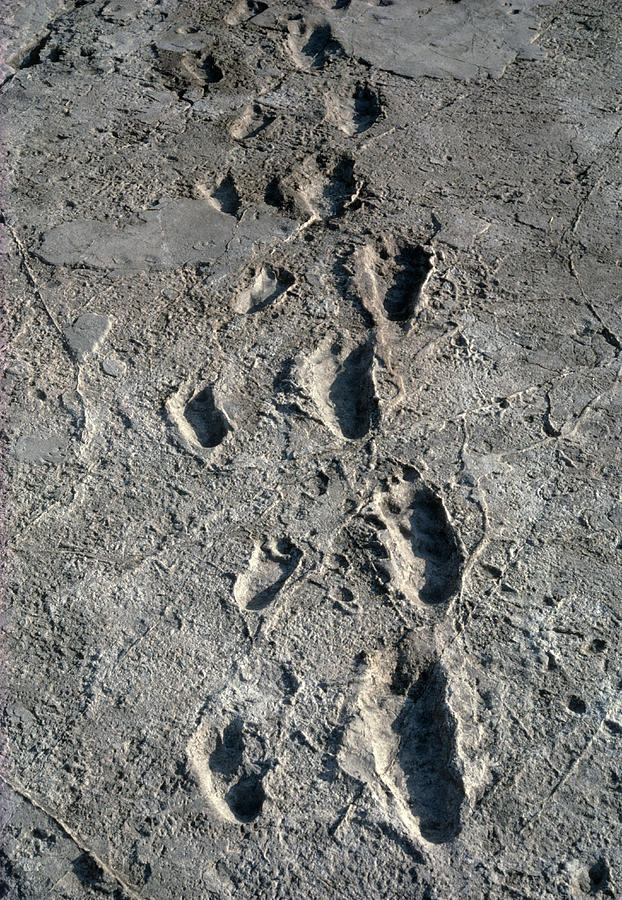
After our primate ancestors moved out of the trees, they eventually evolved for bipedal travel — walking upright on two legs.  In Tanzania, 3.6 million years ago, two bipedal ancestors left their footprints in wet volcanic ash.  In 1978, scientists discovered 70 of their fossilized footprints, in a sequence that was 88 feet long (27m).  [Image]  These ancestors were probably Australopithecus afarensis.

Today, our living primate relatives are quadrupeds, four legs.  Chimps can sprint much faster than humans, but we excel at running long distances.  Moving on two legs is more energy efficient than on four.  Evolution optimized our feet and legs for the spring-like mechanics of running, not walking.  Over time, we lost our fur coats, and developed the ability to sweat profusely, so we excelled at shedding body heat.  Standing upright gave us a better view of the surroundings.

Many game animals can move much faster than humans, for short bursts, then they must stop to cool off.  The desert is especially hot at midday.  Humans are unusual because we can run for hours in the heat of the day.  We can doggedly follow the tracks of speedy prey, not giving them a chance to rest, until heat stroke brings them down, and often kills them.  Hunters also carried spears or clubs, to finish the job, if needed.  HERE is a 7-minute video.

This is called persistence hunting, and Liebenberg was apparently the first civilized scientist to participate in this (he nearly died from heat stroke).  In other regions, this method has been used to hunt reindeer, kangaroos, deer, and pronghorn antelope.  Our ancestors have likely practiced persistence hunting for two million years or more.  It played a central role in the evolution of the person you see in the mirror.

Gorillas are vegetarians, spending long hours stuffing their faces at the salad bar.  They have evolved large guts in order to digest this bulky fibrous diet.  In addition to plant foods, chimps, bonobos, and baboons also eat meat, an excellent source of nutrients and calories.  They are good at predation, killing small animals without weapons.

In the early days, our bipedal ancestors likewise killed small critters with their bare hands.  Eventually, they became hunters.  Early hunters used pointed sticks, stones, and clubs to stun small mammals and birds.  By and by, the ancestors learned how to kill large game, via persistence hunting, javelins, spears, bows and arrows, and so on.  Meat maybe provided forty percent of their calories.

In addition to predation and hunting, our ancestors also acquired meat by scavenging.  Large carnivores often kill large game, devour as much as possible, and then abandon a partially eaten carcass.  On the Kalahari, hunters always note vultures circling in the distance.  They indicate the location of a dying animal, or a yummy carcass.  With luck, our ancestors’ running abilities sometimes enabled them to beat the hyenas to lunch.  Hyenas are not as good at shedding heat.  They periodically need to stop and pant to cool off.

Because game animals can move faster than humans, for limited distances, the success of persistence hunting largely depended on tracking skills — following the spoor of their chosen prey who might be out of sight.  Kalahari people had exceptional tracking skills.  Women were as good as men, or better, at interpreting spoor.  Everyone in a band, both men and women, could observe human tracks, and accurately identify the individual person who made them.

One time, Liebenberg asked some trackers if they could actually recognize the spoor of an individual antelope.  “They found it very amusing that I should ask them such a stupid question.  To them it is difficult to understand that some people can not do it.”  Liebenberg described three levels of tracking strategies.

(1) Simple tracking is just following the prey’s footprints, under ideal conditions, when the prints are clear and easy to follow.

(2) Systematic tracking is used when the spoor trail is less than complete.  Using reasoning and deduction (inductive-deductive reasoning), the tracker can then develop a hypothesis of what the prey was doing, and the most likely direction of its escape route.  This is solely based on real evidence.  Then, the hunter proceeds in the prey’s probable direction, in hope of picking up the track again. 

(3) Speculative tracking is the most advanced and creative.  “Anticipating the animal’s movements, by looking at the terrain ahead and identifying themselves with the animal on the basis of their knowledge of the animal’s behavior, the trackers may follow an imaginary route, saving much time by only looking for signs where they expect to find them (hypothetico-deductive reasoning).  By predicting where the animal may have been going, the trackers can leave the spoor, take a shortcut, and look for the spoor further ahead.”

Like vervets, baboons, jackals, and most other species, our ancestors learned ways of communicating with each other, via sounds and gestures.  Some birds make one warning call for lions, and a different one for snakes.  Many species, including humans, pay careful attention to the vocalizations of other species.  It’s good to know when a lion is approaching, long before it can be seen.

At some point, nobody knows when, the ancestors developed complex language.  As social animals, they lived in small bands.  Each member collected and shared information, and the group developed a body of wisdom.  Language made it easier for them to relay accumulated wisdom to the next generation.

Biological evolution (genes) moves at a snail’s pace, but cultural evolution (knowledge) can boogie like gazelles on meth.  With spears and javelins, the ancestors didn’t need to spend hundreds of thousands years evolving claws and fangs.

A few million years of scampering through the rainforest canopy, followed by a few million years of persistence hunting and tracking, fundamentally directed the evolution of our bodies and minds.  Today, we have abandoned our ancient way of life; it’s nearly extinct.  Imagine what we’d look like after 500,000 years of sitting on couches, entranced by glowing screens, chugging sugar water.

I’ve now given you a wee whiff of this book.  When I write reviews, I usually select a few subjects that especially interest me.  This one was especially interesting from one end to the other.  It carries readers off to a sacred mountaintop, where we can get a better view of the big picture.  If we want to live sustainably for hundreds of thousands of years, simple living is the only option.  What good are all our amazing gizmos if they require an insanely unsustainable flash-in-the-pan culture?

In every way, the wild people of the Kalahari were completely in tune with their ecosystem.  In my world today, I observe the opposite — a society that could not possibly be more alienated.  Recent DNA mapping strongly suggests that the hunter-gatherers of the Kalahari are the ancestors of all humans now on Earth.  You and I carry their genes.  Liebenberg pulls back the curtains of modernity and provides readers with a mind-expanding peek into distant corners of our family tree — the ancestors we have forgotten, and would be wise to remember.

In 2013, Liebenberg published The Origin of Science, which furthers his discussion of our Kalahari relatives.  My review is HERE.  There is some subject matter overlap between the two books, and my two reviews.  Sorry!  Take your anxiety meds.

Free PDFs of two Liebenberg books can be downloaded HERE.  YouTube has many Kalahari documentaries.

Liebenberg, Louis, The Art of Tracking, David Philip Publishers, Claremont, South Africa, 1990.