Showing posts with label food storage. Show all posts

Saturday, November 21, 2020

Wild Free and Happy Sample 50


[Note: This is the fiftieth sample from my rough draft of a far from finished new book, Wild, Free, & Happy.  The Search field on the right side will find words in the full contents of all rants and reviews.  These samples are not freestanding pieces.  They will be easier to understand if you start with sample 01, and follow the sequence listed HERE — if you happen to have some free time.  If you prefer audiobooks, Michael Dowd is in the process of reading and recording my book HERE.

PATHWAY TO DOMINATION

As discussed earlier, humans originated on the tropical savannahs of east Africa.  For most of the human saga, we were strong, healthy, nearly naked tropical critters with beautiful brown skin and curly hair.  In the tropics, winters were not cold, and food was available year round, so there was no need to preserve and store food.  There was no need to invent technology for staying warm, like protective clothing and shelter.

Because they were nomads, hoarding personal belongings would have made no sense.  Hauling stuff across roadless wilderness was hard work.  Because they lived simply, they didn’t need much stuff.  Instead, their survival largely depended on the knowledge stored in the glop between their ears.  For them, the keys to survival included cooperation and sharing, working well together.  Hunter-gatherers were egalitarian, everyone was equal.  Nobody gave orders, or took them.  No one went hungry unless everyone did.

The berry patch was freely open to all.  If a wandering forager picked some berries, they were hers to share and eat.  If I killed a kudu, the event was a perfectly normal and natural, like the sun rising at dawn.  Nobody owned the animal, no one got upset.  It would be carried back to camp, shared with the band, making everyone happy.  All was good.  If a lion ate my brother, nobody exploded with rage.  Lions ate many brothers and sisters, because they were good to eat.  We all feed each other.

In the tropics, some sort of food was generally available year round.  From week to week, folks knew the prime time for various munchies, and where to find them.  They regularly visited the wild buffet, and took what they needed from the daily specials.  Long term food storage was unnecessary and absurd. 

Big Mama Nature devoted a couple million years to fine tuning the evolution of tropical primates for survival in tropical climates, our home sweet home, where we belonged.  Compared to today, our ancient ancestors would seem to have been simple, stable, sane, and sustainable.  They were not two-legged category 5 hurricanes, like modern consumers.  Things were relatively cool for a very long time (sort of).  It wasn’t until much later that some sorcerers discovered the Fountain of Progress, guzzled its hallucinogenic fluids, and started smashing things.

Snow Country Colonization

As discussed earlier, maybe 100,000 years ago, some intrepid pioneers began migrating from Africa into Asia.  They wandered eastward through tropical lands, eventually reaching Australia.  The pioneers had a great time, and found many wonderful things to eat.  Quite a bit later, some of them wandered northward, into regions having a temperate climate, snow country. 

In portions of northern Eurasia, they discovered vast steppe and prairie grasslands that spanned from central Europe, east to the Pacific coast.  Temperate grasslands were ideal habitat for nurturing large herds of large herbivores, the food most cherished by hunter-gatherers.  It was as if they had stumbled into an unimaginable Serengeti-like heaven of limitless meat.  Joy!

Oddly, this was a bit like polar bears migrating into steaming hot Congo rainforests.  The notion of tropical primates colonizing snow country was equally silly.  The colonists were not born with fur coats.  They were not capable of hibernation.  They were too big to easily travel across deep snow, or thin ice.  Food was scarce during the winter months.  They knew little if anything about food preservation and long-term food storage.  But they were spellbound by the availability of so much meat!  Might there be some way that they could possibly make a home in this land?

The colonists proceeded to improve their skills at hunting, trapping, and surviving the long and frigid winters.  Over time, they got a bit too skilled.  As generations passed, the abundance of game gradually diminished.  Some species blinked out forever.  By and by, folks began fooling around with horticulture and herding, setting the stage for the dawn of plant and animal domestication.

I’ve already pointed out the obvious fact that the domestication of plants and animals was a sharp change of direction in the human saga.  It forced us into the express lane to a turbulent future.  I must emphasize that it’s also important to understand that the mere fact that hunter-gatherers successfully colonized snow country — thousands of years before domestication — was itself a crucial turning point, a necessary prerequisite.  Domestication originated in regions having a temperate climate, as did the first civilizations.  Colonization unlocked the gate to dangerous realms.

Energy Storage and Risks

In snow country, hunters faced more challenges than their ancestors had in Africa.  Back in the tropics there was no frigid season, so no need for the long-term storage of food energy.  If hyenas snatched the kudu you just killed, you may have lost one day’s effort, or less.  In snow country, the two options were store energy or starve.  Many weeks of hard work were invested in creating their winter food stash, lots of eggs in few baskets.  On any day, it could be raided by rodents, wolves, dogs, bears, or other hungry visitors.  A sudden hot spell could melt frozen meat and spoil it.

Of course, compared to snow country hunters, the farmers and herders faced more and bigger challenges.  From planting to harvest, a farmer’s crops were vulnerable to many potential risks (weather, fire, insects, disease, deer, bunnies, etc.).  Once the harvest was brought in, the granary was loaded with valuable energy for future use, something like a tank of oil.  It was a treasure chest that stored the concentrated results of countless hours of hard work — like a crisp new $100 bill, not a mere handful of pennies.  Carefully stored energy could be an irresistible temptation to folks who weren’t your best buddies. 

Likewise, herders invested loads of time and effort in creating impressive treasure chests of living flesh.  Herding was not risk free.  Late at night, your livestock could be quickly driven away by thieves.  Wild predators could pick them off.  During a long drought, or when anthrax or rinderpest came to visit, the herds in a region could be obliterated.  At any time, you could lose the stored treasure of a year’s hard work, or more.  Nothing was insured.

Livestock herds were overseen by masters who firmly controlled their movements, protected them from predators and raiders, and blocked their escape attempts.  Lifelong enslavement made it easy for masters to acquire their meat, milk, blood, hides, and wool whenever needed.  Imagine spending your entire life subservient to a dominator who eventually intended to cut your throat, strip off your hide, and eat you (and your kids). 

In snow country, when hunters, farmers, or herders enjoyed a lucky streak, it could lead to population growth, which could lead to increased tension and conflict.  More folks expected a piece of the pie, and some got wee slices.  Treasure chests, of course, have a long tradition of inspiring the belligerent behavior of aggressive parasites.  One successful day of raiding could snatch the rewards of months or years of toil, an outstanding profit.  Very clever!

More is Better

The colonization of snow country, and the necessity of food storage, inspired a new meme: more is better.  Having adequate energy storage was mandatory, but having even more was better still.  When good luck disappeared, it could be a blessed life saver. 

Folks painfully understood when they were dangerously hungry.  They also understood when life was kind to them.  Oddly, many humans seem to have a hard time perceiving the border line between enough and way too much.  In their brains, the idiot light that indicated [ENOUGH] never came on.  More was always better.  Too much was impossible.  Why do wobbly wrinkly 85 year old gits, with a billion dollars stashed away, still put on a suit and tie every morning and strive to hoard even more?

Herds of livestock were self-propelled warehouses of living meat that didn’t spoil.  Provided with grass and water, their bodies added more meat every month.  So, more is better was an intoxicating idea, until the land was stripped of vegetation, and herders experienced the painful revenge of merciless limits.  Farmers could farm like crazy, year after year, until their topsoil was drained of nutrients or ran away.  Limits spoil rowdy parties.

Of course, for our wild ancestors who remained in the tropics, the more is better concept was absolute nonsense.  It was impossible for nomadic folks to make use of more than enough (too much = waste).  They couldn’t haul surplus with them, and in the hot climate, it would spoil, or attract pests and scavengers.  It wasn’t until much later, when domesticated crops and livestock were imported into Africa, that tropical folks began suffering from serious more is better deliriums.  Prior to this, enough was enough, and they all lived happily ever after.

Control Freaks

Big Mama Nature is fully aware that unusual population outbursts in any species can destabilize healthy ecosystems.  She generally does what’s needed to restore balance.  The current human outburst has become a spectacularly destructive living asteroid.  It’s now traveling at maximum velocity toward an invincible fortress of merciless limits that will take great delight in splattering the juggernaut.  There will once again be peace on Earth (and a staggering mess).

Domestication triggered a shock wave in the human saga.  It radically altered the traditional core relationship between humans and the rest of the ecosystem.  For maybe two million years, hominins were participants in a family of life that joyfully danced to the ecstatic music of freedom.  Then, domestication gave birth to a monster child, a new and obscene verb named control.  Devilish anti-freedom.  The toxic juju of control has infected the relationship, rendering it dysfunctional and violently abusive.

During the hunter-gatherer era, folks foraged for wild plant foods, and took what they needed.  This wasn’t a labor intensive control-oriented process of clearing, tilling, planting, weeding, etc.  The shift to agriculture transformed healthy sustainable wild landscapes into unsustainable radically simplified manmade food production systems.  Wild and free are the opposite of controlled.

Hunting was the pursuit of wild game, which required a combination of skill and random chance.  Wild game is intelligent, alert, and driven by a powerful desire to avoid predators.  Being alive is precious.  Wild game is out of control.  They are not passive dimwitted sheep in the pasture, constantly overseen by shepherds and dogs.  Herding is the process of controlling enslaved animals, for every minute of their lives.  When the herder needs meat, he selects which animal dies.  Escape is impossible.

Agriculture was a sedentary enterprise, the farmer was firmly bound to a specific piece of land.  When danger approached, the granary treasure chest could not be easily moved to a safe place, because it was not self-propelled, like livestock.  Depending on the threat, a farmer could defend it (and maybe die), or abandon it (and maybe starve).  High vulnerability, and a desire to survive, inspired farmers to reside in villages, and benefit from mutual defense.  Over time, as threats increased, villages became walled and fortified cities.  Over time, a warrior class emerged, to molest incoming attackers, and to attack and rob vulnerable outsiders.

Many farmers didn’t have the time, space, or desire to keep much livestock, but herders did.  Herders who had access to extensive open grasslands could pursue a very different way of life, and they did.  Indeed, the mindset of pastoralism eventually achieved great power.  It provided the foundation for the mindset of the world as we know it (stay tuned, more later).

Mother Africa Infected

Lyall Watson wrote a fascinating biography of Adrian Boshier (1939-1978), a young British man who went to South Africa and walked a path of power.  During his first six years in Africa, the lad spent most of his time in the bush, learning the ways of the land, rewilding.  He would head off into wild country with nothing but a pocketknife and a bag of salt (for trading), and live off the land for as long as he wanted. 

Boshier became highly skilled at catching and befriending dangerous snakes.  Walking into a village wrapped up in a 14-foot python (4.2 m), he terrified the natives, giving birth to his reputation as a powerful magician.  He would catch an eight-foot cobra, milk its venom, and drink it before a gasping wide-eyed crowd. 

Prehistoric cave painting in Europe gets a lot of attention.  African cave art gets less.  Boshier visited many caves, because the rock art in them had immense spirit power.  One day, he sat in a cave in Makgabeng, and had a chilling experience when his eyes focused on a horrific heartbreaking image.  The artists were likely San people, the original residents.

Mother Africa is where the human saga began, an evolutionary adventure spanning back maybe two million years, when early hominins came down from the trees.  There’s a good chance that the San people are the ancestors of most or all humans alive today.  Around 100,000 years ago, some Africans began migrating into the Eurasian landmass, where they eventually learned how to survive in a temperate climate, and then much later conjured plant and animal domestication into existence.

The images that had filled Boshier with horror were portraits of fat-tailed sheep, critters domesticated in the Middle East.  Sheep were not indigenous to sub-Saharan Africa.  They were brought to Africa by folks who were returning to Mother Africa, their ancestral homeland, with some new and creepy habits.  Some say the Bantus brought the sheep, others suspect the Khoi (Hottentots).  Whoever brought them, they were symbols of a dark transition.  The family of life in Africa was, for the first time ever, no longer entirely wild and free.  Hideous manmade freak show critters had arrived, along with a freak show culture of control and domination.  Trouble ahead.

Watson lamented, “The introduction of a pastoral economy, starting perhaps three or four thousand years ago, seems to have marked the beginning of a relentless destruction, now almost complete, of the earliest way of human life.  It was the end of a society that had discovered how to live in harmony with — rather than at the expense of — nature.”

 [Continued in sample #51]

Thursday, April 2, 2020

Wild Free and Happy Sample 35


[Note: This is the thirty-fifth sample from my rough draft of a far from finished new book, Wild, Free, & Happy.  I don’t plan on reviewing more books for a while.  My blog is home to reviews of 203 books, and you are very welcome to explore them.  The Search field on the right side will find words in the full contents of all rants and reviews, if you are interested in specific authors, titles, or subjects.] 

The Curse of the Soil Molesters

If you are a lucky one, and your high school education provided you with a competent understanding of environmental history, you would probably be bored out of your mind by now, reading my tiresome jabber about stuff that every teen should know.  But, if you have been institutionalized for years in a more typical school system, there’s a chance that you’re stumbling through some uncharted territory here.  If so, it’s time we had an embarrassing “birds and bees” talk about soil molesters — the naughty things they do in their fields, and how their actions harm the region, the nation, the generations yet to be born, and the long term health of the planet’s ecosystem.

The birds and bees talk I got at age 15 had to do with boys, girls, sex, and reproduction.  The primary objective was to help kids avoid unintended and unwanted pregnancies.  With regard to my relationship with soil, I never got a similar talk, I had to figure it out on my own.  If we want to avoid ignorantly creating unwanted wastelands, the safe and effective prevention is abstinence — never, never, never engage in invasive and abusive forms of intercourse with highly fertile ecosystems.  Remember how our wild ancestors lived.  Think!

At the dawn of agriculture in Mesoamerica, folks majored in growing corn, beans, and squash.  They used techniques that were similar to other regions of the world where plant domestication emerged.  Their farm equipment was digging sticks and hoes, so the first places they molested were often along shorelines, rivers, wetlands, and flood plains, where the soils were soft and moist.  When the planters first rammed their digging tools into fertile virgin soil, the initial harvests could be impressive.  But with every year, when a field was replanted, the nutrients in the soil were a bit more diminished, and the harvest was a bit smaller. 

Depending on soil quality, a field could produce decent autumn harvests for up to maybe six years.  When “evil spirits” (nutrient depletion) eventually reduced yields, the field was abandoned, and a new one was cleared.  The abandoned field might be given a rest for maybe 10 or 20 years, to recharge its soil a bit.  Then, it might be cleared again, and returned to production for a while.  This cycle might be repeated a few times, sometimes for several generations, but not forever.  There is no free lunch.  Long term agriculture is a progressive and terminal pathology.

In Mesoamerica, this was called the milpa system, in other regions similar practices were called slash and burn, swidden, or shifting agriculture (milpa means corn field).  Milpa is the opposite of wild and free.  Big Mama Nature adores healthy soil, and strives to protect it.  Where rainfall is generous, she clothes the land with forest.  Where rain is more modest, she covers the soil with grassland.  Wild and free has three huge benefits.

(1) Protected soil retains moisture better than bare naked soil that is exposed to the sun and wind.  Consequently, wetter soil encourages a wetter ecosystem, promoting the existence of springs, streams, ponds, wetlands, and a greater abundance of many forms of life.  Magnificent swamps are home to far more biodiversity than deserts.  Both forests and wild grasslands send roots deep into the ground, so they can better retrieve nutrients and water, hold the soil in place, and continuously improve soil health and fertility with each passing century. 

In the milpa system, the primary crops are annuals, plants that live just one season and then die.  Trees and many grassland plants are perennials, plants that have longer lifespans.  Annuals have to be replanted every year, after the farmer first pulverizes the soil surface.  This disturbance encourages some of the precious carbon stored in the soil to be released into the atmosphere.  It also encourages the moisture in the soil to evaporate, which makes annuals more vulnerable to drought.

(2) Protected soil is held in place by the green blanket of vegetation, which prevents it from being blown away by the wind, or washed away by rain or snowmelt.  Bare naked sloped land is especially prone to water erosion, which can rip deep gullies into hillsides over time.  Earlier, I mentioned the catastrophic erosion in the Yellow River watershed that created gullies 600 feet deep (183 m).  Paul Shepard noted that massive erosion in the watershed of the Tigris and Euphrates Rivers dumped so much soil into the Persian Gulf that 35,000 square miles (90,650 km2) of salt marsh was created.

Once upon a time, on a lovely Sunday in June, Wes Jackson was driving through Mennonite country in Kansas.  He stopped to observe a Mennonite’s field, which had recently been planted.  During the previous night, a hard rain had dumped up to five inches (12 cm) in some places, a normal event in that region.  Mennonites devote extra effort to being good stewards of the land.  Compared to industrial agriculture, their methods have lower impact.  Looking at the field, Jackson observed that the rain had washed the seeds away, and the ditches were clogged with rich black mud.  It was a wipeout. 

Then, Jackson went to inspect a prairie not far away.  It was not damaged at all.  In fact, it had been invigorated by the refreshing rain, and none of its soil had run away.  Prairies can absorb 14 times more moisture than tilled cropland.  Forests and prairies can be fairly eternal, but cropland has an expiration date.  Sooner or later, the soil is depleted, and the cropland becomes wasteland.  This can take many generations, it’s not an immediate house-on-fire threat, so it’s easy to pretend that all is good.  But the damage caused is cumulative and almost always irreparable.

Richard Manning noted that a healthy wild prairie can absorb 5 to 7 inches (13-18 cm) of rain in an hour with no runoff.  A field of corn or soybeans can absorb 0.5 to 1.5 inches (1.3-3.8 cm) in an hour, and the excess water runs off almost as fast as from a parking lot.  This difference explains the catastrophic 2008 floods in the U.S., following several days of generous rainfall.

(3) Protected soil is often an ongoing miracle of continuous improvement.  Several thousand years ago, as the glaciers melted, Iowa’s soil was exposed to warm sunbeams for the first time in ages.  Vegetation recovered and, with each passing century, the happy prairie created an ever growing layer of tremendously fertile black topsoil.  Before settlers arrived in the nineteenth century, the soil was remarkably deep in places.  Because the sod layer was so healthy, thick, and rugged, native people with corn seeds could not rip it open with digging sticks or hoes — much to the delight of the prairie, and Big Mama.

The Iowa Association of Naturalists became freaked out by soil erosion in Iowa.  In 1999, the state was losing 240 million tons of its “black gold” every year.  This incredible treasure of soil had been created over thousands of years by a thriving tallgrass prairie.  Half of it had been lost since 1848, as the settlers launched a full-scale war on the soil, armed with the insanely destructive steel moldboard plows manufactured by a demon-possessed madman named John Deere.

Jared Diamond once visited Iowa, and observed a church in corn country that was more than 100 years old.  He said that the churchyard was like a table, a plateau elevated ten feet (3 m) above the surrounding fields, which had been savagely molested by the radicalized fanatics of the Deere cult.

Geologist Walter Youngquist noted that half of Iowa’s topsoil had been flushed down the Mississippi River, and dumped into the Gulf of Mexico.  On some Iowa hills, streaks of the ancient tan and gray marine clays, which had long been buried under the black gold, were beginning to see the light of day once again.  He wrote, “The great enemy of soil and, therefore, civilization, is civilization itself as we know it — the human-induced accelerated rate of erosion.”  From a human timescale, topsoil is a finite nonrenewable resource.  Destroying it is foolish.

The Danse Macabre

The emergence of plant domestication in both the Old World and the Americas typically triggered a devastating chain reaction of consequences — increased food production, deforestation, soil destruction, ballooning population, technological innovation, social stratification, bloody warfare, patriarchy, empire building, civilization, megalomania, ridiculous decadence, collapse, and ruins.  Then, if anything was left of the ecosystem, folks dusted themselves off, regrouped, and repeated the same mistakes, again and again, until the land was absolutely and permanently wrecked.

The transition to domestication, in multiple regions, was an extreme shift away from maybe two million years of the traditional hunter-gatherer way of life.  Our wild ancestors rocked the boat far, far less.  They were lucky to enjoy a very long era of wild, free, and happy — the calm before the storm (or the wellbeing before the epidemic).

William McNeill wrote that both plants and animals can become hosts to diseases.  Some microparasites simply enjoy an ongoing free ride on their hosts, snatching some nutrients, but not too many.  Others seriously weaken their hosts and kill them.  McNeill imagined that, in addition to plants and animals, there was a third category of hosts — ecosystems.  Over time, some human societies became foolishly clever, and mutated into macroparasite (large predator) roles, attacking and degrading healthy ecosystems.  McNeill thought that the relationship between these rogue societies and the family of life came to resemble “an acute epidemic disease.” 

When agriculture escaped from Pandora’s Box of powerful evils, it created something like a devastating infection in the family of life.  This reminded me of a meme from the era of bubonic plague epidemics: the dance of death.  Everyone was sick and dying, especially the priests, who visited the sick.  Why didn’t God even protect his own special agents?  Hello?  Many lost their faith.

Johannes Nohl reported that during plague years, a number of communities in Europe engaged in country dances, in order to dispel depression.  In 1424, a Scottish lad named Maccaber arrived in Paris.  Folks believed he had supernatural powers.  He initiated an ecclesiastic procession, the Maccaber Dance (Danse Macabre) — the Dance of Death.  Every day, for months, crowds of men and women danced in the cemetery.  Folks wore scary masks to drive away the evil spirits.

The notion of a dance of death is sort of a fitting description for how ecosystems were impacted by the emergence and expansion of agriculture.  Let’s sketch out a generic pattern for how agriculture triggered its own whirlwind of evil spirits.  The horror began with clearing and planting in soft moist soils.  This led to more food, more people, and tired soil.  This led communities to gradually expand the size of the milpa, until it reached the limits of prime locations to deflower.  Then, planting began to move up slopes.  If forests covered the slopes, as they often did, the tree people were chopped down.  This led to more food, more people, more soil depletion, and more erosion and gullying.

As communities expanded their realms, at some point they were likely to bump into other communities, and generate some friction and sparks.  The survival of each settlement required folks to protect their stores of corn and beans — precious treasures that opponents were eager to swipe or destroy.  Consequently, many Native Americans surrounded their communities with tall and sturdy wooden palisades.  Dean Snow wrote that corn spread into Iroquois country around 1350 to 1400.  Population grew, villages got larger, longhouses got longer, and most villages had double or triple palisades.  This defensive strategy was similar to the Old World practice of building fortifications, moats, and walled cities.

In the conflict game, the cardinal rule is strength in numbers.  At first, a village might be managed by a tribal chief.  Then, multiple villages would unite, and live under the protection of a warlord.  Later, these alliances merged together into kingdoms or empires.  Communities that prepared for conflict were more likely to survive than communities that attempted to avoid the mother of conflict via family planning — reproductive taboos.  By and by, civilizations appeared, and initiated full-scale warfare on ecosystems.

Big shots in lofty power centers got very big headed and heavy handed.  Their minds floated in a giddy dream world, soaring with grandiose infantile visions of full dose megalomania.  One day, in an online encyclopedia, I was looking at a discussion of pre-Columbian (before 1492) civilizations in the New World.  I was suddenly walloped by a mind expanding dope slap.  SMACK! 

My eyes scanned a series of photos of ancient Mesoamerican ruins.  They were strangely similar in many ways — huge pyramids, elevated temple platforms, sculptures, palaces, streets, and plazas.  It was spooky how these New World images resembled the ruins created by the early civilizations in the Fertile Crescent and the Mediterranean basin.  Civilizations around the world, totally isolated from each other, clearly exhibited symptoms of the same acute disease — the curse of cleverness, domination, patriarchy, and self-glorification.

Why were so many people forced to spend their lives engaged in monumental construction projects that survived centuries longer than the brief explosion of decadence and egomania that created them?  What could be more ridiculous?  Well, (blush!) today’s industrial civilization has succeeded in boosting human foolishness and mindless destruction to levels never before believed to be possible.  No generation has created more and bigger ruins than the voracious mob alive today.

Beginning around 1200 B.C., a series of New World civilizations appeared here and there, aggressively devoured their resource base, enjoyed a giddy orgasm of debauchery, and then plummeted into oblivion.   The parade included the Olmecs, Mayans, Aztecs, Toltecs, Oaxacans Incas, Mixtecs, Zapotecs, and so on.  This pattern of growth and collapse was also the norm in many regions of the Old World — Uruk, Babylon, Phoenicia, etc.  Like fireflies, they blink on for a moment, then off.  In unsustainable cultures, what goes up must come down, no exceptions.

Old World civilizations were fuelled by junior grade propellants like wheat, barley, and rice.  New World civilizations were turbocharged by two highly potent propellants: corn and potatoes.  Clive Ponting noted that in A.D. 600, wheat powered Rome was home to 50,000.  At that time, in the Valley of Mexico, corn powered Teotihuacán was home to 100,000 (others say 150,000).  It is located about 18 miles (30 km) northeast of Mexico City. 

The Old World had many powerful things that Mesoamerica did not — livestock, horses, wheels, ships, and advanced metallurgy.  Maybe the Romans were handicapped by their inferior food, or by the persistent barbarian attacks, or by the waves of infectious diseases nurtured by animal domestication, or by their soils depleted by several centuries of wheat farming, or by their lead pipe water distribution system.

In 600, hungry dirty Europeans were struggling to survive in what we now call the Dark Ages, while Teotihuacán was a state of the art masterpiece of monumental architecture (look at online images).  There was the Street of the Dead, the Pyramid of the Sun, and the Pyramid of the Moon.  Aztecs ominously referred to Teotihuacán as “the place where men became gods.”  The society was destroyed in about 650, and everything flammable was burned.  By 900, it was an abandoned ghost town.

Much later, in 1521, when Spaniards arrived, the Aztec civilization of Tenochtitlán (Mexico City) was one of the biggest cities in the world, with a population of about 200,000 (some say 250,000), which was five times larger than London.  The invaders were amazed to see a big city in which the streets were not stinky and slippery with deep horse shit.  Aztecs are also known as the Mexica.

In an effort to recycle soil nutrients, the Aztecs fertilized their fields with human poop.  Imagine how much poop 200,000 people can plop every day.  Imagine continuously moving that poop out to the cornfields — without the benefit of wheeled carts or (nonhuman) beasts of burden.  Despite challenges, their population was soaring to new heights — until Old World diseases rumbled into town like a mega-death steamroller.

Several of the Spanish invaders wrote down accounts of what they observed, including the Aztec rituals of human sacrifice.  Prisoners were taken to the top of the temple-pyramid, where they were cut open, their beating heart removed and offered to the sun, and their corpse kicked down the steps.  Several Spaniards estimated that the number of folks sacrificed was maybe 20,000 per year.  On one especially sacred occasion in 1487, according to Aztec sources, the dedication of the main pyramid in Tenochtitlán was even bloodier, possibly more than 80,000.

Michael Harner focused his attention on the human sacrifices.  What was their purpose?  He noted that scholars tended to consider the practice shocking, but sacrifices were not unique to Mesoamerica.  Old World cultures had their own tradition of bloody mass murders that were inspired by periodic outbursts of holy hysteria and rabid intolerance.

Harner contemplated the notion that there was more to the rituals than good old fashioned religion.  Long before the rise of the Aztec culture, the deer in central Mexico had been hunted to scarcity.  Tenochtitlán was built on a manmade island on the western shore of Lake Texcoco.  The lake was too shallow and salty for fish to live in, so the meat department majored in domesticated turkeys and hairless dogs (Chihuahuas).

In the Andes, the Incas also performed sacrifices, but on a much smaller scale.  Their meat department was more generous, including llamas, alpacas, and guinea pigs.  Because long distance travel was extremely difficult, the people of the Andes didn’t acquire turkeys or Chihuahuas from Mexico, but they did get corn.  On the other end, Mesoamerica did not acquire llamas, alpacas, guinea pigs, or potatoes from the Andes.

While it’s possible to be fairly well nourished on a diet majoring in corn and beans, it takes some luck.  Both have to be consumed during the same meal, in adequate portions, in order to assemble essential proteins.  Adding some meat to their diet could help compensate their protein requirements.

John Reader noted that fat is essential for the absorption, transport, and storage of vitamins A, D, E, and K.  Growing children especially need two types of fat.  Arctic folks can enjoy excellent health on a diet of blubber and raw meat, but Aborigines would abandon a kangaroo that had too little fat.

Reader noted that we need to consume 40 to 50 nutrients, including carbs, fat, protein, 14 vitamins, and 15 minerals.  The building blocks of proteins are 22 types of amino acids.  From the food we eat, we can assemble 12 types of amino acids.  We cannot assemble the other 10 types, they must be consumed readymade.  These are called “essential” amino acids.  All 10 are present in plant foods, but not in the ideal proportions.  When our diet is missing just one essential amino acid, protein assembly ceases. 

It is possible to get by on a combo of cereals and beans, but this option was not practical until the era of agriculture.  For non-farmers, meat is an essential component of a healthy diet.  Different types of animal foods provide proteins, but we need to reassemble them into forms that our bodies need.  Reader said that the one and only animal food that provides the exact mix of required proteins readymade is human meat.  Full scale cannibal cultures are impossible, because the rate of consumption would far exceed the rate of reproduction.

Harner proposed the theory that the Aztec sacrifices had two roles, one was religious, and the other was about reducing malnutrition.  Aztecs often raided their neighbors, and brought back prisoners.  They did not annex their land, but they left behind survivors to breed replacements that could be captured during future raids.  Prisoners who were not eaten on the battlefield were taken back home, where they were kept in sturdy wooden cages, in which they were fattened up for an upcoming sacrifice.

Bernal Díaz was a Spaniard who was an eyewitness to sacrifices.  He wrote:  “Moreover every day they sacrificed before our eyes three, four, or five Indians, whose hearts were offered to those idols and whose blood was plastered on the walls.  The feet, arms, and legs of their victims were cut off and eaten, just as we eat beef from the butcher’s in our country.”

In the sacrifice process, the heads were also removed.  In Tenochtitlán, their skulls were displayed on a rack near the temple.  Two soldiers were assigned the job of estimating the number of skulls on the rack.  They concluded about 136,000 skulls (not including the ones on the towers).  Sacrifices were also normal events in other Aztec cities.

As school children, we were taught that civilization was an outstanding achievement, a great leap forward.  We also learned that our wild ancestors, who had far less eco-impact, were primitive, stupid, and pitiable.  Their lives were “nasty, brutish, and short.” 

Saturday, June 1, 2019

Wild Free and Happy Sample 16


[Note: This is the sixteenth sample from my rough draft of a far from finished new book, Wild, Free, & Happy.  I don’t plan on reviewing more books for a while.  My blog is home to reviews of 201 books, and you are very welcome to explore them.  The Search field on the right side will find words in the full contents of all rants and reviews, if you are interested in specific authors, titles, or subjects.] 

Food Storage

In the tropics of Mother Africa, meat spoiled quickly, and yummy carcasses soon attracted mobs of ravenous and dangerous scavengers.  When folks fancied a juicy steak, they killed something.  Preserving and storing surplus meat was unnecessary, and highly impractical, a stupid idea that never occurred to anyone.  There was no reason to hunt heavily for a while, dry lots of meat, haul it around, and constantly protect it.

Snow country was a different story.  Winter made travel, hunting, and fishing more difficult.  Folks who accumulated and stored surplus food for the winter months were far more likely to survive and inhale the fragrant aromas of blooming springtime flowers.  For our human ancestors, fine-tuned for tropical living, long-term food storage was a weird and unnatural idea.  But once some pioneers learned how to do it, far more regions became potential locations for future colonization.  With storage, we were able to expand into lands having harsher climates.

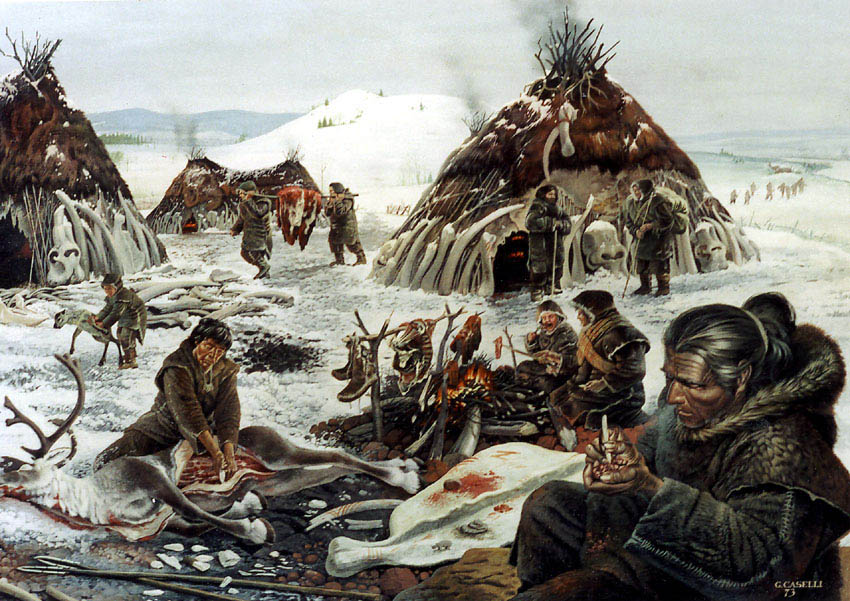
Clive Finlayson jabbered about a group of humans known as the Gravettian culture, who managed to survive in the steppe-tundra of the Eurasian Plain from 30,000 to 20,000 years ago.  Large game was abundant.  Here they invented one of the most diabolical Earth-shaking technologies of all time (gasp!), the storage pit!  Holes chopped into the frozen permafrost could be used as scavenger-resistant deep freezers, to store surplus food for the lean seasons.

Finlayson believed that food storage was a significant milestone on our long and painful descent to modernity.  Surplus made clans more secure, as long as adequate food resources remained available.  Acquiring surplus food for winter dining required intensified hunting, which could lead to waste, spoilage, unintentional overhunting, population growth, and the depletion of game over time.

An additional quirk of snow country was that folks needed to burn lots of calories to stay warm and strong in their physically active outdoor life.  So, a diet rich in fat was essential.  The fat content of game animals varied with the seasons.  Meat had the most fat in late summer and autumn.  In late winter and spring, many animals were unfit to eat due to insufficient fat.  In lean seasons, Native Americans killed buffalo just to eat their tongues, which were high in fat.

Dixie West noted that animals with minimal fat were junk food.  When humans and other carnivores eat lean meat, they can lose weight, because digesting it requires more energy than the meat contains.  Folks commonly smashed and boiled the bones that contained the most marrow, to extract the precious marrow fat.

In snow country, as long as large game remained readily available, labor intensive agriculture made zero sense.  As game became scarcer, hunting was gradually displaced by farming.  This began about 6,000 years ago.  In regions less suitable for farming, hunting persisted longer.  The focus shifted from storing meat to storing grain.  According to Finlayson, the concept of producing surplus food, and competently managing the surplus, set the stage for the birth of civilization.

The advantages of food storage in snow country encouraged the dawn of the “more is better” mindset, which eventually became a core belief in cultures engaged in agriculture or herding.  The Gravettians and other hunters stockpiled frozen or dried meat.  Farmers loaded granaries with calorie dense grains.  Herders stored their meat on the hoof, gathered milk daily, and slaughtered livestock only when needed.  They strove to accumulate as many animals as possible.  In different forms, the practice of food storage spread across snow country, eventually crossing from Siberia into the Americas.

Life was simpler for tropical hunter-gatherers, like the San people of the Kalahari.  On a really crappy day, if a gang of hyenas snatched an antelope just killed by hunters, what was lost was merely the work of a single day.  They were able to maintain their conservative traditional way of life for many, many thousands of years.  It was not a high impact way of life.

For the food hoarders of snow country, on the other hand, misfortune could suddenly eliminate months of tedious work, and endanger winter survival.  Their food stockpile could be wiped out by fire, flood, scavengers, spoilage, vermin, theft, and so on.  The whole community might starve and blink out.  Over the long run, “more is better” cultures, with their denser populations, were more likely to swerve into bloody turbulence.  Storage is big juju.

Dress for Success

Hunter-gatherer cultures differed widely in their dependence on technology.  The utterly simple Kalahari way of life was practiced by our hominin ancestors for at least two or three million years.  In the tropics of Mother Africa, evolution spent several million years fine tuning our bodies for life on the savannah, and the result was an excellent design. 

After hominins migrated out of Africa, and colonized tropical Asia and Australia, some folks decided to wander north.  It was a cool place to live, and the farther north they wandered, the cooler it got.  In snow country, tropical primates were like fish out of water.  Brrrr!  They wrapped themselves in animal hides, lived in protective shelters, and huddled around warm campfires.

In 1908, Knud Rasmussen told the story of a Greenland Eskimo named Qumangâpik, who had four wives and 15 children.  The first wife froze to death, the second was buried by an avalanche, the third died of illness, and the fourth froze to death.  Of his 15 children, one starved, four were frozen, and five died of illness.  Then, Qumangâpik froze to death, with his wife and two little children.  Three of his kids outlived him.  In frigid times, ripped or inadequate clothing could be a death sentence.

Over time, early colonists in snow country learned how to cut and sew hides into custom tailored clothing that provided better protection for both humans and their body lice companions.  Killing a deer, tanning its hide, and turning it into coats, trousers, hats, or footwear, was a time consuming process.  Deerskin attire was not especially warm, especially when soaking wet or frozen.  On the plus side, it could be boiled and eaten when starvation threatened.

The first stitching was likely done with sinew, or thin strips of leather.  Eventually, some groups learned how to spin plant fibers into thread, which could be used for stitching seams together.  In the Republic of Georgia, researchers have found spun and dyed fragments of flax fibers that were 34,000 years old. 

Needles were used for sewing clothing and tents, and for making nets.  Animal bone needles with eyes, about 25,000 years old, have been found in Central Europe.  Needles have not been found at Neanderthal sites yet, but looking for a needle in a haystack is far easier than finding an extremely old needle buried somewhere on the Eurasian land mass.

Over time, folks got better at spinning different types of high quality thread.  It was spun from plant fibers like flax, cotton, or hemp; or animal fibers like wool.  Eventually, a clever person invented weaving, a process that wove thread into cloth.  Cloth could be used to make a wide variety of useful things.

Kassia St Clair described how gathering and processing plant fibers was time consuming.  So was carefully collecting and preparing fibers from sheep, goats, silkworms, and others.  So was spinning and weaving.  In some regions, folks may have devoted more hours to their wardrobe than to acquiring food.  For hardworking people, clothing was precious, and carefully kept mended and patched.  Many owned little more than what they were wearing.

During the agricultural era, wool clothing was popular in snow country, until the eighteenth century, when new technology made cotton cloth cheaper to make, and more profitable.  Cotton was the dominant fabric until the 1970s, when synthetic fibers rose to dominance.  It won’t be long now until almost all clothing is polyester, which is exceedingly cheap to produce from petrochemicals using state of the art automation, and super cheap sweatshop labor.

Today, many consumers own enormous wardrobes of apparel, much of it rarely worn, if ever.  Modern attire is not designed for rugged durability, but to be rapidly mass produced, in order to meet the demand for the latest trendy styles.  Trendy styles have deliberately short lifespans.  This encourages radicalized consumers to maximize their apparel purchasing.  For them, nothing is more embarrassing than to be seen wearing obsolete fashions.  Landfills are stuffed with countless tons of formerly trendy attire.  Much of it is discarded while still in excellent condition.

Great Leap Forward

A number of thinkers have jabbered about a miraculous turning point in the human saga.  Before this event, humans were dim witted, knuckle dragging, mouth breathing bubbas.  And then — shazam! — we triumphantly glided across a magic bridge, from the archaic era into the modern one.  Our species was gaining momentum on the treacherous path to technological utopia and ecological dystopia.

Jared Diamond once speculated that if space aliens had visited Earth 100,000 years ago, humans would have appeared to be nothing more than ordinary animals.  But then, as the millennia passed, those critters were acting less and less ordinary.  By 40,000 years ago, our modernizing ancestors were demonstrating revolutionary changes that were both beneficial and risky.  What happened?  Diamond named this miracle the Great Leap Forward.

Of course, Diamond was raised in a crazy self-destructive wonderland of high technology — extremely clever stuff that enabled humankind to beat the living crap out of the planet’s ecosystems for no sane purpose.  Actually, those “ordinary” two-legged ancestors, observed by space aliens, were the one and only critters on Earth who were capable of conjuring domesticated fire — a fantastically revolutionary innovation.  It was close to step one on the long march to world domination.

For Diamond, the act of routinely using domesticated fire seemed ordinary and insignificant.  In his 1992 reality, even four-year olds could easily burn down the neighborhood with a cheap disposable lighter.  In addition to fire, the visiting space aliens would have also seen that the two-legged critters were unique in their ability to knap sharp stone tools, and manufacture assorted gizmos for hunting.  Our hominin ancestors had been developing these unordinary skills for more than two million years.

Extremely weird was the fact that those fire critters were at the top of the food chain, yet they had no serious fangs, claws, speed, strength, or size.  All the other top predators had naturally evolved some combination of those traits, gradually, over the course of millions of years.  But today, those traditional natural predators are being pounded into oblivion via guns, cyanide, habitat destruction, and so on.  There are not seven-plus billion lions and tigers and bears staring at cell phones.

With the Great Leap, humans began doing more and more things beyond what ordinary animals did.  They baked ceramic figurines in kilns, made flutes, wore ornamental beadwork, sewed clothing, invented new and improved tools, and built trophy homes with mammoth bone walls.  These luxurious dwellings have been found in Ukraine, Czech Republic, Poland, Romania, Belarus, and Russia.

Venus figurines have been found in Slovakia, Italy, Austria, Russia, Germany, Czech Republic, Switzerland, France, Romania, and Siberia.  They were carved in soapstone, steatite, sandstone, mammoth ivory, horse bone, serpentine, black jet, antler, limestone, and hematite.  Venus figurines date from 30,000 to 10,000 years ago.

Folks learned how to process red and yellow ochre, hematite, manganese oxide, and charcoal into pigments useful for cave painting.  Wild artists crawled far inside caverns with torches, and painted gorgeous portraits of the sacred animals for which they had the deepest respect and reverence.  Images included the horse, lion, auroch, rhinoceros, salmon, bear, mammoth, buffalo, owl, hare, ibex, auk, weasel, reindeer, chamois, and fox.  Often, artists placed their spread out hand against a wall, and sprayed paint over it, creating a hand stencil.

Those folks did not spend most of their lives indoors, isolated from the wild ecosystem, like astronauts in orbit.  They had no glowing screens.  Their world was entirely wild and alive, and they were intimately involved in it, every minute of every day, bloody hands and all.  The paintings celebrate their sacred relationship with the animals that fed them, clothed them, and sometimes killed them.

Prehistoric cave art has now been found in every continent except Antarctica.  In France and Spain, it has been found in almost 340 caves.  Famous sites include Chauvet in France (30 to 32 thousand years ago), Altamira in Spain (15,000), and Lascaux in France (18,000).  Recently, D. L. Hoffman’s team found paintings in three Spanish caves that were more than 64,800 years old — about 30,000 years before the arrival of humans.  This was the Neanderthal era.

The Great Leap Forward has also been called the Cultural Revolution or the Cognitive Revolution.  Cognition is about thought, understanding, and knowledge.  Twenty years ago, some believed that the leap was the result of miraculous genetic mutations that turbocharged our intelligence, but that theory went extinct, for lack of convincing DNA evidence.

A number of experts theorize that the leap was encouraged by powerful advances in complex language and communication, but this is impossible to prove via archaeological evidence.  Spoken words are not preserved in fossils.  We may have been singers and poets several million years ago.  We’ll never know.  Many primates and other animals are vocal.

Some sort of Great Leap certainly occurred in snow country, maybe between 50,000 and 30,000 years ago.  Our tropical primate ancestors were excited to discover lands loaded with abundant food, but challenged by a life-threatening climate for which evolution had not prepared them.  The only way they could stay, and feast on the delicious wildlife, was to cleverly invent a collection of prosthetic technology that would increase the odds of winter survival.  Eventually, the accelerating pace of cultural evolution enabled us to conquer the planet, explode in numbers, and savagely vandalize Earth in every imaginable way.

While many of the innovations of the Great Leap were survival-oriented prosthetics, others were not.  Painting, ornamentation, figurines, flutes, and so on were probably motivated by spiritual affairs, or the desire for enjoyment.  Obviously, for a while, these were not folks who were desperately struggling to survive.  Their new indulgences would seem to indicate that these folks were living in a bubble of affluence, leisure, and decadence.  They had learned and refined the skills of survival, and their food resources were temporarily abundant.  They were rich.  Life was good.

They remind me of America’s baby boomer generation, of which I am a member.  We were born at a time when industrial civilization soared to ridiculous excesses, fueled by an orgy of consuming enormous amounts of premium quality nonrenewable resources, as if they were infinite.  Some have called this joyride in self-destruction “The Blip” — a brief extreme spike in many trend lines, something equivalent to an asteroid strike. 

History repeatedly reminds us that high impact lifestyles always have an expiration date.  Yet, despite being proud descendants of the Cognitive Revolution, our clever minds routinely refuse to comprehend this simple and vital idea.  Magical thinking is always an effective cure for the unpleasant deliriums caused by occasional whiffs of reality.

Anyway, over the long run, was it truly a leap “forward” into greater joy, wisdom, health, and sustainability?  Or, was it something else?  When was the planet healthier and happier?

Thursday, July 6, 2017

Great Leaps


It’s fascinating to explore the deeper roots of our family tree.  They reveal a lot about the path that led us to today.  Homo sapiens emerged in Africa, somewhere between 300,000 and 130,000 years ago, depending on which expert you read.  DNA mapping asserts that the oldest surviving human group is the San people of South Africa and Namibia (also known as Khoisan, Bushmen, or !Kung).  Their genes are the closest to the ancient female from whom all living humans descend (Mitochondrial Eve).

The San have been hunter-gatherers since the dawn of humankind, enjoying a way of life that managed to survive into the 1970s.  Eight hundred years ago, the San homeland included all of southern Africa.  Since then, Bantu and European herders and farmers have displaced them from their better lands.  They now reside in the Kalahari Desert, where they are being devastated by the dark juju of modernity — missionaries, bureaucrats, booze pushers, and the money economy.

The Pygmies, who live in the rainforest of central Africa, are the second oldest surviving group.  They also managed to live as hunter-gatherers into recent decades.  The Pygmies and San coevolved in their ecosystems, and their way of life was genuinely sustainable, like all other (normal) animals.  They did not live like ecological firestorms.  Prior to the arrival of outsiders, they had no domesticated plants or livestock.

In the tropics of Mother Africa, meat spoiled quickly, and yummy carcasses quickly attracted mobs of ravenous scavengers.  When folks wanted a steak, they killed something.  Preserving and storing meat was impractical and unnecessary, a stupid idea that never occurred to anyone.  This limitation was a blessing, because it made large-scale hunting impossible, keeping low limits on population.  It was impossible for nomadic hunters in the tropics to acquire and preserve surplus meat that could feed non-hunting specialists like priests, technicians, warriors, or kings.

Somewhere between 100,000 and 50,000 years ago, pioneers began migrating out of Africa, into southwest Asia.  They discovered new species of big game, many of which had no instinctive fear of small, smelly, goofy-looking tropical primates with sharp sticks.  In tropical regions like India, Southeast Asia, and Australia, traditional lifestyles essentially continued, because meat storage was impractical.

Pioneers who migrated into colder regions were confronted with daunting new challenges.  They were something like moon explorers.  Outside the tropics, food was less available all year long.  Surplus had to be carefully stored to ensure winter survival.  They needed weatherproof shelters, warm hearths, and stylish wardrobes of fur clothing.

The San and Pygmies lived in sustainable, time-proven, low-tech ways.  However, in chilly non-tropical regions, where living was more complicated, ongoing innovation boosted the odds for survival.  The clever ones invented sleds, canoes, kayaks, lances, harpoons, nets, snares, and on and on.  For the moon explorers, innovation became insanely addictive, because cool gizmos reduced the odds of premature death.  As centuries passed, innovation became something like an endless arms race, a nightmare-inducing runaway train, according to Alfred Crosby.

Clive Finlayson discussed the humans living in snowy Europe from 20 to 30 thousand years ago.  The clever Gravettian culture preserved surplus meat by freezing it in pits dug in the permafrost.  Finlayson perceived the storage pit to be a wicked invention, because it radically changed the world.  “They had found ways of producing surplus, something almost impossible in tropical climates, and with it emerged an unstoppable drive to increase rapidly in numbers.”  Food storage infected the moon explorers with a new and diabolical idea, “more is better.”

Around 10,000 years ago, in the Fertile Crescent, the genie of domestication emerged from the magic lamp, and steered humankind into the express lane to catastrophe.  Jared Diamond wrote a fascinating essay on the emergence of domestication.  Obviously, it was impossible for the cunning conjurors to foresee the unintended consequences of the monster they were creating.  If a vision had revealed the dark future to them, Diamond thought that they would have immediately ceased their experiments, and made food production taboo.  The shift to agriculture “was in many ways a catastrophe from which we have never recovered.”

No matter how hard the control freaks tried, most plant and animal species proved to be unsuitable for domestication.  Of the 200,000 species of wild plants, only 100 have been enslaved.  Of the 148 species of terrestrial herbivores and omnivores weighing more than 100 pounds (45 kg), only 14 have been enslaved.  Of those 14 species, 13 were enslaved in Eurasia, including the big five: cattle, sheep, goats, pigs, and horses.

None of the 14 species enslaved originally resided south of the equator in Africa.  Horses, donkeys, and zebras are close relatives, and can interbreed.  Horses and donkeys were enslaved in Eurasia, but all four species of African zebras defiantly resisted 200 years of efforts to destroy them — the older a zebra gets, the more vicious it becomes.  Freedom is precious.  No surrender!

In the homelands of the San and Pygmies, few wild plants were suitable for domestication.  Of the crop plants domesticated in Africa, all originated north of the equator.  In their ancient homelands, the San and Pygmies had no domesticated plants or livestock, and zero need for long-term food storage.  Progress was not an option for them, so they lived simply and sustainably, like their hominid ancestors had for the last two million years.

Unfortunately, the moon explorers wandered into harsh ecosystems where it was impossible to live like tropical hunter-gatherers.  The way-too-clever oddballs eventually became exotic invasive loose cannons.  Large game became scarce, then small game.  The dark and slippery path to agriculture was nicely described by Mark Nathan Cohen.

Diana Muir noted how the process unfolded in prehistoric New England.  In the good old days, game was abundant.  Stuff like acorns and shellfish were reserved for famine food.  As game became scarce, shellfish became a mainstay.  An adult male would need 100 oysters or quahogs each day.  Thousands were dug and smoked for winter consumption, a tedious job.  In the lower layers of huge shell dumps are oyster shells 10 to 20 inches across (25 to 50 cm) — oysters 40 years old.  In higher levels, the shells get smaller and smaller.

Eventually, the seeds of corn (maize), squash, and beans reached New England.  If a region was home to 100 tribes of hunter-gatherers, and just one tribe adopted corn, helter-skelter followed.  The farmers produced more calories, and could feed more bambinos.  With abundant stored foods, they had a much better chance of surviving harsh winters when hunting was poor.

Eventually, farmers outnumbered hunters.  Muir wrote, “Once any group in a region decides to adopt agriculture, no neighboring group can afford not to.”  Farming spread, population grew, conflicts increased, and villages were surrounded by defensive wooden palisades.  Soils were depleted, new fields displaced forests, and stronger tribes trumped weaker ones.  Progress!

In Mother Africa, the San continued their traditional way of life (i.e., naked, illiterate, heathen savages).  The folks who stumbled into Europe took a different path.  The turbo thrusters of progress roared.  In the Czech Republic 25,000 years ago, folks lived in mammoth bone huts.  A bit later, folks in France were painting gorgeous graffiti in caves.  A bit later, folks were whacking down forests, living in filthy cities, and slaughtering each other in great numbers.

Pleistocene Europeans had heroically transformed from “anatomically modern humans” (like the San), to “behaviorally modern humans” (like the Trumps).  Hooray!  This miracle began maybe 50,000 years ago, an event celebrated by the cult of human supremacy.  They call it the Great Leap Forward — cave paintings, complex language, ceramics, ornaments, rational thinking, and on and on.  It had a lot to do with migrating out of Africa and adapting to exotic ecosystems via technological innovation.

The bottom line disturbs me.  Until recently, the San followed an ancient path, which didn’t wreck their ecosystem.  The folks who adapted to non-tropical ecosystems eventually strayed away from a two million year tradition of sustainability.  Consequently, after a relatively brief rocket ride of bad craziness, the climate is trashed, the ocean is trashed, and seven-point-something billion primates are painfully discovering the embarrassing side effects of great leaps.

It’s fun playing “what if?”  Imagine what the world would be like if our ancestors had remained in sub-Saharan Africa, and continued living like wild tropical primates — and nothing was domesticated.  Would Europe and America still be home to mammoths, rhinos, and saber-toothed cats?  Is there something we might learn from our bloody adventure?

Image: A San Tribesman (Source)

Cohen, Mark Nathan, The Food Crisis in Prehistory — Overpopulation and the Origins of Agriculture, Yale University Press, New Haven, 1977. 

Crosby, Alfred W., Throwing Fire: Projectile Technology Through History, Cambridge University Press, New York, 2010.

Diamond, Jared, “Evolution, consequences and future of plant and animal domestication,” Nature, 418, 700-707 (8 August 2002) | doi:10.1038/nature01019  Free download.

Diamond, Jared, Guns, Germs, and Steel, W. W. Norton & Company, New York, 1997.

Diamond, Jared, “The Worst Mistake In The History Of The Human Race,” Discover, May 1987.  Free download.

Finlayson, Clive, The Humans Who Went Extinct — Why Neanderthals Died Out And We Survived, Oxford University Press, New York, 2009.

Muir, Diana, Reflections in Bullough’s Pond: Economy and Ecosystem in New England, University Press of New England, Hanover, New Hampshire, 2000.

Thomas, Elizabeth Marshall, The Harmless People, Vintage Books, New York, 1989.

Turnbull, Colin M., The Forest People, Simon and Schuster, New York, 1961.

Wade, Nicolas, Before the Dawn: Recovering the Lost History of Our Ancestors, Penguin Books, New York, 2006.