Showing posts with label fire. Show all posts

Sunday, November 3, 2024

Wild Free and Happy Sample 64

 [Note: This is a new section from the rough draft of Wild, Free, & Happy. This is probably the end of the body text.  These samples start with sample 01, and follow the sequence listed HERE (if you happen to have some free time). 

Helter Skelter

Stephen Pyne has spent a lifetime thinking about fire.  Without the ability to use fire as a powerful tool, humans could have never migrated out of tropical Africa and colonized the outer world. 

When human pioneers eventually reached the Fertile Crescent in the Middle East, they discovered plant and animal species that were especially ideal for domestication.  This region became known as the Cradle of Civilization.  Its development enabled us to accelerate our long and painful march to the staggering eco-horrors of today. 

Pyne is especially concerned about industrial fire.  Its combustion of fossil fuel results in carbon emission levels that are turbocharging an angry swarm of catastrophes.  “Our ecological effects have had the impact of a slow collision with an asteroid… together we have so reworked the planet that we now have remade biotas, begun melting most of the relic ice, turned the atmosphere into a crock pot, and the oceans into acid vats.”

Fire made us the unusual creatures we have become.  Our colonization of the world was like a spreading human wildfire that expanded across unspoiled wildernesses in search of fuel.  We enjoyed feasting on megafauna until they became scarce, at which point we advanced into new regions.  Over time, hungry humans ran out of unoccupied territory to expand into.  Oh-oh!

Groups had to revise their menus to include different food sources.  Aggressive groups could attempt to smash their way into territories inhabited by other groups.  As the millennia passed, and populations grew, friction between groups increased and spilled blood became more common. 

Weaker groups were more likely to be swept aside.  For example, of all the surviving wild cultures, the San people have the oldest DNA.  Their time-proven way of life was incredibly sustainable.  Their original homeland territory was vast, but over time, farmers and herders eventually snatched most of it away, forcing the San to retreat to the harsh Kalahari Desert.  By the 1970s, their traditional way of life had taken a serious beating.

Alfred Crosby summed up a bedrock lesson of history: “Winning streaks are rarely permanent.”  Like the traditional San people, most of the countless wild cultures that once existed sooner or later got blindsided by stuff like disease, colonization, capitalism, genocide, urbanization, and so on.  The wild cultures that still survive are not safe and secure.  Intruders from the outer world rarely enjoy a warm and fuzzy reputation for being kind and caring ladies and gentlemen. 

Meanwhile, in the fast lane, the human wildfire learned how to paddle down rivers, sail across oceans, roll on railways, drive across continents, fly through the clouds, zoom to the moon, vaporize cities, produce enough food to feed billions, blindside a stable climate, exterminate vast forests, and turn Earth into a loony bin for hordes of lost and confused primates.

Big History is a million-page catalog of countless bloody dog-eat-dog conflicts between tribes, nations, religions, and empires.  The strongest usually triumphed over the weakest, because the weak had no right to what they could not defend.  But those who remained in the fast lane were still vulnerable to getting blindsided by brutal surprises.

Sadly, glowing screens and motor vehicles are more precious than wooly mammoths or healthy planets.  The wizards of progress are guiding us toward a future of unimaginable prosperity, decarbonized energy, and tremendous achievements in family planning.  Everyone will eagerly cooperate.  Really?  Well, if you believe it, it’s true!

Animal in the Mirror

Pyne noted, “Without fire humanity sinks to a status of near helplessness, a plump chimp with a scraping stone and digging stick, hiding from the night’s terrors, crowding into minor biotic niches.”  In other words, an ordinary wild animal.

Since Neanderthals disappeared from the stage, our closest living relatives are now the chimps and bonobos, with whom we share up to 99 percent of our genes.  They have lived in the same forests, in the same way, for several million years, without degrading their ecosystem, starting a fire, or fooling around with tools fancier than sticks or stones.  They luckily benefit from their isolation, and the fact that their traditional habitat does not contain valuable resources that are tempting to greed monsters from outer space.

In his book Grandfather, Tom Brown shared a beautiful story he heard from his mentor Stalking Wolf, a traditional Apache from desert country, who traveled widely over the years, from the Amazon to Alaska, living off the land, and learning from it.  One time, while in Alaska as winter approached, he frantically had to stock up on food and firewood for the coming months. 

A bit later, when the snows arrived, he became fascinated by the ptarmigans, birds that survived in the frigid climate by their wits alone, sleeping in cozy snowdrifts.  They belonged in this arctic land, like the lizards belonged in Death Valley.  Lizards could not survive in Alaska, and ptarmigans could not survive on the desert. 

With the use of specialized tools, our species could survive almost anywhere.  But Grandfather felt uncomfortable because humans without fire and tools can only survive in special ecosystems.  He deeply wanted to genuinely belong somewhere, like the ptarmigans and lizards.  Over the passage of time, their way of life had become fine tuned for surviving in the ecosystems they inhabited.

Dear reader, this is a tremendously important point.  Animals that are wild, free, and happy are perfectly at home in the wild ecosystems they inhabit.  Like squirrels in an oak forest, they live where they belong, and remain intimately attuned to their habitat.

Our hominin ancestors fanned out across the planet, and eventually generated assorted impacts, including numerous extinctions.  Today, most of the mob of eight billion no longer lives and thinks like healthy wild animals.  A number of cultures have developed worldviews and lifestyles that are self destructively unclever, and ferociously brutal to the family of life.

Jay Griffiths wrote that humans evolved as highly alert nomadic hunters and foragers.  “We were made to walk through our lives wildly awake.”  Modern lifestyles are often mind-numbing routines — the opposite of the freedom we so deeply need.  When healthy wildness deteriorates into passive obedience, we become vulnerable to the burning pain of cage rage.  Very often, the daily news seems to be a barrage of batshit crazy cage rage stories from a wheezing world.

Timothy Scott Bennett concluded that we modern consumers were born and raised in captivity, something like zoo animals, the opposite of free, wildly awake, and at one with the land.

Robin Wall Kimmerer is a Potawatomi biologist.  One of the spirits in their tribal traditions is Windigo, a monstrous demon cursed with a voracious appetite.  The more it eats, the hungrier it becomes.  In the old days, Windigo was notorious for hunting too hard, and not sharing with others, leading to hunger times.

Later, uninvited pale faced invaders from outer space smashed into tribal lands.  Native folks were stunned by their pathological foolishness.  Around the world, colonists have now created countless Windigo whirlwinds of mining, deforestation, industrial agriculture, overhunting, and insatiable shopping. 

Today, the hurricane of daily news from around the world shouts that the Windigo spirit has become a horrific global superpower.  Billions of folks everywhere eagerly dream of having more, more, more.  Even the superrich are maniacally grabbing and hoarding as much status glitter as possible.  This is not the path to a balanced and healthy future.

The Future?

In the preceding pages, I have explored my core question: how did things get to be this way?  Now what?  Humankind is deep in overshoot, and zooming down the path to a treacherously exciting future without brakes or safety nets.  My computer has a wonderful Undo function that can easily vaporize a sequence of mistakes.  Nature does not.  If you broke it, you bought it.

For folks who have more than a dozen working brain cells, the growing number of climate change reports and news stories are overwhelming.  It’s not a fake news hoax (unless you pretend it is).  Indeed, folks who yank off their blinders can discover a nonstop firehose of heartbreaking stories about floods, furious storms, heat waves, droughts, crop failures, melting glaciers, massive wildfires, and on and on — week after week after week.

Our foolishly unclever culture, hobbled by limited understanding and foresight, has successfully conjured into existence a colossal whirlwind of bad juju.  Eight billion consumers, with their famously big brains, are stampeding down the fast lane to a turbulent blind date with the rough justice of overshoot.  How embarrassing!

Fare Thee Well!

Dearest reader, congratulations!  One way or another, you’ve arrived at the skanky rear end of this word dance.  Pressure is visibly rising around the world, rivets are popping on the Titanic, and the global circus has become a freakshow of wildfires, climate catastrophes, conspiracy theories, religious fanaticism, cocky neofascism, merciless dog-eat-dog greed, berserk cage rage, pathological status seeking, fire-breathing patriarchy, and all-purpose bad craziness.  Something seems to be out of balance.  Like the old Chinese proverb warns, we are living in interesting times.

OK!  I’ve said what I needed to say.  I hope you’ve had some kind of meaningful experience with my literary monsterpiece.  Good luck!  Do your best!

An Innocent Booboo?

Finally, a weird idea.  Kindling the first domestic fire by spinning a fire drill stick was not, in any way, an obvious thing for a wild African primate to do.  The uncomfortable possibility is that maybe just one individual ancestor (a kid?) discovered it purely by accident, and it consequently unleashed two million years of change and catastrophe, and created the global horror show outside your window.  Whoops!  Undo! Undo! Undo!  Shit!

Wednesday, October 2, 2024

Wild Free and Happy Sample 63

 [Note: This is a new section from the rough draft of Wild, Free, & Happy. It’s finally getting closer to the home stretch.  These samples start with sample 01, and follow the sequence listed HERE (if you happen to have some free time). 

Welcome to the Anthropocene

Scientists enjoy categorizing, ranking, and naming.  In the realm of Earth history, they have broken the process down into a series of epochs — like the Pliocene, Pleistocene, Holocene, etc.  In the mid-1970s, some folks began feeling a need to create a new epoch, the Anthropocene, an era when human activities generated substantial eco-impacts. 

Science has not yet agreed on an official definition.  Some say it started with the explosive impacts of the Great Acceleration, which began in 1945.  Others say the Industrial Revolution (~1780).  Others say the Neolithic Revolution, the dawn of agriculture and civilization, which began about 12,000 years ago. 

Dan Flores believes that it began much earlier, during the late Pleistocene, as humans migrated out of Africa.  When they arrived in new regions for the first time, megafauna species were hit hard, resulting in a series of extinctions.  He wrote, “The Pleistocene extinctions, in other words, look very much like the first act of the Anthropocene, the beginnings of what we now call the Sixth Extinction.”

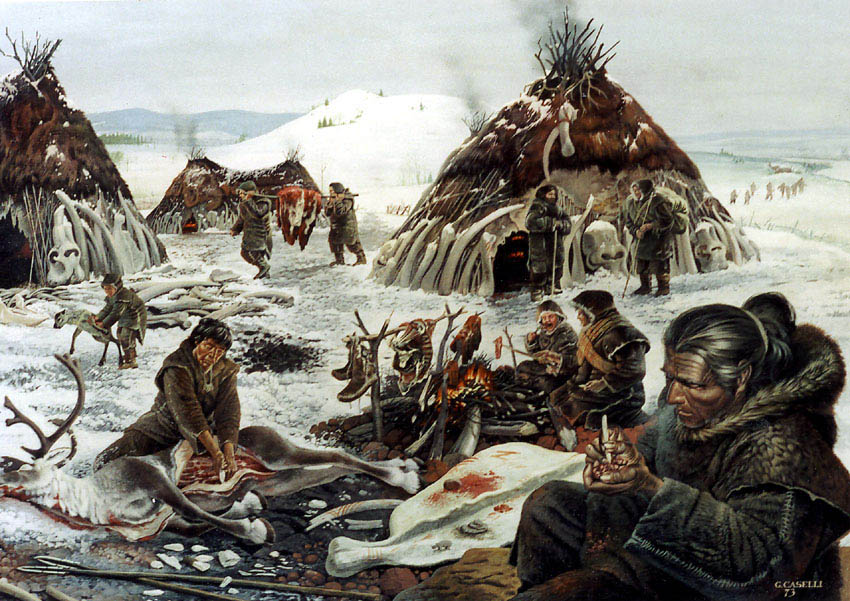
These early ancestors were successful predators because they benefitted from technological advantages including spears, slings, blades, warm clothing, and fire.  High-tech teams were able to kill powerful prey.  Their high-tech advantages enabled humans to successfully colonize much of snow country — despite the fact that their lean and nearly hairless bodies were finetuned by evolution for tropical climates. 

Close your eyes and imagine what northern Eurasia and the Americas would look like today if they had never been colonized by hominins — a vast, astonishing, Serengeti-like wild paradise of abundant life!  Wow!  Wild, free, happy… and perfectly healthy and sustainable!  Imagine that!

When our ancestors first wandered in, snow country was home to a variety of huge animals that had enjoyed living there for a very, very long time — grazers, browsers, predators, and so on.  A number of these species were originally from tropical regions of Africa and Asia, like the elephant, rhino, and sabertooth families.  Over time, these tropical megafauna species gradually evolved traits that improved their ability to survive in the cooler climate, like warm coats of thick fur.

Snow monkeys (Japanese macaques) are interesting primates.  Like our hominin ancestors, they originated in tropical Africa several million years ago.  Over time, their ancestors wandered off into the outer world, and eventually migrated from Korea to Japan more than 300,000 years ago.  Some now live in Japan’s chilly regions, where snow might cover the ground for four months, in depths up to 10 feet (3 m), and temperatures can plunge to -4°F (-20°C).

Snow monkeys adapted to snow country via a long slow process of evolution.  So now, when winter approaches, their thin summer fur automatically grows and thickens into luxurious warm coats.  During the summer, they build up body fat by feasting at the warm season buffet.  In winter months, they survive on stored body fat, and rough foods like leaves and bark.  They huddle together to keep warm.  They don’t use fire.  They’ve lived 300,000 years in Japan, and they’re still alive today because humans have allowed them to continue existing. 

Also around 300,000 years ago, Homo sapiens emerged in Africa.  From there, we migrated out of the tropics, and eventually colonized most of the world, including regions having temperate or arctic climates.  Instead of gradually evolving beneficial adaptations like the snow monkeys did, our clever technology boosted our ability to keep warm and survive in chilly places.

In modern cultures, a belief in human supremacy is the norm.  Our limitless brilliance is the mother of infinite miracles.  We’ll easily fix climate change, save the world, colonize Mars, and enjoy endless love, peace, and happiness!  The notion of Anthropocene has an aroma of human vanity.  We are the most powerful and important critters on Earth!

Welcome to the Pyrocene

The four primordial elements are earth, water, air, and fire.  Fire has existed on the planet for more than 400 million years, long before the dinosaurs.  It will continue burning long after the human circus moves off the stage, as long as there is fuel, oxygen, and spark. 

One mind-altering day, my brain crashed into the work of Stephen Pyne, the author of more than 30 books about fire, and one of the world’s foremost experts on fire history.  He described an extremely crucial turning point in Big History: the domestication of fire.  The earliest evidence of this has been found in South Africa, inside Swartkrans Cave.  It dates to about two million years ago, long before the emergence of Homo sapiens.  The two primary suspects are Homo erectus, or an earlier australopithecine hominin.  Did we drive these predecessors off the stage?

Much later, Homo sapiens inherited the knowledge of fire making, and this ability eventually enabled us to become the dominant species on Earth, and the planet thrashing demolition team of today. 

Greek mythology includes the story of Prometheus, a sassy man who stole fire from the god Zeus and gave it to humans.  Stories say that he was the inventor of the fire drill, the tool for kindling flame.  He boldly violated forbidden limits, and the gods severely punished him.  His theft initiated the dawn of human misery.

As discussed earlier (see Mother Africa), the domestication of fire began in the same general timeframe as a wave of megafauna extinctions in Africa.  Was this a coincidence?  Peter Ungar noted, “…the sudden appearance of large concentrations of artifacts and animal remains around two million years ago surely signals a change in the role of hominins in their world. 

Our ancestors had grabbed a place at the dinner table with the large carnivores.  Hominins were eating antelopes, hippos, horses, giraffes, and elephants.  Stone tools gave hominins better access to meat and marrow. 

Pyne thinks that the Anthropocene idea is too limited.  It is rooted in the emergence of agriculture and civilization.  But the primary event that made these changes possible was the domestication of fire.  So, instead of the narrower time window of the Anthropocene, he recommends the creation of a broader epoch called the Pyrocene (pyro means fire).  It would include the events of the Anthropocene.  The Pyrocene would close the curtains on the ancient Ice Age, and usher in the new and turbulent Fire Age. 

Pyne described three categories of fire. 

·       First fire is natural, sparked into flame by lightning, volcanoes, etc.  Its fuel is wood and vegetation.  This fire has existed for 400 million years.

·       Second fire is anthropogenic, ignited by hominins.  It enabled agriculture, civilization, early industry, soil destruction, deforestation, and the massive expansion of human inhabited regions.  Its fuel is wood and vegetation.

·       Third fire ripped open the trap door to hell.  Growth of the industrial era eventually required far more fuel than firewood could provide.  The heartbreaking mistake was to introduce the fire breathing monster to fossil hydrocarbons (coal, oil, gas).  Suddenly, humankind had access to a million times more energy dense combustible fuels.  Shit!  Trouble ahead! 

Carbon Cycle

NOAA calls carbon “the chemical backbone of life on Earth.  Carbon compounds influence the Earth’s temperature, make up the food that sustains us, and provide energy that fuels the global economy.”

Carbon is an element that exists in the atmosphere, oceans, living organisms, rocks, soils, sediments, fossil fuel reservoirs, etc.  This is called the carbon pool.  The pool is a magic act that allows the flow of carbon throughout the ecosystem, which is vital to the survival of the family of life.  The pool includes both carbon sources and carbon sinks. 

A carbon source emits more carbon than it absorbs.  Major sources include the burning of coal, oil, and gas, and the emissions from making concrete. 

A carbon sink absorbs more carbon than it releases.  For example, a forest is a carbon sink, and it absorbs and stores carbon as it lives and grows.  The two primary sinks in the global carbon cycle are the land and the water.

The atmosphere is neither a source nor sink.  It constantly absorbs carbon emissions, and it’s constantly a source of carbon for plant life to absorb.  In the atmosphere, carbon is allowed to pass back and forth between sources and sinks — something like a train station, an ongoing flow of in and out.

Prior to the industrial era, the carbon load in the atmosphere was a relatively stable closed loop — the volume of incoming carbon from sources was similar to the volume of outgoing carbon absorbed by sinks.

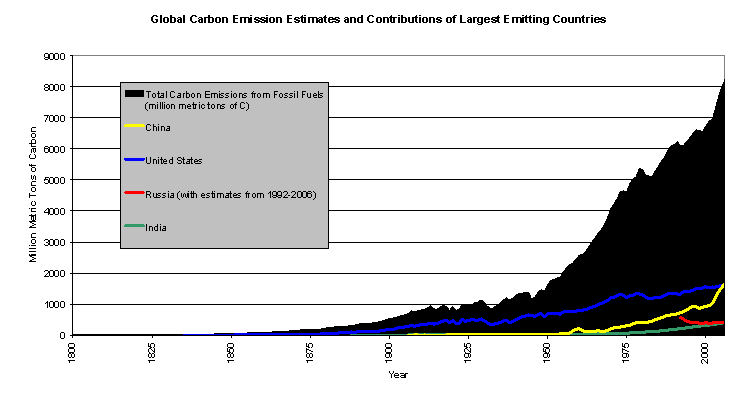
Today, that stable closed loop is long gone.  When fossil energy is burned, CO2 is released into the atmosphere.  From there, the water sink absorbs some of it, and so does the land sink.  Unfortunately, these two sinks cannot absorb CO2 as quickly as it’s now being emitted, so the growing surplus accumulates in the atmosphere.  Here is a chart that displays the explosive growth of global CO2 emissions from 1900 to 2020.  Note that what the land and ocean sinks can’t absorb builds up in the atmosphere. 

With the fantastically tragic mistake of industrialization, humankind unleashed a planet roasting monster that is raging against the vitality of life on Earth — a furious roaring bonfire of fossil carbon.  This monster had been safely and harmlessly sleeping underground for millions of years.  Unfortunately, some goofy smarty pants could not leave it alone, and all hell broke loose.  Big Mama Nature screamed!

The normal and natural balancing act of atmospheric carbon got slammed.  In 1850, the atmosphere contained 280 ppm of CO2 (parts per million).  In 2024 it’s up to 426 ppm and growing.  Consequently, the CO2 content of the atmosphere is now higher than at any time in the last 3.6 million years, and its volume is skyrocketing now.  The planet’s climate is going batshit crazy, and the worst is yet to come.  Ooops!

Global CO2 Emissions is a chart showing carbon emissions from 1800 to 2006.  The four nations that emit the most carbon are highlighted.  Note the enormous surge of carbon emissions since 1930!

As we burn fossil energy day after day, year after year, faster and faster, enormous amounts of ancient carbon are released into the atmosphere, where it constantly accumulates, clobbers climate stability, and generates heat waves, droughts, catastrophic floods, monstrous storms, and huge wildfires.  Earth is getting hotter and hotter.  Thawing permafrost is releasing huge amounts of methane.  Glaciers are shrinking, sea levels are rising, the family of life is getting brutally bludgeoned.  Circle what is wrong in this picture.

If humankind suddenly went extinct next week, the permafrost would continue thawing, releasing additional methane, trapping more heat, and further boosting the temperature of the atmosphere and oceans.  And every day we keep burning like crazy.  The pyromania genie cannot be put back into the bottle.  Sorry kids!

Saturday, December 4, 2021

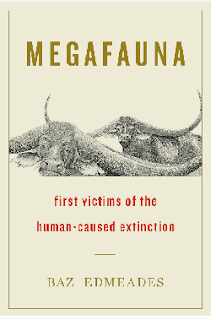
Megafauna Review


Megafauna is an important, fascinating, unforgettable, one-of-a-kind book.  It primarily focuses on prehistoric megafauna extinctions around the world, and how they happened.  Baz Edmeades (“ed-meedz”) has been working on this book for 20+ years, and it is impressively thorough.  His grandfather was a professor who found a unique human-like skull that was about 259,000 years old.

Megafauna are mammals weighing more than 100 pounds (46 kg).  Hominins are primates that walk on two legs, like you and I.  Hominins have been around for several million years.  Humans have been around for 250,000 to 400,000 years, depending on who you ask. 

During the last two or three million years, lots of megafauna species, all around the world, have moved off the stage forever.  Why?  A heated debate has been buzzing for 50+ years.  Was it an asteroid strike?  No evidence.  Were they zapped by diseases?  No evidence.  Was it climate change?  It probably strained some regional situations.  Was it human activities?  The evidence strongly supports this.  In 1966, Paul Martin presented his megafauna overkill theory (humans did it), which ignited big controversy in academia.  Edmeades became friends with Paul Martin, and learned a lot from him. 

Hominins originated in Mother Africa, where there used to be at least nine species of big cats (three today), nine types of elephants (one today), and four hippos (one today).  There were giant antelopes, giant hyenas, giant pigs, giant monkeys, and giant baboons — all gone.  Extinction spasms especially surged as humans wandered out of Africa, and gradually colonized the planet.  They migrated across Southern Asia, to Australia, then Eurasia, and finally the Americas. 

Paul Martin coined the misleading term “blitzkrieg overkill,” which angered quite a few folks.  As humans colonized new regions, the megafauna declined in number, in a process that could take a thousand years or more, multiple generations.  It was not a high-speed massacre.  These hunters were Stone Age people, using simple tools.  Many of the large game they hunted had low reproductive rates, which made them extremely vulnerable to extinction.

There is a clear pattern that when hunters migrated into continental land masses, stuff went extinct — except on uninhabited (human-free) offshore islands of the Mediterranean, Caribbean, and elsewhere.  On these islands, extinctions didn’t begin until humans eventually stepped ashore, sometimes thousands of years later.  Understand that offshore islands have a climate quite similar to the nearby mainland.  Climate was not a factor here.  Many of the megafauna species that blinked out had survived multiple ice ages over the passage of several million years.

In 2015, I stumbled across early sections of the Edmeades book online, and they blindsided me.  I never understood how incredibly alive this planet once was, and how tragically damaged it now is.  None of my teachers ever explained this, because they never learned it.  Our cultural myths celebrate the upward spiral of humankind’s brilliant achievements.  We live in a technological wonderland, not an ecological graveyard.  Life has never been better, and the best is yet to come.

The ancestors of hominins were originally tree dwellers.  Our closest living relatives are chimps, with whom we share 98.8 percent of our DNA.  Long ago, when the climate changed, and forests shrank, our ancestors were forced to survive as ground dwellers, a lifestyle for which evolution had not prepared them.

Over the course of several billion years, evolution has been a remarkable force that guided the journey of the family of life.  When frigid eras arrived, critters evolved fur coats.  When foxes became faster, evolution selected for faster bunnies.  It was a balancing act.  Foxes needed bunnies, and bunnies needed foxes.  The family of life was continuously fine-tuned at the speed of evolution, an extremely slow process.  Alterations could take many thousands of years.

Over millions of years, evolution provided giant tortoises with large bodies, invincible lion-proof shells, and long lifespans.  In the blink of an eye, these advantages were rubbished when hominins moved into the neighborhood, and began killing 200-year-old tortoises with big rocks.  This hunting method was not fine-tuned by evolution.  It was a sudden innovation that popped into the mind of a hungry hominin — and it worked!  Invincible tortoises were immediately transformed into helpless sitting ducks that didn’t have a bright future.  Evolution was yanked out of the driver’s seat.  Ancient rules no longer mattered. 

Hominin cleverness changed the world.  It made it far easier to grab essential resources, grow in numbers, and avoid becoming cat food.  Cleverness had the long term impact of an asteroid strike.  Cleverness enabled hominins to domesticate fire, plants, and animals.  We colonized the planet, developed industrial civilization, zapped the forests, polluted everything, and destabilized the climate.

Many folks in the human herd suffer from a blind faith that the miraculous power of cleverness can easily overcome all challenges.  Their vision is to keep our maximum impact way of life on life support, as long as possible, and hope for the best.  Edmeades presents no solutions, but this is a story that was important to tell.  He laments that cleverness “has given our species the power to transform the biosphere so profoundly that no other organism on this planet may get the opportunity of evolving it again.” 

His book does an excellent job of discussing the megafauna extinctions in an understandable way, with up-to-date information.  Its bitter medicine, and good medicine.  Many misperceive evolution to be a divine competition, in which species fight relentlessly to reach the top of the hierarchy, seeking to wear the Dominant Animal crown.  This pyramid-climbing quest for domination is the engine of civilization.  By the end of the book, you understand that evolution is more about adapting to changing conditions in a way that is as smooth and balanced as possible. 

Evolution has been the great friend of the family of life.  The Dominant Animal game has been its grim reaper.  While the wild megafauna are now sharply diminished, human-caused extinctions of many other species continue at an accelerating rate.  Cleverness never sleeps.  I’ve spent 69 years in a roaring hurricane of devastating cleverness.  Edmeades book reminded me that this planet was once a healthy and amazing living paradise.  Some of my genes have their roots in those good old days of abundant life.  That’s a comforting notion.

Edmeades, Baz, Megafauna: First Victims of the Human-Caused Extinction, Houndstooth Press, 2021.


Monday, August 30, 2021

Wild Free and Happy Sample 57


[Note: This is the fifty-seventh sample from my rough draft of a far from finished new book, Wild, Free, & Happy.  The Search field on the right side will find words in the full contents of all rants and reviews.  These samples are not freestanding pieces.  They will be easier to understand if you start with sample 01, and follow the sequence listed HERE — if you happen to have some free time.  If you prefer audiobooks, Michael Dowd is in the process of reading and recording my book HERE.

[Continued from Climate Crisis 02 Sample 56]

Water and Climate

In The Great Acceleration, McNeill and Engelke described how a warming climate is disturbing the relationship between water and the family of life.  The precipitation patterns of the past are changing, creating new challenges for ecosystems, human societies, and life as we know it.

Extreme weather events are expected to occur more frequently.  When ocean surface temperatures get warmer, cyclones are more likely to be spawned.  Warmer air can hold more moisture.  In regions having a moist climate, clouds bloated with water are more likely to form.  More and more often, storms are dumping huge loads of rain, sudden deluges that cause destructive floods and landslides.  In regions having a dryer climate, warmer air will create fewer clouds, produce less rain, crank up the air temperature, intensify drought conditions, and encourage wildfires. 

With a warming climate, the glaciers of the world are melting and retreating more rapidly.  Winter precipitation is delivering more rain, less snow.  Winter rain tends to run off promptly.  Snowpack retains the moisture longer.  It melts later, closer to the growing season, when the water can be used to irrigate thirsty cropland. 

The water flowing out of the Himalayas feeds the Indus, Yangzi, Mekong, Ganges, Yellow, Brahmaputra, and Irrawaddy rivers.  Two billion people depend on this water arriving in adequate amounts, at the appropriate time.  In the coming years, more water shortages and major changes are expected.

Paul Ehrlich and John Harte wrote that a third of global crop production depends on irrigation.  Melting snow has been an essential source of irrigation water.  “The winter snowpack in mountainous regions such as the Himalayas, the Rockies, the Sierra, and the Andes is a most efficient reservoir, storing water through the cold months and releasing it gradually as snowmelt in warm months when farmers need it.”

“In response to severe and prolonged drought in many regions of the world, including China, India, Thailand, Italy, and California, loss of surface irrigation water has resulted in excessive pumping of groundwater, which in turn has led to land subsidence, groundwater depletion, and irreversible loss of aquifer volume.”  Food production is also challenged by droughts, deluges, super storms, heat waves, aggressive wildfires, declining insect pollinators, soil salinization, soil depletion, erosion, and so on.

Sahana Ghosh reported that the once mighty Ganges River is wheezing.  Over the years, river volume has been declining, because farmers have been diverting too much water via their irrigation canals.  The river got shallower.  Then, they switched to tube wells with motorized pumps.  Naturally, overpumping the groundwater has serious consequences.  In the dry months, the river now looks more like a mudflat.  Reduced flow also concentrates the load of pollutants.  Researcher Abhijit Mukherjee said, “Our prediction shows that about 115 million people can be impacted due to insufficient food availability in the next few decades.”

Jim Robbins wrote about the Colorado River blues.  The 1,450 mile (2,333 km) watershed starts in the Rocky Mountains and ends at the Pacific.  It used to empty into the Gulf of California, but not a single drop of water enters the Gulf today.  In 2018, river volume was just two-thirds of normal, tied for the record low.

The Colorado is one of the most heavily engineered waterways in the world — designed for the benefit of humans, not nature.  It is the source of much contention.  It serves 40 million people, and the number of users keeps growing.  A drought since 2000 has reduced its flow.  It is the most severe drought in 1,250 years.  The Lake Mead reservoir at Hoover Dam, and the Lake Powell reservoir at Glen Canyon Dam, are at all-time lows.

Some suspect that climate change is drying out the West.  This is not just a temporary drought, the West may actually be getting permanently dryer.  “Worst case, if the reservoirs ever hit ‘dead pool’ — when levels drop too low for water to be piped out — many people in the region could become climate refugees.”

Agriculture uses 80 percent of the Colorado’s water, cities use 10 percent.  As demand exceeds supply, some users will be cut off.  Dewatering agriculture would snuff out many farms and nearby towns.  Wildlife does not have a top priority. 

Frederick Pleitgen and team described an emerging water shortage crisis in the Middle East, caused by persistent drought and extreme heat.  Temperatures sometimes soar to life threatening levels.  Rainfall mostly evaporates.  Rivers, lakes, and wetlands are drying up.  As Iran’s once large and beautiful Lake Urmia shrinks, its water is getting too salty, so farmers are pumping groundwater for irrigation.  Aquifers are being overpumped, depleting the limited reserves.  If current trends continue, some regions will become uninhabitable.

Homes in Jordan receive some water once or twice a week.  Numerous upstream dams limit the amount of water that eventually arrives at the end of the watershed.  Israel has a huge water desalinization program that requires large amounts of fossil energy to operate, adding still more carbon into the atmosphere.

Agriculture and Climate

Every variety of plant and animal has different environmental requirements for optimal health.  They all have evolved to survive within a limited range of conditions.  Humans can’t survive extreme conditions, nor can the livestock and crops we depend on.  When reality is shifting into a new and unusual trend, the family of life will struggle, and some will blink out.  Evolution is not a speedy process. 

With regard to crop plants, important variables include temperature, sunlight hours, pH, available moisture, soil fertility, and so on.  As warming proceeds, the regions that have a tropical climate are expanding from their equatorial homeland toward the poles.  Regions that used to be temperate are getting hotter.  In the good old days, frigid winters used to provide beneficial pest control, by freezing lots of insects and other things that harmed crops and humans.  Winter precipitation was stored in ice and snow.

Brian Halweil emphasized how important a stable climate is to agriculture.  In 2003, for the first time, the potato blight fungus came to visit the town of Chacllabamba, Peru.  It almost totally destroyed their crop.  Located at an altitude of 13,000 feet (4,000 m), a cool climate had protected the potato fields for thousands of years.  No more.  Spuds had been their staple food.

Jerry Hatfield and John Prueger investigated how rising temperatures affected a variety of crop plants.  Extreme heat events may last a few days, and have a big impact.  When temperatures are outside of the ideal range, plant growth, pollination, and reproductive processes can be affected.  Pollination is especially sensitive to rising temperatures.  High temperatures during the reproductive phase of the life cycle can reduce corn yields by as much as 80 to 90 percent. 

When wheat is maturing, a frost can cause the grains to be sterile.  Too much heat can reduce the number of grains that form.  Rice is especially vulnerable to high heat during the pollination process.  For the major crops, yields are expected to decrease as global temperatures rise. 

Kimberly Cartier noted that growing conditions are getting less predictable than in the past.  Rainy seasons may be more intense than usual, or less.  Their arrival may be earlier than the ideal time, or later.  The El Niño-Southern Oscillation (ENSO) pattern is associated with precipitation patterns, and it is a well-known troublemaker.  In 1983, an unusual ENSO coincided with the largest global failure of corn (maize) crops in modern records.  ENSO can also alter wheat and soybean production on a global scale.

Mike Davis wrote about a horrific era of ENSO related droughts and famines.  In the years 1876-79 and 1896-1902 between 12.2 and 29.3 million died of famine in India.  In the Madras Deccan, “the only well-fed part of the local population were the pariah dogs, ‘fat as sheep,’ that feasted on the bodies of dead children.”  In the same period, between 19.5 and 30 million died of famine in China, and 2 million in Brazil.  Famine hit these three nations the hardest, but many other nations were also affected.  In the U.S., churches organized to send relief to hungry farmers in the Dakotas and western Kansas.

Samuel Markings wrote about the relationship between photosynthesis and temperature.  In plants, photosynthesis is the process that uses sunlight to transform water and CO2 into food (glucose) and oxygen.  Optimum temperatures range between 50 to 68°F (10 to 20°C).  Above this range, higher temperatures slow photosynthesis.  The process declines sharply when temps rise above 104°F (40°C).  When temps persist in this range, plant survival is endangered.

Abdul Wahid and team wrote an extensive report on heat tolerance in plants.  Each crop species has a threshold temperature.  If this temperature is exceeded too long, the result is heat stress — irreversible damage to plant growth and development.  Harm varies based on intensity (temperature in degrees), duration, and the rate at which the temperate rose.

Qunying Luo extensively described threshold temperatures for a number of major crop species.  At different stages of a plant’s life, they can be damaged by excess heat — leaf initiation, shoot growth, root growth, sowing to emergence, grain filling, etc.  For example, “Several studies found that temperatures of above 35°C (95°F) are lethal to maize pollen viability”

Tnau Agritech Portal published a report on the effects of high temperature on plant growth in India.  Each plant species has a thermal death point.  For many annual crops, 122°F (50°C) is fatal.  Excess heat can reduce yields, and inhibit the absorption and assimilation of nutrients.  It can cause pollen abortion, which reduces the grain set.  Even short exposure can affect the growth of shoots and roots. 

Evelyn Lamb wrote that rice provides 16 to 20 percent of the calories consumed by humankind.  Corn and wheat are similarly popular.  Thus, more than half of the calories consumed by humans are provided by rice, corn, and wheat.  Growing rice in flooded paddies produces more greenhouse gas emissions per calorie than corn or wheat, twice the emissions from wheat.

Santosh Koirala reported that most rice crops begin by transplanting young plants in flooded paddies (“puddling”).  “When rice is grown under puddled transplanted conditions, paddy soil becomes anoxic — depleted of dissolved oxygen — and then, in the absence of oxygen, microbes that break down plant matter produce methane.”  Puddling “is becoming less profitable because of the costs of labour, shortage of water, and high energy costs.”  It results in depletion of soil quality, and higher methane emissions.

 “Methane is the second major greenhouse gas, after carbon dioxide, and agriculture accounts for 40% of these greenhouse emissions.  Although farm animals are a major source, flooded rice paddies emit as much as 500 million tons, which is around 20% of total manmade emissions of this gas.”

Kritee Kritee and team noted that rice is a staple food for almost half of humankind, so it’s especially important to pay attention to its climate impacts.  Globally, one third of water used for irrigation goes to rice farming.  Rice receives one seventh of all fertilizer used.  “Methane from global rice cultivation currently accounts for one-half of all crop-related greenhouse gas emissions.”

Experts recommended that these methane emissions could be reduced by shifting from continuously flooded rice fields to intermittent flooding.  Unfortunately, the team was surprised to discover that this brilliant solution had an unintended consequence.  The emissions of nitrous oxide (N2O) tripled — a greenhouse gas that persists in the atmosphere much longer than methane.  It is an unintended consequence of using nitrogen rich fertilizer.

Janet Ranganathan and team wrote a hefty and thorough report filled with recommendations for reducing the environmental harm caused by high impact diets and overpopulation.  Consumption of animal-based foods is growing, and these foods (especially beef), result in higher emissions of greenhouse gases. 

Meat and dairy foods are not necessary for adequate nutrition, so less is better.  “Plant-based foods can be readily combined to provide the full set of essential amino acids, as with rice and beans or peanut butter and bread.”  The only essential not provided by a vegetarian diet is vitamin B12, which supplements can provide. 

Obesity is a growing trend, even among low-income people.  “Globally, there are now two-and-a-half times more overweight than undernourished people.  More than one in three adults are overweight.”  Folks around the world are overdoing the consumption of calories and protein. 

The Second State of the Carbon Cycle Report is a spellbinding 878 page report on the carbon cycle in North America.  I learned a very important fact of life:  “Globally, soils contain more than three times as much carbon as the atmosphere, and four and a half times more carbon than the world’s biota [living things]; therefore, even small changes in soil carbon stocks could lead to large changes in the atmospheric concentration of carbon dioxide (CO2).”

Carbon compounds are central to the existence of the entire family of life.  The CO2 that plants extract from the atmosphere allows them to live and grow.  Plants exhale oxygen that animals need, and animals exhale CO2 that plants need.  Soil is home to an amazing community of fantastic microbes.  Dead organic material contains carbon.  When it drops to the ground, soil microbes eagerly decompose it, and do so in a way that stabilizes the carbon, so it is more likely to be retained in the soil, rather than float away.  Soil microbes that encourage carbon retention do not enjoy unusual shifts in moisture or temperature.  They don’t enjoy deforestation, tilling, or being sprayed with farm chemicals. 

Livestock production is a significant source of greenhouse gases — CO2, methane, and nitrous oxide.  Ruminants include cattle, sheep, goats, elk, deer, bison, etc.  The digestive system in ruminants includes a process called enteric fermentation, which produces methane emissions (3% farts, 97% belches).  Poultry, hogs, and horses emit greenhouse gases in smaller volumes via different processes.  Manure stored in large quantities generates large emissions of methane.  Pools of deep shit contain little or no oxygen, so they provide ideal conditions for producing methane.

“Soils in North America have lost, on average, 20% to 75% of their original topsoil carbon with historical conversion to agriculture.”  Most of this conversion took place in the last 200 years or so.  To add insult to injury, “On a per-person basis, food loss and waste in North America is 375 to 500 kilograms per year.” (826 to 1,102 pounds)

Arctic Fires

Zombie fires were the subject of a BBC story.  They are also called overwintering fires or peat fires.  They occur in Russia, Canada, and Alaska.  In recent years, temperatures in the Arctic have been soaring, and permafrost has been thawing.  When tundra and forest lands dry out, they become prone to wildfires.  These fires can ignite ancient peat deposits beneath the surface.  Toasty peat can smolder all winter, beneath the snow cover.  When spring arrives, the snow melts, oxygen reaches the embers, and the fire can reignite.  They “come back from the dead,” hence the zombie tag. 

Alexandra Witze reported that in the summer of 2020, there were many Siberian tundra fires, and they emitted 244 megatons of CO2, a 35 percent increase over the intense 2019 fire season.  About half of the fires were burning on peat lands, the most carbon-dense ecosystems.  When shallow layers near the surface dry out, they are more susceptible to burning.  Warmer winters and springs mean the fire season starts sooner.  In the Arctic, the fire zone is moving northward, into lands that have traditionally been fire-resistant. 

Portia Kentish reported that the climate crisis is well underway in Arctic regions, causing huge and spooky impacts — a powerful warning to the rest of the world, which is not leaping to action.  During a May 2020 heat wave, locations in Siberia that are normally close to freezing had temperatures hotter than Athens or Rome.  Some Arctic permafrost is up to 80,000 years old.  When permafrost thaws, methane emissions begin.  Heat waves encourage wildfires.  They are burning peat deposits that have been building up for 15,000 years.  About half of Russia’s Arctic fires are consuming peat soil. 

Forest Impacts

We could sequester lots of CO2 by planting enormous numbers of trees.  That sounds wholesome.  Sadly, the current fad is deforestation — cutting enormous numbers of trees to grow soybeans, create livestock pastures, make charcoal, produce wood products, and clear the way for urban sprawl.

As the planet gets warmer, forests will become more vulnerable to pests and pathogens.  Droughts will become hotter, longer, and dryer.  This encourages wildfires.  Wikipedia is posting pages that, year by year, document wildfire activity in the world.  The report for the record breaking year of 2021 is [HERE].  As of August 19, fires had been reported in Algeria, South Africa, Cyprus, India, Israel, Russia, Turkey, France, Greece, Italy (10 regions), Canada, and United States (9 states), Argentina, and Australia.

Rodrigo Pérez Ortega reported that climate change is encouraging trees to grow fast and die young.  Research suggests that this may be universal, affecting almost all tree species and climates.  Based on tree ring analysis, this trend corresponds with the exponential growth of human caused CO2 emissions, as well as rising temperatures — a combo that stimulates rapid growth.  This reduces their potential for maximum long term CO2 absorption. 

Nate McDowell and team studied changing forests.  “Shifts in forest dynamics are already occurring, and the emerging pattern is that global forests are tending toward younger stands with faster turnover as old-growth forest with stable dynamics are dwindling.”  These shifts are occurring because of “anthropogenic-driven exacerbation of chronic drivers, such as rising temperature and CO2, and increasing transient disturbances, including wildfire, drought, windthrow, biotic attack, and land-use change.”  Their findings indicate that it is “highly likely that tree mortality rates will continue to increase.” 

Robert Hunziker reported on new information linking rising temperatures with the increase in tree deaths.  In the U.S., giant sequoias are dying from the top down.  In the Southwest, drought has killed hundreds of millions of trees.  In Africa, 2,000 year old baobab trees are wheezing and dying.  In Germany, dead trees are everywhere.  Dead and dying trees are more vulnerable to insects and disease.  They provide abundant fuel for forest fires.  Siberia is burning up.  “New studies show drought and heat waves will cause massive die-offs, killing most trees alive today.” 

Dahr Jamail visited Glacier National Park, home to a formerly thriving boreal forest.  A warming climate has delighted millions of hungry pine bark beetles, some of whom can now have two life cycles per year.  In the last 20 years, beetles have killed 40 million acres (16 million ha) of trees.  They kill fewer pines now, because fewer pines remain alive.  The latest serial killer is white pine blister rust, which has infected almost 85 percent of the trees in the park.

Songlin Fei and team studied how insects and diseases are hammering U.S. forests, which are now home to more than 450 nonnative tree-feeding insects and tree pathogens.  The study focused on the 15 most destructive nonnative forest pests.  It found that “41.1% of the total live forest biomass in the conterminous United States is at risk of future loss from these 15 pests.  These results indicate that forest pest invasions, driven primarily by globalization, represent a huge risk to U.S. forests and have significant impacts on carbon dynamics.” 

Peter Wohlleben shared his intimate knowledge of the trees in his beloved German forest.  Trees can’t walk, but forests are always slowly wandering.  Since the end of the last ice age, a warming climate has enabled the trees of central Europe to gradually migrate northward.  Animals and winds move seeds away from their source.  Today, the climate is warming way too fast, which presents a mortal threat to temperature sensitive species.  Human tree huggers are working to relocate and transplant as many types of trees as possible.  Assisted migration is a heroic effort to “help forests walk.”

Climate and Disease

The climate crisis is not expected to promote miraculous advances in the health of humankind.  The huge herd is moving into an era of food insecurity, power shortages, water scarcity, poor sanitation, infectious diseases, deteriorating medical care systems, and so on.  A hotter climate and extreme weather events will add to these challenges.

The Lancet’s 2020 report presented a competent 42 page discussion on the climate change impacts on health.  Warming trends are increasing the frequency and intensity of floods, drought, storms, wildfire, temperature anomalies, and food scarcity.  These changes are killing more folks in the 65+ age range.  In 2018, heat waves killed about 296,000 people.

“The climate suitability for infectious disease transmission has been growing rapidly since the 1950s.”  The dengue virus is spreading across South America.  “From 1950 to 2018, the global climate suitability for the transmission of dengue increased by 8.9% for Aedes aegypti and 15% for Aedes albopictus.  In 2015 to 2019, suitability for malaria transmission in highland areas was 38.7% higher in the African region and 149.7% higher in the Western Pacific region compared with a 1950s baseline.”

David Wallace-Wells added that malaria also thrives in hotter regions because “for every degree increase in temperature, the parasite reproduces ten times faster.”  Consequently, by 2050, up to 5.2 billion people may be infected, according to World Bank estimates.  As tropical climates move northward, so will tropical pathogens.

Tipping Points

A tipping point in an ecosystem is a threshold that, when exceeded, can lead to large changes.  Sometimes an imbalance can reach a level of intensity that triggers an irreversible cascade of events, like a chain reaction of falling dominoes.  The climate crisis is a momentous tipping point in the human saga.  Melting Arctic ice has busted loose an avalanche of devastating changes.  Clever humans, with all their gee-whiz technology, are powerless to refreeze the Arctic, halt the avalanche, put the carbon back where it came from, and make everything nice again.

Over the millennia, high impact cultures have increasingly evolved into aggressive control freaks, radically manipulating ecosystems to satisfy their impulsive whims.  They are unencumbered by foresight, and display little respect for the family of life and the generations yet to come. 

For a very long time, their enthusiastic cleverness usually didn’t slam head-on into devastating limits.  They kept nature on a short leash, and brutally abused her.  The game is different now.  We’ve created changes that threaten our survival, changes we can’t undo.  We are no longer in the driver’s seat. 

Nature has put a tight leash around our necks, and we’re about to discover what it’s like to be powerless, kicked, and beaten.  Mistakes indeed have consequences (ouch!).  Our seat in the family of life is not a throne.  We are not the Crown of Creation.  We’re often more like hyperactive children who get completely lost, confused, and anxious.

Many folks who deliberately pay acute attention to reality are totally spooked.  These hyper alert folks have developed a special ability to comprehend the obvious — we’re in the <bleeping> express lane to surprising changes.  Many of them seem to perceive tipping points to be elements of a remarkable cosmic drama.  Tipping points are fire-breathing dragons that we must heroically slay in order avert runaway warming, and a hellish ecological apocalypse called Hothouse Earth.  

The alert ones are jumping up and down and shouting about tipping points, in a desperate frantic effort to wake up the clueless billions.  Dudes!  It’s time for action!  We only have ten years to fix this mess!  It’s not too late!  The presumption is that the mess is a solvable problem.  We are heavily indoctrinated with the illusion that technology can overcome any challenge. 

At the same time, the titans of industry assure us that they are ready and eager to sell us the miracles we need: electric cars, solar panels, wind turbines — clean green energy, and a prosperous economy that will grow until the end of time!  We can simply shop our way to a better tomorrow.  Everything will be OK.  Think happy thoughts.  Hope will save the world.

Will electric cars will be so cool that the Arctic ice refreezes?  Will the glaciers rise and shine again?  Will green energy be so cool that the permafrost stops thawing, and the methane seeps go back to sleep?  Is learning how to walk as hard as they say?  To learn more about tipping points, check out Fred Pearce, Timothy Lenton, Katharyn Duffy, and Will Steffen. 

[Continued in Climate Crisis 04, Sample 58]

Saturday, June 1, 2019

Wild Free and Happy Sample 16


[Note: This is the sixteenth sample from my rough draft of a far from finished new book, Wild, Free, & Happy.  I don’t plan on reviewing more books for a while.  My blog is home to reviews of 201 books, and you are very welcome to explore them.  The Search field on the right side will find words in the full contents of all rants and reviews, if you are interested in specific authors, titles, or subjects.] 

Food Storage

In the tropics of Mother Africa, meat spoiled quickly, and yummy carcasses soon attracted mobs of ravenous and dangerous scavengers.  When folks fancied a juicy steak, they killed something.  Preserving and storing surplus meat was unnecessary, and highly impractical, a stupid idea that never occurred to anyone.  There was no reason to hunt heavily for a while, dry lots of meat, haul it around, and constantly protect it.

Snow country was a different story.  Winter made travel, hunting, and fishing more difficult.  Folks who accumulated and stored surplus food for the winter months were far more likely to survive and inhale the fragrant aromas of blooming springtime flowers.  For our human ancestors, fine-tuned for tropical living, long-term food storage was a weird and unnatural idea.  But once some pioneers learned how to do it, far more regions became potential locations for future colonization.  With storage, we were able to expand into lands having harsher climates.

Clive Finlayson jabbered about a group of humans known as the Gravettian culture, who managed to survive in the steppe-tundra of the Eurasian Plain from 30,000 to 20,000 years ago.  Large game was abundant.  Here they invented one of the most diabolical Earth-shaking technologies of all time (gasp!), the storage pit!  Holes chopped into the frozen permafrost could be used as scavenger-resistant deep freezers, to store surplus food for the lean seasons.

Finlayson believed that food storage was a significant milestone on our long and painful descent to modernity.  Surplus made clans more secure, as long as adequate food resources remained available.  Acquiring surplus food for winter dining required intensified hunting, which could lead to waste, spoilage, unintentional overhunting, population growth, and the depletion of game over time.

An additional quirk of snow country was that folks needed to burn lots of calories to stay warm and strong in their physically active outdoor life.  So, a diet rich in fat was essential.  The fat content of game animals varied with the seasons.  Meat had the most fat in late summer and autumn.  In late winter and spring, many animals were unfit to eat due to insufficient fat.  In lean seasons, Native Americans killed buffalo just to eat their tongues, which were high in fat.

Dixie West noted that animals with minimal fat were junk food.  When humans and other carnivores eat lean meat, they can lose weight, because digesting it requires more energy than the meat contains.  Folks commonly smashed and boiled the bones that contained the most marrow, to extract the precious marrow fat.

In snow country, as long as large game remained readily available, labor intensive agriculture made zero sense.  As game became scarcer, hunting was gradually displaced by farming.  This began about 6,000 years ago.  In regions less suitable for farming, hunting persisted longer.  The focus shifted from storing meat to storing grain.  According to Finlayson, the concept of producing surplus food, and competently managing the surplus, set the stage for the birth of civilization.

The advantages of food storage in snow country encouraged the dawn of the “more is better” mindset, which eventually became a core belief in cultures engaged in agriculture or herding.  The Gravettians and other hunters stockpiled frozen or dried meat.  Farmers loaded granaries with calorie dense grains.  Herders stored their meat on the hoof, gathered milk daily, and slaughtered livestock only when needed.  They strove to accumulate as many animals as possible.  In different forms, the practice of food storage spread across snow country, eventually crossing from Siberia into the Americas.

Life was simpler for tropical hunter-gatherers, like the San people of the Kalahari.  On a really crappy day, if a gang of hyenas snatched an antelope just killed by hunters, what was lost was merely the work of a single day.  They were able to maintain their conservative traditional way of life for many, many thousands of years.  It was not a high impact way of life.

For the food hoarders of snow country, on the other hand, misfortune could suddenly eliminate months of tedious work, and endanger winter survival.  Their food stockpile could be wiped out by fire, flood, scavengers, spoilage, vermin, theft, and so on.  The whole community might starve and blink out.  Over the long run, “more is better” cultures, with their denser populations, were more likely to swerve into bloody turbulence.  Storage is big juju.

Dress for Success

Hunter-gatherer cultures differed widely in their dependence on technology.  The utterly simple Kalahari way of life was practiced by our hominin ancestors for at least two or three million years.  In the tropics of Mother Africa, evolution spent several million years fine tuning our bodies for life on the savannah, and the result was an excellent design. 

After hominins migrated out of Africa, and colonized tropical Asia and Australia, some folks decided to wander north.  It was a cool place to live, and the farther north they wandered, the cooler it got.  In snow country, tropical primates were like fish out of water.  Brrrr!  They wrapped themselves in animal hides, lived in protective shelters, and huddled around warm campfires.

In 1908, Knud Rasmussen told the story of a Greenland Eskimo named Qumangâpik, who had four wives and 15 children.  The first wife froze to death, the second was buried by an avalanche, the third died of illness, and the fourth froze to death.  Of his 15 children, one starved, four were frozen, and five died of illness.  Then, Qumangâpik froze to death, with his wife and two little children.  Three of his kids outlived him.  In frigid times, ripped or inadequate clothing could be a death sentence.

Over time, early colonists in snow country learned how to cut and sew hides into custom tailored clothing that provided better protection for both humans and their body lice companions.  Killing a deer, tanning its hide, and turning it into coats, trousers, hats, or footwear, was a time consuming process.  Deerskin attire was not especially warm, especially when soaking wet or frozen.  On the plus side, it could be boiled and eaten when starvation threatened.

The first stitching was likely done with sinew, or thin strips of leather.  Eventually, some groups learned how to spin plant fibers into thread, which could be used for stitching seams together.  In the Republic of Georgia, researchers have found spun and dyed fragments of flax fibers that were 34,000 years old. 

Needles were used for sewing clothing and tents, and for making nets.  Animal bone needles with eyes, about 25,000 years old, have been found in Central Europe.  Needles have not been found at Neanderthal sites yet, but looking for a needle in a haystack is far easier than finding an extremely old needle buried somewhere on the Eurasian land mass.

Over time, folks got better at spinning different types of high quality thread.  It was spun from plant fibers like flax, cotton, or hemp; or animal fibers like wool.  Eventually, a clever person invented weaving, a process that wove thread into cloth.  Cloth could be used to make a wide variety of useful things.

Kassia St Clair described how gathering and processing plant fibers was time consuming.  So was carefully collecting and preparing fibers from sheep, goats, silkworms, and others.  So was spinning and weaving.  In some regions, folks may have devoted more hours to their wardrobe than to acquiring food.  For hardworking people, clothing was precious, and carefully kept mended and patched.  Many owned little more than what they were wearing.

During the agricultural era, wool clothing was popular in snow country, until the eighteenth century, when new technology made cotton cloth cheaper to make, and more profitable.  Cotton was the dominant fabric until the 1970s, when synthetic fibers rose to dominance.  It won’t be long now until almost all clothing is polyester, which is exceedingly cheap to produce from petrochemicals using state of the art automation, and super cheap sweatshop labor.

Today, many consumers own enormous wardrobes of apparel, much of it rarely worn, if ever.  Modern attire is not designed for rugged durability, but to be rapidly mass produced, in order to meet the demand for the latest trendy styles.  Trendy styles have deliberately short lifespans.  This encourages radicalized consumers to maximize their apparel purchasing.  For them, nothing is more embarrassing than to be seen wearing obsolete fashions.  Landfills are stuffed with countless tons of formerly trendy attire.  Much of it is discarded while still in excellent condition.

Great Leap Forward

A number of thinkers have jabbered about a miraculous turning point in the human saga.  Before this event, humans were dim witted, knuckle dragging, mouth breathing bubbas.  And then — shazam! — we triumphantly glided across a magic bridge, from the archaic era into the modern one.  Our species was gaining momentum on the treacherous path to technological utopia and ecological dystopia.

Jared Diamond once speculated that if space aliens had visited Earth 100,000 years ago, humans would have appeared to be nothing more than ordinary animals.  But then, as the millennia passed, those critters were acting less and less ordinary.  By 40,000 years ago, our modernizing ancestors were demonstrating revolutionary changes that were both beneficial and risky.  What happened?  Diamond named this miracle the Great Leap Forward.

Of course, Diamond was raised in a crazy self-destructive wonderland of high technology — extremely clever stuff that enabled humankind to beat the living crap out of the planet’s ecosystems for no sane purpose.  Actually, those “ordinary” two-legged ancestors, observed by space aliens, were the one and only critters on Earth who were capable of conjuring domesticated fire — a fantastically revolutionary innovation.  It was close to step one on the long march to world domination.

For Diamond, the act of routinely using domesticated fire seemed ordinary and insignificant.  In his 1992 reality, even four-year olds could easily burn down the neighborhood with a cheap disposable lighter.  In addition to fire, the visiting space aliens would have also seen that the two-legged critters were unique in their ability to knap sharp stone tools, and manufacture assorted gizmos for hunting.  Our hominin ancestors had been developing these unordinary skills for more than two million years.

Extremely weird was the fact that those fire critters were at the top of the food chain, yet they had no serious fangs, claws, speed, strength, or size.  All the other top predators had naturally evolved some combination of those traits, gradually, over the course of millions of years.  But today, those traditional natural predators are being pounded into oblivion via guns, cyanide, habitat destruction, and so on.  There are not seven-plus billion lions and tigers and bears staring at cell phones.

With the Great Leap, humans began doing more and more things beyond what ordinary animals did.  They baked ceramic figurines in kilns, made flutes, wore ornamental beadwork, sewed clothing, invented new and improved tools, and built trophy homes with mammoth bone walls.  These luxurious dwellings have been found in Ukraine, Czech Republic, Poland, Romania, Belarus, and Russia.

Venus figurines have been found in Slovakia, Italy, Austria, Russia, Germany, Czech Republic, Switzerland, France, Romania, and Siberia.  They were carved in soapstone, steatite, sandstone, mammoth ivory, horse bone, serpentine, black jet, antler, limestone, and hematite.  Venus figurines date from 30,000 to 10,000 years ago.

Folks learned how to process red and yellow ochre, hematite, manganese oxide, and charcoal into pigments useful for cave painting.  Wild artists crawled far inside caverns with torches, and painted gorgeous portraits of the sacred animals for which they had the deepest respect and reverence.  Images included the horse, lion, auroch, rhinoceros, salmon, bear, mammoth, buffalo, owl, hare, ibex, auk, weasel, reindeer, chamois, and fox.  Often, artists placed their spread out hand against a wall, and sprayed paint over it, creating a hand stencil.

Those folks did not spend most of their lives indoors, isolated from the wild ecosystem, like astronauts in orbit.  They had no glowing screens.  Their world was entirely wild and alive, and they were intimately involved in it, every minute of every day, bloody hands and all.  The paintings celebrate their sacred relationship with the animals that fed them, clothed them, and sometimes killed them.

Prehistoric cave art has now been found in every continent except Antarctica.  In France and Spain, it has been found in almost 340 caves.  Famous sites include Chauvet in France (30 to 32 thousand years ago), Altamira in Spain (15,000), and Lascaux in France (18,000).  Recently, D. L. Hoffman’s team found paintings in three Spanish caves that were more than 64,800 years old — about 30,000 years before the arrival of humans.  This was the Neanderthal era.

The Great Leap Forward has also been called the Cultural Revolution or the Cognitive Revolution.  Cognition is about thought, understanding, and knowledge.  Twenty years ago, some believed that the leap was the result of miraculous genetic mutations that turbocharged our intelligence, but that theory went extinct, for lack of convincing DNA evidence.

A number of experts theorize that the leap was encouraged by powerful advances in complex language and communication, but this is impossible to prove via archaeological evidence.  Spoken words are not preserved in fossils.  We may have been singers and poets several million years ago.  We’ll never know.  Many primates and other animals are vocal.

Some sort of Great Leap certainly occurred in snow country, maybe between 50,000 and 30,000 years ago.  Our tropical primate ancestors were excited to discover lands loaded with abundant food, but challenged by a life-threatening climate for which evolution had not prepared them.  The only way they could stay, and feast on the delicious wildlife, was to cleverly invent a collection of prosthetic technology that would increase the odds of winter survival.  Eventually, the accelerating pace of cultural evolution enabled us to conquer the planet, explode in numbers, and savagely vandalize Earth in every imaginable way.

While many of the innovations of the Great Leap were survival-oriented prosthetics, others were not.  Painting, ornamentation, figurines, flutes, and so on were probably motivated by spiritual affairs, or the desire for enjoyment.  Obviously, for a while, these were not folks who were desperately struggling to survive.  Their new indulgences would seem to indicate that these folks were living in a bubble of affluence, leisure, and decadence.  They had learned and refined the skills of survival, and their food resources were temporarily abundant.  They were rich.  Life was good.

They remind me of America’s baby boomer generation, of which I am a member.  We were born at a time when industrial civilization soared to ridiculous excesses, fueled by an orgy of consuming enormous amounts of premium quality nonrenewable resources, as if they were infinite.  Some have called this joyride in self-destruction “The Blip” — a brief extreme spike in many trend lines, something equivalent to an asteroid strike. 

History repeatedly reminds us that high impact lifestyles always have an expiration date.  Yet, despite being proud descendants of the Cognitive Revolution, our clever minds routinely refuse to comprehend this simple and vital idea.  Magical thinking is always an effective cure for the unpleasant deliriums caused by occasional whiffs of reality.

Anyway, over the long run, was it truly a leap “forward” into greater joy, wisdom, health, and sustainability?  Or, was it something else?  When was the planet healthier and happier?