Showing posts with label overhunting. Show all posts

Friday, July 21, 2023

Wild New World


Dan Flores is a historian who has been studying the stormy relationship between humans and the family of life for many years.  He calls this subject Big History.  Wild New World is a fascinating and disturbing masterpiece.  It’s a thick book loaded with ideas gathered over a long career.  The core focus is on North America, which was once an Eden-like paradise of abundant wildlife.  What happened?

Our species emerged in beautiful Mother Africa maybe 300,000 years ago.  Maybe 60,000 years ago, adventurous folks began wandering off into the outer world.  Our exploration of the planet was underway.  Folks went east to Asia, and north to Europe.  By maybe 45,000 years ago, folks were in Siberia and northern Asia.  So far, the earliest evidence of humans in America dates to maybe 25,000 years ago.

Flores described two important discoveries in New Mexico.  At Folsom (1908), the bones of 32 extinct giant bison, 12,450 years old.  At Clovis (1914) the bones of extinct mammoths, 13,000 years old.  At both sites, flaked flint points were found with the bones, smoking gun evidence of human hunting.  A huge surprise!

Humans were team hunters skilled at killing delicious wild animals, preferably jumbo sized megafauna.  As bands of pioneers migrated into new frontiers, a number of megafauna species gradually went extinct, in one region after another, a sequence corresponding to the timeline of human arrival. 

Today, our culture celebrates human brilliance.  We’re simply too smart to disrupt the planet’s climate — global warming is a hoax!  We deny responsibility — not our fault.  Similarly, we’re too smart to cause mass extinctions — not our fault. 

It’s much more comfortable to blame prehistoric climate change.  But the wiped-out species in America had survived for millions of years, including numerous eras of unusual heat and cold.  They weren’t dainty weaklings.  Why did this killer climate shift only exterminate large animals, not small?  Why did it just affect America, but not other continents at the same time?  Hmmm…

In the 1960s, Paul Martin began using a new technology, radiocarbon dating, a better tool for dating prehistoric artifacts.  This enabled him to compare the dates of human presence in North America with the dates of extinctions.  He learned that human arrival came first, and extinctions came later — during a process that took maybe a thousand years. 

Stunned, he referred to this process as “blitzkrieg overkill,” because of its unusual speed.  To Native Americans, this implied that their venerable ancestors foolishly hunted too hard.  They’ve never been fond of the paleface settlers who foolishly obliterated their ancient homeland, and they especially disliked Martin.

We’ve now learned that as the human diaspora advanced around the world, the same pattern followed: arrival first, then extinction.  By 2006, Martin had learned more.  He wrote, “I argue that virtually all extinctions of wild animals in the last 50,000 years were anthropogenic.”  Yikes!  The indigenous white folks of Europe had done it too!

Evolution had fine-tuned us for living in tropical climates.  Many of the new lands we wandered into had uncomfortably chilly non-tropical climates.  We were forced to develop innovative solutions, like needles, awls, sewn clothing, and protective shelters. 

When we arrived in new regions, the wildlife was clueless.  Mysterious bipedal primates did not trigger danger alarms, because we didn’t fit the standard predator template.  “We were a brilliant new predator with sophisticated weapons, dogs, and fire.”  For a while, hunters enjoyed the pursuit of fearless prey, many of whom became victims of fatal tameness, like dodos.  During the Lewis & Clark expedition, Clark once bayoneted a wolf that calmly walked past.

Hunting focused on jumbo sized animals that didn’t breed like bunnies, or zoom like gazelles.  Small groups of humans roamed across vast roadless wilderness on foot, armed with Stone Age weapons.  Game was depleted over the course of centuries, and the process of decline could have been imperceptible to living generations.  As game got scarce, the diaspora advanced into new regions.

Everywhere we migrated, the megafauna had evolved large strong bodies, a traditional defense against fierce predators, like sabertooth cats.  Unfortunately, when the predators were bloodthirsty primates from outer space, jumbo size was a vulnerability, and high speed escape was not an option.  The big guys could be killed with primitive spears.

America was the last major stop of the human diaspora, which had begun maybe 35,000 years earlier.  During this long process, pioneers had become highly skilled survivalists.  When the Beringia land bridge emerged from the sea, they advanced from Siberia into the “American Serengeti.”

I was shocked to realize the very long time spans of evolutionary history prior to human arrival.  The camel family in North America blinked out 10,000 years ago, ending a 40 million year residence.  Horses went extinct 9,000 years ago, after enjoying four million years here.  Mammoths wandered in from the Old World 1.5 million years ago.  It’s heartbreaking to comprehend the impact of the blitzkrieg.

IMPORTANT!  So, a number of species blinked out.  When the American megafauna extinction surge wound down, what came next was 10,000 years (100 centuries) of relative stability, according to Flores.  The human pioneers remained, and eventually coevolved with the species that survived.  This preserved the continent’s downsized wildlife community.  Humans learned ecosystem limits, established wise taboos to avoid overhunting, and nurtured a culture of profound respect and reverence for the entire family of life. 

Species that survived extinction now had less competition.  With the giant bison gone forever, the much smaller bison we know today exploded in number.  They reached reproductive age faster, and successfully coevolved with the remaining survivors.  

Sadly, the 100 centuries of stability zoomed off a cliff 500 years ago, when visitors from the Old World began washing up on the Atlantic coast — something like a bloody asteroid strike.  The aliens brought with them an assortment of deadly infectious diseases for which natives had zero immunity.  There were maybe four million natives in 1492.  Epidemics rapidly spread westward, killing about 90 percent of them within 100 years. 

This die-off sharply reduced hunting pressure on the wildlife, which was free to grow explosively.  In 1585, Thomas Hariot was astonished by the fantastic abundance of animals he saw in Virginia.  It was an Eden created by disease.  Settlers were free to hunt like crazy in a wilderness where there were no rules or regulations. 

In addition to diseases, colonists also imported their infectious worldview.  Their religion had roots in a herding society that treasured enslaved livestock, and detested predators.  Their Old World culture was built on a foundation of human supremacy, domestication, civilization, manufacturing, fanaticism, patriarchy, environmental devastation, and pathological self-interest. 

From time to time, Flores stopped to take a long hard piss on the notion of self-interest, a demonic quirk in the settler’s worldview.  I suspect it emerged with the rise of farming, herding, personal property, and individual salvation.  Its one all-consuming question has been “how can I get what I want?”  We suffer from an insatiable lifelong pursuit of social status, to the fullest extent possible, by any means necessary.  Nothing else matters.  Sorry kids!  Sorry wolves!

The traditional worldview of most tribal cultures majored in cooperation instead.  It nurtured mindfulness, and profound reverence for the family of life, the mother of their existence.  They were something like the folks who made the passionate cave paintings at Chauvet.  With few exceptions, the named gods of Native Americans were animals — coyote, raven, rabbit, etc. 

In the Old World religion, humans were very special critters, the other animals were not.  By and by, settlers from the Old World flooded into America.  They had domesticated animals and religions and economic ideas wherein “animals were not kin but resources.”  Their lives had no sacred significance.  So, the more hides, pelts, and furs you could take to market, the more cool stuff you could get.  Yippee!

Native folks thoroughly detested the monstrous colonists, but were fascinated by the unusual stuff they had.  Fifty deerskins could be traded for a metal pot.  Hatchets, axes, and knives were more expensive.  Whiskey was intoxicating.  The desire for this stuff was powerful, but it wasn’t free.

It was in the self-interest of the market, and the colonies, to leave nothing of monetary value unmolested.  Wild animals were pests that stood in the path of progress, and their extermination would continue until it was no longer profitable.  For natives, all options sucked.  They struggled to do their best.

In 1972, I was a roller coaster operator.  Riders slowly went up the steep hill, and then rapidly zoomed downhill screaming their brains out.  Flores provides readers a similar experience.  Most of his book describes the terrifying mass insanity that ravaged America in the last 500 years.  Readers will scream their brains out as they plunge deep into the cesspool of Big History, our horrifying monster closet.

Flores wrote that the invaders forced “a transformation of a hundred centuries of Native America into a re-creation of Old World civilization on a new continent.”  Five centuries ago, Old World folks and animals arrived, “and then, like some new contagion spreading inland from the coasts, proceeded to effect a widespread demolition of almost all that was here.”

In one year, 1743, the port at La Rochelle, France “took in 127,000 beaver pelts, 30,300 marten furs, 12,400 river otter furs, 110,000 raccoon pelts, along with its big haul for that year, the stripped skins of 16,500 American black bears.”

“In 1874 Bozeman market hunters were hip-deep in the big bonanza.  That year they shipped out 48 tons of elk skins, 42 tons of deerskins, 17 tons of pronghorn skins, and 760 pounds of bighorn skins.”

“Governments at all levels paid money for the heads or ears or scalps of a suite of animals — wolves, coyotes, mountain lions, grizzly and black bears, jaguars, bobcats, lynx — for the single purpose of promoting agricultural economies.”  Dead animals (or meat chunks) injected with strychnine were put everywhere to poison scavengers — wolves, coyotes, eagles, vultures, ravens, magpies, foxes, skunks.  It was sold in bulk in every store.

To delight ranchers, Montana put out 3,567,000 poison baits to kill predators.  Between 1883 and 1928 Montana shelled out payments on 111,545 wolves and 886,367 coyotes.  In one year, a wolf killer earned enough to buy a ranch and livestock.

Passenger pigeons, had been in America for 15 million years.  My father was in diapers when the last one died in 1914.  “The largest nesting site ever reported, near Sparta, Wisconsin, in 1871, spread across 850 square miles (2,200 km2).”  One flock was estimated to have 3.7 billion birds. 

Life on Earth is powered by energy.  Sunbeams feed the plants, and plants feed the critters.  Agriculture and herding amplified the energy flow for humans.  More recently, the flow has been explosively accelerated by burning fossil hydrocarbons, which are not limitless or harmless.  We can now temporarily feed more than eight billion.  We’re heating the planet into a toasty concentration camp crematory.  The machine’s guiding force is insanely clever childish self-interest, which is dumber than dog shit, but far more powerful than foresight, wisdom, cooperation, and mindful self-control.  SCREAM!!!

Flores, Dan, Wild New World: The Epic Story of Animals & People in America, W. W. Norton, New York, 2022.

Saturday, December 4, 2021

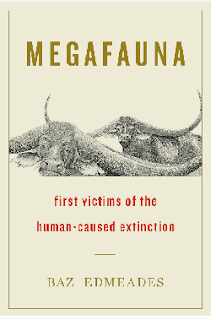
Megafauna Review


Megafauna is an important, fascinating, unforgettable, one-of-a-kind book.  It primarily focuses on prehistoric megafauna extinctions around the world, and how they happened.  Baz Edmeades (“ed-meedz”) has been working on this book for 20+ years, and it is impressively thorough.  His grandfather was a professor who found a unique human-like skull that was about 259,000 years old.

Megafauna are mammals weighing more than 100 pounds (46 kg).  Hominins are primates that walk on two legs, like you and I.  Hominins have been around for several million years.  Humans have been around for 250,000 to 400,000 years, depending on who you ask. 

During the last two or three million years, lots of megafauna species, all around the world, have moved off the stage forever.  Why?  A heated debate has been buzzing for 50+ years.  Was it an asteroid strike?  No evidence.  Were they zapped by diseases?  No evidence.  Was it climate change?  It probably strained some regional situations.  Was it human activities?  The evidence strongly supports this.  In 1966, Paul Martin presented his megafauna overkill theory (humans did it), which ignited big controversy in academia.  Edmeades became friends with Paul Martin, and learned a lot from him. 

Hominins originated in Mother Africa, where there used to be at least nine species of big cats (three today), nine types of elephants (one today), and four hippos (one today).  There were giant antelopes, giant hyenas, giant pigs, giant monkeys, and giant baboons — all gone.  Extinction spasms especially surged as humans wandered out of Africa, and gradually colonized the planet.  They migrated across Southern Asia, to Australia, then Eurasia, and finally the Americas. 

Paul Martin coined the misleading term “blitzkrieg overkill,” which angered quite a few folks.  As humans colonized new regions, the megafauna declined in number, in a process that could take a thousand years or more, multiple generations.  It was not a high-speed massacre.  These hunters were Stone Age people, using simple tools.  Many of the large game they hunted had low reproductive rates, which made them extremely vulnerable to extinction.

There is a clear pattern that when hunters migrated into continental land masses, stuff went extinct — except on uninhabited (human-free) offshore islands of the Mediterranean, Caribbean, and elsewhere.  On these islands, extinctions didn’t begin until humans eventually stepped ashore, sometimes thousands of years later.  Understand that offshore islands have a climate quite similar to the nearby mainland.  Climate was not a factor here.  Many of the megafauna species that blinked out had survived multiple ice ages over the passage of several million years.

In 2015, I stumbled across early sections of the Edmeades book online, and they blindsided me.  I never understood how incredibly alive this planet once was, and how tragically damaged it now is.  None of my teachers ever explained this, because they never learned it.  Our cultural myths celebrate the upward spiral of humankind’s brilliant achievements.  We live in a technological wonderland, not an ecological graveyard.  Life has never been better, and the best is yet to come.

The ancestors of hominins were originally tree dwellers.  Our closest living relatives are chimps, with whom we share 98.8 percent of our DNA.  Long ago, when the climate changed, and forests shrank, our ancestors were forced to survive as ground dwellers, a lifestyle for which evolution had not prepared them.

Over the course of several billion years, evolution has been a remarkable force that guided the journey of the family of life.  When frigid eras arrived, critters evolved fur coats.  When foxes became faster, evolution selected for faster bunnies.  It was a balancing act.  Foxes needed bunnies, and bunnies needed foxes.  The family of life was continuously fine-tuned at the speed of evolution, an extremely slow process.  Alterations could take many thousands of years.

Over millions of years, evolution provided giant tortoises with large bodies, invincible lion-proof shells, and long lifespans.  In the blink of an eye, these advantages were rubbished when hominins moved into the neighborhood, and began killing 200-year-old tortoises with big rocks.  This hunting method was not fine-tuned by evolution.  It was a sudden innovation that popped into the mind of a hungry hominin — and it worked!  Invincible tortoises were immediately transformed into helpless sitting ducks that didn’t have a bright future.  Evolution was yanked out of the driver’s seat.  Ancient rules no longer mattered. 

Hominin cleverness changed the world.  It made it far easier to grab essential resources, grow in numbers, and avoid becoming cat food.  Cleverness had the long term impact of an asteroid strike.  Cleverness enabled hominins to domesticate fire, plants, and animals.  We colonized the planet, developed industrial civilization, zapped the forests, polluted everything, and destabilized the climate.

Many folks in the human herd suffer from a blind faith that the miraculous power of cleverness can easily overcome all challenges.  Their vision is to keep our maximum impact way of life on life support, as long as possible, and hope for the best.  Edmeades presents no solutions, but this is a story that was important to tell.  He laments that cleverness “has given our species the power to transform the biosphere so profoundly that no other organism on this planet may get the opportunity of evolving it again.” 

His book does an excellent job of discussing the megafauna extinctions in an understandable way, with up-to-date information.  Its bitter medicine, and good medicine.  Many misperceive evolution to be a divine competition, in which species fight relentlessly to reach the top of the hierarchy, seeking to wear the Dominant Animal crown.  This pyramid-climbing quest for domination is the engine of civilization.  By the end of the book, you understand that evolution is more about adapting to changing conditions in a way that is as smooth and balanced as possible. 

Evolution has been the great friend of the family of life.  The Dominant Animal game has been its grim reaper.  While the wild megafauna are now sharply diminished, human-caused extinctions of many other species continue at an accelerating rate.  Cleverness never sleeps.  I’ve spent 69 years in a roaring hurricane of devastating cleverness.  Edmeades book reminded me that this planet was once a healthy and amazing living paradise.  Some of my genes have their roots in those good old days of abundant life.  That’s a comforting notion.

Edmeades, Baz, Megafauna: First Victims of the Human-Caused Extinction, Houndstooth Press, 2021.


Saturday, February 1, 2020

Wild Free and Happy Sample 31


[Note: This is the thirty-first sample from my rough draft of a far from finished new book, Wild, Free, & Happy.  I don’t plan on reviewing more books for a while.  My blog is home to reviews of 202 books, and you are very welcome to explore them.  The Search field on the right side will find words in the full contents of all rants and reviews, if you are interested in specific authors, titles, or subjects.]

Dogs

Over the years, I’ve spent a lot of time close to nature.  The deer, bears, skunks, bats, foxes, coons, wolves, beavers, coyotes, and weasels tolerated my passing as long as I behaved calmly and respectfully.  None of these wild beings had the slightest interest in becoming my friends, or my fur children.  None depended on me in any way.  None fully trusted me.

All were absolutely free to live as they wished, every minute of every day (unlike me).  They all had a perfectly healthy relationship to the land (unlike me).  None of them ever sent anything to a landfill, or caused permanent damage to the land, water, or air (unlike me).  All of them will celebrate when the lights go out, the last car dies, and the last bullet is shot.  Hooray!

Gray Wolves

Gray wolves are the wild ancestors of dogs.  Their history is a bit misty.  One source wrote that gray wolves emerged in Eurasia maybe a million years ago, and migrated into North America maybe 750,000 years ago.  Their range spanned across the northern hemisphere, from Europe and Asia to North America.  They didn’t fancy living in tropical forests or intensely arid regions.  Instead, they adapted to grasslands, forests, and artic regions.

Humans emerged in Mother Africa, south of the equator.  Over the course of maybe two million years, in various ways, our ancestors transitioned from foragers and scavengers, to persistence hunters, to innovative weapon users, and then teams of communal hunters.  Africa was wolf-free, but it had a home team of man-eating predators, like big cats, big snakes, big crocodiles, and packs of hyenas.  They did a good job of weeding out the weak, the sick, the injured, the inattentive, and the unlucky.  They kept our clans tidy, fit, and strong.

Wolves evolved in Eurasia, north of the equator.  Barry Lopez noted that wolves shared their food with others in the pack.  They educated their young.  They could hear clouds passing, and were able to smell prey from a couple miles away.  They were expert trackers, and hunted in a state of heightened concentration, paying relentless attention to details.  Wolves generally travelled in packs of 6 to 10 animals, and could sprint as fast as 37 miles per hour (60 km/h).  Like many man-eaters, they mostly moved and hunted at night (not a great time to be out alone).

Wolves and humans likely never met one another until some human pioneers eventually wandered north out of Africa, across the equator, and into wolf country.  History is clear that wolves had no taboos against feasting on yummy tropical primates.  In many cultures, big bad wolves enjoyed starring roles in their myths, because they had to be taken very seriously in real life.  One source noted that wolves and Eskimos were equals — prior to the arrival of firearms.  For them, wolves were valuable teachers.  I have never seen a wolf in the wild, and I hope I never see one in lockdown

The Dynamic Duo

Everyone agrees that dogs were the first domesticated critters, but exactly when and where remains highly controversial.  Wolves and humans maybe began their cautious relationship while scavenging snacks from animal carcasses.  Wolves were certainly attracted to the garbage piles at human camps.  They can chew up bones that humans can’t.  Humans were also magical critters who had the fantastic ability to regularly emit indescribably delicious turds that canines cannot resist.

We’re not sure how, but canines (wolves or dogs) and humans gradually became hunting buddies.  Eventually, via a long process of selective breeding, wolves were reduced to dogs, critters less likely to rip out your throat, and kill your friends and family.  Dogs were four-legged garbage disposals that helped keep camps tidy.  Compared to a wolf of the same size, a dog’s skull is 20 percent smaller, and its brain is 10 percent smaller.  Dogs have smaller teeth and jaw muscles, after thousands of years of dining on human refuse and other soft foods.

Anyway, the hunting buddies had complementary skills.  Dogs had superb senses of smell and hearing, excelled at team hunting, and were far speedier than humans.  Humans had the advantage of weaponry.  They had the spooky ability to hurl projectiles (sticks and stones) with remarkable accuracy, often with lethal results.

So, sniffing dogs could discover the presence of coons, and chase them up a tree, where humans could then kill them.  Thus, dogs ate better, and humans ate better, while coons (and other prey) became more vulnerable to predation.  Previously, the coon’s ability to quickly climb trees was their primary defense tactic, for maybe a million years or three.  It now became less safe to be a coon.  By gaining access to more food resources, the number of both dogs and humans could grow.

Actually, “buddies” exaggerates the intimacy of the relationship.  Elizabeth Marshall Thomas spent lots of time with the San hunter-gatherers of the Kalahari.  Writing in the 1950s, she noted that the dogs in their camp were skeletal and weak from starvation.  The dogs were owned and named, but folks never fed them anything except shit.  When a mongrel made a move on the humans’ food, it was stoned or whipped.  At night, they chased away visiting hyenas, jackals, and leopards.

Louis Liebenberg also wrote about the San.  By the late 1960s, hunters were using dogs, which radically changed the game.  On their own, dogs were not top class hunters.  Sometimes they could run down small animals.  When they teamed up with humans, both could eat more meat.  And so, ancient food chain balancing acts were disrupted, and life became less safe for some.

With dogs, it became far easier for the San to kill gemsbok, because when pursued, they will eventually stop, turn around, and confront the dogs, at which point it was much easier for hunters to kill them (deer also eventually stop and surrender).  Gemsbok was a prime prey for hunters, because they were fairly large, and fairly numerous.  Despite the assistance of dogs, hunters still had to possess exceptional knowledge of tracking, animal behavior, and the ecosystem.  This traditional knowledge was vital for mindfully directing the dogs toward the most promising locations to find a hot lunch.

Wireless Voice-Activated Herding Robots

At some point in the game, clever shepherds, with abundant free time on their hands, taught dogs to quickly and accurately obey their exact instructions for controlling the herd.  With a well-trained dog, a herder on foot could manage 150 to 200 sheep.  With this great advance, humankind was well on the path to the wondrous realm of modernity.

Writing in 1902, Irishman W. G. Wood-Martin wrote: “The dog is the greatest conquest ever made by man, for the taming of the dog is the first element in human progress.  Without the dog, man would have been condemned to vegetate eternally in the swaddling clothes of savagery.  It was the dog which effected the passage of human society from the savage to the patriarchal state, in making possible the guardianship of the flock.  Without the dog there would be no flock and herds; no roast beef, no wool, no blanket, no time to spare; and, consequently, no astronomical observations, no science, no industry.  It is to the dog man owes his hours of leisure.”

The Deadly Trio

Liebenberg noted that following the introduction of dogs to hunting, some folks also added horses to the Kalahari team of hunters and dogs.  Consequently, the traditional method of persistence hunting — tirelessly chasing game for hours during the heat of the day until they collapsed — was no longer necessary.  Speedy horses made it far easier for the team to hunt speedy antelopes.  Dogs will chase anything that moves, and horses excel at high-speed pursuits.

As a result of this great advance, the hunting game got too easy.  Hunters no longer needed to possess exceptional knowledge.  At the same time, the San lost access to much of their former hunting territory.  Now, as the elders die, large portions of a two million year old knowledgebase are going extinct, including much of the original hominin software.  The San live in permanent villages.  Game over.

Around A.D. 1300, Marco Polo described how Genghis Khan used the deadly trio for an industrial scale approach for acquiring wild meat.  It included two flanks of mounted hunters, each having 10,000 men and 5,000 great mastiff dogs.  The line of hunters would extend to the length of a full day’s journey, and no wild animal would escape their dragnet.  These hunts were like a bloody vacuum cleaner.

Later, with the adoption of firearms, the deadly trio become a bloody foursome.  Guns made it much easier to kill large animals with the squeeze of a trigger.  Pita Kelekna wrote that when the breech-loading rifle arrived on the U.S. west, the buffalo herd was reduced from 60 million to 1,000.  Back east, there was high demand for buffalo robes and tongues, and new railroads delivered the profitable merchandise.  At the same time, the U.S. government was eager to clear the troublesome heathen savages from the west, and repopulate the region with respectable tax-paying, God-fearing settlers.

Here’s the issue.  All members of the family of life, in all types of ecosystems, continuously coevolve at a gradual pace.  Species at the foundation of the food chain, like insects, evolve the ability to produce massive numbers of offspring.  On the other hand, large, long-lived species that experience minimal losses to predators, like elephants and hippos, do not breed like roaches.  Hunter-gatherers were very interested in pursuing large game, rather than mayflies.  The more they came to depend on the use of the dynamic duo, the deadly trio, and the bloody foursome, the more success they could have at overhunting, and causing extinctions.  This was not a slow and gradual process of coevolution, it was more like a technological asteroid strike.

Big Juju Transition

Paul Shepard was an original thinker who could soar far above the concrete walls of consensus reality.  He perceived the Pleistocene to be the zenith of the human journey, and the high-water mark for the health of life on Earth (the Pleistocene ended 11,700 years ago).  Many professors can’t do this.  In the creative minds of wizards, an imaginative interpretation of deep history can conjure provocative visions, and sometimes blow large holes in deeply rooted cultural myths.

For nearly the entire saga of life on Earth — a 4.5 billion year pilgrimage — all critters everywhere were perfectly wild and free, as they should be.  No species anywhere owned, controlled, and selectively bred others.  Shepard perceived the emergence of domesticated dogs as something like a horrific cosmic tear in the universe.  A new and turbulent epoch was born.  He wrote, “The history of ecological catastrophe begins with the hound.”  To the conventional mindset, that sounds like a ridiculously stoopid idea.  But today the family of life is being massacred by the conventional mindset, a ridiculously stoopid rampage.

The act of gradually transforming a vicious, wild, man-eating predator into a tolerable shit-eating hunting buddy was super-big juju.  Mischievous folks discovered that the spirit of wildness was something that could be suffocated.  If you faithfully drowned the wildest pups in the litter, and allowed the wimps and dimwits to breed, over many generations you could produce genetically modified organisms (GMOs) that were the opposite of wild — mutant canines who would obey commands from domineering tropical primates.  These oddballs were highly vulnerable to wolves, coyotes, big cats, and other wild predators.  They were unlikely to survive outside the human sphere.

Over time, this understanding of control inspired some diabolical impulses.  Why should we spend so much <bleeping> time chasing wild animals all over the place?  Why don’t we just rip out their normal wild spirit and turn them into passive critters that we can keep in dense confinement near camp?  Wow!  Cool idea!

After many centuries of trial and error, the demented efforts of obsessive-compulsive control freaks succeeded in breaking wild aurochs, sheep, goats, and pigs.  For thousands of years, humans had perceived these wild animals to be sacred beings.  We painted magnificent portraits of them in caves.  Now, reduced to freakish GMOs, they were forcibly bred, castrated, branded, sheared, bobbed, hobbled, milked, slaughtered, butchered, and eaten.  Urp!

During this era, a number of groups were also fooling around with plant domestication.  By and by, territories most suitable for intensive exploitation were able to sharply increase their food production.  More and more fields were cleared on the soft floodplain soils along rivers.  Grasslands for herds were expanded by exterminating primordial forests.  Naturally, this led to growing numbers of bambinos, more tents in the camps, and increased social tensions.

Many centuries later, the last major GMO mammal emerged from the madhouse.  The domesticated horse was a critter with a far more disruptive destiny than the dog.  Shepard wrote that horses and hounds can be seen “as destroyers of nature and humankind.”  As noted, the deadly trio of hunter, dog, and steed enabled stunning advancements in wildlife extermination.  Horse power was used to accelerate soil mining, forest mining, and ore mining.  Horse power pulled wagons, plows, and war chariots.  Horse power revolutionized raiding, warfare, and empire building.  The Mongol empire was enormous [MAP].

Danish historian Saxo Grammaticus was born around A.D. 1050.  He shared many snapshots of the testosterone powered mega violence that came into full bloom during the era of domestication.  “Now the warriors, who were always pillaging the neighborhood, used often to commit great slaughters.  Plundering houses, cutting down cattle, sacking everything, making great hauls of booty, rifling houses, then burning them, massacring male and female promiscuously — these, and not honest dealings, were their occupations.”

King Gram boasted, “Singly against eight at once I drove the darts of death, and smote nine with back-swung sword, when I slew Swarin, who wrongfully assumed his honors and tried to win fame unmerited; wherefore I have oft dyed in foreign blood my blade red with death and reeking with slaughter, and have never blenched at the clash of dagger or the sheen of helmet.”

Stable, long lasting egalitarian cultures like the San, were based on sharing, cooperation, and simple sticks and stones technology.  Cultures of domestication are based on self-interest, competition, domination, and technological innovation.  The horse powered expansion of herding and farming turbocharged food production, population growth, and the size and number of horrendous bloody conflicts.  These aggressive cultures sort of behave like wildfires — as long as they can find resources to consume, and conditions remain favorable, they grow and spread.

In wild times, when wolves killed a deer, it was a perfectly normal act, and nobody soiled their britches.  When domestication arrived, and herds of my animals were grazing, wild predators immediately shape-shifted into demonic enemies that had to be exterminated — every single one of them, if possible.

In wild times, it was perfectly normal and natural for wild herbivores to munch on the greenery.  When domestication arrived, wild grasses shifted into being my grass needed by my herd to increase my wealth.  Wild critters that helped themselves to my grass were thieves that could not be tolerated.  They had no right to exist.

In wild times, there were zero fields planted with crops.  The countryside was a free all-you-can-eat buffet.  Help yourself, take what you can find.  Have a nice day!  When domestication arrived, all the birds, bunnies, coons, deer, and bears that were tempted to sample the fruits of my hard work, in my fields could not be tolerated.  Kill them all!

In normal wild ecosystems, Big Mama Nature encourages long term health.  A forest roasted by a wildfire can usually heal and recover.  In ecosystems ravaged by Big Daddy Dominator, the damage is often irreparable.  The vegetation is stripped off, wildlife erased, the land dries out, flowing springs disappear, the climate gets hotter and dryer, persistent toxins soak in, precious soil is blown away, washed away, or rendered infertile by salt buildup, and so on.  When a Big Daddy settlement is eventually reduced to wasteland, the survivors migrate elsewhere and promptly begin repeating the same cycle of mistakes.

Big Mama is sustainable and durable.  Big Daddy is a one-way death march that burns every bridge behind it.  The ecosystems he rubbishes can never fully heal, and return to their original condition.  He’ll strive to expand his domain, by any means necessary, as far as possible, but Earth is finite.  You can’t destroy more than everything (but he’ll try).  Big Daddy is well on his way to what is known as a Pyrrhic victory.  His heroic efforts for glorious conquest are terribly successful, but the losses he suffers in the process are so enormous that the final victory is meaningless.

In countless city parks and squares, it’s common to see huge bronze statues of male conquerors, holding deadly weapons, riding their snorting steeds.  They are proud monuments of the fanatical Big Daddy cult.  The message of each is “I courageously destroyed the despicable opponent that threatened our glorious way of life.”

Big Daddy is a huffing, puffing, smashing, killing, whirlwind of self-destruction, burning up the fossil energy, moving the topsoil into the sea, causing mass extinctions, poisoning the waters, and on and on.  He is the proud father of an accelerating, out of control climate disaster — a massive challenge against which the brightest nerds in the world are impotent, reduced to delivering happy rainbows of magical thinking (hopium).  On the bright side, the economy continues growing!  Hooray!  Let’s go shopping!

OK, well what would a monument celebrating Big Mama look like?  It would not be bronze.  She detests animal slavery.  She has no cannons.  What she has is the power of persistence, the power of life, the power of regeneration and healing.  Her monument would look like a wild planet.  She will someday watch Big Daddy wheeze, stumble, collapse, take his final breath, and dissolve into the ecosystem.  Then, for many thousands and thousands of years, the surviving species will strive to restore some form of ecological balance once again.

Oh!  A hand is raised in the audience, a question.  Hey, in the New World, substantial civilizations emerged that seemed to have Big Daddy DNA, but they had no horses, cattle, sheep, goats, almost no metal tools or weapons — essentially Stone Age.

Good point!  In fact, several big bloody civilizations did emerge in the horse free Americas, develop productive agriculture, and feed growing mobs.  In South America, they were making a few bronze tools, and ornaments of silver and gold.  When Cortes first arrived, the Valley of Mexico had two million residents, and Tenochtitlan was a city of 200,000 — twice the size of Paris at that time.

In 1492, compared to the Old World, the Americas still had far more wild lands, ancient forests, and abundant wildlife.  Without large herds of livestock, there was not abundant manure to optimize soil fertility and crop production.  Luckily, the lack of horses, plows, wheels, and roads limited their trade, travel, expansion, industry, and agriculture.  Like Australia, the Americas enjoyed a lack of contagious infectious diseases, because they did not have large concentrations of domesticated animals from which to acquire exotic pathogens.

In 1492, Native Americans did not discover Spain, it was the other way around.  Because Europe had horses, they had long distance trade networks which linked a variety of cultures and civilizations.  Networks enabled the spread of devious ideas, kooky religions, domesticated plants and animals, dangerous technological innovations, and deadly epidemics.

Kelekna noted that both people and ideas moved slowly in a horseless world, if they moved at all.  The brilliant mathematical achievement of the Mayans was the invention of the zero — 500 years before the Hindus.  In the Old World, the extremely useful idea of zero spread fast and far, while the Mayan zero never left home.  The voyage of Columbus depended on the existence of countless tools, resources, and skills, none of which were invented in Spain.  Some came from as far away as China, like gunpowder, forged steel, paper, and printing.  Imagine what today would look like if the concept of gunpowder had never left China, and was still only used for glittering fireworks.

Ronald Wright pointed out that in 1492, after at least 15,000 years of separation, the cultures of the Old World and New World directly met each other.  In Mexico, the invaders found “roads, canals, cities, palaces, schools, law courts, markets, irrigation works, kings, priests, temples, peasants, artisans, armies, astronomers, merchants, sports, theater, art, music, and books.”  Agriculture enables dense populations, hierarchy, and complexity.

Wright also talked about “progress traps,” beneficial innovations that were also severely addictive, like horse domestication, agriculture, metallurgy, autos, or computers.  Once you got hooked on the habit, good luck quitting.  Over time, the impacts of their unintended consequences kept ratcheting up.  The dodgy solution for problematic progress was to introduce more and bigger progress — snowballing lunacy.  Progress traps had no safe and easy Undo button.

Large predators used to provide an important check on our numbers, but many went extinct.  We got too good at killing them.  We got too good at killing large game.  We got too good at confining herds of livestock.  We got too good at producing and storing huge harvests of calorie dense grain.  We got too good at coercing dense populations of humans to obey orders and perform tedious, difficult, dangerous, soul killing work.  We got too good at perfecting insanely unsustainable technology.  Now what?  [UNDO] [UNDO] [UNDO]  Shit!

Makgabeng Cave

Mother Africa was the land where hominins first evolved two million years ago.  The human line emerged maybe 300,000 years ago.  Hominins coevolved with the ecosystems they inhabited.  Africa was blessed with good luck.  Jared Diamond noted that no crop plants were domesticated south of the equator in Africa, and there were no large herbivores that were suitable for domestication — only the guinea fowl was enslaved in this region.

Thus, the official way of life remained nomadic hunting and gathering.  Traditional wild Africans caused much less disturbance than folks who emigrated out of Africa, into exotic ecosystems, where old survival strategies met many new challenges.  Those who wandered into Eurasia discovered wild cattle, sheep, pigs, goats, and horses.  These animals were domesticated and, along with agriculture, they ignited radical change in the human saga.

Lyall Watson wrote a biography of Adrian Boshier (1939-1978), an English boy who arrived in Africa at the age of 16.  He learned to venture into the bush alone, taking just a knife and a bag of salt, in search of old Africa.  Boshier slept in caves and dined on stuff including bats and lizards.  He collected the venom of snakes and scorpions to earn some money.

At a cave in the mountains of Makgabeng, Boshier discovered ancient paintings, and some of these were terribly disturbing and depressing.  The images included sheep — peculiar critters from outer space.  Some folks had migrated back into Africa, and they imported a number of destructive habits and beliefs.

By three or four thousand years ago, this exotic invasive culture had metastasized into a widespread pastoral economy that often led to conflict and overgrazing.  This unsustainable way of life caused ever-increasing destruction.  It has now almost completely eliminated the earliest human culture — the culture of our oldest, wildest, and freest ancestors — the folks whose genes we all carry.

Extra Credit Reading

Out of courtesy to loyal readers, I’ve tried to avoid recycling earlier writing here.  My second book, Sustainable or Bust (2013), discussed dogs in three essays.  These essays are also on my blog.

Before Dogs Became Pets looked at the wolf-to-dog transition, and the shift from scavenger to hunting companion, to herding aid, to pet.  For tribal people, dogs were not beloved “fur children.”

 Stray Dog Blues talked about the soaring global dog population (900 million in 2018), of which 75 percent are strays.  Vicious dog packs are a growing problem.  Dogs eat humans, and humans eat dogs.  The pet industry makes huge profits.

 Beyond Zenith described how dogs helped hunters kill more game.  War dogs were trained to kill foes on the battlefield.  Dogs have now become pets, living toys.  Health issues with dogs are increasing.

Wednesday, January 15, 2020

Wild Free and Happy Sample 30


[Note: This is the thirtieth sample from my rough draft of a far from finished new book, Wild, Free, & Happy.  I don’t plan on reviewing more books for a while.  My blog is home to reviews of 202 books, and you are very welcome to explore them.  The Search field on the right side will find words in the full contents of all rants and reviews, if you are interested in specific authors, titles, or subjects.] 

Horse

The first species of the horse genus (Equus) emerged in North America about 4.5 million years ago.  Over time, some migrated to South America, and others crossed the land bridge to Eurasia, and spread as far as Western Europe.  Maybe 15,000 years ago, hunters from Siberia discovered America, home to many horses.  Over the following centuries, a surge of megafauna extinctions occurred.  The last horse in the Americas died in Patagonia about 7000 B.C.  In 1493, Spaniards brought domesticated horses to the Americas, and by 1550, there were 10,000 of them rediscovering their ancestral homeland.

Graham Harvey noted that horses are fine tuned for grassland living.  They can run at a sustained gallop of 43 mph (70 km/h).  Sheep and cattle have complicated digestive tracts, so they need to rest after grazing.  Horses can eat and run.  They can go up to four days without water, so they can utilize grasslands farther from water sources.

Dixie West added that horses are able to efficiently digest a high fiber diet, so they can live on a daily intake of just 22 pounds (10 kg) of vegetation.  They are better able to survive on low quality forage, and they require less pampering than other livestock.  Prior to winter, herders had to gather and store hay for feeding cattle and sheep.  Horses were able to feed themselves throughout the cold months.  They also grew warm coats. 

Food Critters

Horses and hominins have had a long relationship.  As mentioned earlier, Neanderthals were trapping and killing horses at the Roche de Solutré site in France about 55,000 years ago.  Later, around 37,000 years ago, humans killed many horses at the same location.  West noted that, when panicked, horses flee in a single file, rather than rapidly scattering in every direction.  This made it easier to drive herds into traps. 

Over time, hunters got too good at trapping and killing horses.  Pita Kelekna wrote an excellent book on the history of the horse-human relationship.  She noted that by the Neolithic era (8000–4500 B.C.), the once plentiful wild horses had disappeared across most of Europe.  Some were able to survive in small pockets of Spain and central Europe. 

To the east, large numbers of wild horses thrived on the vast wide open steppes, where there was no brush or trees to conceal hungry hunters.  The placement of a horse’s eyes gives them a 300° range of vision — they can see in almost every direction.  The flat landscape lacked ravines or valleys into which herds could be conveniently driven, trapped, and killed.

Humans have been eating horses for tens of thousands of years.  Today, folks in many nations continue enjoying lunch dates with horses.  In the top eight horse loving nations, 4.7 million are eaten every year. 

Domestication

Long before horses were enslaved, sheep, goats, and cattle were domesticated in the Middle East.  Horses remained wild and free until maybe 4000 B.C.  They had thrived on the steppes, which were northern shortgrass prairies that spanned a 5,000 mile (8,046 km) range from Hungary to Manchuria.  Several scholars have speculated that domestication probably saved horses from extinction, because it transformed them from wild and free into private property — my horsy!

Wild horses were strong, fast, intelligent, and aggressive.  They were not easy to domesticate.  When cornered, they aggressively stomp, kick, and bite.  Swift kicks could be fatal.  Zebras, their Equus cousins, have never been tamed, despite countless attempts — the older they get, the meaner.

The domestication of horses was a revolutionary event in the human saga — like fire, agriculture, metallurgy, fossil energy, nuclear technology, and so on.  Countless highly destructive new trends did not become possible until after their domestication.  Sometimes it’s interesting to play “what if.”  What if evolution had selected for untamable zebras, rather than horses? 

Kelekna described, at great length, the huge impacts that domesticated horses had on the course of both human and environmental history.  At first, domesticated horses were kept for meat, milk, and hides.  Eventually folks learned how to effectively utilize horse power, greatly reducing society’s heavy dependence on human muscles.  Horses could pull stuff like plows, wagons, logs, and battle chariots.  They could carry heavy loads.  They could be ridden.  A herder with a dog could oversee 150 to 200 sheep, but a mounted herder could manage 500. 

Horses enabled humans to quickly travel long distances, a huge boost to human mobility.  They made it far easier to hunt large animals, or to raid enemies.  Trade networks could extend much farther, and transport larger cargoes of goods back and forth.  Long distance travel could also transfer technologies, religions, ideas, infectious diseases, and invasive exotics over long distances.  Horse domestication promoted the expansion of farming and herding, spurring population growth and conflict.

Nomadic Pastoralists

Bridle, saddle, and stirrup innovations eventually enabled humans to ride horses, at high speed, while effectively using deadly weapons to kill game or enemies.  Military campaigns could travel farther, and strike fast and hard.  Horses enabled the emergence of large nomad empires, and the spilling of oceans of blood.  Kelekna said that horsepower greatly benefitted the pursuit of “bloodshed, massacres, deportations, enslavement, amputation, beheadings, torture, incineration, rape, castration, famine, pestilence, and destruction.”

Nomadic herders did not need to trade with agricultural societies in order to acquire food.  They enjoyed an independent lifestyle.  Seed-bearing grasses were common on the steppe, and nomads simply gathered the wild grain.  Herds provided milk, blood, and meat.  Nomads were likely better nourished than most of the hungry dirty peasants and slaves in farm country.

Paul Shepard wrote that around 1800 B.C., mounted warriors with iron weapons opened the door to a new and super bloody chapter in the human saga.  Sudden surprise attacks from hordes of nomad warriors shattered or destroyed many civilizations, which were plump sitting ducks that were irresistibly tempting to plunder.  These attacks inspired the construction of a variety of defensive fortifications — wooden palisades, massive stone walls, moats, drawbridges, and so on.  Traditional population management services formerly provided by man-eating predators were now shifting to warriors, starvation, and epidemics.

It was no longer safe to live in many regions.  An old Bedouin proverb declares, “Raids are our agriculture.”  Describing tribes of horse-worshipping German herders in A.D. 98, Tacitus wrote that fighting was better than farming.  “They even think it base and spiritless to earn by sweat what they might purchase with blood.”  Shepard noted that these mounted nomadic raiders developed a culture of “hierarchy, theft, rebellious sons, and competitive use of the earth.” 

Our wild hunter-gatherer ancestors were egalitarian, no leaders, all were equal.  The secret to their tens of thousands of years of success was sharing, cooperation, and an intimate relationship with the land.  Nomads had an entirely different worldview, one that favored patriarchy, raiding, conquering, accumulating personal wealth, and competing for status.  Primary components of their worldview continue to be the foundation in modern cultures.

Horses and Wheels

David Anthony wrote that wheeled vehicles first appeared in the Old World around 3300 B.C., and were of great benefit to herders.  Carts made it much easier to move families, food, tents, and water to greener pastures, for extended stays, to better keep their herds well fed.  He said that horses and carts enabled nomads to intensify their exploitation of the steppes, which had previously been little used by humans.

To better appreciate the impact of horses and wheels in the Old World, it’s interesting to look at the Americas.  In the New World, the llamas and alpacas of Peru were the only large animals domesticated, and neither was capable of carrying an adult rider.  In the Old World, the diabolical invention of the wheel greatly accelerated agriculture, deforestation, population growth, empire building, and on and on.  Industrial civilization could not exist in a world without wheels.  In the New World, the only wheels were those found on tiny clay toys.  Without horses, the pampas and prairies of the Americas had wee populations, and little or no agriculture.

Having no carts or wagons, the Inca civilization in Peru did not need to build smooth roads.  They did build bridges, dig tunnels, and cut steps up steep hillsides.  Pack trains of llamas could travel up to 12 miles per day (19 km), with each animal carrying up to 101 pounds (46 kg).  Speedy long-distance communication was provided by messages relayed from one Inca runner to the next.  This was much slower than Genghis Khan’s pony express system, which could move messages 248 miles (400 km) per day.

In Mesoamerica, the pack animals were two legged primates.  On a good day, a healthy lad might carry 50 pounds (23 kg) for 13 to 17 miles (21 to 28 km).  Without carts or pack animals, Mesoamericans could not create vast sprawling empires like Rome.  While the Mayans built some roads, hiking in Mexico was via dirt paths, where they existed.  Military adventures were restricted in the New World.  Each soldier had to carry his own provisions, which limited the load size and distance travelled.  Thus, if supplies could not be snatched from villagers along the way, campaigns would have been limited to round trips of eight days or so. 

In Eurasia, huge Mongol cavalries could zoom across the steppe at 68 miles (110 km) per day.  The Eurasian steppes experienced century after century of the rise and fall of numerous hordes of horse-mounted nomads like the Cimmerians, Scythians, Sarmatians, Alans, Huns, Avars, Bulgars, Magyars, Mongols, and Turks.  Mongol empires grew with explosive speed.  They peaked between 1279 and 1350, when they inhabited Iraq, Iran, central Asia, most of Russia, and all of China.  This was the largest contiguous empire in human history.  Later, the British Empire controlled more territory, but in many scattered regions.

Beasts of Burden

Paul Shepard was the opposite of a horse lover, because of the many new imbalances that domesticated horses enabled.  Compared to hand labor, the introduction of horses to agriculture allowed farm production to double.  This, of course, led to population growth, which often increased faster than the endlessly busy Grim Reaper could keep up with.  Agriculture’s faithful shadow is soil destruction.  We’re essentially eating soil.  The skin is being torn off of Mother Earth.  This has no long term future.

Clive Ponting wrote that before 1800, animals provided just 25 percent of the work energy, and humans did most of the rest (many serfs couldn’t afford work animals).  We used very little energy from windmills or waterwheels.  Feeding a horse required at least 6 acres (2.5 ha) of grassland, oxen a bit less.  In those days, most land suitable for crops was needed to grow food for humans, because agriculture was far less productive than today.

Consequently, prior to 1800, since people couldn’t afford a horse, they walked.  In that era, about 95 percent of humans in farming societies were peasants.  We have soft lives today, but Ponting reminds us that “Until about the last two centuries in every part of the world nearly everyone lived on the edge of starvation.”  My grandmother never tossed out apple cores, because the entire apple was food, seeds and all.

William McNeill noted that another troublesome cargo that domesticated beasts delivered into human society was deadly pathogens.  When human communities were brought into constant close contact with animals, it was far easier for diseases and parasites to leap from one species to another.  Over time, different diseases emerged in different regions.  Eventually, long distance travel for trade or warfare carried diseases from their place of origin to virgin populations that had zero immunity to them.  From A.D. 1200 to 1500, isolated regional disease pools eventually combined to form a large pool of civilized diseases.

The Black Death likely arose in China around 1331.  From there, by and by, it spread in every direction.  It hitched rides on merchant ships, armies, and trade caravans, and eventually appeared in Crimea by 1346.  From there, it proceeded to sail to Italy, rapidly visit much of Europe, and promptly delete about a third of the population.

Horses Return Home

Horses originally evolved in the Americas, and then blinked out in 7000 B.C.  In 1493, after an absence of 8,500 years, Spaniards brought domesticated horses back to the Americas.  Reintroduction eventually had dramatic effects on the western U.S. plains.  In 1598, Spanish colonists brought domesticated horses and other livestock to New Mexico.  One way or another, plains Indians acquired some of these animals. 

Richard White discussed how the acquisition of horses impacted the entire plains ecosystem.  Horses quickly became popular with many tribes.  Horses were trade commodities, the target of raids, and the inspiration for many bloody conflicts.  With horses, it became easy for hunters to kill far more buffalo.  With access to more food, population grew, tribal rivalries intensified, and warfare increased.  Horse stealing became a normal activity among the people of the plains.  Living in a remote location was no longer safe and secure, and corn growing villages were especially vulnerable to sudden raids.

Samuel Gwynne noted that prior to horses, the southern plains were lightly populated.  The region wasn’t well suited for agriculture, and hunting buffalo, antelope, and elk on foot was far from easy.  The prey was much speedier than the hunters.  A buffalo can sprint at 35 miles per hour (56 km/h).  The acquisition of horses revolutionized buffalo hunting.  A number of tribes abandoned farming, and became hunters.  With easier access to food, more people could be fed.

As American colonists began moving away from the Atlantic coast, into a wilderness of forests, prairies, and wetlands, travelling on horseback was difficult or impossible.  There were paths, but not roads suitable for wagons or carts.  At that time, Indians in the eastern U.S. travelled by footpath and canoe, via predictable routes, where colonists could ambush them.  Tribes that raised corn were far more vulnerable than nomadic hunters.  When settlers found villages, they burned them.  Stored food went up in smoke.

When colonists moved west of the Mississippi, they eventually moved beyond forest country and onto the open plains, where they met Indians on horses for the first time, and got blindsided.  It took many serious beatings until they figured out how to fight them.  Comanche warriors could readily attack any target within 400 miles.  Settlers and soldiers were sitting ducks for fast moving bands of warriors.  A warrior could shoot 20 arrows whilst a soldier or settler reloaded his musket once. 

James Sherow wrote about the challenges plains Indians had with keeping horses in the Arkansas River Valley.  Horses gave them amazing new powers, and painful new headaches.  Horses were personal property, and the more you owned, the higher your social status.  In 1855, the Cheyennes owned an average of 5.5 horses per person, and the Comanches, Kiowas, Apaches, and Arapahos owned 6.2.

Climate had a major impact on the grassland.  One acre (0.4 ha) could produce 3,000 pounds (1,360 kg) of short grass when annual rainfall rose to 20 inches (51 cm).  When it dropped to 10 inches, only 450 pounds.  During hot spells, rain evaporated in midair.  Creeks and springs dried up.  During winter, the protein content of grass was half of summer levels.  In harsh winters, large herds shrank.  Horses in close confinement provided comfortable homes for a variety of parasites.

George Catlin studied western Indian tribes from 1832-1839, when buffalo herds were still enormous, and natives used bows and arrows to hunt during high speed pursuits on horseback.  He did many drawings and paintings, and wrote extensive notes.  While he was fascinated by the many things he learned, he was also sad, because the plains Indians and the buffalo were on a dead end path.  The arrival of civilized people brought lots of dark juju to the west.  Buffalo were hunted in winter when their fur was thick, and their hides were most valuable for the buffalo robe market.  After skinning the animal, the rest of the carcass was left for the wolves.  Indians living far from traders wasted no part of the animals they killed.

In May of 1832, a mounted hunting party of 500 or 600 Sioux chased a large herd for several hours, and killed many.  At the end of the day, they came to the fort with 1,400 buffalo tongues, for which they received a few gallons of whiskey, which did not last long among the thirsty lads.  The hides and meat of the dead animals were left on the grass.

The whites were making a nice profit today, and it never occurred to them to give consideration to the future of the buffalo.  Among the tribes, there was an ancient and widespread belief that the buffalo were a gift from the Great Spirit, infinite in number, and whatever they took would be replaced.  Whites also overhunted the buffalo.  Catlin could see that the buffalo could be gone in as soon as 8 to 10 years, and was deeply disturbed about the insanity of it all.

Peak Horse

The use of horses for transportation and traction peaked early in the twentieth century.  Clive Ponting noted that the U.S. was home to 20 to 30 million horses in 1900.  About a quarter of the nation’s cropland was needed to produce their food.  Model T Fords did not require six acres of good grassland to fuel them.

My grandparents witnessed the advent of Peak Horse, and my parents saw work horses largely disappear from farms and cities.  Venerable physicist Albert Bartlett calculated that, with regard to the all-time total volume of oil extracted by humankind, more than half of it will be consumed within the lifespan of the generation born since 1966.  We are living during a temporary explosion of staggering waste, and this idiotic binge has an expiration date.  So, we’ll just have to go back to horse power, right?  Well, umm, there are some challenges.

Eric Morris wrote a fascinating essay to help us remember life in the Peak Horse era.  By 1898, big city streets were jammed with horses, carriages, and wagons, squishing through a deep layer of manure and urine, past rotting horse carcasses, amidst dense clouds of flies and overpowering stench.  Cities were rapidly growing, as hordes immigrants moved in to enjoy miserable industrial jobs, while living in crowded, filthy, disease ridden slums. 

Each horse emitted 15 to 30 pounds (7 to 14 kg) of manure daily — 3 to 4 million pounds in New York City every day.  In 1800, farmers would pay haulers to bring manure to their fields.  By 1900, there was way too much poop, and it piled up on empty lots.  Some heaps were 60 feet high (18 m).  Clouds of flies picked up pathogenic microbes and brought them to your kitchen, spreading typhoid and other fecal-oral diseases.  In 1880, 41 horses died each day on the streets of New York.  The average horse weighed 1,300 pounds (590 kg).  Carcasses were often left to rot, making it easier to dismember them, so they could be hauled away.

Horses were jammed into filthy, poorly ventilated stables — excellent disease incubators.  In 1872, the Great Epizootic Epidemic struck, as huge numbers of horses were infected by the equine influenza virus.  Coughing spread it from one animal to the next.  Typically, they recovered in two to three weeks, but severe cases could immobilize an animal for six months.

During the epidemic, available horse power was drastically reduced.  Folks had to use wheelbarrows and handcarts to transport goods.  The postal service was hobbled.  Freight piled up.  Coal deliveries stopped.  Food distribution wheezed.  On farms, plows and other equipment fell idle.  Boats quit moving on the Erie Canal.  Horse-drawn fire engines and street cars did not move.  When a big fire roared in downtown Boston, firemen had to pull their heavy equipment from the station by hand.

Almost certainly, there are people alive today who will see the peak of motor vehicle production, and I wouldn’t be surprised if some (or many) will experience the extinction of motor vehicles, and the lights going out on civilization as we know it.  Bye-bye railroads, air travel, sea transport, refrigerators, elevators, mining, supermarkets, and so on.  Sewage treatment plants, municipal water systems, and digital technology will blink out.  Vast areas of cropland will cease being plowed, planted, irrigated, and harvested.  Humans may actually have to walk (eek!!). 

Future generations will gather around campfires and laugh at hilarious stories about how people used to live.  It’s sad that we the living can’t see this.