Showing posts with label environmental history. Show all posts

Tuesday, July 26, 2022

Wild Free and Happy Sample 44 Update

 [Note: The following is a significant expansion of the Soil Destruction section of Sample 44.]

SOIL DESTRUCTION

Spencer Wells lamented the transition to food production, when folks shifted from foraging to farming and herding.  “Instead of being along for the ride, we climbed into the driver’s seat.”  Richard Manning agreed.  He said that in the good old days, “we didn’t grow food; food grew.”  Food production took an increasing toll on the soil.  Folks didn’t fully understand the consequences of what they were doing. 

In the good old days, wild ecosystems were complex communities of plants and animals.  These wild communities coevolved over time, which kept them fine-tuned for long term survival in ever changing local conditions.  Believe it or not, they could thrive, century after century, without irrigation systems, synthetic fertilizer, pesticides, fossil powered machinery, human stewards, and so on.

With the transition to plant and animal domestication, humans could produce greater quantities of food, and feed more mouths.  But the artificial ecosystems they created (cropland and pasture) commonly reduced natural biodiversity, encouraged erosion, and depleted soil fertility.

Walter Youngquist wrote that the average depth of the world’s topsoil is less than 12 inches (30 cm).  He added that almost all modern folks consider oil to be a vital strategic resource.  Oddly, far fewer have a profound appreciation for soil, the most precious mineral treasure of all.  For almost the entire human saga, our ancestors left fossil hydrocarbons in the ground, where they belong.  Soil is vital for the survival of the entire family of life — yesterday, today, and forever after.

He warned that, from a human timeframe, topsoil is a nonrenewable resource, because new topsoil is created over the passage of centuries, on a geological timeframe.  “Overall, one-third of the topsoil on U.S. cropland has been lost over the past 200 years.”  Humans are destroying it far faster than nature creates it. 

Youngquist mentioned the work of Peter Salonius, a soil scientist who performed 44 years of research.  Salonius came to the conclusion that all extractive agriculture, from ancient times to the present, is unsustainable.  Environmental history clearly supports his conclusion. 

Writing in 2000, J. R. McNeill wrote that the U.S. was currently losing 1.7 billion tons of topsoil per year to erosion.  At that time, there were 281 million Americans.  So, the loss would have been six tons per person.  Writing in 2007, David Montgomery noted that each year, the world was losing 24 billion tons of soil.  In 2015, Joel Bourne reported that every year, a million hectares (2.4 million acres) of world cropland are taken out of production because of erosion, desertification, or development. 

Richard Manning wrote, “There is no such thing as sustainable agriculture.  It does not exist.”  David Montgomery agreed.  “Continued for generations, till-based agriculture will strip soil right off the land as it did in ancient Europe and the Middle East.  With current agricultural technology though, we can do it a lot faster.”

Tobacco

Dale and Carter wrote a history of humankind’s war on soil.  Immigrants who colonized the U.S. behaved much like civilized colonists throughout history.  “They caused more waste and ruin in a shorter time than any people before them because they had more land to exploit and better equipment with which to exploit it.  Some ruined their land because they knew no better, and others destroyed out of greed for immediate profits, but most of them did it because it seemed the easiest thing to do.”

David Montgomery described the farmers of early America.  Tobacco was a goldmine, because it reaped six times more income than any other crop, and it could be shipped across the Atlantic and arrive in perfect condition. 

Growing tobacco was labor intensive, and slaves provided the muscle power.  It was also a heavy feeder on soil nutrients.  A farmer could make great money for three or four crops, after which the soil was severely depleted. 

At that point, they often abandoned the useless fields, and cleared forest to create new ones, for another round of jackpot moneymaking.  It was easier and more profitable.  In the early days, frontier land was abundant and cost little or nothing.

Back in Europe, it was foolish to greedily treat topsoil like a rape and run disposable resource.  Over time, agriculture had eventually collided with serious limits, when it was no longer easy to expand cropland area by exterminating forests.  So, respectful consideration was given to future generations of descendants, who wouldn’t enjoy inheriting a (%@&#!) wasteland.  Each generation deliberately made efforts to slow soil deterioration by regularly adding manure, compost, leaves, crushed bone, and other fertilizers.  Soil was treated like gold.

On the other hand, in early America, ambitious high achievers thought that being conservative stewards of the land was ridiculously stupid.  Livestock was needed to produce manure, and livestock required pasture.  Tobacco acres earned big money fast, and pasture acres did not.  Profit was their god word.

Cotton

Clive Ponting noted that a bit after the tobacco boom, the cotton gin made it more profitable to manufacture cotton fabric, rather than wool.  Cotton became a new goldmine for farmers and slave traders.  In Africa, slaves were often purchased by trading cotton cloth for them.  Like tobacco, cotton was very hard on the soil.  Compared to a food crop, it extracted 11 times the nitrogen, and 36 times the phosphorus.  Between 1815 and 1860, cotton was 50 percent of U.S. exports.

As with tobacco, depleted cotton fields were abandoned, and farm country migrated westward, as it devoured ancient forests.  It was cheaper, easier, and more profitable to move on, so they did.  David Montgomery described how these folks broke every cardinal rule of careful land stewardship.  Farmers did continuous planting without crop rotation, used little or no manure, and plowed straight up and down hills (not contour plowing). 

Highly explosive ignorance resulted in painful lessons and enduring destruction.  Stripping away the forests in hill country deleted what had held the soil in place for thousands of years.  Damage was extreme in the Piedmont belt of the southeastern U.S.  Further north, the wreckage was a bit lighter, because snow protected the soil during winter months.  But in the south, heavy rains were common.  Some regions eventually lost most of their soil, exposing portions of bedrock.  

Shockingly huge gullies were created in the wake of deforestation.  In Alabama, gullies up to 80 feet (24 m) deep soon followed land clearance.  One erosion gully near Macon, Georgia was 50 feet deep (15 m), 200 feet across (61 m), and 300 yards long (274 m).  Montgomery wrote, “By the early 1900s, more than five million acres of formerly cultivated land in the South lay idle because of the detrimental effects of soil erosion.”

Dust Bowl

As the colonization of the U.S. proceeded, folks continued migrating westward, moving beyond forested regions to the open prairies.  They perceived prairies to be wastelands, because they were largely treeless.  Many pushed onward toward Oregon, hoping to settle in lands having fertile soil.  In the process, they skipped right past the tallgrass prairie, home to the nation’s most fertile soil by far.  Eventually, they realized their mistake, and the primo tallgrass belt was settled. 

Latecomers got the less desirable shortgrass prairie, which had highly fertile soil, but it was lighter in texture, and more vulnerable to erosion.  In shortgrass country, strong winds and periodic droughts were normal and common, but evolution had fine-tuned the wild ecosystem to survive these conditions.

The natural vegetation was drought tolerant, retained moisture, and kept the soil from blowing away.  Unfortunately, the settlers brought state of the art steel plows, and proceeded to strip the vegetation off the land, and expose the precious soil.  Unintentional foolishness led to catastrophe.

David Montgomery mentioned a 1902 report by the U.S. Geological Survey that classified the high plains as being suitable for grazing, but not farming.  It was “hopelessly nonagricultural” because it was ridiculously prone to erosion.  Gullible farmers were encouraged by sleazy speculators to settle on the land and get rich quick.  And many did, for a while.

Walter Lowdermilk wrote that much of the time between 1900 and 1930 was a highly unusual period of above average precipitation.  During the wet years, farmers enjoyed big harvests and generous profits.  Wheat could do well in the shortgrass climate, and a thriving wheat field protected the fragile soil from erosion.  But in drought years, the wheat withered, and there was nothing to hold the soil in place when the winds began howling.

  Tractors were the latest cool gizmo.  A lad with a tractor could farm 15 times more land than a lad who used draft animals.  Cropland area greatly expanded, exposing more and more soil, which the winds carried away.  The stage was set for the Dust Bowl. 

Marc Reisner wrote, “The first of the storms blew through South Dakota on November 11, 1933.  By nightfall, some farms had lost nearly all of their topsoil.  At ten o’ clock the next morning, the sky was still pitch black.  People were vomiting dirt.”

“If not the worst man-made disaster in history, it was, at least, the quickest.”  From 1934 to 1938, there were numerous huge dust storms, “black blizzards” that could turn day into night.  In 1934, congressmen in Washington D.C. went outside to watch the sky darken at noon.  The jet stream carried dust across the ocean to Europe. 

In many regions, more than 75 percent of the topsoil was blown away by the end of the 1930s.  The Department of Agriculture estimated that 50 million acres of farmland had been ruined and abandoned during the Dust Bowl. 

Invisible Disaster

Humankind’s war on soil continues, and we’re winning.  In a 2012 article in Time magazine, John Crawford, a risk analysis expert, wrote that “A rough calculation of current rates of soil degradation suggests we have about 60 years of topsoil left.  Some 40% of soil used for agriculture around the world is classed as either degraded or seriously degraded — the latter means that 70% of the topsoil, the layer allowing plants to grow, is gone.”  [LOOK]

In some locations, visible evidence of this loss is obvious, in large clouds of dust, ghastly erosion gullies, or rain shower runoff that looks like chocolate milk.  In other places, the loss may not be readily visible during a lifetime.  When you gaze at a large field, decade after decade, you might not notice the gradual loss of tons of soil. 

Walter Youngquist mentioned a study finding that when one hectare of land lost six metric tons of soil, the surface of the soil dropped just one millimeter.  He thought that erosion was similar to cancer, a persistent intensifying destroyer.

Soils with less humus absorb less water, which increases runoff and soil loss.  Light soils are more likely to disappear than dense soils.  Sloped land is most prone to erosion.  Some regions of Europe typically receive gentle rain showers, while some locations in the U.S. often receive heavy cloudbursts.  Of course, wild grasslands and forests excel at absorbing moisture, building humus, and retaining soil. 

When forest is cleared, or grassland is plowed, the soil is exposed to incoming sunlight.  As the soil warms up, microbial activity is stimulated, which accelerates the oxidation of the carbon-rich humus.  Precious carbon built up over the passage of years is dispersed into the atmosphere as carbon dioxide.  Soil fertility declines, and will not be promptly restored, if ever. 

All tilling, to varying degrees, degrades or destroys soil.  The healthy green blanket of natural vegetation that protects the precious topsoil is entirely torn off the face of the land.  The soil dries out, hardens, and absorbs less precipitation, which accelerates runoff.  This increases the chances of sheet erosion, gullying, landslides, and flooding.  It can sometimes take centuries for nature to replace the unprotected topsoil lost in a stormy hour. 

Long ago, the Mediterranean basin became a hotbed of civilizations as agriculture spread westward out of Mesopotamia.  The Mediterranean climate provided heavy winter rains, making it a suitable place to grow wheat and barley.  Much of the basin was sloped land, which was extensively deforested over time, driven by growing demand for lumber and firewood. 

Flocks of sheep and goats roaming on the clear-cut hillsides overgrazed, encouraged erosion, and prevented forest recovery.  By and by, the rains leached out the nutrients, and washed much of the fertile soil off the hillsides.  In many locations, bare bedrock now basks in the warm sunshine, where ancient forests once thrived in ancient soils.

Carter and Dale noted that, in the good old days, the Mediterranean used to be among the most prosperous and progressive regions in the world.  But when they wrote in 1955, most of the formerly successful civilizations had become backward, or extinct.  Many had just a half or a third of their former populations.  Most of their citizens had a low standard of living, compared to affluent societies.

Montgomery noted that these ancient civilizations often enjoyed a few centuries of prosperity, as they nuked their ecosystems.  Sadly, the soils of the Mediterranean basin were heavily damaged by 2,000 years ago, and they remain wrecked today.  They are quite likely to remain wrecked for many, many thousands of years.  Much of the region that once fed millions is a desert today.

I never learned any of this in school.  Instead, this region was celebrated as the glorious birthplace of civilization, democracy, culture, and science.  It had incredible architecture and dazzling artwork.  It was home to brilliant writers and philosophers (no mention of slaves).  Many of our public buildings today, with their ornate marble columns, pay homage to this era when we first got really good at living way too hard.

Of course, progress never sleeps.  In 2000, J. R. McNeill published a fascinating (and sobering) book on the environmental history of the twentieth century, when cultures blind drunk on gushers of cheap oil spurred a population explosion that probably caused the most destruction to Earth since the Chicxulub asteroid wiped out the dinosaurs.

In a 2014 book, McNeill narrowed his focus to the catastrophic changes that have occurred since 1945.  He noted that in the world, about 430 million hectares (seven times the size of Texas) has been irreversibly destroyed by accelerated erosion.  “Between 1945 and 1975, farmland area equivalent to Nebraska or the United Kingdom was paved over.”  By 1978, erosion had caused the abandonment of 31 percent of all arable land in China.

Thursday, April 14, 2022

The Passenger Pigeon


Once upon a time, North America was home to an estimated five to eight billion passenger pigeons.  They may have been the most numerous bird species in the world.  My father was in diapers when the last one died in 1914.  I was born in Michigan, where immense flocks had once thrived, prior to the invasion of farmers and loggers in the early 1800s.  Today, our culture has largely forgotten the saga of the passenger pigeons.  We still remember the war on bison, which is somehow seen as more heroic and dignified.

Lately, some genetic engineers have been talking about resurrecting the extinct birds.  Huh?  Would that make any sense?  Their natural habitat is long gone, and their return would not be appreciated by farmers, airline pilots, and many others.  Curiosity forced me to read two pigeon books.  It was an illuminating and disturbing experience. 

A. W. Schorger (1884-1972) wrote The Passenger Pigeon, which especially impressed me, because he was totally obsessed with this subject.  He devoted 15 years to research, exploring over ten thousand sources — books, journal articles, newspaper clippings.  He actively sought informants, and corresponded with many old-timers who had been near the front lines in the war on birds.  Passenger pigeons inhabited the eastern U.S., and southeastern Canada.  Wikipedia provides a good overview, and a map of their habitat [HERE]. 

Their primary source of food was mast — nuts, seeds, berries, and fruit produced by trees and woody brush.  The two most important foods were acorns and beechnuts.  Acorns were swallowed whole, and up to 17 could be stored in the bird’s crop.  By morning, they would be digested.  When winter grew old and tired, flocks migrated northward, as the retreating snow exposed a buried treasure of yummy nuts.

Pigeons also raided farms.  In the early days, at planting time, seeds were broadcast by hand (tossed on the ground surface).  Then, hungry flocks would zoom in and eagerly devour them all.  They loved corn and wheat, but buckwheat was their favorite.  Farmers sometimes burned thousands of acres of trees to discourage flocks from roosting close to their fields.  Later, they switched to sowing devices that covered the seeds with soil.

Flocks did not visit the same areas annually, because oak and beech forests did not reliably produce nuts year after year.  Birds might not return to the same place for 11 years.  Nut trees were smart.  By being unpredictable, hungry flocks could not become permanent parasites.  This enabled enough nuts to germinate, sprout, and maintain the survival of the species.  For pigeon flocks, life was a never ending search for free lunches.  They followed their stomachs to delicious locations. 

Observers calculated that enormous flocks zoomed across the sky at about 60 miles per hour (96 km/h).  They constantly scanned the land they flew over, in search of nourishing treasures.  Flocks were most vulnerable when on the ground, where they were prey for predators like wolves, foxes, lynxes, cougars, raccoons, and humans. 

They were far safer when perched in trees, or flying.  Airborne predators included eagles, hawks, and vultures.  A solitary pigeon would have been an easy lunch.  It was much safer to fly within a fast moving mob of a million friends.  Large flocks were not one solid mass, they separated into multiple tiers of birds, layers maybe spaced a foot apart (30 cm).  At high speed, these densely packed clusters moved fluidly in unison — swerving, diving, soaring, and bending.  This made predation difficult.

Large flocks of birds required large amounts of food, so they had to keep moving.  Nights were spent safely roosting in trees.  In the morning, smaller groups scattered across the land to forage.  They might travel 100 miles (160 km) before returning to roost for the night.  If one group discovered a location that contained abundant food, the larger flock would somehow learn this, and join the feast.  When a banquet concluded, the flock took wing and searched for a new place to roost for a while.  Passenger pigeons were nomads, no permanent address.

In Kentucky, observers described a huge roosting site 40 miles (64 km) long, and 3 miles wide.  When large flocks roosted, birds covered every limb, sometimes several layers deep, standing on the backs of others.  Their weight snapped off large limbs.  Sometimes entire trees fell over.  Some forests looked like a tornado had passed through — thousands of acres of dead trees.

Descriptions of migrating flocks, in unbelievable numbers, strain the imagination.  But millions of people saw them.  Flocks often stretched as far as the eye could see, from horizon to horizon.  They might block out the sun for several days.  People could hear the approach of flock that was still 4 miles (6.4 km) away.  The sound of a million wings was deafening, “like the roar of distant thunder.”  John James Audubon, naturalist and artist, calculated that one flock had more than a billion birds.  Someone else watched a flock in Kentucky that sped across the sky for 14 hours.  It was a mile wide and more than 300 miles (483 km) long.  The flock continued on the following day. 

Roosting sites were inhabited until food in an area became scarce, then the flock moved on.  Nesting sites required a longer stay, so they were located where food resources were especially abundant.  They were close to water, sheltered from the wind, and often on islands.  A vital process was performed at nesting sites, reproduction.  Nests were built in trees, eggs laid, and squabs (chicks) hatched.  Flocks nested at least once a year, and most observers reported that just one egg was laid per nest. 

Nesting sites varied in size, but large colonies were typical.  There was safety in numbers.  Pigeon cities could have a hundred million birds or more.  They might inhabit an area ten miles long and three miles wide (16 by 4.8 km).  Tree limbs were crowded with nests.  If a winter storm blew in, or if hunters began shooting, the entire colony might suddenly abandon their nests and squabs.

Nesting was synchronized.  Colonies gathered and nests were built.  Almost all of the eggs were laid on about the same day.  Parents took turns keeping the squabs warm under wing, while the other parent brought back food.  Squabs grew rapidly, remaining in the nest for 13 to 15 days.  At this point, parents brought squabs their last meal, and then departed from the nesting area in a great mass.  It was up to the squabs to learn how to fly.  They were fairly helpless, and predators were happy to eat them.  Their bodies were loaded with fat. 

Native Americans were grateful for the pigeons.  They caught birds with nets.  Nesting sites were primary locations for getting birds.  They used poles to knock squabs from their nests.  Nesting trees were sometimes cut down to access the numerous squabs.  Tribes collected the fat from squabs, stored it, and used it like butter.  Pigeons played starring roles in tribal myths and legends.  There were taboos against prematurely disturbing nesting sites, and scaring away the adults before the young had hatched. 

Early explorers (1534) reported large passenger pigeon populations.  They were the most common birds on Manhattan Island in the 1620s.  In the 1800s, the tide changed.  Settlers were encouraged to conquer and demolish the wild frontier.  In 1849, free land was given to folks who drained wetlands (prime nesting habitat).  New telegraph systems enabled social networking, announcing the location of nesting sites.  New railroads enabled industrial scale pigeon hunting.  Millions of birds could be quickly shipped from rural areas to big cities.  Sometimes tons of squabs were dumped in the river due to spoilage.  Unsold birds were fed to pigs.

Hunters used ducking guns with six foot barrels, double barrel shotguns, and large blunderbusses.  A single shot might kill 132.  A Wisconsin hunter shot 1,458 birds in one day.  Lads skilled with nets could capture up to 6,000 birds per day.  Many birds were killed for their feathers alone, which were used for bedding.

By the 1870s, bird numbers were obviously declining.  Some folks suggested conservation efforts, but few really gave a <bleep>.  Money makes civilized people crazy, and an ambitious lad could make big money selling squabs for 30¢ a dozen.  The last wild flocks were gone by 1889.  They had been massacred far faster than they could reproduce.  Schorger sighed, “Persecution was unremitting until the last wild bird disappeared.” 

Over and over again, natural history teaches us that genetic evolution works slowly and beautifully.  When the species in an ecosystem coevolve over the course of thousands of years, the journey is far more likely to develop a sense of balance and harmony.  Over and over again, reality teaches us that a society obsessed with wealth and status is a fast path to a dead end.  Why don’t schools teach this?  How can we see where we’re going if we don’t know where we’ve been?

Schorger, Arlie William, The Passenger Pigeon, 1955, Reprint, University of Oklahoma Press, Norman, 1973.

Greenberg, Joel, A Feathered River Across the Sky, Bloomsbury, New York, 2014.  


Wednesday, February 23, 2022

Wild Free and Happy Sample 25.5

 [Note: This is a new section in my rough draft of a far from finished book, Wild, Free, & Happy.  It will be inserted before sample 26.  The Search field on the right side will find words in the full contents of all rants and reviews.  These samples are not freestanding pieces.  They will be easier to understand if you start with sample 01, and follow the sequence listed HERE — if you happen to have some free time.  If you prefer audiobooks, Michael Dowd is in the process of reading and recording my book HERE.

STUMBLING INTO DOMESTICATION

In his lecture, Four Domestications, James Scott described four turning points that radically changed the course of the human saga — the domestication of fire, plants, animals, and ourselves.  We domesticated ourselves by radically changing the way we lived, in order to protect and nurture the survival and growth of crops and herds.  We controlled their lives, and they controlled ours.  Many tasks had to be performed at specific times for optimal results — tilling, planting, weeding, watering, harvesting, etc.  Herders also fine-tuned their ongoing schedules and activities for the benefit of their livestock. 

We’ve already looked at the domestication of fire, and how this superpower radically altered the human saga.  It enabled tropical humans to survive in chilly non-tropical regions (snow country), colonize the planet, and eventually become participants in monstrous fire-breathing industrial civilizations.  This chapter will focus on plant and animal domestication, which mostly began within the last 13,000 years, and fired up the turbochargers for our high-speed one-way rocket ride into the unknown.

Supply and Demand

Mother Africa was the homeland where hominins first evolved maybe six million years ago.  Experts do not agree on when humans first emerged.  Estimates range from maybe 250,000 to 400,000 years ago.  For almost the entire human saga, our ancestors were nomadic foragers — hunters and gatherers.  Around 60,000 years ago, some pioneers decided to see the world, and began exploring the tropics of southern Asia, on a path toward Australia. 

Around 42,000 years ago, humans were present up north in Europe, a region with a temperate climate.  It was a major shift, moving outside of the tropical climate for which evolution had fine-tuned us.  The curiosity of these explorers helped to accelerate our journey to a stormy future.  Long term survival in a non-tropical region required loads of radical innovations.

As mentioned earlier, William Rees proposed two fundament ecological concepts.  (1) Every species will expand to all locations that are accessible to them, where conditions might allow their survival.  (2) When they expand into new habitat, they will utilize all available resources, until limits restrain them. 

Humans regularly bumped into limits as they colonized the world, and cleverness often provided ways to bypass the obstacles.  As long as wild foods were abundant, there was no need to pursue farming or herding, which required far more time, difficulty, and risk.  Large game was our ancestors’ preferred food but, over time, hunting a bit too much could gradually deplete the delicious herds.  Efforts then had to shift to class B and class C foods — small game, forest animals, waterfowl, fish, shellfish, insects, and so on. 

Barry Cunliffe noted that as the last ice age weakened, the climate warmed, and the more comfortable Holocene era began.  The forests of Europe were able to migrate northward from the Mediterranean, displacing some tundra regions, and their megafauna residents.  These forests were home to more solitary game like aurochs, boars, elk, deer, and small animals.  The total biomass of these forest animals was only 20 to 30 percent of the biomass of the tundra herds they replaced.  Reduced access to easy meat motivated lifestyle changes.  Folks learned that it was easier to survive in locations close to coastlines, lakes, rivers, and wetlands, where a year round supply of foods might be gathered.  This new way of living apparently worked well enough for a while. 

Diana Muir wrote an environmental history of New England, from the ice age to today.  On the tundra, folks hunted mastodons, horses, bison, and four species of mammoths.  There were sabertooth cats, giant bears, giant beavers, and musk oxen.  As the climate warmed, forests spread northward.  When the tundra megafauna declined, folks hunted for deer, bear, beaver, moose, waterfowl, turkeys, and heath hens. 

Rivers had huge runs of salmon, shad, and alewives.  Stuff like acorns and shellfish were reserved for famine food.  As game got scarce, shellfish became a mainstay.  An adult male would need 100 oysters or quahogs each day.  Thousands were dug and smoked for winter consumption, a tedious job.  In the lower layers of huge shell dumps were oyster shells 10 to 20 inches across (25 to 50 cm) — oysters 40 years old.  In higher levels, the shells got smaller and smaller. 

Eventually, the seeds of domesticated corn (maize), squash, and beans reached New England.  Tribes that pursued the new experiment could produce more food, and feed more people.  When fields were first cleared, and the virgin soil was still highly fertile, agricultural land might sometimes produce a hundred times more food than an equal area of wild land used by foragers.  Of course, population pressure is a predictable cause of social friction and bloody conflict.  Because they had no livestock, they had no manure to help conserve soil fertility, which declines over time, shrinking the harvests.

The big picture here is an endless struggle for survival, in which limits periodically stomped on the brakes, and cleverness often found new ways to temporarily sneak around them.  Cleverness is not an all-powerful miracle-making magic wand.  It also has limits, as the folks on Easter Island discovered, when the last tree fell (whoops!).  It’s not easy to cleverly sneak around food scarcity.  Options often boiled down to starvation, mindful family planning, or a blind leap into the mysterious realm of food production.

Cradle of Civilization

Jared Diamond seriously wondered why some cultures could remain rich and powerful for centuries, while many others rarely, if ever, had an opportunity to sniff prosperity’s butt.  He invested a massive number of brain cycles in a quest to find answers.  In 1987, he published his boat-rocking essay, “The Worst Mistake in the History of the Human Race” [Link or Link]. 

He wrote, “Archaeology is demolishing another sacred belief: that human history over the past million years has been a long tale of progress.  In particular, recent discoveries suggest that the adoption of agriculture, supposedly our most decisive step toward a better life, was in many ways a catastrophe from which we have never recovered.  With agriculture came the gross social and sexual inequality, the disease and despotism that curse our existence.”

Ten years later, in 1997, Diamond published his classic, Guns, Germs, and Steel, in which he presented a book length discussion of what he had learned.  Domestication emerged independently in maybe nine locations around the world, but one region in Eurasia played a starring role in influencing the chain of events that eventually led to the bruised, beaten, and bleeding world outside your window.

It began one day, thousands of years ago, when some intrepid pioneers happened to stumble into an amazing jackpot known as the Fertile Crescent, the Cradle of Civilization.  Gasp!  It was as if their wildest dreams had come true!  The place was home to a great abundance of wild game and plant foods — a heavenly paradise. 

Life was grand for a while, but as the mobs grew in number, they naturally smacked into more and more annoying limits.  Cleverness inspired behaviors and illusions that put folks on the treacherous path to farming and herding.  This generated a surge of temporary prosperity, while it permanently degraded the ecosystem.

Unfortunately, as centuries passed, the forests, soils, and wildlife got rubbished.  Paradise deteriorated into depleted cropland, deserts, ancient ruins, and persistent bloody conflicts.  The Fertile Crescent (like every other region), was not an ecosystem that could tolerate endless agriculture.  Diamond noted that farming is a slow motion act of ecological suicide.

In 2002, five years after Guns, Germs, and Steel, Diamond published a paper, “Evolution, consequences and future of plant and animal domestication.” [Link]  It presented some additional thoughts.  The emergence of domestication, maybe 10,500 years ago, inspired tremendous changes.  It commenced in Eurasia, primarily in the Fertile Crescent and parts of China, where the whims of “biogeographic luck” provided perfect conditions for seriously dangerous mischief. 

Not only were wild foods abundant, but an unusual number of the plant and animal species possessed characteristics that made them suitable for domestication.  Despite centuries of trial and error, clever humans have discovered that it’s impossible to domesticate the vast majority of plants and animals.  To be suitable for domestication, species must have specific collection of vulnerabilities.

For example, Diamond listed six obstacles that made it impossible to domesticate most large animal species.  Any one of these could prevent enslavement: (1) a diet not easily supplied by humans, (2) slow growth rate and long birth spacing, (3) nasty disposition, (4) reluctance to breed in captivity, (5) lack of follow-the-leader dominance hierarchies, and (6) a tendency to panic in enclosures or when faced with predators.  

Diamond wrote that there are maybe 200,000 wild plant species in the world, of which about 100 have been domesticated.  The Fertile Crescent was home several wild grasses that produced large cereal seeds (barley, einkorn, emmer, and spelt), a rich source of carbohydrates.  There were also several varieties of pulses (peas, beans, and lentils) that provided protein.  In the whole world, purely by random chance, the Fertile Crescent was the biggest treasure chest of future super foods, both plant and animal.  It was essentially ground zero for the birth of civilization.

Globally, there are 148 species of large land-dwelling mammalian herbivores and omnivores that weigh more than 100 pounds (45 kg).  Sub-Saharan Africa is home to 51 of these species, but none of them have been domesticated, because they luckily failed to meet all of the six criteria for enslavement.

Of the 148 species, just 14 have been domesticated.  Nine of the 14 only had regional significance, but five species eventually became multinational superstars.  The Fertile Crescent was home to four of the five: the goat, sheep, pig, and cow (horses are the fifth) — an amazing coincidence. 

Of the 14 domesticated species, 13 of them originated in Eurasia.  Consequently, it’s no coincidence that Eurasia played a primary role in the growth and spread of acute, highly infectious, epidemic crowd diseases.  Farming and herding created communities of humans that lived in unhealthy proximity to unnatural concentrations of livestock, poultry, rats, fleas, mosquitoes, etc. 

This encouraged a number of animal pathogens to adapt to human hosts, including influenza, smallpox, tuberculosis, plague, measles, and cholera.  Diamond noted, “Such diseases could not have existed before the origins of agriculture, because they can sustain themselves only in large dense populations that did not exist before agriculture, hence they are often termed crowd diseases.”

Nomadic foragers lived in small groups, enslaved no livestock or poultry, and periodically moved their camps — a brilliant strategy for avoiding diseases.  On the other hand, humans who lived in crowded villages and cities made tremendous advances in unsanitary living.  Crap and garbage was all over the place, all the time.  Rivers were the source of drinking water, and the dumping place for sewage and filth.  A later chapter will take a closer look at disease.

Diamond noted four developments that dimmed the future for hunter-gatherers, and encouraged the expansion of farming and herding.  (1) Over time, hunting gradually made large game less abundant.  (2) We learned new skills for collecting, processing, and storing foods.  (3) Societies competed, spurring innovations that improved our ability to survive.  (4) Growing populations required large-scale food production.

Folks who inhabited a paradise of plant and animal super foods, learned lots of tricks for maximizing food production.  Population surged, spurring the emergence of cities and civilizations.  Civilization encouraged the development of stuff like metallurgy, industry, deforestation, soil destruction, warfare, overcrowding, patriarchy, and slavery.

So, let’s rephrase what William Rees said about species.  (1) “Every civilization will expand to all locations that are accessible to them, where conditions might allow their survival.”  As they expand, they will take along their livestock, crop seeds, weaponry, culture, technology, religions, and diseases.  (2) “When they colonize new habitat, they will utilize all available resources, until limits restrain them.”

Eurasia spans from Europe to China.  The earliest centers of domestication were the Fertile Crescent and parts of China.  State of the art food production provided both centers with powerful advantages over their more humble neighbors.  The two centers became hubs for territorial expansion, and their languages, genes, tools, and cultural influences have spread around the world. 

This is a spooky story.  From the two hubs, the realm of farming and herding spread in many directions.  In the sixteenth century, European travelers began noticing striking similarities in Indo-Aryan, Iranian, and European languages.  They appeared to have a common ancestor.  As the years flowed by, scholars noticed that lots of other languages also had similarities.  A category was created to name this large assortment.

Visit Wikipedia’s discussion of Indo-European Languages.  See the maps that show how this language family spread across the Old World over time.  Around 500 years ago, the age of global colonization exported them to the Americas, Australia, Sub-Saharan Africa, and elsewhere.  Today, the native language of about 46 percent of humankind, is an Indo-European tongue.

Drop a pebble in a calm pool of water, and rings of ripples spread in every direction.  Diamond wrote that humankind’s long and stormy story of food production, population growth, civilization, and global domination, began in the Fertile Crescent.  The pebble is called domestication.

Diamond lamented, “If they had actually foreseen the consequences, they would surely have outlawed the first steps towards domestication, because the archaeological and ethnographic record throughout the world shows that the transition from hunting and gathering to farming eventually resulted in more work, lower adult stature, worse nutritional condition, and heavier disease burdens.”

Looking back from the twenty-first century, we can readily see the many unnecessary wrong turns that our ancestors made.  At the same time, we can observe the world around us today, and readily see the catastrophes that those wrong turns triggered.  It’s heartbreaking.  Cleverness without foresight is a deadly duo.  It sure is an interesting time to be alive!

Saturday, December 4, 2021

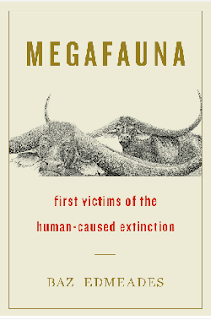
Megafauna Review


Megafauna is an important, fascinating, unforgettable, one-of-a-kind book.  It primarily focuses on prehistoric megafauna extinctions around the world, and how they happened.  Baz Edmeades (“ed-meedz”) has been working on this book for 20+ years, and it is impressively thorough.  His grandfather was a professor who found a unique human-like skull that was about 259,000 years old.

Megafauna are mammals weighing more than 100 pounds (46 kg).  Hominins are primates that walk on two legs, like you and I.  Hominins have been around for several million years.  Humans have been around for 250,000 to 400,000 years, depending on who you ask. 

During the last two or three million years, lots of megafauna species, all around the world, have moved off the stage forever.  Why?  A heated debate has been buzzing for 50+ years.  Was it an asteroid strike?  No evidence.  Were they zapped by diseases?  No evidence.  Was it climate change?  It probably strained some regional situations.  Was it human activities?  The evidence strongly supports this.  In 1966, Paul Martin presented his megafauna overkill theory (humans did it), which ignited big controversy in academia.  Edmeades became friends with Paul Martin, and learned a lot from him. 

Hominins originated in Mother Africa, where there used to be at least nine species of big cats (three today), nine types of elephants (one today), and four hippos (one today).  There were giant antelopes, giant hyenas, giant pigs, giant monkeys, and giant baboons — all gone.  Extinction spasms especially surged as humans wandered out of Africa, and gradually colonized the planet.  They migrated across Southern Asia, to Australia, then Eurasia, and finally the Americas. 

Paul Martin coined the misleading term “blitzkrieg overkill,” which angered quite a few folks.  As humans colonized new regions, the megafauna declined in number, in a process that could take a thousand years or more, multiple generations.  It was not a high-speed massacre.  These hunters were Stone Age people, using simple tools.  Many of the large game they hunted had low reproductive rates, which made them extremely vulnerable to extinction.

There is a clear pattern that when hunters migrated into continental land masses, stuff went extinct — except on uninhabited (human-free) offshore islands of the Mediterranean, Caribbean, and elsewhere.  On these islands, extinctions didn’t begin until humans eventually stepped ashore, sometimes thousands of years later.  Understand that offshore islands have a climate quite similar to the nearby mainland.  Climate was not a factor here.  Many of the megafauna species that blinked out had survived multiple ice ages over the passage of several million years.

In 2015, I stumbled across early sections of the Edmeades book online, and they blindsided me.  I never understood how incredibly alive this planet once was, and how tragically damaged it now is.  None of my teachers ever explained this, because they never learned it.  Our cultural myths celebrate the upward spiral of humankind’s brilliant achievements.  We live in a technological wonderland, not an ecological graveyard.  Life has never been better, and the best is yet to come.

The ancestors of hominins were originally tree dwellers.  Our closest living relatives are chimps, with whom we share 98.8 percent of our DNA.  Long ago, when the climate changed, and forests shrank, our ancestors were forced to survive as ground dwellers, a lifestyle for which evolution had not prepared them.

Over the course of several billion years, evolution has been a remarkable force that guided the journey of the family of life.  When frigid eras arrived, critters evolved fur coats.  When foxes became faster, evolution selected for faster bunnies.  It was a balancing act.  Foxes needed bunnies, and bunnies needed foxes.  The family of life was continuously fine-tuned at the speed of evolution, an extremely slow process.  Alterations could take many thousands of years.

Over millions of years, evolution provided giant tortoises with large bodies, invincible lion-proof shells, and long lifespans.  In the blink of an eye, these advantages were rubbished when hominins moved into the neighborhood, and began killing 200-year-old tortoises with big rocks.  This hunting method was not fine-tuned by evolution.  It was a sudden innovation that popped into the mind of a hungry hominin — and it worked!  Invincible tortoises were immediately transformed into helpless sitting ducks that didn’t have a bright future.  Evolution was yanked out of the driver’s seat.  Ancient rules no longer mattered. 

Hominin cleverness changed the world.  It made it far easier to grab essential resources, grow in numbers, and avoid becoming cat food.  Cleverness had the long term impact of an asteroid strike.  Cleverness enabled hominins to domesticate fire, plants, and animals.  We colonized the planet, developed industrial civilization, zapped the forests, polluted everything, and destabilized the climate.

Many folks in the human herd suffer from a blind faith that the miraculous power of cleverness can easily overcome all challenges.  Their vision is to keep our maximum impact way of life on life support, as long as possible, and hope for the best.  Edmeades presents no solutions, but this is a story that was important to tell.  He laments that cleverness “has given our species the power to transform the biosphere so profoundly that no other organism on this planet may get the opportunity of evolving it again.” 

His book does an excellent job of discussing the megafauna extinctions in an understandable way, with up-to-date information.  Its bitter medicine, and good medicine.  Many misperceive evolution to be a divine competition, in which species fight relentlessly to reach the top of the hierarchy, seeking to wear the Dominant Animal crown.  This pyramid-climbing quest for domination is the engine of civilization.  By the end of the book, you understand that evolution is more about adapting to changing conditions in a way that is as smooth and balanced as possible. 

Evolution has been the great friend of the family of life.  The Dominant Animal game has been its grim reaper.  While the wild megafauna are now sharply diminished, human-caused extinctions of many other species continue at an accelerating rate.  Cleverness never sleeps.  I’ve spent 69 years in a roaring hurricane of devastating cleverness.  Edmeades book reminded me that this planet was once a healthy and amazing living paradise.  Some of my genes have their roots in those good old days of abundant life.  That’s a comforting notion.

Edmeades, Baz, Megafauna: First Victims of the Human-Caused Extinction, Houndstooth Press, 2021.


Friday, November 12, 2021

Forest Rewrite

Greetings!  The following is a rewrite of samples 25 and 41.  They will be combined into one section and moved much later in the manuscript, before Sacred Energy.  One more step closer to the end!

 SACRED FOREST

As mentioned earlier, after the last Ice Age wound down, glaciers and ice sheets melted and retreated, eventually allowing the expansion of tundra, grassland, and forest.  Grassland spurred the momentum of the human experiment by boosting herds of game.  In wooded regions, hunting was more challenging, and forests interfered with the growth of trendy new fads like herding and farming.

This is why civilization emerged in the grassland regions of the Fertile Crescent, where wild wheat and barley grew in great abundance, as did herds of wild game.  Bountiful lands made living easier.  They also had a prickly habit of stimulating population increase.  The uncomfortable pressure of crowding and friction inspired some folks to envision escape.  Maybe they could create a more pleasant life in the forest frontier of Europe’s wild west.  Some of them packed up and left.

In Europe, Barry Cunliffe noted that as the climate warmed, wild folks migrated northward from the Mediterranean.  By 7000 B.C., they were present in a number of locations.  In lean regions they were nomadic, and in places of abundance they settled down.  At the same time, forests were also migrating northward, encouraged by the changing climate. 

By around 4000 B.C., forest expansion stopped, when it finally reached regions that were too chilly for happy trees.  By this time, folks were raising crops and herding livestock in a number of permanent settlements.  These communities were expanding their fields and pastures, which required murdering happy trees.

Over time, this increasingly abusive relationship between the two legs and the tree people led to tremendous destruction.  In the good old days, forests originally covered 95 percent of west and central Europe.  Jed Kaplan and team wrote a paper on the prehistoric deforestation of Europe.  It included stunning maps that illustrated the shrinkage of forests between 1000 B.C. and A.D. 1850. [Look]  Deforestation went into warp drive between 1500 and 1850, driven by the rise of colonization, industrialization, and other dark juju.  The voracious human swarm was swerving deeper and deeper into mass hysteria. 

Humankind’s war on forests has been intensifying for several thousand years.  It’s a huge and complex subject.  Forests have suffered from many impacts, including firestick farming, agriculture, herding, industry, warfare, construction, consumerism, climate change, and population growth.

In this chapter, I’ll share a few snapshots from the ripped and torn photo album of the relationship between two legs and the tree people. 

Humbaba’s Roar

The Fertile Crescent was where plant and animal domestication shifted into high gear.  It was in this region that the first civilizations began popping up all over, like a painful burning rash of deforestation, soil destruction, slavery, patriarchy, exploitation, aggression, self-destruction, etc. 

It’s interesting that the oldest known written story is the Epic of Gilgamesh, the saga of Gilgamesh, a lunatic king who ruled over the city of Uruk, located along the Euphrates River in Sumer (now Iraq).  By around 3100 B.C., Uruk was the biggest metropolis in the world.  Today, Uruk is a crude pile of brown rubble sitting amidst a desolate barren moonscape. [Look]  It has an important message for folks today: “Don’t live like we did.”  But humankind is a herd of sleep walkers, wandering lost in a foggy dream world.

The story was originally scratched into clay tablets in cuneiform script.  Over the course of 2,000 years, components of the story unified into a single narrative by around 1800 B.C.  In the story, King Gilgamesh was a lecherous slime ball who worked hard to expand low-tech, muscle powered, organic agriculture along the Euphrates River (a process now known as Sustainable Development™). 

Gilgamesh was probably a real king who lived somewhere between 2900 and 2350 B.C.  The growth of Uruk led to massive deforestation along the valley, which unleashed immense erosion and flooding.  In the story, Humbaba was the sacred defender of the forest.  Gilgamesh whacked his head off, and proceeded to cut trees like there was no tomorrow.  Rains then washed the soil off the mountains, down to bedrock.  And so, whenever the floods blast down the river, the noise of catastrophic destruction is referred to as “Humbaba’s roar.”  It’s the first sound I hear every morning.

Beyond Hunting and Gathering

Earlier, I jabbered about how some hunter-gatherer cultures used firestick farming to boost the availability of wild game and special plants.  This involved limiting forest, and encouraging the expansion of customized grasslands.  The tree people were never fond of this.  Over time, this expansion encouraged the intensification of farming, herding, civilization, industry, and aggressive deforestation. 

Other cultures used a different survival strategy, mindful self-control.  They understood the need to pay close attention to reality, to recognize the signs of approaching limits, and to avoid scarcity by adjusting current patterns.  Sometimes reproduction taboos were used to reduce the birth rate.  Mindfulness could avoid having an abusive relationship with the tree people, but modern society displays little interest in it.  It’s not good for jobs or the economy.

Let’s take a quick peek at the relationships that several cultures had with the tree people.  (Prehistoric dates are not certain, different sources cite different dates.)

Britain

When the glaciers of the last ice age began melting, sea levels were much lower than today.  England was connected by dry land to Ireland, Scandinavia, and continental Europe.  Barry Cunliffe noted that most of Western Europe essentially became a vast forest.  This expansion of forests displaced natural grazing land, which affected the abundance of large herbivores.

By 9000 B.C., hunter-gatherers had apparently made some small clearings in the forest to attract game.  By 6500 B.C., rising sea levels had made Britain an island, like it is today.  It was no longer connected by dry land to neighboring regions.  By 4500 B.C., when farmers and herders began to trickle in, Britain was largely a forest, except for the highlands.  Hunters dined on red deer, wild boar, aurochs, and so on.  By 3000 B.C., substantial clearances for cropland and pasture were increasing.  By A.D. 1100, just 15 percent of Britain was forest.  By 1919, it was five percent.  Britannia was essentially stripped naked, a ghastly painful open wound.

J. B. MacKinnon mentioned a story about Mark Fisher, a British scientist who visited the U.S.  From an overlook in the White Mountain National Forest, he could gaze down on 800,000 acres (323,748 ha) of woodland, an overwhelming experience.  He burst into tears and had a long, hard cry.  At Yellowstone, he saw wolves in the wild for the first time, and he dropped to his knees.  Fisher dreams of rewilding the U.K. — introducing long lost critters like beavers, lynx, wolves, and so on.

Ireland

The story in Ireland was similar to Britain in many ways, but Ireland got much more rainfall, annually receiving 50 to 200 inches (127-508 cm) of precipitation.  The wet climate encouraged the growth of lush temperate rainforests.  Frederick Aalen noted that early hunter-gatherers arrived about 8,000 years ago, when the isle was covered with a dense unbroken forest.  Folks lived along coastlines, lakes, and streams.  In the forest they created some openings to attract game, but these were apparently small in scale.

Then came a paradise-killing event of dark juju.  Farmers and herders began arriving around 3500 B.C., and the war on trees commenced.  By the end of the 1600s, the destruction of native forests was nearly complete.  When Aalen wrote in 1978, only three percent of the island was occupied by natural forest or tree farms. 

Deforestation had many unintended consequences.  William MacLeish noted that in the good old days, the rainforest wicked up a lot of moisture from the land, and then released it into the passing breezes, which carried it away.  When the trees were gone, this dispersal process wheezed.  Meanwhile, the Gulf Stream faithfully continued delivering warm rainy weather from the Caribbean.  So, the heavy rain continued, and the water remained where it landed.  Consequently, water tables rose, bogs spread, and the ground turned acid.

Deforestation blindsided the rainforest ecosystem.  The new manmade grassland ecosystem seemed to be a perfect place for raising enslaved livestock.  Winters were mild, the grass was green all year, and there was no need to grow, cut, and store hay for winter feed.  Barns were not needed to protect livestock from the cold.  Milk and meat were available all year round.  Herding worked well, but the very rainy climate made it rather risky to grow grain, despite the rich soils.

In A.D. 1185, King Henry II sent Giraldus Cambrensis to visit Ireland and produce a report.  He mentioned many beautiful lakes, where some of the fish were larger than any he had ever seen before.  Common freshwater fish included salmon, trout, eels, and oily shad.  Along the coast, saltwater fish were abundant.  The woods were home to “stags so fat that they lose their speed.”  There were numerous boars and wild pigs.  Wolves had not yet been fully exterminated.  He said it was common to see the remains of extinct Irish elks.  Their remains were usually found in bogs, often in groups.

The herding life allowed the Irish people to survive, sing, and dance.  They did not have the slightest interest in the dreary backbreaking work of agriculture, a stupid fad.  Cambrensis felt great pity for the uncivilized natives.  “Their greatest delight was to be exempt from toil, and their richest possession was the enjoyment of liberty.”

Maximum Security Forests

Rhineland

Julius Caesar roamed around Western Europe and wrote a report in 51 B.C.  He was the emperor of Rome, and his mission was to expand the Empire, collect tribute payments, acquire military conscripts, and vigorously spank uncooperative subjects.  During this campaign, he focused his attention on provinces of Celtic people in what is now France, Belgium, and England. 

He had also hoped to conquer the wild Germanic tribes that lived on the east side of the Rhine, but this fantasy promptly came to an end.  The Rhine was a large, treacherous, swift moving river.  No bridges.  It took a lot of effort and luck to get from one side to the other, and once you set foot on the German side, a super violent welcoming party was eager to immediately cut you to bloody bits.  

Each tribe preferred to keep their homelands surrounded with a barrier of uninhabited wilderness.  The Germans were primarily wandering herders who built no permanent settlements.  They had no granaries loaded with valuable food for raiders to swipe, and no roads to make invasions quick and easy.  When danger threatened, the people and their herds vanished into the deep forest mists.

For the German herders, nothing would have been dumber than to eliminate the vast ancient forests that provided this security system.  The Roman legions were fine-tuned for open battlefield combat, where heavily armored lads attacked in rigid formations.  Wild Germanic tribes excelled at hit-and-run guerilla warfare.

On the west side of the Rhine were the Celts of Gaul (France), who were subjects of the Empire.  Their forests were mostly gone, roads crisscrossed the land, and folks were forced to engage in the backbreaking misery of muscle powered organic agriculture.  Their granaries stored the result of months of hard work. 

Stored grain was treasure that villainous raiders found to be irresistibly tempting.  It was impossible for farmers to hide or quickly move their treasure.  Raiding was popular, because it was much easier than honest work.  Consequently, highly vulnerable farm communities required constant military protection, for which they had to pay dearly.  In several Western European languages, the words for “road” and “raid” evolved from a common root. 

So, the Celts that Caesar described did not reside in the primordial forest that their wild ancestors once enjoyed.  They were the opposite of wild and free.  Peasants were essentially wealth generating livestock controlled by local strong-arm elites.  On the east side of the Rhine, the Germanic tribes had not destroyed their forests.  They were alive and well, wild and free.

Tacitus was a Roman historian who wrote Germania in A.D. 98 (150 years after Caesar).  It described several fiercely independent tribes of that era.  They preferred the thrills and excitement of raiding to the drudgery of farming.  “They even think it base and spiritless to earn by sweat what they might purchase with blood.”  Perhaps they learned this effective and profitable strategy from the Romans. 

Tacitus wrote a fascinating description of the vast Hercynian forest.  From the Rhine, it spanned east, across modern Germany, to the Carpathians, and all the way to Dacia (Romania).  A quick traveler could cross the forest north to south in nine days, but it was very long, from east to west.  Caesar noted, “There is no man in the Germany we know who can say that he has reached the edge of that forest, though he may have gone forward sixty days’ journey, or who has learnt in what place it begins.” 

Pliny also mentioned it:  “The vast trees of the Hercynian forest, untouched for ages, and as old as the world, by their almost immortal destiny exceed common wonders.”  In those days, there were still a number of primeval forests in the world. 

Scandinavia

In Sweden, forests also provided freedom and security for the common folks.  Vilhelm Moberg celebrated the fact that peasant society in Sweden had largely remained stable and functional for 5,000 years.  In most of the regions of Europe, peasants endured many centuries of misery under the heavy fist of feudalism.  Many Norse and Swede settlements were lucky to be protected by their vast, dense, rugged, roadless forests.  It’s simply impossible to kill or rob invisible folks who live in unknown wilderness settlements.  Moberg glowed with gratitude for his nation’s forests, which allowed the rustic peasants to preserve their freedom until the industrial era metastasized.

Aggressive invaders from elsewhere found no roads, and soon became perfectly lost.  Behind every bush might be a man with a crossbow.  The local folks knew every hill and rock in the woods.  They could pick the ideal time and place to strike.  When trouble was advancing, they gathered as many belongings as possible, and vanished into the greenery.

My Norse ancestors told the story of Ragnarök, the twilight of the gods.  Some creepy gods had temporarily subdued nature, but in this great battle, the forces of nature rubbished the gods, and cleansed the Earth with a great flood.  Peter Andreas Munch described the dawn of a new era: “Out of the sea there rises a new earth, green and fair, whose fields bear their increase without the sowing of seed.” 

A man and woman survived.  From them sprang a new race of people.  A few minor deities also survived.  One was Vidar, a son of Odin (Viðr means forest).  Vidar was known for being strong.  His home was in a vast and impenetrable forest.  Rasmus Björn Anderson wrote that Vidar was the god of wild primordial forests, where neither the sound of the ax, nor the voice of man, was ever heard.  He is silent, dwells far away from, and exercises no influence upon, the works of man, except as he inspires a profound awe and reverence.  This was a culture filled with a deep respect and reverence for creation, in its wild and unspoiled form.  Forests were holy places. 

Forest Mining

In the transition from hunting and gathering to farming and herding, forests had served as a limit to growth — grain, grass, and herds don’t thrive in shady places.  Deforestation cleared away the towering giants and let the sunbeams shine in.  When metal axes came into common use, lumberjacks could reduce vast tracts of primeval forest into rotting stumps and erosion gullies.  Early villages and cities were built with the mutilated carcasses of countless tree people.  The rise of civilizations would not have been possible without innovative advances in unsustainable forest mining and soil mining. 

George Perkins Marsh was a brilliant American hero that few modern folks have heard of.  He published Man and Nature in 1864.  This gentleman from Vermont served as the U.S. Minister to Italy.  While overseas, he visited the sites of many once thriving civilizations in the Fertile Crescent.  What he observed was terrifying and overwhelming.  Each of them had seriously damaged their ecosystems and self-destructed in similar ways.

Massive levels of soil erosion created surreal catastrophes.  He saw ancient seaports that were now 30 miles (48 km) from the sea.  He saw ancient places where the old streets were buried beneath 30 feet (9 m) of eroded soil.  He stood in mainland fields, 15 miles (24 km) from the sea, which were formerly located on offshore islands.  He saw the sites of ancient forests, formerly covered with three to six feet (1-2 m) of precious living soil, where nothing but exposed rock remained. 

Far worse, Marsh was acutely aware that every day, back home in America, millions were currently working like crazy to repeat the same mistakes, glowing with patriotic pride at the temporary prosperity they were creating on their one-way joyride to oblivion.  In a noble effort to cure blissful ignorance, he fetched pen, ink, and paper and wrote a book to enlighten his growing young nation.

Sales were respectable for a few decades, but America did not see the light and rapidly reverse course.  Folks thought that the cure was worse than the disease (like today’s climate emergency).  A radical shift to intelligent behavior would not have been good for the highly unintelligent lifestyle.  Tom Brown’s mentor, Stalking Wolf, lamented that our culture was “killing its grandchildren to feed its children.”

Marsh’s book has stood the test of time fairly well.  It presented a wealth of vital information, none of which I learned about during 16 years of education.  Forests keep the soil warmer in winter, and cooler in the summer.  Springtime arrives later in deforested regions, because the land takes longer to warm up.  Forests absorb far more moisture than cleared lands, so after a good rain, runoff is limited, and flash floods are less likely.

Deforestation dries out the land.  Lake levels drop, springs dry up, stream flows decline, and wetlands are baked.  Back in the fourth century, when there were more forests, the water volume flowing in the Seine River was about the same all year long.  When Marsh visited 14 centuries later, water levels could vary up to 30 feet (9 m) between dry spells and cloudbursts.  In 1841, not a drop of rain had fallen in three years on the island of Malta, after the forest had been replaced with cotton fields.  And on and on.  The book is a feast of essential knowledge. 

Walter Lowdermilk was deeply inspired by Marsh’s work.  In the 1920s and 1930s, he visited China, Western Europe, North Africa, and the Middle East.  His mission was to study soil erosion, and write a report for the U.S. Department of Agriculture.  They created a short booklet that was very readable and filled with stunning photographs.  Over a million copies of it were printed.  Conquest of the Land Through Seven Thousand Years is available as a free download. [Link]

Industrial Wood

Marsh generally discussed the environmental impacts of deforestation that he had observed at the sites of extinct or wheezing civilizations.  These catastrophes were usually the unintended consequences of clearing forest to expand cropland or grazing land.  Over the passage of centuries, clever people discovered many new ways that dead trees could be used to generate wealth and power. 

John Perlin wrote an outstanding history of deforestation.  It’s a modern book (1989), and much easier to read than Marsh.  It devotes more attention to the political, military, industrial, and commercial motivations for forest mining.  It visits locations including Mesopotamia, Crete, Greece, Cyprus, Rome, Venice, England, Brazil, and America. 

Dead trees were used to build houses, bridges, temples, and palaces.  Wood was made into fences, docks, wagons, furniture, tools, and barrels.  It heated homes and fueled industries that produced metal, glass, bricks, cement, pottery, lime, sugar, and salt.  Staggering quantities of wood were consumed by industry.  Very importantly, wood was used to build cargo, fishing, and war ships.  Navies sped the spread of colonies, empires, trade networks, and epidemics.

Cultures that mindfully limited their numbers, and continued living in a low impact manner, had no future.  Their thriving unmolested forests looked like mountains of golden treasure in the eyes of civilized sailors cruising by — and civilized people cannot tolerate the sight of unmolested forests; it drives them nuts.  In other words, if you didn’t destroy your forest, someone else would. 

Perlin described the copper industry on Cyprus in around 1300 B.C.  Copper was used to make bronze, which was in high demand during the Bronze Age.  For each 60 pound (27 kg) copper ingot produced, four acres of pine (120 trees) had to be reduced to six tons of charcoal.  Each year, the copper industry on Cyprus consumed four to five square miles (10-13 km2) of forest.  At the same time, the general society consumed an equal amount of forest for heating, cooking, pottery, lime kilns, and so on.  Can you guess what inevitably happened to the forests, soils, industry, and affluence of Cyprus?

Shortages also affected the use of firewood.  In chilly regions, a city of one square mile might depend on 50 square miles of forest to provide the firewood it consumed year after year.  In the good old days, this was often possible.  Later, as forest area decreased, and population grew, limits spoiled the party.

If Perlin’s work sounds interesting, but you can’t get his book, a similar book is available as a free download.  In 1955, Tom Dale and Vernon Gill Carter published Topsoil and Civilization.  Readers are taken on a neat journey, during which they discover how a number of ancient civilizations destroyed themselves.  The free PDF is HERE.  It is not available in some countries, for copyright reasons, but I once saw a pirate copy on Google.

New World Forest

Richard Lillard described how early European visitors experienced the ancient forests of North America.  When standing on mountaintops, they were overwhelmed by the fact that as far as they could see in any direction there was nothing but a wonderland of trees.  The intense experience of perfect super-healthy wildness was surreal, overwhelming, almost terrifying. 

Walking beneath the canopy at midday, the forest floor was as dark as a cellar, few sunbeams penetrated through the dense foliage.  At certain times, some sections of the forest were absolutely silent, a spooky experience that bewildered the white folks.  They saw vast numbers of chestnut trees that were nearly as big as redwoods. 

British visitors to early settlements were stunned to see amazing luxury — wooden houses, sidewalks, fences, and covered bridges!  Commoners were free to hunt large game because the forest was not the exclusive private property of anyone.  In the old country, their diet majored in porridge.  Now it could major in wild grass-fed meat.  Commoners were free to cut as much firewood as they wished, and keep their cottages warmer than the castles of royalty.  Michael Williams mentioned one winter night when the king of France sat in his great hall.  He was shivering as he ate dinner, the wine in his glass was frozen. 

William Cronon noted that settlers with sharp axes went crazy on the forests, cutting them down as if they were limitless.  Lots of excellent wood was simply burned, to clear the way for progress.  They built large houses, and heated them with highly inefficient open fireplaces.  By 1638, Boston was having firewood shortages.

As clearing proceeded, summers got hotter, and winters colder.  As stream flows dropped in summer, water-powered mills had to shut down, sometimes permanently.  In winter, upper levels of the soil froze solid on cleared land, and snow piled up on top of it.  When springtime came, the frozen land could not absorb the melt, so the runoff water zoomed away, and severe flooding was common.

Stewart Holbrook wrote about the fantastically destructive obliteration of ancient forests in the U.S. upper Midwest.  On the same day as the great Chicago fire, October 8, 1871, a firestorm obliterated the backwoods community of Peshtigo, Wisconsin, killing five times as many people as in Chicago.  On this day, the new word “firestorm” was added to the English vocabulary. 

Holbrook interviewed John Cameron, an eyewitness to the Peshtigo fire.  Cameron noted that there had been little snow the previous winter, and just one rain between May and September.  Streams were shallow, and swamps were drying up.  Logging operations left large amounts of slash in the woods (piles of discarded limbs and branches).  Slash piles were eliminated by burning, even when it was very hot, dry, windy, and extraordinarily stupid. 

The morning of October 8 was hotter than anyone could remember, and the air was deadly still.  At noon, the sun disappeared.  By nightfall the horizon was red, and smoke was in the air, making their eyes run.  At 9 P.M., Cameron heard an unusual roaring sound.  The night sky was getting lighter by the minute.  A hurricane force wind howled through.  Suddenly, swirling slabs of flames were hurtling out of nowhere and hitting the bone dry sawdust streets.  In a flash, Peshtigo was blazing — maybe five minutes. 

Cameron saw horses, cattle, men, and women, stagger in the sawdust streets, then go down to burn brightly like so many flares of pitch-pine.  He winced when he spoke of watching pretty young Helga Rockstad running down a blazing sidewalk, when her long blond hair burst into flame.  The next day, he looked for her remains.  All he found was two nickel garter buckles and a little mound of white-gray ash.

The river was the safest place that night.  People kept their heads underwater as much as possible, so the great sheets of flame wouldn’t set their heads on fire.  Within an hour, the town was vaporized.  Big lumberjacks were reduced to streaks of ash, enough to fill a thimble.  In this village of 2,000, at least 1,150 died, and 1,280,000 acres (518,000 ha) went up in smoke.

Also on October 8, 1871, numerous big fires raged across the state of Michigan, where it had not rained in two months.  These fires destroyed 2.5 million acres (1 million ha) — three times more timberland than the Peshtigo blaze.  This was an era of countless huge fires.  For example, in just the state of Wisconsin, tremendous fires destroyed huge areas in 1871, 1880, 1891, 1894, 1897, 1908, 1910, 1923, 1931, 1936.

Paul Shepard wrote, “Sacred groves did not exist when all trees were sacred.”  In 1990, I chatted on an internet bulletin board with a Shawnee man named Nick Trim.  He talked about a project 300+ years ago, along the Mississippi.  In a kindly gesture, some French soldiers were teaching the Shawnee how to build log cabins.  This required cutting trees.  The natives were very nervous about chopping down living trees, because they were often home to spirit beings, the little people.

To avoid spiritual retaliation, a respectful process was essential.  They knocked on each tree, described the situation, and explained why they wanted to take lives.  This was followed by a ceremony, prayers, and apologies to the trees.  Then they waited a day or so, to give any spirit residents adequate time to find a comfortable new home.  This took so long that the French lost their patience, and the project ended.

Peter Wohlleben, a German wood ranger, developed an extremely intimate relationship with the forest he cared for, and wrote a precious celebration of his love for it.  Modern folks who spend most of their lives in civilized space stations almost never get to know the tree people.  Some do not eat meat because they sense that animals have souls.  In an interview, Wohlleben conveyed a deeper understanding.  Killing an animal is the same as killing a tree.  He once oversaw a plantation of trees lined up in straight rows, evenly spaced.  It was a concentration camp for tree people.