Showing posts with label language. Show all posts

Monday, March 15, 2021

Wild Free and Happy Sample 54


[Note: This is the fifty-fourth sample from my rough draft of a far from finished new book, Wild, Free, & Happy.  The Search field on the right side will find words in the full contents of all rants and reviews.  These samples are not freestanding pieces.  They will be easier to understand if you start with sample 01, and follow the sequence listed HERE — if you happen to have some free time.  If you prefer audiobooks, Michael Dowd is in the process of reading and recording my book HERE.

[Continued from sample 53]

BEING WILD, FREE, AND HAPPY!

We live in interesting times.  Bunnies aren’t acidifying the oceans.  Salmon aren’t blindsiding the climate.  Geese aren’t nuking rainforests.  Even our closest relatives, the chimps and bonobos, remain absolute champions at sustainable living.  Today, much of humankind has become disconnected from our wild, free, and happy roots.  The rest of the family of life is not amused.

Many folks believe that electric cars are environmentally harmless, and that miraculous technology will certainly stop and reverse the Climate Crisis.  Other folks, the wee minority who pay close attention to the eco-related news feeds, are more inclined toward anger, grief, and haunting premonitions of extinctions.  They perceive that our culture is a runaway steamroller destined to smash everything in its path.

Big Mama Nature is strong, fiercely determined, and invincible.  She is the spirit of life, and its sacred guardian.  She’s glad to see that the planet-thrashing catastrophe is accelerating to its exit.  Maybe its speedy demise could prevent many extinctions.  Rust in peace, and good <bleeping> riddance!  When the storms have passed, Big Mama will still be standing tall and proud amidst the smoldering ruins, nurturing the recovery of what was lucky to survive.

Some folks seriously wonder if the human species is fatally flawed, a goofy divine booboo.  There are cultures that live like hurricanes, and others that walk softly.  History repeatedly assures us that wrecking ball cultures eventually rubbish their resource base and blink out.  Those cultures are indeed ridiculous, fatally flawed, dead ends, and the impacts of their lifestyle harm the entire family of life.  Sadly, they also have a long tradition of brutalizing lower impact cultures.

At the beginning of this long and meandering word dance, I promised to serve you stories that contemplate how things got to be this way.  I promised to propose zero miraculous solutions.  Well into the writing process, I became spellbound by an exceptional culture whose simplicity and sustainability have been highly polished by centuries of heavenly isolation.  They are not fatally flawed.  So, I need to take a side trip here, and share a bit of their story.

Pirahã

I’m delighted to introduce you to the Pirahã (pee-da-ha) people of the Amazon rainforest.  They are hunter-gatherers who live in a few jungle villages near the Maici River in northwestern Brazil.  Estimates of their population range up to 800.  The outer world mostly knows about them via the work of Daniel Everett, who first met them in 1977. 

In the beginning, he had been a missionary and linguist on a mission from God to learn their language, translate the Bible, and inspire the salvation of their damned souls.  His project was nearly derailed by the fact that their language had absolutely nothing in common with any other in the world.  They were able to effectively communicate via speaking, singing, humming, and whistling.  When hunting, whistles were less likely to spook monkeys and other game.  Whistled words allowed conversations between folks who were not close together.  When Dan was present, private conversation shifted to whistling.

To help you get to know the Pirahã, let me toss out some snips and notes from assorted sources.  They hunted, fished, and foraged.  Fish provided about 70 percent of their diet, and the combo of fishing and hunting provided up to 90 percent.  Manioc was recently introduced to them by Steve Sheldon, the linguist whom Everett replaced.  Scraggly manioc plants sometimes grew in small weedy patches, and their food production was miniscule.  They did not depend on this food.

The Pirahã knew the usefulness and location of all important plants in their area.  They understood the behavior of local animals, and how to take them, or avoid them.  They could walk into the jungle naked, with no tools or weapons, and walk out three days later with baskets of fruit, nuts, and small game.  By the age of nine, all of them were capable of surviving in the jungle on their own, feeding themselves and making shelter.  They were at peace with their ecosystem because they knew how to live in it.  Their faith was in themselves. 

The Pirahã had no leaders, or social hierarchy, all were equal.  It was taboo to tell someone to do something.  Violence, anger, and shouting were unacceptable.  They were amazingly content, tolerant, and patient.  Children were never spanked or given orders.  They were free to play with sharp knives.  Adults spoke to them as equals, no baby talk. 

They often chitchat about daily events and personal affairs, but they were not storytellers.  They have no cultural folklore, legends, fables, or worship.  Everett wrote, “Committed to an existence in which only observable experience is real, the Pirahã do not think, or speak, in abstractions.”  He suspects that they may be the only group in the world that has no numbers, and no creation myth.  They have no concept of sin, punishment, or god.  Nor do they fear death or evil spirits.  Belief in evil spirits is common among groups of farmers or herders, where a year’s work can be lost suddenly via bad luck.  Fishers and hunters, on an unlucky day, were more likely to lose no more than a day’s work.

The people were remarkably easygoing and infectiously happy.  They wore bright smiles, and laughed about everything.  Folks from the outer world were often astonished to be among people who were sunbeams of happiness.  A visiting psychologist, amazed by their joy, said, “The Pirahãs look the most happy of all the people we ever saw; they laugh the most of all the populations we have seen.”

In the tribe, memories of ancestors or historic events were not preserved, they evaporated.  The distant past and future were off the radar of their here and now worldview.  Their realm of reality was limited to stuff that they could personally see or hear, or things seen or heard by their living parents, grandparents, friends, and kinfolk.  History was strictly limited to living memory.  Folks didn’t worry about what happened yesterday, or what might happen tomorrow.  They had no word for worry.  They lived entirely in the here and now. 

Origins

The Pirahã have a misty past, and it will likely remain misty.  Archaeologists estimate that they arrived in the Amazon at least 10,000 years ago.  Earlier, they were a subgroup of the Mura people, but they separated from them in 1714, when annoying colonists fell out of the sky, disturbing the peace.  Most of the Mura learned Portuguese and got closer to the Brazilian culture.  The Pirahã said screw this, moved deep into the jungle, and eventually settled along the Maici River, where a passing Portuguese missionary mentioned them in 1784. 

Everyone’s ancient ancestors originally evolved on African savannahs.  As they expanded around the world, grasslands were their preferred habitat, because they could be primo hunting grounds.  Thousands of years ago, when wild hunter-gatherers from Eurasia first arrived in the Amazon, they were happy to find, kill, and eat a variety of delicious large herbivores.  At some point during this era of migration and expansion, we aren’t sure when or how, the ancestors of the Pirahã also arrived in the Amazon region.

In 2020, news stories announced the discovery of tens of thousands of ice age rock paintings in the Amazon rainforest of Colombia (Article) (Video).  They were found on an eight mile (13 km) stretch of cliff face that was sheltered from the rain.  Images date from 12,600 to 11,800 years ago, when humans were busy colonizing North and South America. 

This was about the time that a megafauna extinction spasm was underway.  The rock painters could have never imagined how generations of low intensity overhunting might gradually lead to devastating irreversible impacts (modern highly educated folks are no less shortsighted and clueless).  In the years of feasting on fantastic abundance, they expressed jubilant celebration in their art.  Life is grand!  Yum!

Today, the Amazon rainforest is dense jungle, where it hasn’t been obliterated by loggers, miners, farmers, and ranchers.  The region was much different when the painters worked.  In those days, a warming climate was transforming the ecosystem.  A patchwork of savannahs, trees, and thorny scrub was in the process of shifting into today’s leafy tropical rainforest.  Among the cliff portraits were extinct horses, mastodons, camelids, and giant sloths.  These were not jungle critters. 

The Pirahã were super lucky.  Long before the invasion of pale faced space aliens with swords, axes, and smallpox, the rainforest had time to become well established in the Amazon basin.  It created a moist tropical climate that nurtured the survival of dense jungle.  This lush habitat was not suitable for herds of large herbivores, hunters of large game, livestock herders, or food producing soil miners.  Fish was their primary source of nutrients, and it was available year round.  The daily catch was promptly consumed, to avoid spoilage, or losses to hungry nonhuman neighbors.

The ecosystem was also home to black caiman, jaguars, giant anaconda, schools of piranha, venomous snakes, malaria, and other life threatening challenges.  Roadless jungle largely prohibited overland travel, which discouraged visits from uninvited outsiders.  This worked pretty well for a very long time.  Obnoxious neighbors can be a bloody pain in the ass.

In recent years, when the Brazilian government began providing the Pirahã with food from outer space, folks got fat.  Upon receiving sugary junk food, kids began getting tooth decay.  Folks now have a village generator, lights, a TV, and clinic.  They have a school where the kids are taught math and Portuguese.  And so on.  It would be awesome if the government instead directed their attention to protecting the rainforest, punishing the swarms of two-legged eco-terrorists, and teaching Brazilian kids ecology and environmental history.

The traditional Pirahã culture generated wastes that were biodegradable, no landfill needed.  It’s important to remember that they already had a way of life that worked perfectly, was not self-destructive, and could not be improved by increased exposure to troublesome stuff from outer space — exotic cultures, technology, beliefs, habits, diseases, etc.  They enjoyed living in a stable, low impact, time-proven culture where everyone shared the same belief system, and folks smiled and laughed a lot.  What could possibly be more terrible?

Missionary Work

In the beginning, after three years of tedious struggle, Everett finally became fluent in the Pirahã language.  He translated the Gospel of Mark, and shared it with some natives.  He had no doubt that the Bible was so spiritually powerful that anyone exposed to it could not help but be overwhelmed by its truth, and inspired to rush toward a heaven-bound path.  Well, the natives were fascinated by the bit about John the Baptist getting his head cut off, but nothing else had any effect on them whatsoever.

His holy objective had been “to convince happy, satisfied people that they are lost and need Jesus as their personal savior.”  A traditional missionary proverb says, “You’ve got to get them lost before you can get them saved.”  Everett told them that Jesus could deliver them from fear, and lead them to a good life.  But they didn’t live in fear, and they already enjoyed an excellent way of life. 

Another missionary proverb says that “everyone has a god-shaped hole in their heart,” but the Pirahã apparently had whole hearts.  None were converted despite decades of effort.  They were empirical people who expected compelling here-and-now evidence.  Notions from unknown times, places, or people were beyond their realm of reality — perfectly meaningless nonsense.

Everett had never met Jesus, because Jesus lived 2,000 years ago.  He often tried to tell the Pirahã about Jesus, but stumbled.  They asked, “Did you see him yourself?”  “No.”  “So why do you tell us about things that you have never seen?”  Another time, when he read them names from his translation of the Gospel of Luke, they assumed that these were people that Everett knew.  When he described crucifixion, they were aghast.  It was beyond comprehension.  Did Americans really do that?  This information was from outer space, not here-and-now reality.

In addition to his religious role, Everett was also a linguist, a science-based field.  The scientist in him deeply respected the importance of trustworthy evidence.  As the river of time flowed past, Everett began to question his right to tell them about ancient supernatural miracles that he had not seen with his own eyes.  He believed they were true.  Of course, believing anything makes it true, but “truth” is a slippery rascal that can cast powerful spells, and open trap doors.  He loved the Pirahã, and they loved him, but they had no interest in Jesus, and finally told him so.  This was truly a sharp metaphysical rebuke.

By around 1982, he began having uncomfortable visits from doubt fairies, and these increased with every passing month.  By 1985, the fairies had become a nonstop whirling cloud of fluttering wings.  Finally, there came a day when he was able to summon the power to see beyond the stone wall of his beliefs.  A miracle happened — the mission’s first spiritual conversion.  His old life had become unbearable.  He could never accept that they were lost and going to hell.  “I would go so far as to suggest that the Pirahãs are happier, fitter, and better adjusted to their environment than any Christian or other religious person I have ever known.” 

He remained a closet atheist until the late ’90s, at which point he came out, and his wife and three children abandoned him.  By 2008, the banishment had ended.  In a 2015 interview, he noted that his son had also been awakened by doubt fairies, and that his ex-wife continued her holy efforts to save the Pirahã. 

Webs and Cleverness

Unlike the Pirahã, I wake up every morning in an apartment with hot and cold running water, electricity, refrigerator, stove, flush toilet, heater, computer, phone, book collection, etc. — decadent luxuries for idle rich folks confined in maximum impact societies.  Outside my window is a busy industrial city, streets rumbling with thousands of motorized wheelchairs.  It’s an outpost of a global civilization that’s maniacally devouring resources, pooping out mountains of waste, blindsiding the climate, and racing to oblivion.

In bed, as I wake up, I turn on the radio for an hour or two of morning news.  Every day, there is abundant evidence that much of the world is out of its mind — tsunamis of bullshit, mass hysteria, and countless conflicts.  I think about the Pirahã, who are also getting up, smiling and laughing, down by the river, welcoming the beginning of a new day.  Same species, same morning, same planet.  They have not forgotten who they are, or how to live.

Earlier, I talked a bit about human webs, associations of people that shared a similar knowledgebase.  The U.S. is in the Old World Web, a patriarchal farmer-herder culture that likely originated in Mesopotamia, and eventually grew in all directions.  It’s now found almost everywhere, with a dwindling number of backwater exceptions, like Pirahã country.

I’ve talked about how humans evolved on African savannahs, and eventually expanded around the world, long before the advent of agriculture and herding.  Humans have traditionally had a strong preference for grassland and tundra ecosystems, because they are prime habitat for large herbivores, a highly preferred food source.  Open country made it easier to see both hungry man-eating predators, and delicious herds of walking meat.  Over the centuries, vast regions of forest have been cleared to create grassland openings attractive to herds of grazing animals.

Open grasslands also made overland travel relatively easy.  There were thousands of miles of Silk Road routes.  By making long distance travel more convenient, they also encouraged the long distance exchange of seeds, commodities, ideas, and technologies.  Cleverness can be highly infectious and contagious.  When a clever idea from one culture smacks into a different culture for the first time, the collision can set off a snowballing chain reaction of brilliant, highly destructive foolishness.  For example, when knowledge of the Chinese substance we call gunpowder arrived in Europe, it sparked an explosion of innovation, which soon began generating mountains of mutilated corpses.

Epidemics of cleverness can trigger bloody competition for resources.  In these conflicts, the groups with superior cleverness tend to have the advantage.  Winners are able to grab more, feed more, fight more, enslave more, rape more, and hoard more.  It’s essential for clever wizards to pay close attention to the jungle drums of innovation, because the cutting edge is a moving target.  Great empires were never built by sleepy half-clever societies.

Living in the wholesome isolation of their rainforest, the Pirahã have not domesticated plants or animals, built cities and civilizations, developed industries, obliterated the trees, conquered neighbors, or invented automobiles and cell phones.  Their cleverness was invested in carefully mastering the art of sustainable survival, which was all they ever needed.

Diversity

In a 2007 interview, Everett said that his initial impression of Pirahã culture was that it was colorless and disappointing.  “But then I realized that this is the most intense culture that I could ever have hoped to experience.  This is a culture that’s invisible to the naked eye, but that is incredibly powerful, the most powerful culture of the Amazon.  Nobody has resisted change like this in the history of the Amazon, and maybe of the world.”

To him, the Pirahã success in resisting change seemed miraculous and otherworldly.  How was it possible that a society so healthy and happy could still survive in the twenty-first century?  It was stunning to see.  I’m not sure that resistance was the key factor here.  Isolation was probably what benefitted them most.  They had very little contact with clever people from elsewhere who had bad habits, odd tools, dark impulses, and heads slithering with brainworms. 

Everett was born and raised in California, where his cultural programming conditioned him to believe that innovation was the golden path to a better tomorrow.  This path was not focused on living in harmony with the ecosystem.  California culture is a highly diverse hell-broth of constantly clashing races, religions, classes, fads, and politics.  A better tomorrow is about more jobs, more income, more consumption, more landfills, and keeping your head above water in the ever changing currents.

In a 2017 essay, Everett praised diversity, because we learn far more (for better or worse) when we are around people who are different from us.  The more we learn, the more innovative we can become.  If we live among people who are just like us, we’re not going to learn much.  In a 2008 interview, he said that his biggest personal desire was to be able to learn faster.  He had a very busy mind.

Back in 1977, when he first fell out of the sky in Pirahã country, he landed in a living paradise of jungle diversity that bore no resemblance to California.  This diversity was ecological, not human, and it was overwhelmingly healthy.  He could have spent the rest of his life learning about the rainforest, and becoming one with it. 

Everett was once asked if an outsider could ever become fully integrated in the Pirahã culture.  He said that he could not, and had never met anyone who could.  “It requires tremendous knowledge of the jungle and its flora and fauna, as well as toughness that one rarely finds among outsiders.”  A complicating factor was his wife and three kids, who would not be eager to join a mind-expanding adventure in do-it-yourself rewilding.  If he abandoned mission work, he would lose his lifeline — and you and I would now know nothing about the Pirahã.

In 1999, when he returned to the Pirahã world from a side trip to outer space, he did not gather vegetation and build a lovely hut.  Instead, he unloaded 14 tons of ironwood from a boat, and built a two room dwelling.  It had a gas stove, freezer, water filtration system, TV, and a DVD player.  It was designed to ban the entry of bugs and snakes.  This pleased his wife and three kids.

Three Modes of Society

As mentioned earlier, Jon Young has devoted his life to promoting nature connection, because without connection, we are lost and confused critters.  He spent time with the San people of the Kalahari who had a deep spiritual connection to their land.  He said that they had perfect posture, and that their mental health factors are all positive.  They were super-happy, super-vital, and totally connected from birth to death.  In our society, maybe one in a thousand adults has connection.  Youngsters often have it, but it usually dies in the teen years, as they move into the cultural fast lane, into the realm of glowing screens and steaming hormones.

Colin Turnbull, in his most daunting book, compared the lovely wild society of Mbuti pygmies to the Ik tribe of Uganda, who were in a heartbreaking death spiral.  They had been banished from their ancient hunting grounds by the creation of a national park, and were expected to become farmers during a long and devastating drought.  Their traditional society was rapidly disintegrating, as many perished from starvation, and empathy went extinct.  The Ik reminded him of Western society, where growing de-socialization was also underway.  The Ik seemed like a spooky preview of where we were headed.

Like the Mbuti culture, Pirahã society was also held together by strong social bonds.  Their way of life depended on the complete cooperation of everyone, male and female, young and old.  This was possible because they lived in small intimate groups, where all were kin or friends, and everyone shared the same beliefs and values.  Their way of life echoed the original human blueprint.  They had no need for laws and cops.

For the Ik, family relationships had rotted, and society degenerated into a mob of self-centered individuals.  Western cultures can also be madhouses of rabid dog-eat-dog individualism.  We strive to achieve personal goals via competition for personal advancement.  We frequently suffer from the painful friction of diversity.  Our morals, values, lifestyles, ethnicities, and religious beliefs are all over the place, and often generate intolerance, resentment, exploitation, and hostility.  Our communities are too crowded and diverse to be kept in order by family connections.  So, we try to control the herd via laws, cops, and prisons. 

When cooperation and morals fail, and laws and prisons fail, door number three is social meltdown — absolute morality-free individual freedom, like the Ik.  In the ’70s, Turnbull was horrified by the rising tide of social rot in his world.  “The state itself, is resting ever more on both intellectual and physical violence to assert itself.”  Heads of state and their assistants fill the air with “loud-mouthed anti-intellectual blabberings.”  The populace “must not only not believe or trust or love or hope, but must not think.”  Sound familiar?

Abstractions

The good news is that the Pirahã, Mbuti, San, and others clearly demonstrate that the human species is not fatally flawed.  They show us that it’s possible for humans to be happy, healthy, and sustainable.  Simplicity is elegant.  What about the rest of us?  Babies born in Washington D.C. have essentially the same brains as Pirahã newborns.  Being raised in our warp speed consumer culture rewards us for living like thunder beings.  Pirahã kids leave the world in no worse condition than when they arrived.

Jack Turner was a philosophy professor who grew up to become a “belligerent ecological fundamentalist.”  Modern society was savagely and senselessly pounding the natural world to bloody bits, and this drove him mad, because it was insane.  He was deeply fond of the natural world, because it was the source of all life.  He was far less fond of eco-activists who tirelessly yowled and hissed at the designated villains, including capitalism, greedy corporations, corrupt politicians, the evil enemy-of-the-day, and so on.  They were overlooking the deeper point.

The root problem was philosophical.  Civilized cultures had reduced the natural world to abstractions — a treasure chest to be looted, a valuable machine that human brilliance should strive to rigorously control, despite barely understanding it.  (Abstract is the opposite of concrete.  Abstractions only exist as ideas or thoughts.)  The planet was being pummeled by a culture that was infested with childish abstract ideas — more is better, get rich quick, grow or die, human supremacy. 

These abstractions provided a sleazy seal of approval for numerous villainous behaviors, and they weren’t the sole domain of rich and powerful big shots.  Ordinary bubbas also got the cultural green light to clear a forest, drain a wetland, or plow a prairie.  On countless occasions, ambitious folks have gazed upon a sacred old growth forest, analyzed the potential board feet of milled lumber, calculated its dollar value, estimated the profit potential, fetched their axes, and turned living nature into lifeless cash.  This example of get-rich-quick fever is abstraction powered. 

In civilized cultures, the front line abstractions do not include reverence and respect for the natural world.  “We only value what we know and love, and we no longer know and love the wild,” Turner wrote.  “What we need now is a culture that deeply loves the wild earth.”  We must rejoin the natural world.  That’s an intelligent idea!  Is it possible?  Can we free our minds from the abstractions that cripple us?

Long ago, I chatted with Nick Trim, a Shawnee gentleman, on a Greenpeace bulletin board.  In the mid-1600s, French colonists were teaching the Shawnee how to build cabins, which involved cutting trees, an extremely dark and unnatural activity.  Many trees were home to “little people,” powerful spirits that required utmost respect.  Thus, it was necessary to knock on each tree, mention the possibility of cutting it, provide a worthy reason for doing so, and sincerely apologize for disturbing the peace.

Then, it was necessary to wait for a while, at least a day, to allow the little people to find a new tree.  A highly irritated French officer complained, “These Shawnee can’t cut a tree without a lengthy prayer, and a ceremony, and a day’s delay.”  Nick added, “I am pleased to say that some things don't change.  We still love trees.”  The frustrated officer found some French lads to do the murdering.

In our world, parents, educators, clergy, and others work to pass abstractions from one generation to the next.  Abstractions inspire cultures to send trainloads of heretics, pariahs, and useless eaters to gas chambers.  They inspire holy martyrs to put on suicide vests.  They inspire thundering mobs of Walmart Christmas shoppers to trample others in their maniacal quest to seize a bargain priced TV.  They inspire thousands of dimwitted fanatics to smash apart the U.S. capitol.  They inspire thousands of ambitious self-centered bumpkins to obliterate the Amazon rainforest.

Our poor brains are constantly raw and bleeding, thrashing with countless weird abstractions — owner, slave, freedom, oppression, success, failure, rich, poor, conservative, liberal, organic, conventional, ambition, apathy, valuable, worthless, sustainable, overshoot, sin, guilt, devils, angels, heaven, hell, creation, apocalypse, salvation, damnation, gods, goddesses, scripture, prophesy, dogmas, creeds, priests, shamans, heretics, infidels…. 

Skimming through the Wikipedia page on Abstraction, I read this: “Thinking in abstractions is considered by anthropologists, archaeologists, and sociologists to be one of the key traits in modern human behavior, which is believed to have developed between 50,000 and 100,000 years ago.”  The development of complex language unlocked the gate, and set loose a flash flood of cleverness.  The ingenious ability to effortlessly engage in abstract thinking was a tremendous achievement on the path to domestication, civilization, industrialization, mass extinctions, and the Climate Crisis.

Every day, many long freight trains rumble through my neighborhood, blowing their horns.  Similarly my mind seems to be pulling a long train of abstractions, day after day, a heavy and tiresome burden.  They stimulate confusion, illusion, irritation, distraction.  Life would be so much lighter, freer, and easier if I could simply unhitch my mind, and stop dragging around an enormous load of cultural goofiness.  Imagine what it would be like to switch to an abstraction-free diet and immediately lose 800 pounds (363 kg) of suffocating mental sludge.  You would feel so light, bouncy, free, and alive!

I must now repeat Everett.  Listen!  “Committed to an existence in which only observable experience is real, the Pirahã do not think, or speak, in abstractions.”  Wow!  This beautiful clarity must inspire their trademark smiles, laughter, and happiness.  It never occurs to them to do stupid things — burn down the forest, start a gold mine, build a dam.  They are not dangerous, unpredictable loose cannons. 

Indeed, it seems that the Pirahã were superb shamans.  They succeeded in exorcizing some thorny abstractions that caused Everett so much existential pain.  They were not demons in need of salvation, they were sweet joyful beings who knew how to live well, think with great precision, and instantly deflect mental sludge from the outer world.  When they held a mirror in front of him, he gasped, saw the light, and began a journey of healing, growth, and liberation.  Free at last! 

If only the rest of humankind could spend some years hanging out with happy, sustainable, uncivilized, illiterate, moneyless, abstraction-free role models.


PS:  For the sake of a smoother reading experience, I didn’t clutter up the above by noting sources.  If you are curious, and have two hours to invest, I recommend that you listen to the 52 minute The Humanist Hour #183 podcast (2015), and watch the 2012 documentary, The Grammar of Happiness.  In 2008, Everett wrote the book that introduced the Pirahã people to the world, Don’t Sleep: There are Snakes. 

If you want more, Everett did a TED talk, Wisdom from Strangers. He wrote articles Seek Out Strangers (2017) and About the Pirahãs.  The Instituto Socioambiental wrote a detailed report on the tribe.  See two articles in Wikipedia, Pirahã and Daniel Everett.  Several folks interviewed Everett:  John Colapinto (2007), Dominique Godreche (2012), Clare Dudman (2008).

Friday, March 1, 2019

Wild Free and Happy Sample 10


[Note: This is the tenth sample from my rough draft of a far from finished new book, Wild, Free, & Happy.  I don’t plan on reviewing more books for a while.  My blog is home to reviews of 199 books, and you are very welcome to explore them.  The Search field on the right side will find words in the full contents of all rants and reviews, if you are interested in specific authors, titles, or subjects.] 

Genetic Evolution

Charles Darwin achieved fame for popularizing the knowledge of genetic evolution, a normal and natural life process.  All living things have genes, and their offspring inherit copies of them.  No other critter, living or dead, possesses genes exactly like yours.  Each of the billions of cells in your body carries a copy of your unique genes.  Cells exist for a while, then die.  New cells are created to replace them.  Every hour, your genes are duplicated countless times as your body replaces dead cells with new ones. 

The genes in every cell are incredibly complex, and it is normal and natural for boo-boos to occur in the duplication process.  The mutations are purely random, and they are called genetic drift.  It is not unusual for mutated genes to be passed from parent to offspring.  For some offspring, random mutations might be beneficial in some way.  Other offspring can be diminished by mutated genes, leading them to become less able to survive, thrive, and reproduce. 

Everything on Earth, and all beings in the family of life, are constantly changing.  Food resources can increase or decrease.  Drought can be washed away by deluge.  Parasites, viruses, volcanoes, fires, floods, invasives… the wheels of change keep spinning.  Glaciers become tundra, tundra becomes grassland, grassland becomes forest, and then the parade reverses.  Stability is a temporary state, change is the long-term norm.  Evolution helps the family of life adapt and survive.  Species unable to adapt to change disappear from the stage.

In the animal world, if predators get too good at hunting, they deplete their prey, go to bed hungry, and maybe starve.  If prey get too good at escape, the growing herd will decimate the vegetation, and maybe create a desert, so everyone starves.  If the predators gradually become one percent faster, the prey gradually become one percent faster, not two.  Balance requires predators to be slightly better at their sacred obligation — limiting the herd — but not too good. 

The speed of genetic evolution varies.  Species with slow rates of reproduction, like elephants, can take many generations or millennia to adapt beneficial new features.  Evolution proceeds much faster in species with brief lifespans.  This is why pathogenic bacteria can quickly develop resistance to antibiotics, and insects to insecticides.  Some plants develop resistance to a new herbicide in as few as four years.  Some fungi can develop resistance to a new fungicide in just three years. 

We try so hard to control everything.  Big Mama Nature just howls with laughter, gushing tears, at our comical experiments in playing fake god, silly efforts that regularly bite us on the ass.  She has no use for two-legged stewards, or managers, or sustainable growth maniacs.  She gets along best with animals that are wild, free, and happy.  It’s survival of the fit-ins.  Ecological loose cannons need not apply.

Today, we’re living in an especially exciting time!  The treacherous sorcerers of innovation and progress have conjured a colossal curse on the family of life.  The curse has overloaded the atmosphere with crud, which is destabilizing the climate to a degree that seems certain to turbulently blindside life as we know it.  Thanks to genetic evolution, the surviving species will eventually adapt to wrecked ecosystems, and a heavily scarred family of life can continue on its sacred journey.

And now, dear reader, we need to stop here for a moment, sit down, take a deep breath, and have an extremely embarrassing birds-and-bees discussion on the difference between genetic evolution (yum!) and cultural evolution (danger!). 

Cultural Evolution

Genetic evolution is billions of years old, as old as life on Earth.  Its realm is the metamorphosis of genetic information over time.  Cultural evolution is the realm of learned information — beliefs, ideas, knowledge, and so on.  It has emerged recently, in the last few million years.  It’s essentially a hominin fad, a spooky quirk of swollen brains.  Innovation and progress are two of its monster children.  These children are as unpredictable as two year olds with a box of hand grenades.

In hominins, genetic evolution proceeds at a snail’s pace, but cultural evolution can boogie like a herd of gazelles on meth.  It might have taken our ancestors a million years to genetically evolve vicious claws and fangs, and we may have blinked out before succeeding.  Instead, cultural evolution inspired our ancestors to invent lances and javelins — fake claws and fangs. 

When someone’s leg is amputated, they can be fitted with a prosthetic leg, so they can walk again.  Dentures are prosthetic teeth.  Warm clothing is prosthetic fur.  Heated dwellings provide a prosthetic tropical climate, so tropical primates can survive far from their normal habitat.  Prosthetic claws and fangs eventually made the ancestors capable of killing critters bigger than themselves, bringing home more meat at the end of the day, and feeding more bambinos.

Chimps don’t do this.  They snatch insects and lizards with their hands.  Their small scale hunting is far less likely to rock the ecological boat.  This is why there are not seven billion pudgy chimps staring at cell phones while driving.  Indeed, their million year track record with this effective strategy has to be categorized as genuinely sustainable.  Chimps set an excellent example for the last surviving hominins — humans — who are beginning to swirl the drain.  Alas, we have been bedeviled by a compulsive obsession with every type of prosthetic device that greedy capitalists can imagine.  Zombie consumers endure mindless jobs in order to acquire and proudly display as many of this season’s trendy status symbols as possible.

Anyway, our ancestors got totally addicted to cultural evolution.  They shifted from chimp-type hunting, to stones and clubs, then scavenging, persistence hunting, thrusting spears, projectile javelins, bows and arrows, nets, snares, harpoons, horses, guns, and on and on.  Like junkies, prosthetic addiction requires shooting up bigger and bigger doses to continue experiencing the beautiful soaring flights of euphoria.  Like junkies, cold turkey withdrawal from prosthetic addiction is excruciatingly painful.  Imagine your president, and her husband, stumbling around naked in the Congo, gobbling termites, slugs, bird eggs, berries, and lizards.

Cultural evolution in weaponry enabled our ancestors to extract more food resources from the ecosystem, so the land’s carrying capacity for humans increased, for a while, as long as overhunting didn’t deplete the prey, and chill out the feast.  Each advance in hunting technology temporarily increased the food resources available for hungry hominins, encouraging their numbers to grow.  Inevitably, the ecological boat began to rock, and sometimes overturn. 

As you can see, innovation is risky.  It often has unintended consequences.  Chimps are conservative, and teach us that innovation is unnecessary for enjoying a million years of healthy sustainable living.  The humans that are currently decimating the chimps’ forest, and the entire planet, present a different, and very important lesson.

Chimps have almost no understanding of the human-caused Earth Crisis.  Their knowledgebase is modest, limited to local affairs, in the here and now.  They learn by observing and imitating their elders.  They lack the cultural information needed to destabilize the planet’s climate systems, acidify the oceans, eliminate forests, and generally behave like insane idiots.  They learn exactly enough to live sustainably from birth to death.  Perfect!

When I was a young lad, I was forced to spend years institutionalized in a series of educational penitentiaries.  Like an assembly line, students had their brains filled with cultural information.  I was taught about history, numbers, reading, writing, human supremacy, the daffy pursuit of status, and the sacred principles of unsustainable living.  Our mission in life was to get a job, work hard, accumulate status trinkets, and spend our lives moving as much stuff as possible from nature to landfills — a remarkably toxic game.  I shudder at the amount of stuff that has passed through my life.

Americans, British, and other colonizers created boarding schools for the children of the wild aboriginal people they conquered.  Kids were snatched away from their families, communities, and cultures.  They were forbidden to speak their own language, or sing their songs.  They had their brains filled with the cultural information of industrial civilization.  The kids suffered tremendous emotional damage from this brutal process, and many were seriously wounded for the rest of their days.

Priests used to boast: “Give me your child for his first seven years, and I will have him for life.”  The cultural information you are imprinted with in childhood usually solidifies like concrete, and those beliefs are carried until your final breath.  This works perfectly in sustainable wild cultures, where kids learn time-proven knowledge.  It sucks in super-toxic cultures, where everyone is taught to be mindless eco-terrorists.  Derrick Jensen once noted that unquestioned beliefs are the most dangerous and destructive things in the world.

Humans are not in serious trouble because of crappy genes.  Genes did not get us into this mess, culture did.  Every human that squirts out of the womb is a wild animal, ready to spend a lifetime in a healthy tropical ecosystem.  We don’t become batshit crazy critters until we are trained by a batshit crazy family and society.  If you had been born into a wild, free, and happy tribe in the Amazon rainforest, you would have grown up in a sane culture, and you would be living in a low impact mode that has respect and reverence for the natural world (until the maniacs on bulldozers arrive to introduce you to progress).

Genetic information is passed from one generation to the next via reproduction.  Cultural information is passed via words, images, and demonstration.  We acquire it from TV, websites, books, classrooms, conversations, and so on.  We absorb a knowledgebase that has accumulated over many generations.  Each new generation has no need to spend decades reinventing the wheel, clothing, or the fire drill. 

Paul Ehrlich once spent time among the Inuit of Hudson Bay, Canada.  He was surprised to discover that the entire knowledgebase of their cultural information was known by everyone — how to hunt seals, tan pelts, weave a net, sew a coat, and so on.  In Ehrlich’s own culture, nobody knows even a millionth of our cultural information.  It’s impossible to learn it all, and the knowledgebase is constantly growing, faster and faster.  Folks can get a PhD from Stanford without ever learning a single thing about science.  The survival of humankind is dependent on ecological sustainability, but most PhDs know nothing about it, nor do our political leaders.

Here’s a half-happy idea: William E. Rees reminded us that cultural evolution is also subject to something like natural selection.  Maladaptive cultural mutations, like the belief in perpetual growth, limitless resources, or utopia-bound progress will eventually push the civilization off the cliff, into the compost bin.  Stuff like motorized transport, industrial manufacturing, and agriculture will inevitably go extinct because depletion of resources will pull the plug on them.

The more daunting challenge has to do with wisely and deliberately tossing overboard the maladaptive hallucinations that infest our throbbing thinkers — hierarchy, patriarchy, human supremacy, materialism, disconnection from nature, and so on.  Our culture never stops pushing us to run at full speed to the cliff.  We are completely unprepared to proceed with a healthy, cleansing, cultural evolution enema.

Saturday, January 13, 2018

The Horse in Human History


Our ancestors evolved on the savannahs of tropical Africa, arid grasslands home to herds of large herbivores.  Later, some ancestors migrated out of Africa, into non-tropical Eurasia, a cooler climate for which evolution and experience had not carefully prepared them.  They discovered northern grasslands, called steppes, home to herds of gazelles, argali sheep, saiga antelope, reindeer, and wild horses.  These shortgrass prairies extended 5,000 miles (8,000 km) from Hungary to Manchuria.  The struggle to survive on the steppes encouraged innovation (warm clothing, tighter shelters, food storage, etc.).  Groups that developed better stuff were less likely to become buzzard food.

The first species of the horse genus (Equus) emerged in North America about 4.5 million years ago.  Some migrated to South America, and others crossed the land bridge to Eurasia, and spread as far as Western Europe.  Maybe 15,000 years ago, hunters from Siberia discovered America.  Over the following centuries, a surge of megafauna extinctions occurred.  The last horse in the Americas died in Patagonia about 7000 B.C.  In 1493, Spaniards brought domesticated horses back to America, and by 1550, there were 10,000 roaming the golden plains.

In Pleistocene Europe, humans loved to hunt horses.  At the Roche de Solutré site, near Mâcon, France, archaeologists have found the bones of up to 100,000 horses, with dates ranging from 37,000 to 10,000 years ago.  During seasonal migrations, horses were trapped, butchered, and smoked.  By the sixth millennium B.C., the once plentiful wild horses of Western and Central Europe’s river valleys were apparently eliminated by overhunting.  To the east, large numbers of wild horses managed to survive on the vast open steppes, where they were less vulnerable to traps.  Hunters on foot were much slower than speedy critters so, prior to horse domestication, few humans could survive in the steppe ecosystem.

Cattle, goats, and sheep were domesticated in the Middle East, but horses were domesticated much later (4000 B.C.), on the Pontic-Caspian steppe, which spans from the Ukraine to western Kazakhstan, along the north coasts of the Black Sea and Caspian Sea.  Wild horses were big, strong, fast, intelligent, and aggressive.  When spooked, they attack, and swift kicks can be fatal.  They were not easy to domesticate.  Zebras, their Equus cousins, have never been tamed — the older they get, the meaner.

Prior to the enslavement of horses, society was powered by human muscles.  The addition of horse power was a tremendous boost.  They could move much larger loads.  On horseback, humans could move rapidly, and travel long distances.  The Horse in Human History, by anthropologist Pita Kelekna, is a mind-altering book.  It describes our turbulent 6,000 year relationship with domesticated horses.

Few readers were raised in tribes of nomadic pastoralists.  Our civilized world teaches us grand stories of magnificent empires, and their ongoing conflicts with scruffy bloodthirsty barbarians.  Kelekna reveals the missing half of the story that our culture has bleeped out — the tremendous impact these nomadic horsemen have had in shaping the world of today.  As they grew in scale, both the sedentary farmers and nomadic horsemen caused injuries to the ecosystem.  The earlier hunter-gatherers of the steppe caused far less disturbance.

At first, domesticated horses were kept for meat, milk, and hides.  Compared to other livestock, horses were more tolerant of snowy conditions, better able to survive on low quality forage, and required less pampering.  Because horses were highly mobile, and could go up to four days without water, herders could utilize grasslands farther from rivers, and maintain larger herds.  Nomadic life was an ongoing quest to move hungry herds to greener pastures, so agriculture was rarely an option.  They learned to survive largely on milk, milk products, and wild foods.

Eventually, folks figured out how to utilize horse power for hauling packs, and for pulling carts, wagons, chariots, and plows.  By and by, they transported trade goods, technologies, religions, ideas, and infectious diseases over long distances.  Bridle, saddle, and stirrup innovations eventually enabled humans to ride horses, at high speed, while effectively using deadly weapons.

One herder on foot could oversee 150 to 200 sheep, but a mounted herder could manage 500.  Horse domestication promoted the expansion of farming and herding, spurring population growth and conflict.  Mounted prospectors were better able to explore remote regions, and horse power was a tremendous asset for labor intensive mining operations.  This set the stage for the emergence of the Iron Age on the Anatolian steppe (Turkey).  Iron was history-altering big juju.

Warning!  Before you sit down with this book, be sure to have an inflatable raft nearby, because you’ll soon be up to your neck in blood.  Kelekna thoroughly documents how horsepower led to “bloodshed, massacres, deportations, enslavement, amputation, beheadings, torture, incineration, rape, castration, famine, pestilence, and destruction.”

Old fashioned warriors on foot became sitting ducks for speeding war chariots.  Later came mounted cavalry, which was even more deadly.  Then, armored knights on armored horses.  Then, infantry soldiers got halberds, pikes, and crossbows, which reduced knights to wolf chow.  Then, cannons.  And so on.  In an endless arms race, every brilliant innovation was inevitably trumped by something even more deadly.  Societies that did not maintain cutting edge capabilities were doomed to be dismembered by the cutting edge.

Readers learn about the Mongol blitzkrieg that rapidly created the largest contiguous land empire in history, spanning the steppes from the Baltic to the Pacific.  It survived for a few centuries until the Ottomans stomped them.  The spread of Islam spilled oceans of blood, as did the Christian Crusades.  Kelekna’s tireless recital of bloodbath after bloodbath, the rise and fall of countless cocky gangbangers, is stunning, and before long, absurd.

The words you are reading right now are English, another inheritance from the steppe nomads.  English is one of many Indo-European languages that branched off from the nomads’ ancient mother tongue, proto Indo-European (PIE).  Around 3000 B.C., PIE split into two language families, as people zoomed off in many directions in their new horse drawn carts.  The satem group includes Baltic, Slavic, Albanian, Armenian, Iranian, Punjabi, Hindi, Urdu, Bengali, and Nepali.  The centum group includes Celtic, Italic, Germanic, Greek, Anatolian, and Tocharian.  Today, the first language of more than a third of humankind is one of the Indo-European offshoots.

Multinational religions absorbed spiritual beliefs of the steppe nomads.  Zoroastrianism originated among Iranian tribes.  Their beliefs included one supreme god, a seven day creation, angels and demons, a coming savior, virgin birth, heaven and hell, and judgment day — which influenced Judaism, Buddhism, Christianity, and Islam.  These four religions emerged between 2000 B.C. and A.D. 1000, the era of equestrian empires.  Today, their believers include 72 percent of humankind.

To better appreciate the impact of horses in the Old World, it’s interesting to look at the horseless Americas.  Llamas and alpacas were the only two large animals domesticated, and neither were suitable for riding.  Incas had no wheels, so they had no carts or wagons, and no need for smooth roads.  They did build bridges, dig tunnels, and cut steps up steep hillsides.  “Without the horse, the central steppes of the Americas — the prairies and pampas — remained undeveloped for agriculture and largely uninhabited.”

Pack trains of llamas could travel up to 12 miles per day (19 km), with each animal carrying up to 101 pounds (46 kg).  Horses, donkeys, and mules were far better pack animals.  Speedy long-distance communication was provided by messages relayed from one Inca runner to the next.  This was much slower than Genghis Khan’s pony express system, which could move messages 248 miles (400 km) per day.

Up north in Mesoamerica, they had wheels, but they were only used on tiny clay toys.  Northern pack animals had two legs.  On a good day, a healthy lad might carry 50 pounds (23 kg) for 13 to 17 miles (21 to 28 km).  Without carts or pack animals, Mesoamericans could not create vast sprawling empires like Rome.  While the Mayans built some roads, hiking in Mexico was via dirt paths, where they existed.

Military activities were restricted.  Each soldier had to carry his own provisions, which limited load size and distance travelled.  Thus, if supplies could not be snagged from villagers along the way, adventures would have been limited to round trips of eight days or so.  In Eurasia, huge Mongol cavalries could zoom across the steppe at 68 miles (110 km) per day.

Ideas also moved slowly in a horseless world, if they moved at all.  The brilliant mathematical achievement of the Mayans was the invention of the zero — 500 years before the Hindus.  In the Old World, the extremely useful idea of zero spread fast and far, while the Mayan zero never left home.  The voyage of Columbus depended on the existence of countless tools, resources, and skills, none of which were invented in Spain.  Some came from as far away as China, like gunpowder, forged steel, paper, and printing.  Imagine what today would look like if the concept of gunpowder had never left China.

Bottom line, if horses had never been domesticated, the world of today would be unimaginably different, and far less trashed — maybe.  In fact, big bloody civilizations did emerge in horse free America, develop productive agriculture, and feed growing mobs.  In South America, they were making bronze tools, and ornaments of silver and gold.  When Cortes first arrived, the Valley of Mexico had two million residents, and Tenochtitlan was a city of 200,000 — twice the size of Paris at that time.

By 1705, on the buffalo rich plains of Texas, the Comanche acquired horses.  “Like the Eurasian steppes, before the horse, the prairie had few human inhabitants.  Tough sod discouraged farming, and hunting speedy large mammals on foot in open country was not easy.”  Comanche horsemen could now ride faster than buffalo, and kill as many as they wanted.  Many more people could be fed.  Other tribes got into the game, and grew in size.  Like any ecosystem, grasslands have limited carrying capacity — growth is the mother of conflict.

The domestication of plants and animals, especially the horse, radically altered the human saga.  Hunter-gatherers were egalitarian, non-hierarchical.  Personal belongings were minimal, and sharing was the key to survival.  For pastoralists, domesticated horses were perceived to be personal property, and status symbols.  A new, toxic, and highly contagious belief was born — you are what you own.  Stealing horses became a get-rich-quick scheme.  Raiding led to counter raids, blood was often spilled, and an era of intertribal warfare emerged, in both the Old World and New.  Today, the insatiable and idiotic hunger for status is pounding the planet to pieces.

I’ve only scratched the surface here.  Kelekna did an outstanding job of giving us a long, powerful, and sobering look in the mirror.  Thankfully, she does not visit the fairy pool of magical solutions, fill the obligatory slop bucket, and dump it over our heads.  The traditional path of endless escalating growth and conflict isn’t taking us anywhere good.  She suggests that contemplation, communication, and cooperation might provide an antidote for the urge to self-destruct.  We haven’t tried that.  Hey!

Kelekna, Pita, The Horse in Human History, Cambridge University Press, New York, 2009.

Today, horse power has been replaced with machines powered by fossil energy, a nonrenewable resource that does not have a long and rosy future.  Can seven-point-something billion humans return to horses?  By 1900, modern cities had become horrid smelly nightmares.  Read this:  From Horse Power to Horsepower.

Wednesday, April 12, 2017

The Art of Tracking


Right now, your eyes are following a track of squiggly scratches, and your mind is comprehending meaning from them.  This morning, my mental processes created those tracks, and they contain specific meaning for those who have learned the ability to interpret them.  The farther you are able to follow my tracks, the more you will learn.

Similarly, animals leave behind tracks and other signs as they move across the land, and folks who are skilled at reading this information can accumulate pieces of a story.  The indigenous trackers of the Kalahari Desert in Botswana can perceive a fantastic amount of information by studying spoor — footprints, urine, feces, saliva, blood, fur bits, feeding signs, smells, sounds, and so on.  Spoor provides clues about the animal’s species, gender, size, behavior, direction of travel, time of passage, and so on.

There are large regions of the Kalahari that are quite flat, an endless landscape having no notable landmarks for a white boy like me, who would quickly become hopelessly lost, and turn into cat food.  Hunter-gatherers, on the other hand, always know exactly where they are, because they orient themselves by the layout of plant communities, noting their size, shape, position, and unique features.  They know the face of their land as well as they know the faces of their family.

Louis Liebenberg is a South African lad who has spent years with Kalahari trackers, learning their art.  He calls himself a citizen scientist, not a professional, and he has special gifts for thinking outside the box.  His work has impressed famous academic heavyweights at Harvard.  In 1990, he published The Art of Tracking.

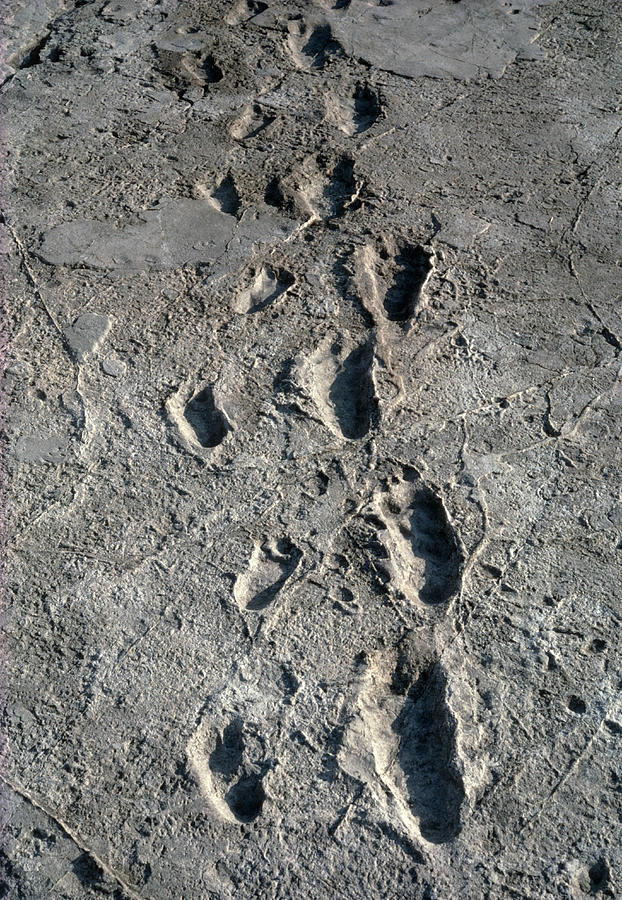
After our primate ancestors moved out of the trees, they eventually evolved for bipedal travel — walking upright on two legs.  In Tanzania, 3.6 million years ago, two bipedal ancestors left their footprints in wet volcanic ash.  In 1978, scientists discovered 70 of their fossilized footprints, in a sequence that was 88 feet long (27m).  [Image]  These ancestors were probably Australopithecus afarensis.

Today, our living primate relatives are quadrupeds, four legs.  Chimps can sprint much faster than humans, but we excel at running long distances.  Moving on two legs is more energy efficient than on four.  Evolution optimized our feet and legs for the spring-like mechanics of running, not walking.  Over time, we lost our fur coats, and developed the ability to sweat profusely, so we excelled at shedding body heat.  Standing upright gave us a better view of the surroundings.

Many game animals can move much faster than humans, for short bursts, then they must stop to cool off.  The desert is especially hot at midday.  Humans are unusual because we can run for hours in the heat of the day.  We can doggedly follow the tracks of speedy prey, not giving them a chance to rest, until heat stroke brings them down, and often kills them.  Hunters also carried spears or clubs, to finish the job, if needed.  HERE is a 7-minute video.

This is called persistence hunting, and Liebenberg was apparently the first civilized scientist to participate in this (he nearly died from heat stroke).  In other regions, this method has been used to hunt reindeer, kangaroos, deer, and pronghorn antelope.  Our ancestors have likely practiced persistence hunting for two million years or more.  It played a central role in the evolution of the person you see in the mirror.

Gorillas are vegetarians, spending long hours stuffing their faces at the salad bar.  They have evolved large guts in order to digest this bulky fibrous diet.  In addition to plant foods, chimps, bonobos, and baboons also eat meat, an excellent source of nutrients and calories.  They are good at predation, killing small animals without weapons.

In the early days, our bipedal ancestors likewise killed small critters with their bare hands.  Eventually, they became hunters.  Early hunters used pointed sticks, stones, and clubs to stun small mammals and birds.  By and by, the ancestors learned how to kill large game, via persistence hunting, javelins, spears, bows and arrows, and so on.  Meat maybe provided forty percent of their calories.

In addition to predation and hunting, our ancestors also acquired meat by scavenging.  Large carnivores often kill large game, devour as much as possible, and then abandon a partially eaten carcass.  On the Kalahari, hunters always note vultures circling in the distance.  They indicate the location of a dying animal, or a yummy carcass.  With luck, our ancestors’ running abilities sometimes enabled them to beat the hyenas to lunch.  Hyenas are not as good at shedding heat.  They periodically need to stop and pant to cool off.

Because game animals can move faster than humans, for limited distances, the success of persistence hunting largely depended on tracking skills — following the spoor of their chosen prey who might be out of sight.  Kalahari people had exceptional tracking skills.  Women were as good as men, or better, at interpreting spoor.  Everyone in a band, both men and women, could observe human tracks, and accurately identify the individual person who made them.

One time, Liebenberg asked some trackers if they could actually recognize the spoor of an individual antelope.  “They found it very amusing that I should ask them such a stupid question.  To them it is difficult to understand that some people can not do it.”  Liebenberg described three levels of tracking strategies.

(1) Simple tracking is just following the prey’s footprints, under ideal conditions, when the prints are clear and easy to follow.

(2) Systematic tracking is used when the spoor trail is less than complete.  Using reasoning and deduction (inductive-deductive reasoning), the tracker can then develop a hypothesis of what the prey was doing, and the most likely direction of its escape route.  This is solely based on real evidence.  Then, the hunter proceeds in the prey’s probable direction, in hope of picking up the track again. 

(3) Speculative tracking is the most advanced and creative.  “Anticipating the animal’s movements, by looking at the terrain ahead and identifying themselves with the animal on the basis of their knowledge of the animal’s behavior, the trackers may follow an imaginary route, saving much time by only looking for signs where they expect to find them (hypothetico-deductive reasoning).  By predicting where the animal may have been going, the trackers can leave the spoor, take a shortcut, and look for the spoor further ahead.”

Like vervets, baboons, jackals, and most other species, our ancestors learned ways of communicating with each other, via sounds and gestures.  Some birds make one warning call for lions, and a different one for snakes.  Many species, including humans, pay careful attention to the vocalizations of other species.  It’s good to know when a lion is approaching, long before it can be seen.

At some point, nobody knows when, the ancestors developed complex language.  As social animals, they lived in small bands.  Each member collected and shared information, and the group developed a body of wisdom.  Language made it easier for them to relay accumulated wisdom to the next generation.

Biological evolution (genes) moves at a snail’s pace, but cultural evolution (knowledge) can boogie like gazelles on meth.  With spears and javelins, the ancestors didn’t need to spend hundreds of thousands years evolving claws and fangs.

A few million years of scampering through the rainforest canopy, followed by a few million years of persistence hunting and tracking, fundamentally directed the evolution of our bodies and minds.  Today, we have abandoned our ancient way of life; it’s nearly extinct.  Imagine what we’d look like after 500,000 years of sitting on couches, entranced by glowing screens, chugging sugar water.

I’ve now given you a wee whiff of this book.  When I write reviews, I usually select a few subjects that especially interest me.  This one was especially interesting from one end to the other.  It carries readers off to a sacred mountaintop, where we can get a better view of the big picture.  If we want to live sustainably for hundreds of thousands of years, simple living is the only option.  What good are all our amazing gizmos if they require an insanely unsustainable flash-in-the-pan culture?

In every way, the wild people of the Kalahari were completely in tune with their ecosystem.  In my world today, I observe the opposite — a society that could not possibly be more alienated.  Recent DNA mapping strongly suggests that the hunter-gatherers of the Kalahari are the ancestors of all humans now on Earth.  You and I carry their genes.  Liebenberg pulls back the curtains of modernity and provides readers with a mind-expanding peek into distant corners of our family tree — the ancestors we have forgotten, and would be wise to remember.

In 2013, Liebenberg published The Origin of Science, which furthers his discussion of our Kalahari relatives.  My review is HERE.  There is some subject matter overlap between the two books, and my two reviews.  Sorry!  Take your anxiety meds.

Free PDFs of two Liebenberg books can be downloaded HERE.  YouTube has many Kalahari documentaries.

Liebenberg, Louis, The Art of Tracking, David Philip Publishers, Claremont, South Africa, 1990.