Showing posts with label clothing. Show all posts

Sunday, December 15, 2019

Wild Free and Happy Sample 28


[Note: This is the twenty-eighth sample from my rough draft of a far from finished new book, Wild, Free, & Happy.  I don’t plan on reviewing more books for a while.  My blog is home to reviews of 202 books, and you are very welcome to explore them.  The Search field on the right side will find words in the full contents of all rants and reviews, if you are interested in specific authors, titles, or subjects.] 

Sheep

Mouflon are the wild ancestors of sheep, and they still survive because they are faster than Olympic athletes on steroids.  They excel at racing across steep, rocky landscapes.  They also have large curled horns, capable of rattling the brains of their bloodthirsty foes.  Long ago, folks sometimes discovered mouflon youngsters, brought them back to camp, and raised them.  Unlike rowdy aurochs, the young lambs were less challenging to raise in captivity.

Paul Shepard noted that wild animals have a stable genome.  Thus, the genes of today’s mouflon are likely much the same as their ancestors 800+ thousand years ago.  But during the process of domestication, breeders deliberately selected for characteristics more beneficial for milk production, wool quality, and ease of control.  Bye-bye stable genes.

After dogs, sheep were among the first critters to be domesticated, maybe 11,000 years ago.  During this tragic demotion, their brains eventually became 24 percent smaller than their wild ancestors.  They lost a lot of their survival skills.  I’ve seen several reports of wolves killing dozens of sheep, and only eating one or two.  When wolves ran into large prey that acted so abnormally helpless, it was surreal and mystifying.  The sacred kill is usually a more dignified ceremony. 

In the old days, sheep shed their winter wool when springtime brought warmer temperatures.  Over the centuries, clever humans have “improved” the sheep they own and exploit.  Because of selective breeding, modern sheep are more likely to retain their wool, rather than scatter it all over the countryside.  This makes it easier for herders to collect as much of their precious wool as possible. 

In Australia, folks discovered one domesticated sheep who had managed to escape six years earlier, and enjoy a life of freedom.  Unfortunately, the miserable critter had never been sheared, and was carrying around 93 pounds (42 kg) of filthy wool.  This beat the previous record of another sheep found in New Zealand that carried so much wool it could barely walk.  It was blind, crippled, and near death.  Unshorn sheep are vulnerable to dying from heat stroke in warm weather.

Domesticated sheep are also vulnerable to pests like scab mites, that thrive in herds of confined prisoners.  The mites multiply and cause skin lesions, which lead to wool loss and open bleeding wounds.  Complications include hypothermia, infections, and death.  Mites are spread via the herder’s clothing, sheering tools, fence posts, and bits of wool hanging from bushes.

Mouflon manage their own lives, and fully take care of themselves.  Enslaved sheep require a lot of human assistance.  Shepherds are needed to protect them from bloodthirsty predators — noxious pests that must be aggressively exterminated whenever possible.  Smart shepherds are careful to avoid overgrazing.  Sometimes sheep also need to be provided with hay, water, salt, and shelter.

Kassia St Clair noted that some types of sheep were selectively bred to produce white wool, which is easier to dye.  This would be a vulnerability for wild ones, because it would make them far more visible to predators.  I learned about St Clair’s book when I read Claire Eamer’s fascinating essay, No Wool, No Vikings. 

Viking Sheep

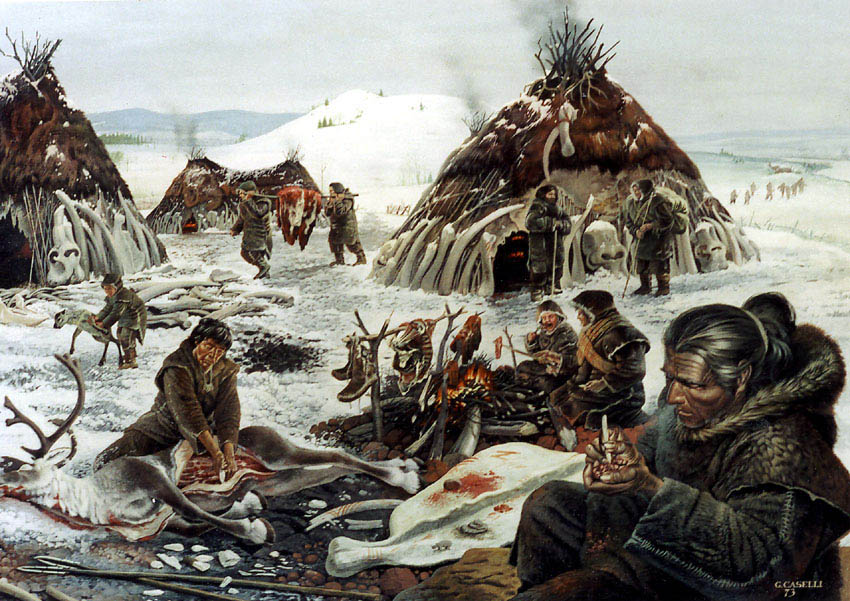
For the first 250,000 years, our ancestors ran around naked in the tropics.  With the colonization of snow country, folks were confronted with the new possibility of freezing to death.  In the early days, it was fashionable to wear clothing made of animal skins and pelts, ideally cut and sewn into stylish tailor made active wear.  This clothing kept folks fairly warm, until it got wet.  Much later, innovation provided colonists with wool clothing, which stayed fairly warm even when wet.  The adaptation of clothing was another radical transition in the human saga.  It opened up vast regions of uninhabited land for exploration and colonization.

St Clair wrote that Vikings used wool to make their clothing, mittens, blankets, and sails.  A blanket required the wool of 17 sheep.  It took two highly skilled women more than a year to make a typical square sail.  To outfit an average Viking cargo ship and crew, making the clothing, bedding, and sails would require 440 pounds (200 kg) of wool, and ten person years of labor for producing, shearing, carding, spinning, weaving, and finishing the products.  Some believe that, in the old days, folks in snow country might have spent more hours making cloth than acquiring food.

Viking long ships were yet another radical transition.  Sailing boats were not a new idea.  Folks used them in other regions, like the Mediterranean.  Coastal regions of Scandinavia were not home to many sheltered, deep water harbors, so Viking ships were built with a shallow draft, so they could be landed on beaches.  This made them great for surprise attacks and fast getaways.  The use of sail power was enabled by keels that could be lowered in deep water, and raised when beaching.

These new boats allowed Vikings to raid communities that had formerly been safe and secure for centuries.  In A.D. 98, Tacitus wrote about the Suiones, who lived along the Swedish coastline.  For them, the sea provided an invincible defensive barrier.  It was impossible for enemies to attack them by water.  But the new boats set the stage for the Viking era — several centuries of raiding, pillaging, bloodshed, and colonizing that rocked northern Europe. 

Remarkably, the design of longboats also made them capable of travelling on the open ocean.  Rugged woolen sails allowed them to cross the Atlantic and build an outpost at L’Anse aux Meadows in Newfoundland, Canada.  In those days, most of humankind spent their entire lives fairly close to their place of birth.  Imagine gaining the ability to sail to unknown lands more than a thousand miles away.  This was a mind-blowing possibility.  It rubbished the traditional perception of space and limits.

Long distance sea travel flung open a ghastly Pandora’s Box.  Sailing ships enabled aggressive conquerors to colonize vast regions around the world.  Environmental history is loaded with horror stories of pathogens delivered by long distance sea travel — potato blight, anthrax, Dutch elm disease, chestnut blight, white-nose fungus, bubonic plague, smallpox, cholera, typhoid, yellow fever, influenza, and countless others.  Millions of unlucky indigenous people have been conquered, enslaved, and/or killed by alien invaders from distant lands.

Anyway, wool was big juju.  Prior to the nineteenth century, clothing was the product of extremely labor-intensive processes.  For hardworking common folks, clothing was precious, carefully mended and patched, and passed on to the next generation.  When someone died in a hospital, the clothing of the deceased had to be removed and given to the lawful inheritors.  Many folks owned little more than what they were wearing.  Like moon explorers, wool space suits enabled tropical primates to survive in frigid life-threatening environments.

White Gold

St Clair also discussed English wool.  The Normans were Vikings who colonized the north coast of France and smelled like sheep.  In 1066, they conquered England.  By the thirteenth century, England had become famous for its high quality wool.  Regions that produced the softest, richest wool could sell it for very high prices.  Most of the cloth makers that bought the wool were not English, many were Flemish or Florentine.  Ships that carried the wool to buyers were prime targets for pirates, eager to snatch the precious white gold, and get rich quick.

On the manors of wealthy aristocrats, the peasant tenants were given rights to use specific strips of cropland.  Assignments would change from year to year, because some cropland was regularly allowed to lie fallow and recharge.  Beside cropland, there were also common pastures, and common forests, which the whole community could use.  Tenants raised livestock, hunted, foraged, grew vegetables, and cut firewood and timber.  The survival of the peasant community was dependent on always having access to the commons.  Even with access, the lives of most were brutally harsh and marginal, compared to modern couch potatoes. 

By 1297, half of the total English economy was generated by the wool industry.  Before long, ambitious aristocrats realized that they could make far more money from raising sheep than by collecting rents from their dirt-poor tenant farmers.  This deep hunger for wealth slowly led to a process known as the enclosure movement.  Fences and hedgerows were created to prohibit tenants from entering the commons.  They were not amused, they were doomed.

Graham Harvey wrote that the enclosures began in England, during the fourteenth century.  They gradually spread over the passage of several centuries, and then surged from 1750 to 1860.  Simon Fairlie noted that between 1760 and 1870, about 7 million acres (2.8 million ha), about a sixth the area of England, was changed from common land to enclosed land.

One source estimated that, in Scotland alone, a half million peasants were driven off the land by the enclosures.  No food, no home, no future.  Across the U.K., the dispossessed were forced into filthy, disease ridden cities, where there were no social safety nets.  Rioting became popular, as did infant mortality.

John Reader noted that the enclosure movement led to the breakdown of a long standing culture of land-based subsistence living for many.  Tenant communities had benefitted from the mutual support of extended families.  They were replaced by a small number of shepherds.  With the tenants gone, there were fewer horses and oxen on the manor, so more grass was available for sheep.  Tennant cottages and outbuildings were demolished.  Several hundred villages disappeared, except for their churches.  Aristocrats enjoyed getting higher income from their manors, and raising sheep was more dependable than agriculture.  From year to year, grain harvests were quite vulnerable to the mood swings of weather and luck.

Harvey wrote that in the Black Death era (1340s), Britain was a backwater.  Three centuries later, it was Europe’s most advanced country.  Wool flooded the U.K. with cash, and for 200 years it was the world’s richest country.  Millions of hungry dirty people in cities were willing to work insane hours, in miserable conditions, for peanuts.  This nourished the emergence of a powerful industrial state.  By 1832, the medieval peasant community had been completely destroyed.  Like I said, wool was big juju.  The gentle sheep had eaten many lives and villages.

My Ancestors

My great-great-grandmother was Sarah Cleaton, who married Edward Rees in 1838.  They were born and raised in the village of Cwmbelan, Wales, where a small stream passing through the village powered a waterwheel at the flannel factory.  Sheep grazed on the surrounding hillsides (formerly lush forest).  Cwmbelan was in the parish of Llangurig.  In 1836, the 49,600 acre (20,000 ha) parish had 37,000 acres of commons.  By 1875, “large quantities of the common land have been enclosed.”

Edward and Sarah had three sons before he died at 23 from “decline.”  Sarah was a handloom weaver, as was her mother Mary, and her sister Catherine.  So were her sister-in-laws, Mary, Elizabeth, Margaret, and Jane Rees.  Handloom weaving was a skilled profession.  It apparently provided something like a respectable middle class income for that era. 

With the arrival of the Industrial Revolution and its power mills, 500,000 weavers lost their source of income, according to Clive Ponting.  Many were forced to move to filthy cities.  By 1861, Sarah and her three sons had moved south to Merthyr Tydfil, home to an iron mining district, Dowlais.  She was a barkeep at the Green Dragon pub, and her two older sons mined iron.

Merthyr Tydfil had four ironworks, and a slum known as Little Hell, where a super-poor population of “unhappy and lawless” folks were piled together in conditions of squalor that were at least as bad as Liverpool or Nottingham.  The district had no toilets.  Open sewers encouraged the spread of cholera and typhoid.  Millions of friendly lice thrived on folks who rarely if ever bathed.

Unfortunately, for Sarah and sons, by 1861, the ironworks industry in Merthyr Tydfil got blindsided by new technology, the Bessemer process, and local prosperity was fading fast.  In 1863 they moved to Pennsylvania.

In 1919, her son Richard E. Rees, celebrated his fiftieth anniversary in Columbus, Ohio.  To commemorate the event, he sent a story to a Welsh newspaper.  In it he wrote, “I have worked underground for 65 years; ten in the Old Country, two in Pennsylvania, and 53 in Ohio.  He was 75 years old, and lived another ten years.

Australian Sheep

Elinore Melville wrote about the introduction of sheep in Australia, where the firestick farming by Aborigines maintained expansive regions of grassland.  Unfortunately, this excellent grassland was supporting the existence of useless vermin called kangaroos.  Britain wasn’t interested in buying kangaroo meat, but they would pay good money for wool.  So, colonists worked hard to exterminate as many kangaroos as possible, as they rapidly expanded the sheep ranching industry.  By 1845 there were 9 million sheep, and in 1854 there were 12 million. 

The British colonists came from a moist land that had reliable rainfall.  Australia was different.  When a herd had stripped the vegetation from an area, shepherds moved the herd to a greener pasture.  The vegetation they devoured had been storing moisture, which slowed evaporation.  The land dried out, and groundwater was not replenished.  Drought followed drought.  Overgrazing often rubbished grassland regions within 7 to 20 years. 

Bill Gammage noted that the native kangaroo grass was excellent (“caviar for grazers”).  It was a deep-rooted, drought tolerant perennial that held the soil in place, retained soil moisture, survived fire, and was highly nutritious.  It remained green after four months without rain, a great asset for wildlife in drought times.  The colonists’ sheep grazed it down to bare clay, killing the precious grass.

Colonists drained wetlands to expand pastures.  Livestock proceeded to compact the soil, which dried out, and cracked.  Springs, ponds, and creeks evaporated, eliminating the critters that lived in them.  When rains returned, rapid runoff encouraged erosion, landslides, deep gullies, floods, silt chokes, and the spread of salts.  An observer in 1853 commented on the growing soil destruction: “Ruts, seven, eight, and ten feet deep (2 to 3 m), and as wide, are found for miles, where two years ago it was covered with a tussocky grass like a land marsh.”

Navajo Sheep

Between the twelfth and sixteenth centuries, the Navajo moved from Alaska and western Canada down into the U.S. southwest, home of the Hopi, Zuñi, and Pueblo.  In the early days, the Navajo lived as hunter-gatherers.  In 1598 Spanish colonists arrived, bringing with them domesticated sheep, cattle, horses, and goats.  The Navajo became sedentary, and learned sheep herding, weaving, and gardening.  They planted fruit orchards.  When forage was still adequate, livestock provided more reliable access to food, so famine times were reduced.  This new mode of living led to population growth.

The Spanish did not allow the Navajo to own or ride horses, but eventually they acquired them.  Horses made it much easier to hunt, and to raid neighbors.  Stealing sheep was much easier than raising them.  Raiding was about making unannounced visits to neighboring tribes and stealing sheep, horses, women, and children.  Sometimes the defenders were killed and scalped.  Naturally, other tribes responded by raiding the Navajo.  Raiding was an extremely common practice among pastoral societies around the world. 

Peter Iverson noted that by 1846, the Navajo had 500,000 sheep, 30,000 cattle, and 10,000 horses, mules, and asses.  As white settlers moved in, they complained about the Indians.  So, the government ordered the Navajo to relocate to a reservation, where they could become farmers and get rich quick.  The Indians preferred to remain on their land, and continue living in their traditional manner.  This was not the proper response.

So, the government sent Lieutenant Colonel Kit Carson to make the whites happy.  In 1863 his troops brutally attacked the Navajos and destroyed homes, gardens, orchards, livestock, and people.  The 8,000 surviving natives were forced to march 300 miles (480 km) to the luxurious Fort Summer facility.  In 1868, they were allowed to return to a portion of their homeland.  Each family was given two sheep, one male, one female.

The railroad arrived in 1881, and trading posts appeared along its route.  This encouraged the Navajo to weave rugs and make jewelry to be used as trade goods.  They raised large herds of Churro sheep, which produced long, smooth, and less greasy wool that was ideal for hand spinning. 

By the time the Depression began in 1929, the Navajo population had swelled.  Kendall Bailes wrote that by 1933, two million acres (809,000 ha) of Navajo land was severely overgrazed, some of it reduced to desert.  There were huge erosion gullies, and large amounts of silt were moving into Lake Mead, the reservoir at Hoover Dam.  Their herding practices, developed 200 years earlier, when grass was abundant, didn’t work as well in a dryer climate, when there was far less grass.  Animals were starving.  In the western states, the Dust Bowl had begun.

In 1935, the Bureau of Indian Affairs conducted a survey on grazing land.  They found that the Navajo sheep flocks contained more than a million animals, and they were kept on land that could only support 560,000.

The government perceived this to be a very serious problem, for which the obvious solution was a sharp reduction in herd size.  The Navajo, on the other hand, believed that this was the opposite of a problem, it was a sacred gift.  Their livestock were tokens of wealth, status, and cultural identify.  They loved their goats and sheep almost as much as their own children.

The white authorities moved in, without permission, and by the 1940’s, the herds were reduced by half.  According to Iverson, at first the sheep were shipped urban centers to feed poor people.  Eventually, the animals were just taken over the hill, shot, piled up, and left to rot.  The government paid the Navajo for every animal eliminated, but the tribal economy was blindsided.  Navajo resentment over this action remains fierce.  The tribe now has a quota system for herd sizes in grazing ranges.

Saturday, June 1, 2019

Wild Free and Happy Sample 16


[Note: This is the sixteenth sample from my rough draft of a far from finished new book, Wild, Free, & Happy.  I don’t plan on reviewing more books for a while.  My blog is home to reviews of 201 books, and you are very welcome to explore them.  The Search field on the right side will find words in the full contents of all rants and reviews, if you are interested in specific authors, titles, or subjects.] 

Food Storage

In the tropics of Mother Africa, meat spoiled quickly, and yummy carcasses soon attracted mobs of ravenous and dangerous scavengers.  When folks fancied a juicy steak, they killed something.  Preserving and storing surplus meat was unnecessary, and highly impractical, a stupid idea that never occurred to anyone.  There was no reason to hunt heavily for a while, dry lots of meat, haul it around, and constantly protect it.

Snow country was a different story.  Winter made travel, hunting, and fishing more difficult.  Folks who accumulated and stored surplus food for the winter months were far more likely to survive and inhale the fragrant aromas of blooming springtime flowers.  For our human ancestors, fine-tuned for tropical living, long-term food storage was a weird and unnatural idea.  But once some pioneers learned how to do it, far more regions became potential locations for future colonization.  With storage, we were able to expand into lands having harsher climates.

Clive Finlayson jabbered about a group of humans known as the Gravettian culture, who managed to survive in the steppe-tundra of the Eurasian Plain from 30,000 to 20,000 years ago.  Large game was abundant.  Here they invented one of the most diabolical Earth-shaking technologies of all time (gasp!), the storage pit!  Holes chopped into the frozen permafrost could be used as scavenger-resistant deep freezers, to store surplus food for the lean seasons.

Finlayson believed that food storage was a significant milestone on our long and painful descent to modernity.  Surplus made clans more secure, as long as adequate food resources remained available.  Acquiring surplus food for winter dining required intensified hunting, which could lead to waste, spoilage, unintentional overhunting, population growth, and the depletion of game over time.

An additional quirk of snow country was that folks needed to burn lots of calories to stay warm and strong in their physically active outdoor life.  So, a diet rich in fat was essential.  The fat content of game animals varied with the seasons.  Meat had the most fat in late summer and autumn.  In late winter and spring, many animals were unfit to eat due to insufficient fat.  In lean seasons, Native Americans killed buffalo just to eat their tongues, which were high in fat.

Dixie West noted that animals with minimal fat were junk food.  When humans and other carnivores eat lean meat, they can lose weight, because digesting it requires more energy than the meat contains.  Folks commonly smashed and boiled the bones that contained the most marrow, to extract the precious marrow fat.

In snow country, as long as large game remained readily available, labor intensive agriculture made zero sense.  As game became scarcer, hunting was gradually displaced by farming.  This began about 6,000 years ago.  In regions less suitable for farming, hunting persisted longer.  The focus shifted from storing meat to storing grain.  According to Finlayson, the concept of producing surplus food, and competently managing the surplus, set the stage for the birth of civilization.

The advantages of food storage in snow country encouraged the dawn of the “more is better” mindset, which eventually became a core belief in cultures engaged in agriculture or herding.  The Gravettians and other hunters stockpiled frozen or dried meat.  Farmers loaded granaries with calorie dense grains.  Herders stored their meat on the hoof, gathered milk daily, and slaughtered livestock only when needed.  They strove to accumulate as many animals as possible.  In different forms, the practice of food storage spread across snow country, eventually crossing from Siberia into the Americas.

Life was simpler for tropical hunter-gatherers, like the San people of the Kalahari.  On a really crappy day, if a gang of hyenas snatched an antelope just killed by hunters, what was lost was merely the work of a single day.  They were able to maintain their conservative traditional way of life for many, many thousands of years.  It was not a high impact way of life.

For the food hoarders of snow country, on the other hand, misfortune could suddenly eliminate months of tedious work, and endanger winter survival.  Their food stockpile could be wiped out by fire, flood, scavengers, spoilage, vermin, theft, and so on.  The whole community might starve and blink out.  Over the long run, “more is better” cultures, with their denser populations, were more likely to swerve into bloody turbulence.  Storage is big juju.

Dress for Success

Hunter-gatherer cultures differed widely in their dependence on technology.  The utterly simple Kalahari way of life was practiced by our hominin ancestors for at least two or three million years.  In the tropics of Mother Africa, evolution spent several million years fine tuning our bodies for life on the savannah, and the result was an excellent design. 

After hominins migrated out of Africa, and colonized tropical Asia and Australia, some folks decided to wander north.  It was a cool place to live, and the farther north they wandered, the cooler it got.  In snow country, tropical primates were like fish out of water.  Brrrr!  They wrapped themselves in animal hides, lived in protective shelters, and huddled around warm campfires.

In 1908, Knud Rasmussen told the story of a Greenland Eskimo named Qumangâpik, who had four wives and 15 children.  The first wife froze to death, the second was buried by an avalanche, the third died of illness, and the fourth froze to death.  Of his 15 children, one starved, four were frozen, and five died of illness.  Then, Qumangâpik froze to death, with his wife and two little children.  Three of his kids outlived him.  In frigid times, ripped or inadequate clothing could be a death sentence.

Over time, early colonists in snow country learned how to cut and sew hides into custom tailored clothing that provided better protection for both humans and their body lice companions.  Killing a deer, tanning its hide, and turning it into coats, trousers, hats, or footwear, was a time consuming process.  Deerskin attire was not especially warm, especially when soaking wet or frozen.  On the plus side, it could be boiled and eaten when starvation threatened.

The first stitching was likely done with sinew, or thin strips of leather.  Eventually, some groups learned how to spin plant fibers into thread, which could be used for stitching seams together.  In the Republic of Georgia, researchers have found spun and dyed fragments of flax fibers that were 34,000 years old. 

Needles were used for sewing clothing and tents, and for making nets.  Animal bone needles with eyes, about 25,000 years old, have been found in Central Europe.  Needles have not been found at Neanderthal sites yet, but looking for a needle in a haystack is far easier than finding an extremely old needle buried somewhere on the Eurasian land mass.

Over time, folks got better at spinning different types of high quality thread.  It was spun from plant fibers like flax, cotton, or hemp; or animal fibers like wool.  Eventually, a clever person invented weaving, a process that wove thread into cloth.  Cloth could be used to make a wide variety of useful things.

Kassia St Clair described how gathering and processing plant fibers was time consuming.  So was carefully collecting and preparing fibers from sheep, goats, silkworms, and others.  So was spinning and weaving.  In some regions, folks may have devoted more hours to their wardrobe than to acquiring food.  For hardworking people, clothing was precious, and carefully kept mended and patched.  Many owned little more than what they were wearing.

During the agricultural era, wool clothing was popular in snow country, until the eighteenth century, when new technology made cotton cloth cheaper to make, and more profitable.  Cotton was the dominant fabric until the 1970s, when synthetic fibers rose to dominance.  It won’t be long now until almost all clothing is polyester, which is exceedingly cheap to produce from petrochemicals using state of the art automation, and super cheap sweatshop labor.

Today, many consumers own enormous wardrobes of apparel, much of it rarely worn, if ever.  Modern attire is not designed for rugged durability, but to be rapidly mass produced, in order to meet the demand for the latest trendy styles.  Trendy styles have deliberately short lifespans.  This encourages radicalized consumers to maximize their apparel purchasing.  For them, nothing is more embarrassing than to be seen wearing obsolete fashions.  Landfills are stuffed with countless tons of formerly trendy attire.  Much of it is discarded while still in excellent condition.

Great Leap Forward

A number of thinkers have jabbered about a miraculous turning point in the human saga.  Before this event, humans were dim witted, knuckle dragging, mouth breathing bubbas.  And then — shazam! — we triumphantly glided across a magic bridge, from the archaic era into the modern one.  Our species was gaining momentum on the treacherous path to technological utopia and ecological dystopia.

Jared Diamond once speculated that if space aliens had visited Earth 100,000 years ago, humans would have appeared to be nothing more than ordinary animals.  But then, as the millennia passed, those critters were acting less and less ordinary.  By 40,000 years ago, our modernizing ancestors were demonstrating revolutionary changes that were both beneficial and risky.  What happened?  Diamond named this miracle the Great Leap Forward.

Of course, Diamond was raised in a crazy self-destructive wonderland of high technology — extremely clever stuff that enabled humankind to beat the living crap out of the planet’s ecosystems for no sane purpose.  Actually, those “ordinary” two-legged ancestors, observed by space aliens, were the one and only critters on Earth who were capable of conjuring domesticated fire — a fantastically revolutionary innovation.  It was close to step one on the long march to world domination.

For Diamond, the act of routinely using domesticated fire seemed ordinary and insignificant.  In his 1992 reality, even four-year olds could easily burn down the neighborhood with a cheap disposable lighter.  In addition to fire, the visiting space aliens would have also seen that the two-legged critters were unique in their ability to knap sharp stone tools, and manufacture assorted gizmos for hunting.  Our hominin ancestors had been developing these unordinary skills for more than two million years.

Extremely weird was the fact that those fire critters were at the top of the food chain, yet they had no serious fangs, claws, speed, strength, or size.  All the other top predators had naturally evolved some combination of those traits, gradually, over the course of millions of years.  But today, those traditional natural predators are being pounded into oblivion via guns, cyanide, habitat destruction, and so on.  There are not seven-plus billion lions and tigers and bears staring at cell phones.

With the Great Leap, humans began doing more and more things beyond what ordinary animals did.  They baked ceramic figurines in kilns, made flutes, wore ornamental beadwork, sewed clothing, invented new and improved tools, and built trophy homes with mammoth bone walls.  These luxurious dwellings have been found in Ukraine, Czech Republic, Poland, Romania, Belarus, and Russia.

Venus figurines have been found in Slovakia, Italy, Austria, Russia, Germany, Czech Republic, Switzerland, France, Romania, and Siberia.  They were carved in soapstone, steatite, sandstone, mammoth ivory, horse bone, serpentine, black jet, antler, limestone, and hematite.  Venus figurines date from 30,000 to 10,000 years ago.

Folks learned how to process red and yellow ochre, hematite, manganese oxide, and charcoal into pigments useful for cave painting.  Wild artists crawled far inside caverns with torches, and painted gorgeous portraits of the sacred animals for which they had the deepest respect and reverence.  Images included the horse, lion, auroch, rhinoceros, salmon, bear, mammoth, buffalo, owl, hare, ibex, auk, weasel, reindeer, chamois, and fox.  Often, artists placed their spread out hand against a wall, and sprayed paint over it, creating a hand stencil.

Those folks did not spend most of their lives indoors, isolated from the wild ecosystem, like astronauts in orbit.  They had no glowing screens.  Their world was entirely wild and alive, and they were intimately involved in it, every minute of every day, bloody hands and all.  The paintings celebrate their sacred relationship with the animals that fed them, clothed them, and sometimes killed them.

Prehistoric cave art has now been found in every continent except Antarctica.  In France and Spain, it has been found in almost 340 caves.  Famous sites include Chauvet in France (30 to 32 thousand years ago), Altamira in Spain (15,000), and Lascaux in France (18,000).  Recently, D. L. Hoffman’s team found paintings in three Spanish caves that were more than 64,800 years old — about 30,000 years before the arrival of humans.  This was the Neanderthal era.

The Great Leap Forward has also been called the Cultural Revolution or the Cognitive Revolution.  Cognition is about thought, understanding, and knowledge.  Twenty years ago, some believed that the leap was the result of miraculous genetic mutations that turbocharged our intelligence, but that theory went extinct, for lack of convincing DNA evidence.

A number of experts theorize that the leap was encouraged by powerful advances in complex language and communication, but this is impossible to prove via archaeological evidence.  Spoken words are not preserved in fossils.  We may have been singers and poets several million years ago.  We’ll never know.  Many primates and other animals are vocal.

Some sort of Great Leap certainly occurred in snow country, maybe between 50,000 and 30,000 years ago.  Our tropical primate ancestors were excited to discover lands loaded with abundant food, but challenged by a life-threatening climate for which evolution had not prepared them.  The only way they could stay, and feast on the delicious wildlife, was to cleverly invent a collection of prosthetic technology that would increase the odds of winter survival.  Eventually, the accelerating pace of cultural evolution enabled us to conquer the planet, explode in numbers, and savagely vandalize Earth in every imaginable way.

While many of the innovations of the Great Leap were survival-oriented prosthetics, others were not.  Painting, ornamentation, figurines, flutes, and so on were probably motivated by spiritual affairs, or the desire for enjoyment.  Obviously, for a while, these were not folks who were desperately struggling to survive.  Their new indulgences would seem to indicate that these folks were living in a bubble of affluence, leisure, and decadence.  They had learned and refined the skills of survival, and their food resources were temporarily abundant.  They were rich.  Life was good.

They remind me of America’s baby boomer generation, of which I am a member.  We were born at a time when industrial civilization soared to ridiculous excesses, fueled by an orgy of consuming enormous amounts of premium quality nonrenewable resources, as if they were infinite.  Some have called this joyride in self-destruction “The Blip” — a brief extreme spike in many trend lines, something equivalent to an asteroid strike. 

History repeatedly reminds us that high impact lifestyles always have an expiration date.  Yet, despite being proud descendants of the Cognitive Revolution, our clever minds routinely refuse to comprehend this simple and vital idea.  Magical thinking is always an effective cure for the unpleasant deliriums caused by occasional whiffs of reality.

Anyway, over the long run, was it truly a leap “forward” into greater joy, wisdom, health, and sustainability?  Or, was it something else?  When was the planet healthier and happier?

Monday, May 13, 2019

The Golden Thread


As I write these words, I’m wearing sweatpants and an old faded shirt.  I suspect that most readers are also wearing clothes.  Oddly, humans are the only animals that make and wear clothing.  Our ancestors evolved in the tropics of Mother Africa, where it was so warm that many folks preferred the comfortable and practical bare naked look.  Evolution spent several million years fine tuning our bodies for life on the savannah, and the result was an excellent design.

After humans migrated out of Africa, and colonized tropical Asia and Australia, some folks decided to wander north.  It was a cool place to live, and the farther north they wandered, the cooler it got.  In snow country, tropical primates were like fish out of water.  Brrrr!  They wrapped themselves in animal hides, lived in protective shelters, and huddled around warm campfires. 

Over time, they learned how to cut and sew hides into custom tailored clothing that provided better protection for both humans and body lice.  Eventually, they learned how to spin plant fibers into thread, which could be used for stitching seams together.  In the Republic of Georgia, researchers have found spun and dyed fragments of flax fibers that were 34,000 years old.  At some point, folks learned how to weave thread into fabric.  We aren’t sure when.  Cloth made from natural fibers is perfectly biodegradable, leaving few clues for modern archaeologists.

Kassia St Clair wrote an interesting book about fabric, The Golden Thread.  It’s not a comprehensive history, but a collection of snapshots — linen wrapped mummies in Egypt, the silk monopoly in China, wool production in medieval England, slavery and the rise of cotton, synthetic fibers, and so on. 

My great-great-grandmother, Sarah Cleaton Rees, was a handloom weaver in central Wales, and so were many of her female kinfolk and neighbors.  Flannel was made from wool produced by herds of sheep grazing on the surrounding deforested hillsides.  Prior to power looms and factories, millions of women spent much of their lives spinning, weaving, and sewing in their homes, where they could also tend to their children. 

I learned about St Clair’s book by reading a fascinating essay, No Wool, No Vikings.  My ancestors also include Vikings from the west coast of Norway, where the homesteads were scattered across numerous rocky islands.  Boats were how they got around.  Sheltered deep water harbors were not common, so boats were designed to ride high in the water, so they could stop in shallow places, or on beaches.  Early boats were propelled by paddles or oars. 

Sails were not used until clever folks learned how to add keels to boat bottoms.  Keels made wind powered sea travel possible.  Large, sea worthy, shallow draft boats with sails set the stage for the Viking era — several centuries of rowdy raiding, pillaging, bloodshed, and colonizing that rocked northern Europe. 

These new boats totally surprised many communities that had formerly been safe and secure for centuries.  In A.D. 98, Tacitus wrote about the Suiones, who lived along the Swedish coastline.  For them, the sea provided an invincible defensive barrier.  It was impossible for enemies to attack them by water.  For the first time, Viking ships made many safe places vulnerable to violent surprise attacks.

While history recorded the names and sagas of some heroic male warriors, it disregarded the hard working women who made the Viking era possible.  The adventurous lads were attired in wool from head to toe, slept under wool blankets, and traveled long distances in boats with woolen sails.  This required large numbers of sheep, and enormous amounts of tedious human labor.  The wool of 18 sheep was needed for each blanket.  It took two highly skilled women more than a year to make a typical square sail.

Viking sails were another revolutionary turning point in the human saga.  They enabled Scandinavians to cross the Atlantic and establish settlements, like L’Anse aux Meadows in Newfoundland, Canada.  In Viking times, most of humankind spent their entire lives fairly close to their place of birth.  Imagine gaining the ability to sail to unknown lands more than a thousand miles away.  This was a mind-blowing possibility.  It rubbished the traditional perception of space and limits.

Long distance sea travel flung open a ghastly Pandora’s Box.  Sailing ships enabled aggressive conquerors to colonize vast regions around the world.  Environmental history is loaded with horror stories of pathogens delivered by long distance sea travel — potato blight, anthrax, Dutch elm disease, chestnut blight, white-nose fungus, bubonic plague, smallpox, cholera, typhoid, yellow fever, influenza, and countless others.  Millions of unlucky indigenous people were forcibly absorbed into oppressive alien systems.

Anyway, wool was a life preserver in snow country.  The notion of “no wool, no Vikings” can be expanded to “no wool, no Britons, Saxons, Scots, Picts, Teutons, Gauls, Vandals, etc.”  Prior to the nineteenth century, clothing was the product of extremely labor-intensive processes.  For hardworking common folks, clothing was precious, and carefully kept mended and patched.  Many likely owned little more than what they were wearing.  Like moon explorers, wool space suits enabled tropical primates to survive in chilly life-threatening environments.

In the eighteenth century cotton began displacing wool.  Large cotton plantations emerged in the American south, where legions of slaves enjoyed miserable lives.  Power looms and cotton gins sharply reduced the labor needed to produce fabric.  Cotton remained the dominant fabric until the 1970s, when synthetic fibers rose to dominance — rayon, nylon, polyester, and so on.

In recent decades, polyester clothing has shifted from cruddy, stinky, and creepy to comfortable, practical, and very cheap.  It’s made from petrochemicals, which arouse the snarling displeasure of Big Mama Nature.  A lot of the apparel sold at stores in your community is made by poor women who work long days, in nasty conditions, and maybe earn $37 per month.  The apparel industry is the world’s biggest employer of women, of whom only two percent earn a living wage.

As the human herd grows, more folks enter the consumer class, and clever marketers wickedly accelerate the pace at which super-trendy styles suddenly become horribly uncool.  So, the demand for new clothing accelerates.  “In 2010, for example, it was estimated that 150 billion garments were stitched together, enough to provide each person alive with twenty new articles of clothing,” according to St Clair.  “For the first time in human history, the vast majority of fabric being made has become disposable, something to be consumed and thrown away within weeks or months of being made.  Synthetic fibers made this possible.”

Marc Bain reported that the future of clothing is plastic (synthetic).  Wool has become an endangered fiber.  Cotton production experienced modest growth since 1980, and has now plateaued.  Polyester zoomed past cotton in 2007.  In 1980, its production was 5.8 million tons, rising to 34 million tons in 2007, and is projected to soar to 99.8 million tons by 2025.

It’s daunting to contemplate the future of clothing.  Wool production is limited by the availability of grazing land, and the need for much manual labor.  It seems impossible that the huge human herd can go back to dressing in wool.  Cotton production requires cropland, fertilizer, extra-large doses of pesticides and water, and lots of energy-guzzling machinery.

The human herd recently zoomed past 7.7 billion.  Should current cropland be used for producing more food, more fiber, or more urban spawl?  Oil is a finite nonrenewable resource, and the mother of polyester.  The easy to extract oil is about gone, and what remains is increasingly expensive to produce.  Resource limits guarantee that the plastic clothing era has an expiration date.  All industrial scale apparel production is ecologically unsustainable.  On the bright side, neither cotton nor polyester biodegrade when buried in landfills.  So, the latest fashions in coming decades might be mined from dumps.

Will climate change solve this challenge by transforming snow country into a toasty tropical nudist colony?  Our ancestors once lived like the San people of the Kalahari, in a time-proven low impact manner.  Their way of life was leisurely compared to the workaholics of snow country.  The San had no need to spend much of their lives spinning and weaving.  They had no need to construct sturdy warm cottages.  They had no need to produce and store surplus food for consumption during the icy months.  They had no need for herding livestock, or planting crops, or mining minerals, or building cities.  Imagine that.

St Clair, Kassia, The Golden Thread: How Fabric Changed History, John Murray, London, 2018.

Wednesday, May 1, 2019

Wild Free and Happy Sample 14


[Note: This is the fourteenth sample from my rough draft of a far from finished new book, Wild, Free, & Happy.  I don’t plan on reviewing more books for a while.  My blog is home to reviews of 200 books, and you are very welcome to explore them.  The Search field on the right side will find words in the full contents of all rants and reviews, if you are interested in specific authors, titles, or subjects.] 

Expansion and Limits

William Rees noted that every species has two traits.  (1) They will expand to all locations that are accessible to them, if conditions allow their survival.  On the other hand, negative feedback can discourage new expansion, or encourage retreats.  The climate might be hostile.  Food or water resources might be scarce.  Powerful predators or hostile people might live there.  So might disease agents, like tsetse flies, malarial mosquitoes, or parasitic worms.

For walking critters, the area accessible for expansion has limits.  People with domesticated horses or camels have greater potential for long distance expansion.  The same is true for folks having watercraft that can travel on rivers, or move across seas and oceans.  Also, folks with flying machines, or driving machines.  Critters that know how to make fire and sew warm clothing can expand into snow country, far beyond the normal and appropriate habitats for tropical primates.

(2) When critters expand into new habitat, they will utilize all available resources — until they smack into limits, and have to back off.  This is no big deal for animals that live as they naturally evolved to live — without complex tools.  When a resource becomes scarce, they can switch to a substitute, if any, or they can move elsewhere, or they can turn into cat food.

Technology can expand what resources are available.  A mammoth is not a resource that an empty handed hominin can utilize, but a hominin with a thrusting spear, stone blade, and fire drill can.  Fishing with a hand net is one thing, a motorized trawler is another.  Hunter-gatherers did not mine and smelt ores, fabricate machines, drill oil wells, or replace wilderness with mega farms growing millions of tons of corn — but industrial civilizations do.

As you can see here, there are limits to expansion.  Innovation and technology can push back narrow limits, sometimes to a huge degree.  For example, 10,000 years ago, the human population was maybe 10 million.  Today, it’s seven-point-something billion, thanks our ability to cleverly bypass countless limits, our feeble ability to foresee the unintended consequences, and our reluctance to question reality when we’re enjoying regular meals. 

This artificially swollen carrying capacity can only be temporary, because it is fantastically unsustainable.  Modern folks, the most educated generation ever, have a fervent blind faith in the ridiculous idea that we have no limits.  They’ve been angrily pissing on Thomas Malthus for almost 200 years for suggesting the logical and rational ‘heresy’ that unlimited growth is impossible.

Technological innovation is the fruit of diabolically clever genius.  But… it seems that genius and wisdom rarely, if ever, meet.  Wisdom is almost invisible in our culture, a ghost, a will-o-wisp.  All the spotlights are on geeky genius, as it enthusiastically tap-dances across the stage, like a whirlwind of nerve gas.

Genius designs and builds 440 nuclear power plants — before giving any serious consideration to the enormous challenge of how to permanently store countless tons of radioactive wastes that can remain highly toxic for a million years.  Wisdom cries.  Wisdom recommends turning off the lights, turning on your thinker, converting your Mercedes into a chicken coop, and discovering the evolutionary purpose of those mysterious five-toed thingees at the ends of your legs. 

Genius, the hyper-ambitious idiot savant, gives us automobiles, cell phones, hydrogen bombs, plastic diapers, landfills, and a severely rubbished ecosystem.  The bottom line is that healthy, sustainable, ordinary animals like chimps have zero need for wisdom, or genius, or foresight, or technological innovation.  They live in the manner for which they evolved, period.  Imagine that.

Unlike wild chimps, we are not free.  Industrial civilization keeps us in cages.  Miles Olson pointed out that we are essentially enslaved by the powers that control the technology we are addicted to for survival — corporations that provide energy, transportation, food production, and so on.  Chimps would not notice if all of these corporations went bankrupt next week.

Hominin Wanderers

Anyway, hominins emerged in Mother Africa, and eventually expanded around the world.  This was not unique.  Long before hominins appeared, many “ordinary” animals travelled widely — mammoths, horses, wolves, salmon, bears, bison, migratory birds, and so on.  These species did so gradually, allowing evolution to fine tune them for new conditions — with zero dependence on technological crutches.

Much later in the hominin saga, Homo sapiens emerged, maybe 300,000 years ago.  In Africa, this era is sort of a black hole in the archaeological record.  Minimal evidence has been found.  Paul Jordan wrote that the geologic chemistry of African caves was lousy for preserving bones, while the limestone caves of Europe were excellent.

By and by, our human ancestors wandered out of Africa, and entered the Middle East somewhere around 130,000 and 100,000 years ago.  Clive Finlayson suggested that this was not an exodus to escape problems, and it was not purposeful — brave pioneers eager to explore the unknown.  Folks just gradually moved into new regions over the span of many generations, like roaming herds of bison, going where their stomachs led them.

The early pilgrims were probably small groups, and there were likely multiple expeditions over the centuries.  They wandered eastward, across tropical regions of Asia, and arrived in Australia maybe 50,000 years ago.  Humans began migrating into Eastern Europe about 36,000 years ago, and arrived in Portugal 2,000 years later.  Finally, we wandered into the Americas maybe 13,000 years ago.

Moving through the tropical regions of Asia was not a daunting challenge for critters that evolved in tropical Africa.  They didn’t need clothing or warm shelters.  Meat and plant-based foods were available year round.  They may have left some African pathogens behind, and they may have discovered some new pathogens in Asia.  Tropical ecosystems are home to high biodiversity, including pathogens.

In Asia, as well as Africa, they remained vulnerable to man-eating predators that were big, strong, fast, smart, and armed with sharp teeth and claws.  In both continents, our ancestors were at a distinct disadvantage — smaller, weaker, slower, and wimpy in the teeth and claws department.  Back then, the notion that we would someday become the dominant animal on Earth seemed hilarious.

Self-defense was a primary challenge.  Folks likely kept a fire burning all night, with someone staying awake on guard duty.  They used spears, clubs, rocks, and impolite suggestions to discourage unwelcome visits from their hungry carnivorous neighbors.  In those days, being a plump juicy walking meatball 24 hours a day inspired folks to constantly pay acute attention to the sights, sounds, smells, and patterns of the surrounding reality (unlike today’s cell phone zombies).  Like all other animals, it was not common for humans to die from old age.  The other primary challenge was regularly acquiring food.  Cold turkey withdrawal from a serious addiction to food is unpleasant, often fatal.

Fearless Prey

OK, now pretend that it is 75,000 years ago, and you are a huge, powerful, ass-whooping aurochs munching on the greenery along a river in tropical India.  One fine day, a few strange animals appear in the meadow — brown, hairy, stinky, fairly small, oddly walking on two legs, and carrying long sticks.  What the <bleep> are those?  You sense no danger and continue grazing.  Healthy mature aurochs fear no other animals.  Large carnivores prefer to attack game that is less likely to tear them to bloody shreds.  Suddenly, the gang of alien critters charge and ram their sticks into you.  Game over. 

Thanks to predator control programs run by the U.S. government, wolves ceased living in the Tetons for a while.  By and by, new generations of elk and moose lost their memory of wolves.  Later, some wolves from Yellowstone began drifting back in.  They were delightfully surprised to discover herds of delicious animals that had absolutely no instinctive fear of them.  William Stolzenburg wrote that wolves could simply stroll into a herd and snatch away their calves.  Eventually, animals realized that wolves were dangerous predators, and promptly rewrote their survival manuals.

Back in Mother Africa, no critters ever forgot that lions, leopards, hyenas, and humans were vicious serial killers.  Life on the savannah was an endless crime wave, the bloody sacred dance of life.  When human pioneers wandered away from their original African home, into the great unknown, they regularly encountered (and ate) a wide variety of animals that had no fear of them — at first.

In 1921, Knud Rasmussen’s arctic expedition made a winter camp on Danish Island.  Out on a walk, “we encountered a hare so amazingly tame that we were tempted actually to essay his capture with our bare hands.  Soon afterward, we spied a lonely caribou who at once was all curiosity and came running toward us to investigate these strange visitors.  Never before had I encountered from animals such a friendly greeting.”

Tim Flannery wrote about the elephant seals that lived on Tasmania’s King Island.  Some weighed up to four tons.  When hunters found them, the seals calmly watched as the animals around them were killed.  It was a surreal experience.  The hunters felt like gods.  In 1802, when European explorers arrived at Kangaroo Island, off the south coast of Australia, the fearless kangaroos could be calmly approached and shot in the eye, or smacked with a club.

In 1805, when the Lewis and Clark expedition was crossing into Montana, Lewis wrote, “The buffalo, elk, and antelope are so gentle that we pass near them while feeding, without appearing to excite any alarm among them, and when we attract their attention, they frequently approach us more nearly to discover what we are, and in some instances pursue us a considerable distance apparently with that view.”

On numerous islands, the first explorers found that the wildlife was incredibly tame.  Birds could be killed with a stick, and many islands were home to enormous bird communities.  Thriving colonies of fish knew nothing about hooks or nets.  When legions of sea turtles came to nest, they were sitting ducks.  For a while, newcomers to islands enjoyed an easy life of feasting —until limits began raining on the party.

Surplus Killing

Sometimes hungry predators kill more prey than they need, and abandon what they can’t use.  Often surplus carcasses are simply abandoned, tasty offerings for the local scavengers.  Surplus killing is common with many species including badgers, wolves, red foxes, leopards, lions, spotted hyenas, bears, coyotes, lynx, feral dogs, house cats, and humans.

A pack of 19 spotted hyenas once attacked a herd of Thompson’s gazelles, killing 82, and severely injuring 27.  Only 16 percent of them were eaten. 

During a severe Minnesota winter, when the snow was very deep, the deer had a hard time moving.  Wolves killed every one they found, leaving many uneaten. 

Sometimes surplus killing is deliberate and purposeful.  Weasels kill voles as winter approaches, and leave them in burrows for later dining.  In Alaska, a wolf pack killed 17 caribou in early February.  Over the next three months, they returned, dug up carcasses, and continued dining on them.

Barry Lopez spent time with native Alaskan hunters, and wrote a book about wolves.  When a wolf chases and confronts a caribou or moose, their eyes meet, and their spirits communicate, in what Lopez calls the conversation of death.  The prey can chose to resist, which sometimes works, or they can attempt to flee, which sometimes works.  A sick or elderly prey might indicate surrender — take me, let my healthy comrades live.  Or, the wolves might suddenly end the confrontation and walk away.  If there is to be a death, both predator and prey choose this outcome during their spirit-to-spirit ceremony, wrote Lopez.

Wolves and moose have coevolved for a very long time, and both comprehend the sacred power of the life and death encounter.  They are fully aware of what is happening.  Wolves know that a strong, healthy, mature moose can splatter their skulls with a swift kick.  When wolves are desperately hungry, the risk of injury is secondary to the risk of starvation.

Domesticated animals are a different story.  Many have had their wild intelligence bred out of them, rendering them passive and infantile.  So, when the hungry predator confronts them, and it’s time for the conversation of death, the wild spirit of the prey is absent — the lights are out, nobody is home, a truly pathetic situation. 

In South Africa, one leopard killed 51 sheep in a single attack.  There are a number of stories of wolves killing 20 or 30 sheep and just eating 2 or 3.  If a herd of prey makes no effort to flee, or are helplessly trapped, predators sometimes keep killing them.  In the family of life, predators evolved to be natural born killers.  Their sacred mission is to discourage population outbursts in prey species, and the consequent ecosystem impacts.  They help maintain balance.

It’s daunting to contemplate the ongoing expansion of highly skilled human hunters into new regions outside of Mother Africa, where they certainly encountered fearless prey.  Did the human hunters instinctively treat fearless critters the way hungry wolves treat clueless sheep?  As humans entered Australasia, Eurasia, and the Americas, large animal extinctions followed.  They were the most desired prey, and they had not coevolved with heavily armed tropical primates.