Showing posts with label progress. Show all posts

Sunday, November 1, 2020

Wild Free and Happy Sample 49


[Note: This is the forty-ninth sample from my rough draft of a far from finished new book, Wild, Free, & Happy.  The Search field on the right side will find words in the full contents of all rants and reviews.  These samples are not freestanding pieces.  They will be easier to understand if you start with sample 01, and follow the sequence listed HERE — if you happen to have some free time.  If you prefer audiobooks, Michael Dowd is in the process of reading and recording my book HERE.

LIMITS

“Limit” is a power word, a gateway that can open or close, and influence the course of ecosystem trends.  When members of a species move into an ecosystem, and adapt to it, they make use of available resources, and expand until their growth is paused by limits — food, water, climate, predators, etc.  Herbivores are limited by the availability of digestible vegetation.  Predators are limited by the availability of prey.  The whims of climate can suddenly tighten limits, or relax them.  The dance of life is full of surprises.  Humans are unique in that we can sometimes blow away traditional limits via the wildcard of technological innovation. 

In 1798, Thomas Malthus wrote a landmark book announcing that there were limits to growth, an idea that many still consider to be silly nonsense (we have no limits!).  At the time, Britain’s Industrial Revolution was rapidly eliminating the traditional cottage-based craft workers who spun yarn, knitted garments, and wove fabric. 

During this era, aristocrats were also busy enclosing (privatizing) the common lands, which forced many peasants from homes where their ancestors had lived for generations.  Enclosure freed up land that could be used to raise lots of sheep, which generated far more income than rents from hungry dirty peasants.

Many displaced peasants migrated to filthy crowded cities to work in textile factories.  Kirkpatrick Sale described folks working up to 18 hours per day (never less than 10), breathing air that was thick with dust.  Many were injured by the whirling and jerking machines.  Most of the workforce was women and children (as young as 4 or 5), because they worked for far less money than men.  While the poor folks lived in misery, the well to do were surfing on big waves of wealth.  Life was grand!

Steam powered textile factories were driving cottage enterprises extinct, at the same time that enclosures were forcing many to migrate to cities, where low-paying factory work was available.  Factories could make clothing that was far less expensive, and far lower in quality.  Shoddy hosiery sometimes decomposed after a single wearing.  Poor folks could only afford the cheap crap.  Cottage workers were too proud of their craft to lower their standards, or work for peanuts.

Let’s take a quick side trip.  In the 1851 census, my great-great-grandmother, Sarah Cleaton Rees was a handloom weaver in the parish of Llangurig, Wales, as was her mother, sister, four of her sisters-in-law, and many of their neighbors.  The wool produced in the Cambrian Mountains was rugged.  Flannel woven from it lasted nearly forever, but was a bit scratchy.

Sarah had been a widow since 1844, when her husband died from “decline” at 23.  She had three sons.  Unlike factory rats, handloom weavers generally earned a living income.  Sarah did not marry again for 11 years, but she did leave Llangurig.  In about 1853, Sarah and her sons moved south to Merthyr Tydfil, an ironworking district.  Was she forced out by enclosure, or did her source of income go belly up?

In the 1861 census, she was working as a beer house keeper at the Green Dragon, and her sons were iron miners.  In the region, dense coal smoke made the air black, and the rivers too.  It was a miserable life — hard work, wee wages, filthy air, raw sewage everywhere, and tainted water that killed thousands.  Cholera was common.  Legends tell of families being alive and well in the morning, and all dead by sunset.  In 1863, Sarah, her sons, and new husband, packed up and moved to the U.S., where they found coal mining work in Ohio.

When Malthus wrote in 1798 there were about 8.8 million English.  By 1861, the number had soared to 20.1 million.  Sarah and Malthus spent their lives in a population explosion, an era of intense social turbulence.  In 1798, like today, the wizards in the center stage spotlights were radicalized utopians, like Marx, Engels, and Malthus’s crazy daddy, who enthusiastically celebrated the wonders of progress, and the limitless rosy future that laid ahead.

For 200+ years, legions of critics have been denouncing the legacy of Malthus, because he predicted that rapid population growth would soon lead to catastrophe.  Actually, he never made that prediction, although he was right to be wary of growth.  Few critics have actually read his book.  Over the years, Malthus penned six editions.  Garrett Hardin sat down and read them all, comparing the additions and deletions.  In Living Within Limits, Hardin concluded that 95 percent of his ideas were correct.  Not bad!

Carrying Capacity

William Catton put his finger on Malthus’ core misunderstanding.  Malthus simply could not imagine that it was possible for humankind to ever exceed Earth’s carrying capacity.  At the time, the global population was just approaching one billion.  Much of the U.S. Midwest was still a vast ancient forest.  He clearly underestimated the destructive potential of technological innovation, and what it would do to the planet.

Catton wrote a masterpiece on carrying capacity, and how it impacts humans and everything else.  On the book cover, his five word definition of carrying capacity was “the maximum permanently supportable load.”  His use of “permanent” doesn’t mean for all eternity, because all living systems never stop changing.  It sort of meant living in a manner that was not at the expense of the next generation(s), or the vitality of the ecosystem — something that could operate indefinitely, because it was not a belligerent enemy of the family of life.

Around 300,000 years ago, the planet’s carrying capacity for humans was limited by the resources available within their original homeland in east Africa.  They lived lightly, because that was their only option.  Later, as the ancestors migrated into Asia, Europe, and Australia, the planet’s carrying capacity for humans expanded, because they inhabited more territory, and had access to more resources.  Their expansion did not leave behind a wake of ecological wreckage, at first.  As discussed earlier, a number of large game species were gradually driven to extinction when the intrepid pioneers lived a bit too hard.

Over the passage of millennia, some ancestors gradually swerved farther and farther across the yellow line of limits.  Eventually, with the domestication of plants and animals, some clever ones closed their eyes and stomped on the accelerator.  Bye-bye forests, wetlands, topsoil, and animal life.  Bye-bye healthy wild ecosystems.  Hello growing mobs, civilizations, tyrants, slavery, patriarchy, and a wake of irreparable wreckage.  Whoops!

For any species, the carrying capacity limits for a region, or the planet, can be altered in two ways.  (1) Takeover is expansion into new habitat, which provides access to additional resources.  This is not inherently naughty.  For example, long, long ago horses and camels migrated from America to the Old World.  Mammoths and saber-tooth cats migrated in the opposite direction.  So, takeover can genuinely enlarge carrying capacity for a species. 

(2) Drawdown enables carrying capacity limits to be temporarily overridden by diminishing exhaustible resources — forests, topsoil, minerals, oil reservoirs, and so on.  For example, when an ancient forest is displaced to create farms and pastures, more food can be produced, and the mob can grow — at the cost of degrading exhaustible resources, and overthrowing traditional balances in the ecosystem.  Drawdown can include horses being replaced with tractors, manure replaced with synthetic fertilizer, and rainfall supplemented with water extracted from ancient aquifers.

Catton wrote that drawdown did not actually elevate carrying capacity.  Instead, it created “phantom carrying capacity,” because the expansion was unsustainable and temporary.  Writing in 1980, he said that the ongoing survival of 90 percent of humankind (including Americans) was dependent on phantom carrying capacity, far in excess of traditional limits.  Today, that percentage is certainly higher, because it is enabled by ever-growing dependence on fossil energy and other strategic nonrenewable resources.

Drawdown leads to overshoot — growth beyond an area’s carrying capacity, eventually leading to crash and die-off.  Blissfully ignorant consumers, as well as world leaders, often mistake overshoot for progress.  Today, humankind has advanced deeply into overshoot, impacting the entire planet.  Consequently, as the still soaring population works harder and harder to ravage the natural world, the global carrying capacity for humans is deteriorating, while phantom carrying capacity soars ever higher.

Overshoot doesn’t <bleep> around.  It is beginning a messy and merciless process of herding the enormous human mob into a narrow bottleneck, through which only a limited number can pass.  The tight squeeze will continue until the human mob is reduced to a number that can live in peace with a severely damaged Earth (if we don’t simply get pushed off the stage forever).

Energy and Growth

In this long and lumpy comedy of errors, the transition to fossil energy shifted the monster into warp drive.  In the famous story, Dr. Frankenstein’s creepy monster spoke these words to him, “You are my maker, but I am your master.”  Today’s globalized industrial civilization is living like there’s no tomorrow, and behaving as if we were the last generation.  This story will have a crappy ending.  Consumer society has zoomed far beyond the border, deep into the bowels of Crazyland, where folks soar away in beautiful hallucinations of limitlessness — a magical realm of progress, abundance, perpetual growth, maniacal shopping, and 500 channels of nonstop entertainment with no commercials.

J. R. McNeill and Peter Engelke wrote about the planet shaking explosion of eco-destruction that has occurred since 1945.  They noted that energy is the guiding force, the trail blazer, of humankind’s long meandering saga.  We can’t photosynthesize sunlight, so we survive by eating plants and animals.  In the days before hominins learned how to kindle fire, their sole source of life energy was a raw food diet.  Fire led to cooking, which enabled the ancestors to transform indigestible stuff into an additional sources of life energy.  Increased access to edible energy enabled the survival of more food eaters. 

Tragically, with the emergence of plant and animal domestication, traditional limits to growth could be radically exceeded, temporarily, by rubbishing wild ecosystems, and replacing them with manmade ecosystems capable of producing far more edible energy, when conditions were favorable.  Cereal grains are energy dense, and suitable for long term storage.  Today, our food is produced by mechanized, irrigated, chemical drenched, industrial agriculture, which further accelerates overpopulation.

Similarly, the domestication of livestock and poultry generated even more food energy, especially when wild predators (competitors) were systematically exterminated.  Enslaved horses could convert the solar energy stored by vegetation into mechanical energy useful for carrying riders and cargo, or for pulling plows, carts, and carriages.  Prior to this time, for almost 300,000 years, the primary source of mechanical energy used by our ancestors was human muscle power.

Catton wrote that agriculture provided phantom carrying capacity.  Another phantom was the exploitation of “ghost acreage.”  The hungry mobs in places like Britain could be fed by importing lots of food produced on faraway acres in other lands.  Many nations are now depend on imported food.  Another phantom was industrial fish mining, depleting wild fisheries to feed hungry urban populations.  All wild animals have limits too.  The global food system can seem like a shaky house of cards.

The planet-eating monster is primarily powered by nonrenewable fossil energy, a form of stored sunshine that accumulated over the course of 500 million years.  Every day we move closer to the post-fossil era, and to the funeral wake for today’s global food industry, and the overshoot it conjured into existence.

In 2019, ecological economist William E. Rees wrote a stunning sentence: “It is a quirk of exponential growth that half the fossil energy ever used (and half the fossil CO2 ever produced), has been burned (emitted) in just the past 35 years!”  Rees has come to the conclusion that humans are not “primarily a rational species.”  It’s hard to disagree.

Growth Soars Away

Eventually, our food production surpluses rose to the point where a portion of the mob was no longer needed in the fields and pastures.  It became possible to feed people who could indulge in specialized activities, like metallurgy, woodworking, ceramics, construction, warfare, religion, government, and on and on.  We swerved into the express lane, and commenced our joyride of turbocharged cleverness with no brakes, no roads, and no foresight — full speed ahead into the powerful nightmare world of unintended consequences.  Yippee!

Growing numbers of folks accumulated in villages, towns, and cities.  Poor sanitation, malnutrition, and high density living laid out the welcome mat to a wide variety of herd diseases.  William McNeill noted that for 8,000 years, cities were demographic black holes, because of their high death rates.  Their ongoing existence depended on the constant inflow of surplus people from the countryside, commonly bachelors, spinsters, orphans, and refugees who were not among the lucky winners in the land inheritance lottery.

William Stanton pointed out that around 1750, population trends shifted into a new mode, accelerating growth.  Food production was booming.  Colonies in Africa, Australia, and the Americas greatly expanded the area of land used for growing crops and raising livestock.  It became possible to import abundant amounts of food.  New World crop plants were sent back to the Old World, including two extremely productive super foods — potatoes and corn (maize).  Old World livestock was sent to the colonies, where they could explode into the millions. 

Our skills at soil mining improved.  The area of land that could support ten people in 1700, could support 50 by 1900.  New types of potent fertilizers became available, further boosting productivity.  Crop breeding research launched the Green Revolution, which enabled a dramatic increase in productivity. 

Stanton wrote that when agriculture became dependent on oil, the need for human labor was reduced by a factor of 40 to 1.  Using the latest mega-technology, the factor might be close to 100 to 1.  New farm machinery promoted higher crop yields.  New dams enabled deserts to become lush croplands.  New irrigation pumps enabled water miners to drain ancient aquifers.  New petrochemicals reduced crop losses by insects, diseases, and weeds. 

Birth control is intended to prevent unwelcome pregnancies.  Stanton talked a lot about its opposite, death control, which was intended to delay unwelcome deaths.  Prior to 1750, high mortality rates provided a reliable restraint on growth.  Then, from 1750 to now, stunning advances in death control kicked open the gateway to a horrific population explosion.  He decreed that this was an era of weak restraints on growth (WROG).  Naturally, when death rates drop below birth rates, population rises.  Growth happens.

In prehistoric times, there were periods of WROG that began when wild humans first set foot on uninhabited continents and islands, and discovered an abundance of delicious resources.  Five centuries ago, civilized folks from the Old World washed ashore in the New World.  The infectious diseases they carried with them rapidly spread, killing most of the inhabitants on two continents.  The massive die-off then cleared the stage for a 500 year WROG rocket ride.

In the current WROG surge, while birth rates chug along, death rates have been dramatically driven down by technological innovations.  Food production is booming.  Mortality from infectious diseases has been reduced by new vaccines, antibiotics, wonder drugs, antiseptic surgery, and other health care advances.  Public health has been improved by energy-guzzling systems for garbage disposal, safe drinking water, and sewage treatment.  What this one-time binge on fossil energy is doing to the climate will eventually drive a stake through the heart of the WROG era.

Growth Nears Retirement

As the old proverb says, what goes up, must come down.  During the current WROG nightmare, technological cleverness has made it possible to maximize drawdown, and foolishly override carrying capacity limits.  We’re rocketing into the future, at maximum velocity, blindfolded, out of control, lost in a dream world of vivid hallucinations — a joyride into the roaring flames of overshoot.  This is what is known as progress, sustainable growth, a high standard of living, and other oxymoronic gibberish.

When you spend every minute of your life pounded by a hurricane of conflicting, nonsensical, fabricated information, it can sometimes be difficult to see and think clearly.  Most folks unconsciously assume that the decadent lifestyles of the WROG era (including our entire lifetime) are perfectly normal.  Wrong! 

When I was born in 1952, there were 2.6 billion humans.  Today in 2020, it has tripled to 7.8 billion, and is still growing — a massive explosion resulting in catastrophic irreversible damage.  Oddly, most folks in the land of glowing screens consider the status quo to be not only normal, but the pinnacle of the entire human experience.  We have great powers of imagination.

We’ve gotten way too clever at exceeding limits — by sneaking around them, leaping over them, tunneling under them, or exterminating them.  Consumer society has soared away into a state of limitless debauchery.  No previous generation has ever lived in such a destructive manner.  This way of life has an expiration date, and there are folks alive today who will experience its arrival.

In the absence of wisdom, foresight, radical birth control, and enthusiastic worldwide cooperation, food will become increasingly expensive and/or scarce.  No matter how hard we wish, it is not possible to conjure megatons of food out of thin air via hope, prayers, voting, or positive thinking.  When overshoot finally slams into the stone wall of carrying capacity, carrying capacity giggles, overshoot splatters, and the obesity epidemic sings its death song.

Sooner or later, as the WROG circus rides off into the sunset, the most vulnerable regions will eventually reach what Stanton calls the violent cutback level (VCL).  When this happens, violence becomes inevitable, he says, because the surefire medicines that effectively cure acute overpopulation are bitter.  He noted that a number of regions began approaching VCL levels in the late 1970s, Rwanda for example.  The number of hotspots continues growing.  Stanton noted that folks having low social status, or high bad luck, will be among those affected first.  Political correctness will go extinct, as will sympathy for underdogs, scapegoats, heretics, and (fill in the blank). 

Societies that are ethnically and culturally homogenous, like Iceland, have not shattered into aggressively competing factions, so the possibility of reaching their VCL is not a constant danger.  On the other hand, in dysfunctional, oppressive, intolerant, multi-cultural societies — flaming hotbeds of merciless, power crazy, pathological selfishness — like the U.S., the Middle East, and many other regions, VCL is always just one spark away.

Saturday, June 1, 2019

Wild Free and Happy Sample 16


[Note: This is the sixteenth sample from my rough draft of a far from finished new book, Wild, Free, & Happy.  I don’t plan on reviewing more books for a while.  My blog is home to reviews of 201 books, and you are very welcome to explore them.  The Search field on the right side will find words in the full contents of all rants and reviews, if you are interested in specific authors, titles, or subjects.] 

Food Storage

In the tropics of Mother Africa, meat spoiled quickly, and yummy carcasses soon attracted mobs of ravenous and dangerous scavengers.  When folks fancied a juicy steak, they killed something.  Preserving and storing surplus meat was unnecessary, and highly impractical, a stupid idea that never occurred to anyone.  There was no reason to hunt heavily for a while, dry lots of meat, haul it around, and constantly protect it.

Snow country was a different story.  Winter made travel, hunting, and fishing more difficult.  Folks who accumulated and stored surplus food for the winter months were far more likely to survive and inhale the fragrant aromas of blooming springtime flowers.  For our human ancestors, fine-tuned for tropical living, long-term food storage was a weird and unnatural idea.  But once some pioneers learned how to do it, far more regions became potential locations for future colonization.  With storage, we were able to expand into lands having harsher climates.

Clive Finlayson jabbered about a group of humans known as the Gravettian culture, who managed to survive in the steppe-tundra of the Eurasian Plain from 30,000 to 20,000 years ago.  Large game was abundant.  Here they invented one of the most diabolical Earth-shaking technologies of all time (gasp!), the storage pit!  Holes chopped into the frozen permafrost could be used as scavenger-resistant deep freezers, to store surplus food for the lean seasons.

Finlayson believed that food storage was a significant milestone on our long and painful descent to modernity.  Surplus made clans more secure, as long as adequate food resources remained available.  Acquiring surplus food for winter dining required intensified hunting, which could lead to waste, spoilage, unintentional overhunting, population growth, and the depletion of game over time.

An additional quirk of snow country was that folks needed to burn lots of calories to stay warm and strong in their physically active outdoor life.  So, a diet rich in fat was essential.  The fat content of game animals varied with the seasons.  Meat had the most fat in late summer and autumn.  In late winter and spring, many animals were unfit to eat due to insufficient fat.  In lean seasons, Native Americans killed buffalo just to eat their tongues, which were high in fat.

Dixie West noted that animals with minimal fat were junk food.  When humans and other carnivores eat lean meat, they can lose weight, because digesting it requires more energy than the meat contains.  Folks commonly smashed and boiled the bones that contained the most marrow, to extract the precious marrow fat.

In snow country, as long as large game remained readily available, labor intensive agriculture made zero sense.  As game became scarcer, hunting was gradually displaced by farming.  This began about 6,000 years ago.  In regions less suitable for farming, hunting persisted longer.  The focus shifted from storing meat to storing grain.  According to Finlayson, the concept of producing surplus food, and competently managing the surplus, set the stage for the birth of civilization.

The advantages of food storage in snow country encouraged the dawn of the “more is better” mindset, which eventually became a core belief in cultures engaged in agriculture or herding.  The Gravettians and other hunters stockpiled frozen or dried meat.  Farmers loaded granaries with calorie dense grains.  Herders stored their meat on the hoof, gathered milk daily, and slaughtered livestock only when needed.  They strove to accumulate as many animals as possible.  In different forms, the practice of food storage spread across snow country, eventually crossing from Siberia into the Americas.

Life was simpler for tropical hunter-gatherers, like the San people of the Kalahari.  On a really crappy day, if a gang of hyenas snatched an antelope just killed by hunters, what was lost was merely the work of a single day.  They were able to maintain their conservative traditional way of life for many, many thousands of years.  It was not a high impact way of life.

For the food hoarders of snow country, on the other hand, misfortune could suddenly eliminate months of tedious work, and endanger winter survival.  Their food stockpile could be wiped out by fire, flood, scavengers, spoilage, vermin, theft, and so on.  The whole community might starve and blink out.  Over the long run, “more is better” cultures, with their denser populations, were more likely to swerve into bloody turbulence.  Storage is big juju.

Dress for Success

Hunter-gatherer cultures differed widely in their dependence on technology.  The utterly simple Kalahari way of life was practiced by our hominin ancestors for at least two or three million years.  In the tropics of Mother Africa, evolution spent several million years fine tuning our bodies for life on the savannah, and the result was an excellent design. 

After hominins migrated out of Africa, and colonized tropical Asia and Australia, some folks decided to wander north.  It was a cool place to live, and the farther north they wandered, the cooler it got.  In snow country, tropical primates were like fish out of water.  Brrrr!  They wrapped themselves in animal hides, lived in protective shelters, and huddled around warm campfires.

In 1908, Knud Rasmussen told the story of a Greenland Eskimo named Qumangâpik, who had four wives and 15 children.  The first wife froze to death, the second was buried by an avalanche, the third died of illness, and the fourth froze to death.  Of his 15 children, one starved, four were frozen, and five died of illness.  Then, Qumangâpik froze to death, with his wife and two little children.  Three of his kids outlived him.  In frigid times, ripped or inadequate clothing could be a death sentence.

Over time, early colonists in snow country learned how to cut and sew hides into custom tailored clothing that provided better protection for both humans and their body lice companions.  Killing a deer, tanning its hide, and turning it into coats, trousers, hats, or footwear, was a time consuming process.  Deerskin attire was not especially warm, especially when soaking wet or frozen.  On the plus side, it could be boiled and eaten when starvation threatened.

The first stitching was likely done with sinew, or thin strips of leather.  Eventually, some groups learned how to spin plant fibers into thread, which could be used for stitching seams together.  In the Republic of Georgia, researchers have found spun and dyed fragments of flax fibers that were 34,000 years old. 

Needles were used for sewing clothing and tents, and for making nets.  Animal bone needles with eyes, about 25,000 years old, have been found in Central Europe.  Needles have not been found at Neanderthal sites yet, but looking for a needle in a haystack is far easier than finding an extremely old needle buried somewhere on the Eurasian land mass.

Over time, folks got better at spinning different types of high quality thread.  It was spun from plant fibers like flax, cotton, or hemp; or animal fibers like wool.  Eventually, a clever person invented weaving, a process that wove thread into cloth.  Cloth could be used to make a wide variety of useful things.

Kassia St Clair described how gathering and processing plant fibers was time consuming.  So was carefully collecting and preparing fibers from sheep, goats, silkworms, and others.  So was spinning and weaving.  In some regions, folks may have devoted more hours to their wardrobe than to acquiring food.  For hardworking people, clothing was precious, and carefully kept mended and patched.  Many owned little more than what they were wearing.

During the agricultural era, wool clothing was popular in snow country, until the eighteenth century, when new technology made cotton cloth cheaper to make, and more profitable.  Cotton was the dominant fabric until the 1970s, when synthetic fibers rose to dominance.  It won’t be long now until almost all clothing is polyester, which is exceedingly cheap to produce from petrochemicals using state of the art automation, and super cheap sweatshop labor.

Today, many consumers own enormous wardrobes of apparel, much of it rarely worn, if ever.  Modern attire is not designed for rugged durability, but to be rapidly mass produced, in order to meet the demand for the latest trendy styles.  Trendy styles have deliberately short lifespans.  This encourages radicalized consumers to maximize their apparel purchasing.  For them, nothing is more embarrassing than to be seen wearing obsolete fashions.  Landfills are stuffed with countless tons of formerly trendy attire.  Much of it is discarded while still in excellent condition.

Great Leap Forward

A number of thinkers have jabbered about a miraculous turning point in the human saga.  Before this event, humans were dim witted, knuckle dragging, mouth breathing bubbas.  And then — shazam! — we triumphantly glided across a magic bridge, from the archaic era into the modern one.  Our species was gaining momentum on the treacherous path to technological utopia and ecological dystopia.

Jared Diamond once speculated that if space aliens had visited Earth 100,000 years ago, humans would have appeared to be nothing more than ordinary animals.  But then, as the millennia passed, those critters were acting less and less ordinary.  By 40,000 years ago, our modernizing ancestors were demonstrating revolutionary changes that were both beneficial and risky.  What happened?  Diamond named this miracle the Great Leap Forward.

Of course, Diamond was raised in a crazy self-destructive wonderland of high technology — extremely clever stuff that enabled humankind to beat the living crap out of the planet’s ecosystems for no sane purpose.  Actually, those “ordinary” two-legged ancestors, observed by space aliens, were the one and only critters on Earth who were capable of conjuring domesticated fire — a fantastically revolutionary innovation.  It was close to step one on the long march to world domination.

For Diamond, the act of routinely using domesticated fire seemed ordinary and insignificant.  In his 1992 reality, even four-year olds could easily burn down the neighborhood with a cheap disposable lighter.  In addition to fire, the visiting space aliens would have also seen that the two-legged critters were unique in their ability to knap sharp stone tools, and manufacture assorted gizmos for hunting.  Our hominin ancestors had been developing these unordinary skills for more than two million years.

Extremely weird was the fact that those fire critters were at the top of the food chain, yet they had no serious fangs, claws, speed, strength, or size.  All the other top predators had naturally evolved some combination of those traits, gradually, over the course of millions of years.  But today, those traditional natural predators are being pounded into oblivion via guns, cyanide, habitat destruction, and so on.  There are not seven-plus billion lions and tigers and bears staring at cell phones.

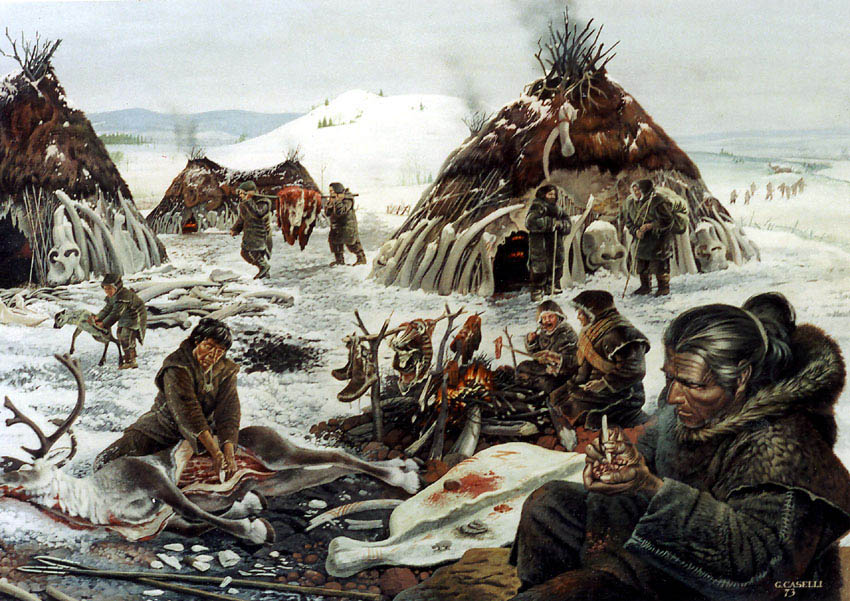
With the Great Leap, humans began doing more and more things beyond what ordinary animals did.  They baked ceramic figurines in kilns, made flutes, wore ornamental beadwork, sewed clothing, invented new and improved tools, and built trophy homes with mammoth bone walls.  These luxurious dwellings have been found in Ukraine, Czech Republic, Poland, Romania, Belarus, and Russia.

Venus figurines have been found in Slovakia, Italy, Austria, Russia, Germany, Czech Republic, Switzerland, France, Romania, and Siberia.  They were carved in soapstone, steatite, sandstone, mammoth ivory, horse bone, serpentine, black jet, antler, limestone, and hematite.  Venus figurines date from 30,000 to 10,000 years ago.

Folks learned how to process red and yellow ochre, hematite, manganese oxide, and charcoal into pigments useful for cave painting.  Wild artists crawled far inside caverns with torches, and painted gorgeous portraits of the sacred animals for which they had the deepest respect and reverence.  Images included the horse, lion, auroch, rhinoceros, salmon, bear, mammoth, buffalo, owl, hare, ibex, auk, weasel, reindeer, chamois, and fox.  Often, artists placed their spread out hand against a wall, and sprayed paint over it, creating a hand stencil.

Those folks did not spend most of their lives indoors, isolated from the wild ecosystem, like astronauts in orbit.  They had no glowing screens.  Their world was entirely wild and alive, and they were intimately involved in it, every minute of every day, bloody hands and all.  The paintings celebrate their sacred relationship with the animals that fed them, clothed them, and sometimes killed them.

Prehistoric cave art has now been found in every continent except Antarctica.  In France and Spain, it has been found in almost 340 caves.  Famous sites include Chauvet in France (30 to 32 thousand years ago), Altamira in Spain (15,000), and Lascaux in France (18,000).  Recently, D. L. Hoffman’s team found paintings in three Spanish caves that were more than 64,800 years old — about 30,000 years before the arrival of humans.  This was the Neanderthal era.

The Great Leap Forward has also been called the Cultural Revolution or the Cognitive Revolution.  Cognition is about thought, understanding, and knowledge.  Twenty years ago, some believed that the leap was the result of miraculous genetic mutations that turbocharged our intelligence, but that theory went extinct, for lack of convincing DNA evidence.

A number of experts theorize that the leap was encouraged by powerful advances in complex language and communication, but this is impossible to prove via archaeological evidence.  Spoken words are not preserved in fossils.  We may have been singers and poets several million years ago.  We’ll never know.  Many primates and other animals are vocal.

Some sort of Great Leap certainly occurred in snow country, maybe between 50,000 and 30,000 years ago.  Our tropical primate ancestors were excited to discover lands loaded with abundant food, but challenged by a life-threatening climate for which evolution had not prepared them.  The only way they could stay, and feast on the delicious wildlife, was to cleverly invent a collection of prosthetic technology that would increase the odds of winter survival.  Eventually, the accelerating pace of cultural evolution enabled us to conquer the planet, explode in numbers, and savagely vandalize Earth in every imaginable way.

While many of the innovations of the Great Leap were survival-oriented prosthetics, others were not.  Painting, ornamentation, figurines, flutes, and so on were probably motivated by spiritual affairs, or the desire for enjoyment.  Obviously, for a while, these were not folks who were desperately struggling to survive.  Their new indulgences would seem to indicate that these folks were living in a bubble of affluence, leisure, and decadence.  They had learned and refined the skills of survival, and their food resources were temporarily abundant.  They were rich.  Life was good.

They remind me of America’s baby boomer generation, of which I am a member.  We were born at a time when industrial civilization soared to ridiculous excesses, fueled by an orgy of consuming enormous amounts of premium quality nonrenewable resources, as if they were infinite.  Some have called this joyride in self-destruction “The Blip” — a brief extreme spike in many trend lines, something equivalent to an asteroid strike. 

History repeatedly reminds us that high impact lifestyles always have an expiration date.  Yet, despite being proud descendants of the Cognitive Revolution, our clever minds routinely refuse to comprehend this simple and vital idea.  Magical thinking is always an effective cure for the unpleasant deliriums caused by occasional whiffs of reality.

Anyway, over the long run, was it truly a leap “forward” into greater joy, wisdom, health, and sustainability?  Or, was it something else?  When was the planet healthier and happier?

Friday, March 1, 2019

Wild Free and Happy Sample 10


[Note: This is the tenth sample from my rough draft of a far from finished new book, Wild, Free, & Happy.  I don’t plan on reviewing more books for a while.  My blog is home to reviews of 199 books, and you are very welcome to explore them.  The Search field on the right side will find words in the full contents of all rants and reviews, if you are interested in specific authors, titles, or subjects.] 

Genetic Evolution

Charles Darwin achieved fame for popularizing the knowledge of genetic evolution, a normal and natural life process.  All living things have genes, and their offspring inherit copies of them.  No other critter, living or dead, possesses genes exactly like yours.  Each of the billions of cells in your body carries a copy of your unique genes.  Cells exist for a while, then die.  New cells are created to replace them.  Every hour, your genes are duplicated countless times as your body replaces dead cells with new ones. 

The genes in every cell are incredibly complex, and it is normal and natural for boo-boos to occur in the duplication process.  The mutations are purely random, and they are called genetic drift.  It is not unusual for mutated genes to be passed from parent to offspring.  For some offspring, random mutations might be beneficial in some way.  Other offspring can be diminished by mutated genes, leading them to become less able to survive, thrive, and reproduce. 

Everything on Earth, and all beings in the family of life, are constantly changing.  Food resources can increase or decrease.  Drought can be washed away by deluge.  Parasites, viruses, volcanoes, fires, floods, invasives… the wheels of change keep spinning.  Glaciers become tundra, tundra becomes grassland, grassland becomes forest, and then the parade reverses.  Stability is a temporary state, change is the long-term norm.  Evolution helps the family of life adapt and survive.  Species unable to adapt to change disappear from the stage.

In the animal world, if predators get too good at hunting, they deplete their prey, go to bed hungry, and maybe starve.  If prey get too good at escape, the growing herd will decimate the vegetation, and maybe create a desert, so everyone starves.  If the predators gradually become one percent faster, the prey gradually become one percent faster, not two.  Balance requires predators to be slightly better at their sacred obligation — limiting the herd — but not too good. 

The speed of genetic evolution varies.  Species with slow rates of reproduction, like elephants, can take many generations or millennia to adapt beneficial new features.  Evolution proceeds much faster in species with brief lifespans.  This is why pathogenic bacteria can quickly develop resistance to antibiotics, and insects to insecticides.  Some plants develop resistance to a new herbicide in as few as four years.  Some fungi can develop resistance to a new fungicide in just three years. 

We try so hard to control everything.  Big Mama Nature just howls with laughter, gushing tears, at our comical experiments in playing fake god, silly efforts that regularly bite us on the ass.  She has no use for two-legged stewards, or managers, or sustainable growth maniacs.  She gets along best with animals that are wild, free, and happy.  It’s survival of the fit-ins.  Ecological loose cannons need not apply.

Today, we’re living in an especially exciting time!  The treacherous sorcerers of innovation and progress have conjured a colossal curse on the family of life.  The curse has overloaded the atmosphere with crud, which is destabilizing the climate to a degree that seems certain to turbulently blindside life as we know it.  Thanks to genetic evolution, the surviving species will eventually adapt to wrecked ecosystems, and a heavily scarred family of life can continue on its sacred journey.

And now, dear reader, we need to stop here for a moment, sit down, take a deep breath, and have an extremely embarrassing birds-and-bees discussion on the difference between genetic evolution (yum!) and cultural evolution (danger!). 

Cultural Evolution

Genetic evolution is billions of years old, as old as life on Earth.  Its realm is the metamorphosis of genetic information over time.  Cultural evolution is the realm of learned information — beliefs, ideas, knowledge, and so on.  It has emerged recently, in the last few million years.  It’s essentially a hominin fad, a spooky quirk of swollen brains.  Innovation and progress are two of its monster children.  These children are as unpredictable as two year olds with a box of hand grenades.

In hominins, genetic evolution proceeds at a snail’s pace, but cultural evolution can boogie like a herd of gazelles on meth.  It might have taken our ancestors a million years to genetically evolve vicious claws and fangs, and we may have blinked out before succeeding.  Instead, cultural evolution inspired our ancestors to invent lances and javelins — fake claws and fangs. 

When someone’s leg is amputated, they can be fitted with a prosthetic leg, so they can walk again.  Dentures are prosthetic teeth.  Warm clothing is prosthetic fur.  Heated dwellings provide a prosthetic tropical climate, so tropical primates can survive far from their normal habitat.  Prosthetic claws and fangs eventually made the ancestors capable of killing critters bigger than themselves, bringing home more meat at the end of the day, and feeding more bambinos.

Chimps don’t do this.  They snatch insects and lizards with their hands.  Their small scale hunting is far less likely to rock the ecological boat.  This is why there are not seven billion pudgy chimps staring at cell phones while driving.  Indeed, their million year track record with this effective strategy has to be categorized as genuinely sustainable.  Chimps set an excellent example for the last surviving hominins — humans — who are beginning to swirl the drain.  Alas, we have been bedeviled by a compulsive obsession with every type of prosthetic device that greedy capitalists can imagine.  Zombie consumers endure mindless jobs in order to acquire and proudly display as many of this season’s trendy status symbols as possible.

Anyway, our ancestors got totally addicted to cultural evolution.  They shifted from chimp-type hunting, to stones and clubs, then scavenging, persistence hunting, thrusting spears, projectile javelins, bows and arrows, nets, snares, harpoons, horses, guns, and on and on.  Like junkies, prosthetic addiction requires shooting up bigger and bigger doses to continue experiencing the beautiful soaring flights of euphoria.  Like junkies, cold turkey withdrawal from prosthetic addiction is excruciatingly painful.  Imagine your president, and her husband, stumbling around naked in the Congo, gobbling termites, slugs, bird eggs, berries, and lizards.

Cultural evolution in weaponry enabled our ancestors to extract more food resources from the ecosystem, so the land’s carrying capacity for humans increased, for a while, as long as overhunting didn’t deplete the prey, and chill out the feast.  Each advance in hunting technology temporarily increased the food resources available for hungry hominins, encouraging their numbers to grow.  Inevitably, the ecological boat began to rock, and sometimes overturn. 

As you can see, innovation is risky.  It often has unintended consequences.  Chimps are conservative, and teach us that innovation is unnecessary for enjoying a million years of healthy sustainable living.  The humans that are currently decimating the chimps’ forest, and the entire planet, present a different, and very important lesson.

Chimps have almost no understanding of the human-caused Earth Crisis.  Their knowledgebase is modest, limited to local affairs, in the here and now.  They learn by observing and imitating their elders.  They lack the cultural information needed to destabilize the planet’s climate systems, acidify the oceans, eliminate forests, and generally behave like insane idiots.  They learn exactly enough to live sustainably from birth to death.  Perfect!

When I was a young lad, I was forced to spend years institutionalized in a series of educational penitentiaries.  Like an assembly line, students had their brains filled with cultural information.  I was taught about history, numbers, reading, writing, human supremacy, the daffy pursuit of status, and the sacred principles of unsustainable living.  Our mission in life was to get a job, work hard, accumulate status trinkets, and spend our lives moving as much stuff as possible from nature to landfills — a remarkably toxic game.  I shudder at the amount of stuff that has passed through my life.

Americans, British, and other colonizers created boarding schools for the children of the wild aboriginal people they conquered.  Kids were snatched away from their families, communities, and cultures.  They were forbidden to speak their own language, or sing their songs.  They had their brains filled with the cultural information of industrial civilization.  The kids suffered tremendous emotional damage from this brutal process, and many were seriously wounded for the rest of their days.

Priests used to boast: “Give me your child for his first seven years, and I will have him for life.”  The cultural information you are imprinted with in childhood usually solidifies like concrete, and those beliefs are carried until your final breath.  This works perfectly in sustainable wild cultures, where kids learn time-proven knowledge.  It sucks in super-toxic cultures, where everyone is taught to be mindless eco-terrorists.  Derrick Jensen once noted that unquestioned beliefs are the most dangerous and destructive things in the world.

Humans are not in serious trouble because of crappy genes.  Genes did not get us into this mess, culture did.  Every human that squirts out of the womb is a wild animal, ready to spend a lifetime in a healthy tropical ecosystem.  We don’t become batshit crazy critters until we are trained by a batshit crazy family and society.  If you had been born into a wild, free, and happy tribe in the Amazon rainforest, you would have grown up in a sane culture, and you would be living in a low impact mode that has respect and reverence for the natural world (until the maniacs on bulldozers arrive to introduce you to progress).

Genetic information is passed from one generation to the next via reproduction.  Cultural information is passed via words, images, and demonstration.  We acquire it from TV, websites, books, classrooms, conversations, and so on.  We absorb a knowledgebase that has accumulated over many generations.  Each new generation has no need to spend decades reinventing the wheel, clothing, or the fire drill. 

Paul Ehrlich once spent time among the Inuit of Hudson Bay, Canada.  He was surprised to discover that the entire knowledgebase of their cultural information was known by everyone — how to hunt seals, tan pelts, weave a net, sew a coat, and so on.  In Ehrlich’s own culture, nobody knows even a millionth of our cultural information.  It’s impossible to learn it all, and the knowledgebase is constantly growing, faster and faster.  Folks can get a PhD from Stanford without ever learning a single thing about science.  The survival of humankind is dependent on ecological sustainability, but most PhDs know nothing about it, nor do our political leaders.

Here’s a half-happy idea: William E. Rees reminded us that cultural evolution is also subject to something like natural selection.  Maladaptive cultural mutations, like the belief in perpetual growth, limitless resources, or utopia-bound progress will eventually push the civilization off the cliff, into the compost bin.  Stuff like motorized transport, industrial manufacturing, and agriculture will inevitably go extinct because depletion of resources will pull the plug on them.

The more daunting challenge has to do with wisely and deliberately tossing overboard the maladaptive hallucinations that infest our throbbing thinkers — hierarchy, patriarchy, human supremacy, materialism, disconnection from nature, and so on.  Our culture never stops pushing us to run at full speed to the cliff.  We are completely unprepared to proceed with a healthy, cleansing, cultural evolution enema.

Thursday, February 14, 2019

Wild Free and Happy Sample 09


[Note: This is the ninth sample from my rough draft of a far from finished new book, Wild, Free, & Happy.  I don’t plan on reviewing more books for a while.  My blog is home to reviews of 199 books, and you are very welcome to explore them.  The Search field on the right side will find words in the full contents of all rants and reviews, if you are interested in specific authors, titles, or subjects.] 

The Dance of Hominin Evolution

Experts have endless lively disputes about many aspects of hominin evolution.  There were many predecessors to Homo sapiens, but an accurate lineage of the hominin family tree does not exist, and probably never will.  The physical evidence discovered so far is extremely incomplete.  It’s like a million piece jigsaw puzzle where more than 99 percent of the pieces are missing, and most of these have disintegrated over time.

Evolution does not resemble automobile assembly plants, where production of 2018 models completely ends on a fixed date, and the process of building new and improved 2019 models begins.  The transition from one species to the next is a blurry process that can take hundreds of thousands of years, and isolated groups of the same species can evolve in significantly different ways. 

In addition to arguments over the branches of the family tree, the dates assigned to specific events are also controversial and inconsistent.  Technology for dating specimens has advanced over the years, and different technologies often produce very different dates for the same bone or artifact.  Also, ongoing field work continues to make new discoveries.  So, did Homo sapiens emerge 190,000 years ago, or 300,000?  Did they arrive in Europe 50,000 years ago or 36,000?  And so on.  Numbers are slippery.

If we step back a bit, and disregard numeric dates, there is general agreement on a number of big picture trends.  Homo erectus is much older than Neanderthal, and both are older than Homo sapiens.  Homo sapiens evolved in Africa, and Neanderthals did not.  Erectus and Neanderthals are not associated with megafauna extinctions, but our species certainly is.  For the purposes of this book, the trajectory of trends is important — event A preceded event B.  All numeric dates presented here are controversial.

Although the Earth Crisis has roots much older than Homo sapiens, our species is playing a starring role in this catastrophic tragedy.  For this reason, the following chapters will primarily focus on humans, and the emergence and expansion of some highly destructive cultures.  But first, a few comments on two notable cousins.

Erectus and Neanderthal

Homo erectus emerged maybe 1.9 million years ago, and eventually spread across some of the warmer regions of Africa, Asia, and Europe.  They may have been an early ancestor of modern humans.  Erectus hunted, gathered, and used stone tools.  They were the first hominins to evolve a larger than average brain, and they may have been the first to domesticate fire.  Erectus maybe walked off the stage somewhere between 200,000 and 50,000 years ago.  Their long era of existence does not correspond to extinction spasms or serious ecological injuries.  Erectus apparently lived on Earth much longer than Neanderthals did.

Neanderthals probably evolved north of the Mediterranean, not in Africa.  Their remains have been found in Siberia, the Middle East, and Europe.  The earliest discoveries date to maybe 350,000 years ago.  We share up to 99.9 percent of our DNA with them.  Because they lived in non-tropical regions, they evolved thick bodies with large bones that provided greater strength and better cold tolerance.  Elizabeth Kolbert noted that modern humans have up to four percent Neanderthal DNA. 

Erectus, on average, had 1,000 cc brains.  Neanderthals were the brainiest hominins, at 1,600 cc.  Sapiens averages a modest 1,350 cc.  Could our smaller brains be the result of having access to cutting edge new technology (javelins, harpoons, bows and arrows, etc.)? 

Kathleen McAuliffe reported on research finding that human brains have shrunk about 10 percent in the last 20,000 years.  The Homo sapiens with the biggest brains lived in Europe 20,000 to 30,000 years ago.  They were the Cro-Magnons, who had to overcome the many new challenges of surviving in snowy ecosystems, while fending off hungry cave lions, cave hyenas, and saber-tooth cats.  The shrinking brain trend has been found in China, Europe, Africa, and even Australia, which remained Stone Age until 1788.  Why?  Perplexed experts propose some theories, but they don’t know for sure. 

One study found that brains get smaller as population density increases.  Tim Flannery suggests that modern consumers live like cattle on a feedlot, all our needs conveniently provided.  We no longer have the skills or knowledge to survive in the wild.  Thirty species of animals have been domesticated, and for every one of them their brain volume was 10 to 15 percent smaller than their wild ancestors.  Some think that humans domesticated themselves.

Anyway, the trademark Neanderthal weapon was a heavy thrusting lance.  Hunters had to slowly, silently, and very skillfully approach the prey undetected, then suddenly charge the animal, firmly gripping the spear with both hands, and ram it deep into its flesh.  Readers who have hunted hippos with wooden thrusting spears know that this can be very dangerous.  One site in Croatia contained the remains of 75 Neanderthals, and none were older than 35.  Many of their bones had healed fractures, suggesting painful accidents or encounters with fierce animals.  Dying of old age was unlikely.

The climate of the Neanderthal era was like a roller coaster.  In Europe, they were pounded by an era of extreme cold maybe 70,000 years ago.  From maybe 50,000 to 30,000 years ago, the climate was a spastic freak show.  Clive Finlayson noted that the climate often flip-flopped between warm periods and intensely frigid.  Radical shifts could arrive suddenly, and last hundreds or thousands of years, all across Eurasia.  Youngsters might grow up in a chilly steppe ecosystem that used to be a comfortable forest in the days of their grandparents.

Would Neanderthals have become the modern global primate if Homo sapiens had blinked out in Africa?  I sometimes wonder if real estate was a significant limiting factor.  Caves were luxurious addresses during glacial centuries, compared to hide-covered teepees or huts.  The primo caves were south (sun) facing, and ideally overlooked the seasonal migration routes of animal herds.  But there was a limited number of caves, and many were not vacant.  Neanderthals were always welcome dinner guests when they stumbled into caverns inhabited by hungry, jumbo-sized cave lions, cave hyenas, and cave bears.

In warmer and wetter periods, glaciers retreated, and tundra transformed into forest and grassland, habitat for critters like red deer, horses, and moose.  In colder and drier periods, glaciers advanced, forest retreated, and tundra returned, as did mammoths, woolly rhinos, and reindeer.  Neanderthals listened to their growling tummies, and went where the meat was.  They migrated northward in warmer eras, and retreated south when blast freezers returned.  The last Neanderthals died on the sunny shores of the Mediterranean, in Gibraltar, maybe 40,000 to 28,000 years ago.  This was definitely after the arrival of humans in Western Europe, and before the spasm of megafauna extinctions on the continent.

Our human supremacist culture routinely preaches that Neanderthals were pathetic dullards.  During their long vacation in Europe, maybe 270,000 years, Neanderthal technology didn’t change much.  From the supremacist perspective, Neanderthals’ 350,000 year era of stable, low impact, ecological sustainability was indisputable proof of low intelligence. 

Elizabeth Kolbert absolutely disagreed.  Neanderthals lived in Europe for a very long time while affecting their ecosystem no more than any other large mammals.  Flannery noted that, for hundreds of thousands of years, Neanderthals coexisted with straight-tusked elephants, mammoths, and woodland rhinos — without driving them extinct.  If humans had never wandered in from the Middle East, Europe might still be a wild, free, and happy celebration of Neanderthals, Irish elk, saber-tooth cats, straight tusk elephants, and aurochs.  What’s wrong with that?

Everything!  The supremacists leap to their feet, jump up and down, spitting, shouting, smashing bottles.  Humans are blessed by incredible intelligence, brilliant innovation, complex hunting weapons, sophisticated language skills, artistic creativity, decorative ornaments, and the powerful ability to invent totally irrational beliefs, accept them as absolute truth, and exterminate large numbers of nonbelievers.  Ancient mystical stories invented by Homo sapiens proudly assert that Homo sapiens is the absolute Crown of Creation, and the rest of the family of life was provided for our sustenance, amusement, and assorted perversions.

OK.  Stop right here.  Reread the list of human blessings in the previous paragraph.  For the most part, these are not characteristics of species that managed to live sustainably for more than a million years, like the chimps, baboons, lions, horses, and on and on — “ordinary animals” in other words.  In the big picture, it’s not irrational to conclude that the unusual intelligence we have acquired is powerful, dangerously irrational and destructive, and has become the primary threat to our continued existence.

For 150+ years, it has been a normal and respectable tradition for scholars and theologians to line up and urinate on the stupid Neanderthals.  European intellectuals were quite sure that the Garden of Eden was located rather close to London.  They were stunned and bewildered by the growing evidence that the ancestors of all hominins trace back to Mother Africa.  All Homo sapiens living 50,000 years ago had beautiful dark skins.   Oh my God!  It can’t be true!  Horror!

In 2014, Paola Villa and Wil Roebroeks reexamined the traditional beliefs in Neanderthal inferiority, to see if the latest archaeological research still supported them.  They did not find compelling data.  They also pointed out that the traditional beliefs of human superiority in language, symbolic communication, cognitive abilities, and abstract thinking were impossible to prove via archaeological data.  These were the biased opinions of supremacist imaginations.  Science is not required to be rational, and very often isn’t.

Sustainability Doesn’t Suck

Anyway, Neanderthals demonstrated that bipedal primates with huge brains can live sustainably for several hundred thousand years, in extremely challenging conditions, without agriculture, metal making, animal enslavement, fish mining, deforestation, or writing.  In fact, stability is not a problem or flaw.  Stability sounds like a fun and healthy alternative to mindless perpetual growth, fanatical eco-destruction, and devastating hurricanes of irrational illusions.

Clive Finlayson reminded us that no animal species can foretell the future.  When life is comfortable, and the ecosystem is not being ravaged, the safe and intelligent option is to be conservative, and remain on the well-worn time-proven path.  But when the <bleep> hits the fan, and traditions totally fail, innovation might be a less dangerous option.  The path of innovation is risky, often leading to unintended consequences and bloody surprises.  In worst case scenarios, innovation can backfire spectacularly, as 7+ billion people are now painfully discovering.  Yikes!

Chris Stringer reminded us that the myth of progress is a new idea.  The notion of utopia-bound continuous improvement is a bit over 200 years old.  Civilization was imagined to be an upward spiral. 

But in earlier civilizations, mobs of loonies were furiously mowing down ancient forests, triggering landslides, flash floods, and harbors choked with silt.  Each new generation inherited an ecosystem that was obviously in worse condition.  The passage of time was seen as a downward spiral of decay and decline, an inevitable one-way descent into social and ecological Armageddon. 

Hesiod, an ancient Greek thinker, described the glorious days of his venerable ancestors as the Golden Age, when men were pure and lived like gods.  It was followed by a descent into the Silver Age, the Copper Age, the Bronze Age, and finally the Iron Age, when men were violent, foul-mouthed, and fascinated by every form of evil.

Stringer noted that the wizards of modern society are possessed by an overwhelming and irrational blind faith in progress and perpetual growth.  We are far more advanced than Neanderthals, and they were better than Erectus.  You and I are lucky to enjoy the amazing pinnacle of billions of years of evolution.  Stringer does not see this as proof of divine destiny.  He believes that the fact that Neanderthals blinked out, and we didn’t, was largely a result of chance.  We survivors were assisted by the good fortune of being in the right place at the right time.

For example, about 70,000 to 75,000 years ago, the Mount Toba super volcano erupted on the island of Sumatra, spreading enormous amounts of ash.  In some regions of India, up to 19 feet (6 m) of ash accumulated.  Much incoming sunlight was blocked, and global temperatures may have dropped by 3° to 5°C for several years.  Others imagine an intense thousand year instant ice age.  Still others suspect far less global impact.  One theory, presented by geneticists, asserts that the human population plunged to 5,000 to 10,000 individuals — implying that we nearly went extinct.  Others point out that there is no evidence of extinction spasms among mammals at this time.  It’s not easy being an expert on days long past.

Anyway, Stringer suggests that if a similar eruption had happened closer to Africa, instead of Sumatra, it could have been game over for our species, but maybe not Neanderthals, who resided north of Africa.  Or, today might look very different if the rollercoaster of ice ages had occurred in a slightly different pattern over the last 200,000 years.  The outcome could have easily been quite different.  Chance is powerful juju.  Stringer is not a member of the progress cult.  He believes that our long-term future is entirely unpredictable.   I agree.