Showing posts with label Europe. Show all posts

Saturday, November 21, 2020

Wild Free and Happy Sample 50


[Note: This is the fiftieth sample from my rough draft of a far from finished new book, Wild, Free, & Happy.  The Search field on the right side will find words in the full contents of all rants and reviews.  These samples are not freestanding pieces.  They will be easier to understand if you start with sample 01, and follow the sequence listed HERE — if you happen to have some free time.  If you prefer audiobooks, Michael Dowd is in the process of reading and recording my book HERE.

PATHWAY TO DOMINATION

As discussed earlier, humans originated on the tropical savannahs of east Africa.  For most of the human saga, we were strong, healthy, nearly naked tropical critters with beautiful brown skin and curly hair.  In the tropics, winters were not cold, and food was available year round, so there was no need to preserve and store food.  There was no need to invent technology for staying warm, like protective clothing and shelter.

Because they were nomads, hoarding personal belongings would have made no sense.  Hauling stuff across roadless wilderness was hard work.  Because they lived simply, they didn’t need much stuff.  Instead, their survival largely depended on the knowledge stored in the glop between their ears.  For them, the keys to survival included cooperation and sharing, working well together.  Hunter-gatherers were egalitarian, everyone was equal.  Nobody gave orders, or took them.  No one went hungry unless everyone did.

The berry patch was freely open to all.  If a wandering forager picked some berries, they were hers to share and eat.  If I killed a kudu, the event was a perfectly normal and natural, like the sun rising at dawn.  Nobody owned the animal, no one got upset.  It would be carried back to camp, shared with the band, making everyone happy.  All was good.  If a lion ate my brother, nobody exploded with rage.  Lions ate many brothers and sisters, because they were good to eat.  We all feed each other.

In the tropics, some sort of food was generally available year round.  From week to week, folks knew the prime time for various munchies, and where to find them.  They regularly visited the wild buffet, and took what they needed from the daily specials.  Long term food storage was unnecessary and absurd. 

Big Mama Nature devoted a couple million years to fine tuning the evolution of tropical primates for survival in tropical climates, our home sweet home, where we belonged.  Compared to today, our ancient ancestors would seem to have been simple, stable, sane, and sustainable.  They were not two-legged category 5 hurricanes, like modern consumers.  Things were relatively cool for a very long time (sort of).  It wasn’t until much later that some sorcerers discovered the Fountain of Progress, guzzled its hallucinogenic fluids, and started smashing things.

Snow Country Colonization

As discussed earlier, maybe 100,000 years ago, some intrepid pioneers began migrating from Africa into Asia.  They wandered eastward through tropical lands, eventually reaching Australia.  The pioneers had a great time, and found many wonderful things to eat.  Quite a bit later, some of them wandered northward, into regions having a temperate climate, snow country. 

In portions of northern Eurasia, they discovered vast steppe and prairie grasslands that spanned from central Europe, east to the Pacific coast.  Temperate grasslands were ideal habitat for nurturing large herds of large herbivores, the food most cherished by hunter-gatherers.  It was as if they had stumbled into an unimaginable Serengeti-like heaven of limitless meat.  Joy!

Oddly, this was a bit like polar bears migrating into steaming hot Congo rainforests.  The notion of tropical primates colonizing snow country was equally silly.  The colonists were not born with fur coats.  They were not capable of hibernation.  They were too big to easily travel across deep snow, or thin ice.  Food was scarce during the winter months.  They knew little if anything about food preservation and long-term food storage.  But they were spellbound by the availability of so much meat!  Might there be some way that they could possibly make a home in this land?

The colonists proceeded to improve their skills at hunting, trapping, and surviving the long and frigid winters.  Over time, they got a bit too skilled.  As generations passed, the abundance of game gradually diminished.  Some species blinked out forever.  By and by, folks began fooling around with horticulture and herding, setting the stage for the dawn of plant and animal domestication.

I’ve already pointed out the obvious fact that the domestication of plants and animals was a sharp change of direction in the human saga.  It forced us into the express lane to a turbulent future.  I must emphasize that it’s also important to understand that the mere fact that hunter-gatherers successfully colonized snow country — thousands of years before domestication — was itself a crucial turning point, a necessary prerequisite.  Domestication originated in regions having a temperate climate, as did the first civilizations.  Colonization unlocked the gate to dangerous realms.

Energy Storage and Risks

In snow country, hunters faced more challenges than their ancestors had in Africa.  Back in the tropics there was no frigid season, so no need for the long-term storage of food energy.  If hyenas snatched the kudu you just killed, you may have lost one day’s effort, or less.  In snow country, the two options were store energy or starve.  Many weeks of hard work were invested in creating their winter food stash, lots of eggs in few baskets.  On any day, it could be raided by rodents, wolves, dogs, bears, or other hungry visitors.  A sudden hot spell could melt frozen meat and spoil it.

Of course, compared to snow country hunters, the farmers and herders faced more and bigger challenges.  From planting to harvest, a farmer’s crops were vulnerable to many potential risks (weather, fire, insects, disease, deer, bunnies, etc.).  Once the harvest was brought in, the granary was loaded with valuable energy for future use, something like a tank of oil.  It was a treasure chest that stored the concentrated results of countless hours of hard work — like a crisp new $100 bill, not a mere handful of pennies.  Carefully stored energy could be an irresistible temptation to folks who weren’t your best buddies. 

Likewise, herders invested loads of time and effort in creating impressive treasure chests of living flesh.  Herding was not risk free.  Late at night, your livestock could be quickly driven away by thieves.  Wild predators could pick them off.  During a long drought, or when anthrax or rinderpest came to visit, the herds in a region could be obliterated.  At any time, you could lose the stored treasure of a year’s hard work, or more.  Nothing was insured.

Livestock herds were overseen by masters who firmly controlled their movements, protected them from predators and raiders, and blocked their escape attempts.  Lifelong enslavement made it easy for masters to acquire their meat, milk, blood, hides, and wool whenever needed.  Imagine spending your entire life subservient to a dominator who eventually intended to cut your throat, strip off your hide, and eat you (and your kids). 

In snow country, when hunters, farmers, or herders enjoyed a lucky streak, it could lead to population growth, which could lead to increased tension and conflict.  More folks expected a piece of the pie, and some got wee slices.  Treasure chests, of course, have a long tradition of inspiring the belligerent behavior of aggressive parasites.  One successful day of raiding could snatch the rewards of months or years of toil, an outstanding profit.  Very clever!

More is Better

The colonization of snow country, and the necessity of food storage, inspired a new meme: more is better.  Having adequate energy storage was mandatory, but having even more was better still.  When good luck disappeared, it could be a blessed life saver. 

Folks painfully understood when they were dangerously hungry.  They also understood when life was kind to them.  Oddly, many humans seem to have a hard time perceiving the border line between enough and way too much.  In their brains, the idiot light that indicated [ENOUGH] never came on.  More was always better.  Too much was impossible.  Why do wobbly wrinkly 85 year old gits, with a billion dollars stashed away, still put on a suit and tie every morning and strive to hoard even more?

Herds of livestock were self-propelled warehouses of living meat that didn’t spoil.  Provided with grass and water, their bodies added more meat every month.  So, more is better was an intoxicating idea, until the land was stripped of vegetation, and herders experienced the painful revenge of merciless limits.  Farmers could farm like crazy, year after year, until their topsoil was drained of nutrients or ran away.  Limits spoil rowdy parties.

Of course, for our wild ancestors who remained in the tropics, the more is better concept was absolute nonsense.  It was impossible for nomadic folks to make use of more than enough (too much = waste).  They couldn’t haul surplus with them, and in the hot climate, it would spoil, or attract pests and scavengers.  It wasn’t until much later, when domesticated crops and livestock were imported into Africa, that tropical folks began suffering from serious more is better deliriums.  Prior to this, enough was enough, and they all lived happily ever after.

Control Freaks

Big Mama Nature is fully aware that unusual population outbursts in any species can destabilize healthy ecosystems.  She generally does what’s needed to restore balance.  The current human outburst has become a spectacularly destructive living asteroid.  It’s now traveling at maximum velocity toward an invincible fortress of merciless limits that will take great delight in splattering the juggernaut.  There will once again be peace on Earth (and a staggering mess).

Domestication triggered a shock wave in the human saga.  It radically altered the traditional core relationship between humans and the rest of the ecosystem.  For maybe two million years, hominins were participants in a family of life that joyfully danced to the ecstatic music of freedom.  Then, domestication gave birth to a monster child, a new and obscene verb named control.  Devilish anti-freedom.  The toxic juju of control has infected the relationship, rendering it dysfunctional and violently abusive.

During the hunter-gatherer era, folks foraged for wild plant foods, and took what they needed.  This wasn’t a labor intensive control-oriented process of clearing, tilling, planting, weeding, etc.  The shift to agriculture transformed healthy sustainable wild landscapes into unsustainable radically simplified manmade food production systems.  Wild and free are the opposite of controlled.

Hunting was the pursuit of wild game, which required a combination of skill and random chance.  Wild game is intelligent, alert, and driven by a powerful desire to avoid predators.  Being alive is precious.  Wild game is out of control.  They are not passive dimwitted sheep in the pasture, constantly overseen by shepherds and dogs.  Herding is the process of controlling enslaved animals, for every minute of their lives.  When the herder needs meat, he selects which animal dies.  Escape is impossible.

Agriculture was a sedentary enterprise, the farmer was firmly bound to a specific piece of land.  When danger approached, the granary treasure chest could not be easily moved to a safe place, because it was not self-propelled, like livestock.  Depending on the threat, a farmer could defend it (and maybe die), or abandon it (and maybe starve).  High vulnerability, and a desire to survive, inspired farmers to reside in villages, and benefit from mutual defense.  Over time, as threats increased, villages became walled and fortified cities.  Over time, a warrior class emerged, to molest incoming attackers, and to attack and rob vulnerable outsiders.

Many farmers didn’t have the time, space, or desire to keep much livestock, but herders did.  Herders who had access to extensive open grasslands could pursue a very different way of life, and they did.  Indeed, the mindset of pastoralism eventually achieved great power.  It provided the foundation for the mindset of the world as we know it (stay tuned, more later).

Mother Africa Infected

Lyall Watson wrote a fascinating biography of Adrian Boshier (1939-1978), a young British man who went to South Africa and walked a path of power.  During his first six years in Africa, the lad spent most of his time in the bush, learning the ways of the land, rewilding.  He would head off into wild country with nothing but a pocketknife and a bag of salt (for trading), and live off the land for as long as he wanted. 

Boshier became highly skilled at catching and befriending dangerous snakes.  Walking into a village wrapped up in a 14-foot python (4.2 m), he terrified the natives, giving birth to his reputation as a powerful magician.  He would catch an eight-foot cobra, milk its venom, and drink it before a gasping wide-eyed crowd. 

Prehistoric cave painting in Europe gets a lot of attention.  African cave art gets less.  Boshier visited many caves, because the rock art in them had immense spirit power.  One day, he sat in a cave in Makgabeng, and had a chilling experience when his eyes focused on a horrific heartbreaking image.  The artists were likely San people, the original residents.

Mother Africa is where the human saga began, an evolutionary adventure spanning back maybe two million years, when early hominins came down from the trees.  There’s a good chance that the San people are the ancestors of most or all humans alive today.  Around 100,000 years ago, some Africans began migrating into the Eurasian landmass, where they eventually learned how to survive in a temperate climate, and then much later conjured plant and animal domestication into existence.

The images that had filled Boshier with horror were portraits of fat-tailed sheep, critters domesticated in the Middle East.  Sheep were not indigenous to sub-Saharan Africa.  They were brought to Africa by folks who were returning to Mother Africa, their ancestral homeland, with some new and creepy habits.  Some say the Bantus brought the sheep, others suspect the Khoi (Hottentots).  Whoever brought them, they were symbols of a dark transition.  The family of life in Africa was, for the first time ever, no longer entirely wild and free.  Hideous manmade freak show critters had arrived, along with a freak show culture of control and domination.  Trouble ahead.

Watson lamented, “The introduction of a pastoral economy, starting perhaps three or four thousand years ago, seems to have marked the beginning of a relentless destruction, now almost complete, of the earliest way of human life.  It was the end of a society that had discovered how to live in harmony with — rather than at the expense of — nature.”

 [Continued in sample #51]

Thursday, August 1, 2019

Wild Free and Happy Sample 20


[Note: This is the twentieth sample from my rough draft of a far from finished new book, Wild, Free, & Happy.  I don’t plan on reviewing more books for a while.  My blog is home to reviews of 201 books, and you are very welcome to explore them.  The Search field on the right side will find words in the full contents of all rants and reviews, if you are interested in specific authors, titles, or subjects.] 

Imperceptible Overkill

It’s easy to become perplexed when contemplating the megafauna extinctions.  Paul Martin described the process in North America as a blitzkrieg, an ecological catastrophe that was largely accomplished in a mere thousand years or so — far faster than the earlier extinction spasms in the Old World.

Obviously, the North American spasm was only lightning fast in an evolutionary timeframe.  From the perspective of living humans, a thousand years is quite a while.  I expect that some of my readers are younger than 200.  A much earlier spasm in Africa took place over hundreds of thousands of years.  These hominin ancestors were apparently still cadets in their ability to hunt slightly too hard.

All animals pay careful attention to the here and now, in the immediate vicinity.  Few, if any, think about tomorrow or next year.  Wild ecosystems, and the weather, exist in a state of constant change.  It’s impossible to predict what living conditions will be like a year from now, or in two months.  What game will be plentiful?  What will be scarce? 

Small isolated bands of people were living in a vast wilderness, unaware of current conditions in every surrounding hill and valley.  There was no way they could accurately monitor the populations of game animals.  When hunting was bad, they couldn’t know why.  Was the herd declining, or had they wandered elsewhere to visit relatives?  An ecosystem is not an enclosed laboratory where everything can be precisely measured and controlled.  Hunting is a game of chance.

Anthropologists have reported that some hunter-gatherer cultures, who survived into recent times, understood the risks of overhunting.  They developed rituals and taboos for avoiding it.  Richard Nelson wrote that when deer numbers declined, the Koyukon people stopped hunting them for several years, and ate other critters instead.  Also, when game was abundant, they would stop hunting in a portion of their domain, creating a refuge where game could get a break from hunting, and recharge their numbers.  Sometimes mindful efforts at conservation worked well.  Sometimes folks starved.  Humans were not in full control.

Two important factors in megafauna extinctions were shifting baseline syndrome, and the low reproductive rates of large game animals.  Shifting baseline syndrome describes the fact that our conception of “normal” is continuously changing.  Kids in school today can’t imagine a world without smart phones, video games, and access to unlimited sources of entertainment.  When I was born in 1952, there were five billion fewer humans on Earth.  In my childhood, the only glowing screen was a small black and white TV with four boring channels that shut down out at 11:00 P.M.  In those days, we kids regularly played together outdoors all the time, and communicated by actually speaking to each other, face to face.

“Normal” in 1960 was far different from normal in 1990, or 2020.  My perception of normal fishing is far more modest than my father’s, my grandfather’s, and so on.  Each generation experiences fewer and smaller fish, yet each considers the reality they experience to be the normal state.  Pleistocene hunters did not know how abundant game was in their grandfather’s days, or 500 years earlier.  Nobody probably noticed if the number of mammoths was gradually declining.

Fernando Fernandez concluded that the primary factor in megafauna extinctions was the fact that the jumbo-sized walking meatballs that hunters eagerly desired did not reproduce like bunnies or cockroaches.  Killing them just slightly above their fertility rate could wipe them out over the passage of centuries.  It wasn’t so much about the intensity of the hunting as the fragility of the hunted.  Over a thousand years, and many generations of hunters, extinctions may have been essentially invisible.

Elizabeth Kolbert noted that modern elephants do not reach sexual maturity until their late teens, each pregnancy takes 22 months, and there are never twins.  Because they reproduce so slowly, mammoths could have been driven to extinction by nothing more than modest levels of hunting.  Doug Peacock estimated that taking only 4 or 5 percent of a slow breeding species could put them on a gradual path to extinction.  Peter Ward estimated that if hunters had regularly taken just two percent of the mammoths each year, the extinction process would have taken 400 years — too slow for each generation of hunters to notice.  Hunting alone could have wiped them out.

Kolbert wondered how Neanderthals had lived in Europe for more than 100,000 years without causing weird disturbances.  She suspected that if humans had never arrived, the good old days of abundant megafauna would have never ended.  Prior to the arrival of skilled teams of human hunters, jumbo size provided a survival advantage.  Megafauna thrived in Eurasia and the Americas 50,000 years ago, before trouble rumbled in — at which point being huge and slow became a serious vulnerability.  Kolbert was not sure if there was ever a time when humans lived in ecological harmony.

Pita Kelekna wrote that large herds of wild horses were once common in the river valleys of western and central Europe.  By about 8,000 years ago, they were nearly eliminated by overhunting in most of the continent, except in a few small pockets.  Several writers concluded that domestication probably spared horses from extinction.  Folks learned that horses were more valuable for transportation, and as beasts of burden.  There were many other delicious critters to feast on.

Australasia

The Australian extinctions probably occurred between 50,000 and 40,000 years ago, following the arrival of humans.  Tim Flannery described how ecosystems went through a number of substantial changes, as the early Aborigines learned how to survive in an unusual land, via trial and error.  He believes that they finally learned how to live in relative balance by around 12,000 years ago. 

Australia was blessed with having ancient worn-out soils, and a bipolar climate.  Severe droughts could last years, which might suddenly end with terrific deluges.  Thus, Australia was a lousy location for the emergence of agriculture and civilization.  Aborigines retained a Stone Age way of life until 1788, when British colonists arrived, and attempted to transplant an English way of life to a land for which it was not ideal.

Humans arrived in New Zealand between 800 and 1,000 years ago, and by 400 years ago the moas were extinct.  Moas were ostrich-like birds that could grow to 10 feet (3 m) tall, and weigh 550 pounds (250 kg).  Many collections of moa bones have been found, some containing the remains of up to 90,000 birds.  Evidence suggests that a third of the meat was tossed away to rot.  Obviously, the birds were super-abundant and super-easy to kill.

In the global eco-catastrophe that we are experiencing today, Australasia did not historically play a leading role.  The planet-thrashing juggernaut, which was born in Africa, gained a lot of strength and momentum when humans migrated into snow country, where a challenging climate inspired a surge in techno innovation.

Europe

In Europe, the era of megafauna extinctions corresponded to the arrival of human colonists.  Most of the extinctions occurred in two spasms — from 45,000 to 20,000 years ago in the warmer south, and from 14,000 to 9,000 years ago in the cooler north.  The process was much faster than the earlier extinctions in Africa.  Two million years ago in Africa, our pre-human ancestors were smaller, and still learning the basics of big game hunting.  The humans who later colonized Europe were bigger, stronger, and better equipped for hunting.

Paul Martin had an intriguing notion.  In the tropics of Africa and Asia, the warm climate favored the existence of infectious diseases and parasites that tropical primates were vulnerable to, like sleeping sickness and malaria.  Maybe these pathogens limited the size of hominin populations, thereby boosting the survival of large game.  In the cooler climate of Europe, the pathogens that could harm humans were fewer in number or less virulent.  In snow country, maybe healthier humans lived longer and hunted more. 

Below is a sampler of some of the species that blinked out in Europe.  Most had been around for more than a million years, and had survived multiple ice ages.  This list is far from complete, and highly oversimplified.  These species had survived for a very long time, but their luck ran out following the arrival of humans.

Irish “elk” were actually a species of large deer (not elk).  They existed for several million years, including 400,000 years in Europe.  The last ones died 7,700 years ago in the Ural Mountains.  They lived throughout Europe, east to Siberia and China, and south to northern Africa.

Straight-tusked elephants were in Europe by around 780,000 years ago, and vanished 30,000 years ago.

Cave hyenas were gone by 13,000 years ago, after 3.5 million years.  They dined primarily on horses, steppe wisent, and woolly rhinoceros.  Large hyenas could weigh up to 225 pounds (102 kg).  They inhabited northern Africa, the Middle East, and much of Europe, and Asia.

Cave bears emerged about 1.2 million years ago, and vanished 29,500 years ago.  They ranged from Britain and Spain, east across much of Europe, and into Russia and Iran.

European cave lions were quite similar to the lions still alive in Africa.  The two lines diverged about 1.9 million years ago, and the European cats went extinct 13,000 years ago.  They ranged in a wide belt from Spain and southern England, to Siberia, Alaska, and the Yukon.

European hippopotamus ranged across Europe, from Spain to Britain to Greece.  They emerged 1.8 million years ago, and went extinct 24,000 years ago.

Woolly Mammoths emerged 400,000 years ago in Eurasia, and went extinct in Europe 10,000 years ago.

Woolly rhinoceroses were living on the Tibetan Plateau 3.6 million years ago.  They were common throughout Europe and northern Asia, from Spain to China.  They survived until 10,000 years ago.

Americas

Paul Martin created much controversy with his theory that many of the extinctions in North America took place within a thousand years.  Among his critics were Native Americans, who were offended by the implication that their ancient ancestors foolishly hunted too hard.  For them, Martin’s ideas had the stinky aroma of racism.  The dating of the fossil specimens found so far does not rubbish his theory.  He did acknowledge that the extinctions seem to have ended about 12,000 years ago, but by this time, all the remaining large species had probably learned, the hard way, that primates were dangerous predators.

In an attempt to sidestep accusations of racism, a number of experts have tried to shift the primary blame to climate change, but that theory does not hold up as well to scrutiny.  Efforts to place the blame on epidemic animal diseases have yet to discover supporting evidence.  In the last 50,000 years, there is a clear pattern that megafauna extinctions routinely followed the arrival of humans into new continents — not the ups and downs of glaciation cycles.

As humans crossed into North America from Siberia, hunting began in northwest Canada, and spread south and east like a wild fire.  Peter Ward wrote that within one to two thousand years, at least 33 genera (50 species) of large mammals went extinct — far more than in the preceding three million years, which included numerous glaciation cycles.  Many of those that disappeared had lived in America for tens of millions of years. 

To put the North American extinctions in context, let’s take a peek at some of the evidence. 

Elephant family species immigrated into America from 1 to 15 million years ago.  There were at least seven varieties (mammoths, mastodons, etc.).  They survived until 12,000 years ago.

Horses originated in North America about 4 million years ago, and later spread into South America, Asia, Europe, and Africa.  They were extinct in North and South America by 8,000 years ago.  The Equus genus includes horses, asses, and zebras. 

Saber-tooth cats emerged in Africa 12 million years ago.  Some types could grow up to 620 pounds (280 kg).  They have been found in North America, South America, Eurasia, and Africa.  They went extinct in Africa 1.4 million years ago.  In North America they vanished 10,000 years ago.

Scimitar-tooth cats emerged in Africa about 4 million years ago.  They vanished from Africa 1.5 million years ago, from Eurasia about 28,000 years ago, and from America about 12,000 years ago.

American lions originated in Africa over a million years ago, and migrated into North America, as far south as Central America.  They went extinct around 11,300 years ago.

Camels originated in North America maybe 40 million years ago.  By 2 to 5 million years ago, some had crossed into Asia, and spread into Africa.  In North America, they went extinct 10,000 years ago.  They still survive in the Old World.

Short-faced bears were among the largest land dwelling mammalian carnivores on Earth, and they were abundant in California.  The species emerged about 1.8 million years ago, and went extinct about 11,000 years ago.

Giant armadillos were mammals that originated in South America 5.3 million years ago, migrated into North America, and went extinct about 12,000 years ago.

Ground sloths could grow as large as elephants.  They emerged in North and South America about 4.9 million years ago, and went extinct 11,000 years ago.

Giant beavers were the largest North American rodent.  They emerged about 2.6 million years ago, and went extinct about 11,700 years ago.

Tapirs could grow up to 4.6 feet (1.4 m) long, and weigh up to 496 pounds (225 kg).  They emerged 20 to 30 million years ago in North America, and went extinct about 11,000 years ago in America.  In China, some survived until 4,000 years ago.

Woodland musk ox could grow to 934 pounds (423 kg).  They lived from Alaska to California, and east to New Jersey.  They emerged about 2 million years ago, and went extinct about 11,000 years ago.

Dire wolves lived in North and South America from 125,000 to 9,440 years ago.  The average wolf weighed about 150 pounds (68 kg).  Their prey included camels, bison, mastodons, ground sloths, and horses.

Monday, July 15, 2019

Wild Free and Happy Sample 19


[Note: This is the nineteenth sample from my rough draft of a far from finished new book, Wild, Free, & Happy.  I don’t plan on reviewing more books for a while.  My blog is home to reviews of 201 books, and you are very welcome to explore them.  The Search field on the right side will find words in the full contents of all rants and reviews, if you are interested in specific authors, titles, or subjects.] 

Climate Shifts?

So, what caused megafauna extinctions?  The two primary suspects in this mystery are hominin hunters and climate change.  After numerous rowdy fistfights at scholarly conferences, the overhunting theory has become the most widely accepted.  Quite a few still believe climate change was a secondary factor, because the swings between hot eras and frosty ones could cause substantial shifts in a habitat’s vegetation.  When tundra became forest, mammoths no longer lived in paradise.  Their numbers likely declined, and their groups could have become more isolated.

When the climate warmed, hippos and monkeys migrated into Europe, joining the woodland rhinos, elephants, boars, and deer.  Tundra became boreal forest, and the cold adapted critters no longer enjoyed optimal conditions.  This could have weakened them, and made them more vulnerable to hungry hominin hunters. 

Then, when temperatures dropped, ice sheets advanced again, and the good old days ended for the warmth loving critters.  Woodlands were displaced by tundra and taiga — good habitat for lemmings, arctic foxes, reindeer, woolly mammoths, and woolly rhinos. 

Peter Ungar discussed research in Greenland, where scientists bored deep into the thick 150,000 year old ice sheet.  In the ice core samples, the annual layers of ice buildup contained details about climate trends.  Patterns could remain stable for thousands of years, and then suddenly change.  The emergence of agriculture and civilization only became possible with the arrival of the current, unusually long warming trend, which began about 11,600 years ago.  It followed a 1,200 year stretch of intense cold.  The transition from intense cold to the modern warm trend occurred during one lifetime.  A lass who was born in an arid tundra would see the land transform into a young forest by the time her hair was gray.

Now, gaze at the globe on your desk.  As Earth makes its annual joyride around the sun, its axis tips.  When the northern hemisphere tips closer to the sun, it’s summer time.  Six months later, summer begins in the southern hemisphere, and winter arrives up north.  The regions close to the equator consistently receive the most solar energy throughout the year, so they are Earth’s warmest — the tropics.  Both the North Pole and the South Pole get the least solar energy, so they are icy year-round. 

On your globe, note that most dry land regions on the planet are north of the equator.  Also, at the top of the world, the northern edges of North America, Europe, and Asia extend into the Arctic Circle.  Consequently, the northern hemisphere has experienced a number of intense glaciation cycles.

The southern hemisphere has far less dry land, and far more ocean area.  The surrounding oceans retain heat, and encourage a more moderate climate.  In the southern hemisphere, the bottom edges of South America, Africa, and Australasia do not come close to the Antarctic Circle.  For these reasons, glaciation events have been less extensive.

The Last Glacial Maximum (LGM) was the frigid peak of the most recent glacial cycle.  Ice sheets began growing about 33,000 years ago.  Glaciation peaked between 26,500 and 19,000 years ago.  Large regions of northern Europe, Asia, and North America were buried under ice sheets up to one mile (1.6 km) thick.  During the LGM, climate conditions were similar across these northern regions.  Glaciers retained so much frozen water that sea levels were 410 feet (125 m) lower than today.  A lass could walk from Ireland to Scandinavia or France without getting her feet wet. 

Bernardo Araujo’s team studied up-to-date climate models for the last 122,500 years.  For 19 regions, they compared the dates when humans arrived, with the dates when megafauna species went extinct.  They found that humans were entering Europe and Central Russia about 45,000 years ago.  In the colonized regions of Eurasia, extinction dates began about 40,000 years ago, and continued until about 10,000 years ago — the longest of the megafauna extinction cycles outside of Africa.

Araujo emphasized that our colonization of Eurasia was a significant turning point in the human colonization of the planet.  It was the first time that our fully tropical species was moving into regions that were colder than the conditions for which evolution had fine-tuned us.  It was far more challenging for humans to survive in snow country.

Fernando Fernandez also found no connection between climate patterns and extinctions.  He wrote that there were essentially two pulses of extinctions in Eurasia.  The first pulse was from 45,000 to 20,000 years ago, across the southern latitudes.  The second pulse was from 14,000 to 9,000 years ago, in the northern latitudes.

In North America, Fernandez reported a much quicker extinction spasm.  It mostly occurred between 13,500 and 11,000 years ago.  Experts still disagree when humans arrived on the continent, suggesting dates ranging from 20,000 to 13,000 years ago.  By the time humans entered North America, they had developed effective tools and strategies for succeeding in snow country, making a faster dispersal possible.  South American extinctions were mostly between 13,000 and 7,800 years ago.

Fernandez presented a list of arguments why climate change was not the primary cause of megafauna extinctions.  Climate swings affected the whole planet, but the extinction spasms occurred at widely different times, in different places — not everywhere at the same time.  The timing of extinctions does not closely correspond to the timing of glacial cycles.  Preceding the megafauna extinction spasms were 31 earlier glacial cycles which wiped out few if any species. 

Extinctions occurred first on continental mainlands, while species on isolated islands in the same region, with the same climate, survived much longer.  When extinctions took place in a region, there is no evidence that plant species were zapped by temperature swings at the same time.  It was the large animals that blinked out (the preferred game of hunters).  Small animals did not vanish in the same era (like they might have during a climate shift).  He did say that glacial cycles could have stressed ecosystems, making some species less resilient.

Baz Edmeades noted that most of Africa lies between the Tropic of Cancer and the Tropic of Capricorn, the equatorial belt.  When there were extinction spasms in the equatorial belt, there was no rise of extinctions in regions where hominins had not yet arrived.  The extinctions were limited to Africa and southern Asia — tropical regions where hominins resided.

OK!  So, based on what I know today, I am convinced that climate change was not the primary cause of megafauna extinctions.  I am also thoroughly convinced that the pattern of extinction spasms was closely related to the early emergence of advanced hominins in Africa, and to the later pattern of world colonization by humans.

I remain befuddled by one mystery.  During the North America extinction spasm, most of the megafauna species that survived were not indigenous. They were immigrants from the Old World, like moose, bison, caribou, elk, deer, grizzly bears, black bears.  Indigenous megafauna got hammered.  Super-speedy pronghorn antelope were among the few to escape extinction.  The implication here is that the Old World megafauna immigrants had arrived at about the same time as the Siberian hunters, and these foreigners were fully aware that humans were dangerous murderers — run!  I was not able to find information confirming that “about the same time” is true.

William Stolzenberg presented a different twist.  He shared a fascinating story about Joel Berger.  Early in the twenty-first century, when Berger was working near the Teton Range of Wyoming, wolves from Yellowstone began wandering back into the region.  They had been absent for 50 years, victims of a predator eradication project.  For 50 years, moose and elk had not been bothered by serious predators.  Berger freaked out.  He tried scaring the moose with wolf calls and scents.  No response.  They had completely forgotten their natural fear of wolves.  So, the wolves casually walked past the clueless moose mothers, and hauled away their calves.  Eventually moose learned that wolves were dangerous.

Global Serengeti

Baz Edmeades grew up in South Africa, where he enjoyed observing the remnants of African megafauna at Kruger National Park.  His deep interest in archaeology and evolution led him to read Björn Kurtén’s book on Pleistocene Europe.  He was shocked to discover that 15,000 years ago, hyenas, leopards, and lions roamed Europe, and they closely resembled the animals he watched in Africa.  Woolly rhinos and mammoths had cousins at Kruger.  Not that long ago, large animals were incredibly abundant.  Grassland regions of Europe were once a wildlife wonderland, like Africa’s Serengeti.

North and South America also had Serengeti-like grassland regions.  Dan Flores wrote that the Great Plains used to be home to many species of large mammals, none of which had evolved adaptations for living near packs of aggressive bloodthirsty tropical primates with spears, dogs, and fire.  Many blinked out.  Five hundred years ago, when European colonists began arriving in great numbers, with highly advanced technology, life on the American Serengeti got blindsided with astonishing speed and efficiency.

Today, many documentaries and nature programs present images of the African megafauna that still survive in protected areas, like the Serengeti.  These images of lions, zebras, giraffes, and baboons inspire astonishment among the wretched mobs trapped in sprawling, grungy, concrete landfills like New York City or London.  But, compared to the Serengeti of 2 million years ago, the twenty-first century Serengeti is much diminished.

Two million years ago, all the other continents were also astonishing Serengetis.  Earth was one big wonderful celebration of abundant life.  The critters of every ecosystem had coevolved with each other, resulting in functional relationships between the eaters and the eaten.  Loose cannon critters were not yet molesting the sacred dance.  Today, of course, a hurricane of swarming tropical primates has reduced Planet Serengeti to Planet Train Wreck.

It’s heartbreaking to comprehend that this staggering tragedy was driven by the innocent unintended consequences of thousands of years of gradually accumulating more and more clever innovations.  Today, the rate of extinctions is in the stratosphere.  Innovation and technology have given us the ability to thoroughly obliterate healthy ecosystems faster than ever before.  We call this “progress,” one of our god words.  Another one is “growth.”

In North America, when humans arrived, there were at least nine species of big cats, and seven species of elephants.  The biodiversity was incredible — beavers as big as bears, two-ton buffaloes, armadillos the size of VW Beetles

Mammoths emerged in South Africa about five million years ago.  By 2.6 million years ago, they had spread across Eurasia and North America.  Around 190,000 years ago, all mammoths in Europe had evolved the woolly look.  Until 14,000 years ago, mammoth country ranged from Western Europe to Siberia to New England to Mexico.  The last mammoths survived until about 3,700 years ago, on Wrangel Island, off the coast of Siberia.

Aurochs once ranged from England to Korea, and south to India and North Africa.  Rhinos once ranged from Africa to Europe to Sumatra.  Leopard country spanned from southern Africa to England, to Java.  Short-faced hyenas were as big as lions, and their addresses included India, China, Transvaal, and Europe.  And on and on….

Tim Flannery mentioned Neanderthals, who had significantly larger brains than humans.  They were long-time residents of Eurasia that had coevolved with the other large animals.  For hundreds of thousands of years, they coexisted with mammoths, straight-tusked woodland elephants, and two species of woodland rhinoceros.  Scholars tend to regard Neanderthals as dullards.  Ecological stability is not a sign of pathological intelligence.

Mother Africa

Around 5 million years ago, the climate in Africa was getting cooler and dryer, forest area was being displaced by expanding savannah.  The ancestors of hominins learned ways to survive in the changing conditions.  Our hominin ancestors were bipedal at least 3.6 million years ago.  Somewhere around 2.5 million years ago, the climate in Africa once again entered a cooler and dryer pattern. 

By this time, our hominin ancestors were getting better adapted to savannah living.  They were bigger and smarter, using stone tools.  They may have been cooking with domesticated fire, but we’ll never know when the first fire was kindled.  As previously mentioned, hominin evolution was influenced by having the ability to regularly dine on cooked food, which significantly tweaked the design of our teeth and digestive tracts.  This implies that domesticated fire appeared early in the game.

The series of megafauna extinctions that occurred during the hominin era began in Mother Africa.  Lars Werdelin, an expert on ancient carnivores, wrote that beginning around 2 million years ago, large carnivore species began to gradually decline.  Hominins were becoming regular hunters, and they were eating more meat.  Carnivore extinctions accelerated around 1.5 million years ago.  Coincidentally, Homo erectus emerged around 1.5 million years ago.   Erectus was the first advanced hominin, having a brain larger than average for its body size.  This era corresponds to the oldest known evidence of domesticated fire.  Today, only two percent of the original African large carnivore species still survive.

Werdelin assumed that hominins were not deliberately hunting large carnivores, which would have been insanely dangerous.  The extinctions were likely due to a decline in herbivores — the prey that carnivores depended on.  Was climate change reducing the forage that herbivores required for survival?  Small carnivores were not in decline, which would have been the case if ecosystems were being walloped by a climate shift.  Werdelin believes that hominins had become successful competitors for the traditional carnivores, both of whom were eager to dine on the same prey. 

Baz Edmeades noted that the African continent was loaded with megafauna 1.8 million years ago, but many were gone by 1.4 million years ago.  In the good old days, Africa had nine species of big cats (three today), up to nine species of elephants (one today), and at least four types of hippos (one today).  There were giant antelopes, giant hyenas, giant pigs, giant monkeys, giant baboons, and many others — all gone.  Over the course of many thousands of years, the consequences of hunting just a bit too hard accumulated. 

Some species that disappeared in Africa continued to survive on other continents.  Edmeades emphasized that during the African wave of extinctions, there were no corresponding extinction blips in Siberia, Europe, Australia, or the Americas.  In these other regions, most megafauna species thrived for another million years.  A jury would not convict climate change for the extinctions in Africa.

Saturday, June 1, 2019

Wild Free and Happy Sample 16


[Note: This is the sixteenth sample from my rough draft of a far from finished new book, Wild, Free, & Happy.  I don’t plan on reviewing more books for a while.  My blog is home to reviews of 201 books, and you are very welcome to explore them.  The Search field on the right side will find words in the full contents of all rants and reviews, if you are interested in specific authors, titles, or subjects.] 

Food Storage

In the tropics of Mother Africa, meat spoiled quickly, and yummy carcasses soon attracted mobs of ravenous and dangerous scavengers.  When folks fancied a juicy steak, they killed something.  Preserving and storing surplus meat was unnecessary, and highly impractical, a stupid idea that never occurred to anyone.  There was no reason to hunt heavily for a while, dry lots of meat, haul it around, and constantly protect it.

Snow country was a different story.  Winter made travel, hunting, and fishing more difficult.  Folks who accumulated and stored surplus food for the winter months were far more likely to survive and inhale the fragrant aromas of blooming springtime flowers.  For our human ancestors, fine-tuned for tropical living, long-term food storage was a weird and unnatural idea.  But once some pioneers learned how to do it, far more regions became potential locations for future colonization.  With storage, we were able to expand into lands having harsher climates.

Clive Finlayson jabbered about a group of humans known as the Gravettian culture, who managed to survive in the steppe-tundra of the Eurasian Plain from 30,000 to 20,000 years ago.  Large game was abundant.  Here they invented one of the most diabolical Earth-shaking technologies of all time (gasp!), the storage pit!  Holes chopped into the frozen permafrost could be used as scavenger-resistant deep freezers, to store surplus food for the lean seasons.

Finlayson believed that food storage was a significant milestone on our long and painful descent to modernity.  Surplus made clans more secure, as long as adequate food resources remained available.  Acquiring surplus food for winter dining required intensified hunting, which could lead to waste, spoilage, unintentional overhunting, population growth, and the depletion of game over time.

An additional quirk of snow country was that folks needed to burn lots of calories to stay warm and strong in their physically active outdoor life.  So, a diet rich in fat was essential.  The fat content of game animals varied with the seasons.  Meat had the most fat in late summer and autumn.  In late winter and spring, many animals were unfit to eat due to insufficient fat.  In lean seasons, Native Americans killed buffalo just to eat their tongues, which were high in fat.

Dixie West noted that animals with minimal fat were junk food.  When humans and other carnivores eat lean meat, they can lose weight, because digesting it requires more energy than the meat contains.  Folks commonly smashed and boiled the bones that contained the most marrow, to extract the precious marrow fat.

In snow country, as long as large game remained readily available, labor intensive agriculture made zero sense.  As game became scarcer, hunting was gradually displaced by farming.  This began about 6,000 years ago.  In regions less suitable for farming, hunting persisted longer.  The focus shifted from storing meat to storing grain.  According to Finlayson, the concept of producing surplus food, and competently managing the surplus, set the stage for the birth of civilization.

The advantages of food storage in snow country encouraged the dawn of the “more is better” mindset, which eventually became a core belief in cultures engaged in agriculture or herding.  The Gravettians and other hunters stockpiled frozen or dried meat.  Farmers loaded granaries with calorie dense grains.  Herders stored their meat on the hoof, gathered milk daily, and slaughtered livestock only when needed.  They strove to accumulate as many animals as possible.  In different forms, the practice of food storage spread across snow country, eventually crossing from Siberia into the Americas.

Life was simpler for tropical hunter-gatherers, like the San people of the Kalahari.  On a really crappy day, if a gang of hyenas snatched an antelope just killed by hunters, what was lost was merely the work of a single day.  They were able to maintain their conservative traditional way of life for many, many thousands of years.  It was not a high impact way of life.

For the food hoarders of snow country, on the other hand, misfortune could suddenly eliminate months of tedious work, and endanger winter survival.  Their food stockpile could be wiped out by fire, flood, scavengers, spoilage, vermin, theft, and so on.  The whole community might starve and blink out.  Over the long run, “more is better” cultures, with their denser populations, were more likely to swerve into bloody turbulence.  Storage is big juju.

Dress for Success

Hunter-gatherer cultures differed widely in their dependence on technology.  The utterly simple Kalahari way of life was practiced by our hominin ancestors for at least two or three million years.  In the tropics of Mother Africa, evolution spent several million years fine tuning our bodies for life on the savannah, and the result was an excellent design. 

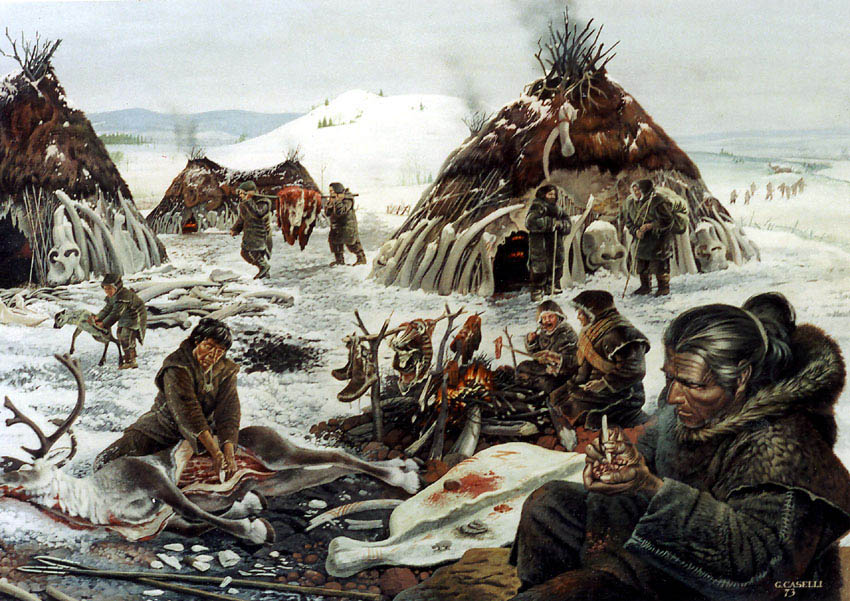
After hominins migrated out of Africa, and colonized tropical Asia and Australia, some folks decided to wander north.  It was a cool place to live, and the farther north they wandered, the cooler it got.  In snow country, tropical primates were like fish out of water.  Brrrr!  They wrapped themselves in animal hides, lived in protective shelters, and huddled around warm campfires.

In 1908, Knud Rasmussen told the story of a Greenland Eskimo named Qumangâpik, who had four wives and 15 children.  The first wife froze to death, the second was buried by an avalanche, the third died of illness, and the fourth froze to death.  Of his 15 children, one starved, four were frozen, and five died of illness.  Then, Qumangâpik froze to death, with his wife and two little children.  Three of his kids outlived him.  In frigid times, ripped or inadequate clothing could be a death sentence.

Over time, early colonists in snow country learned how to cut and sew hides into custom tailored clothing that provided better protection for both humans and their body lice companions.  Killing a deer, tanning its hide, and turning it into coats, trousers, hats, or footwear, was a time consuming process.  Deerskin attire was not especially warm, especially when soaking wet or frozen.  On the plus side, it could be boiled and eaten when starvation threatened.

The first stitching was likely done with sinew, or thin strips of leather.  Eventually, some groups learned how to spin plant fibers into thread, which could be used for stitching seams together.  In the Republic of Georgia, researchers have found spun and dyed fragments of flax fibers that were 34,000 years old. 

Needles were used for sewing clothing and tents, and for making nets.  Animal bone needles with eyes, about 25,000 years old, have been found in Central Europe.  Needles have not been found at Neanderthal sites yet, but looking for a needle in a haystack is far easier than finding an extremely old needle buried somewhere on the Eurasian land mass.

Over time, folks got better at spinning different types of high quality thread.  It was spun from plant fibers like flax, cotton, or hemp; or animal fibers like wool.  Eventually, a clever person invented weaving, a process that wove thread into cloth.  Cloth could be used to make a wide variety of useful things.

Kassia St Clair described how gathering and processing plant fibers was time consuming.  So was carefully collecting and preparing fibers from sheep, goats, silkworms, and others.  So was spinning and weaving.  In some regions, folks may have devoted more hours to their wardrobe than to acquiring food.  For hardworking people, clothing was precious, and carefully kept mended and patched.  Many owned little more than what they were wearing.

During the agricultural era, wool clothing was popular in snow country, until the eighteenth century, when new technology made cotton cloth cheaper to make, and more profitable.  Cotton was the dominant fabric until the 1970s, when synthetic fibers rose to dominance.  It won’t be long now until almost all clothing is polyester, which is exceedingly cheap to produce from petrochemicals using state of the art automation, and super cheap sweatshop labor.

Today, many consumers own enormous wardrobes of apparel, much of it rarely worn, if ever.  Modern attire is not designed for rugged durability, but to be rapidly mass produced, in order to meet the demand for the latest trendy styles.  Trendy styles have deliberately short lifespans.  This encourages radicalized consumers to maximize their apparel purchasing.  For them, nothing is more embarrassing than to be seen wearing obsolete fashions.  Landfills are stuffed with countless tons of formerly trendy attire.  Much of it is discarded while still in excellent condition.

Great Leap Forward

A number of thinkers have jabbered about a miraculous turning point in the human saga.  Before this event, humans were dim witted, knuckle dragging, mouth breathing bubbas.  And then — shazam! — we triumphantly glided across a magic bridge, from the archaic era into the modern one.  Our species was gaining momentum on the treacherous path to technological utopia and ecological dystopia.

Jared Diamond once speculated that if space aliens had visited Earth 100,000 years ago, humans would have appeared to be nothing more than ordinary animals.  But then, as the millennia passed, those critters were acting less and less ordinary.  By 40,000 years ago, our modernizing ancestors were demonstrating revolutionary changes that were both beneficial and risky.  What happened?  Diamond named this miracle the Great Leap Forward.

Of course, Diamond was raised in a crazy self-destructive wonderland of high technology — extremely clever stuff that enabled humankind to beat the living crap out of the planet’s ecosystems for no sane purpose.  Actually, those “ordinary” two-legged ancestors, observed by space aliens, were the one and only critters on Earth who were capable of conjuring domesticated fire — a fantastically revolutionary innovation.  It was close to step one on the long march to world domination.

For Diamond, the act of routinely using domesticated fire seemed ordinary and insignificant.  In his 1992 reality, even four-year olds could easily burn down the neighborhood with a cheap disposable lighter.  In addition to fire, the visiting space aliens would have also seen that the two-legged critters were unique in their ability to knap sharp stone tools, and manufacture assorted gizmos for hunting.  Our hominin ancestors had been developing these unordinary skills for more than two million years.

Extremely weird was the fact that those fire critters were at the top of the food chain, yet they had no serious fangs, claws, speed, strength, or size.  All the other top predators had naturally evolved some combination of those traits, gradually, over the course of millions of years.  But today, those traditional natural predators are being pounded into oblivion via guns, cyanide, habitat destruction, and so on.  There are not seven-plus billion lions and tigers and bears staring at cell phones.

With the Great Leap, humans began doing more and more things beyond what ordinary animals did.  They baked ceramic figurines in kilns, made flutes, wore ornamental beadwork, sewed clothing, invented new and improved tools, and built trophy homes with mammoth bone walls.  These luxurious dwellings have been found in Ukraine, Czech Republic, Poland, Romania, Belarus, and Russia.

Venus figurines have been found in Slovakia, Italy, Austria, Russia, Germany, Czech Republic, Switzerland, France, Romania, and Siberia.  They were carved in soapstone, steatite, sandstone, mammoth ivory, horse bone, serpentine, black jet, antler, limestone, and hematite.  Venus figurines date from 30,000 to 10,000 years ago.

Folks learned how to process red and yellow ochre, hematite, manganese oxide, and charcoal into pigments useful for cave painting.  Wild artists crawled far inside caverns with torches, and painted gorgeous portraits of the sacred animals for which they had the deepest respect and reverence.  Images included the horse, lion, auroch, rhinoceros, salmon, bear, mammoth, buffalo, owl, hare, ibex, auk, weasel, reindeer, chamois, and fox.  Often, artists placed their spread out hand against a wall, and sprayed paint over it, creating a hand stencil.

Those folks did not spend most of their lives indoors, isolated from the wild ecosystem, like astronauts in orbit.  They had no glowing screens.  Their world was entirely wild and alive, and they were intimately involved in it, every minute of every day, bloody hands and all.  The paintings celebrate their sacred relationship with the animals that fed them, clothed them, and sometimes killed them.

Prehistoric cave art has now been found in every continent except Antarctica.  In France and Spain, it has been found in almost 340 caves.  Famous sites include Chauvet in France (30 to 32 thousand years ago), Altamira in Spain (15,000), and Lascaux in France (18,000).  Recently, D. L. Hoffman’s team found paintings in three Spanish caves that were more than 64,800 years old — about 30,000 years before the arrival of humans.  This was the Neanderthal era.

The Great Leap Forward has also been called the Cultural Revolution or the Cognitive Revolution.  Cognition is about thought, understanding, and knowledge.  Twenty years ago, some believed that the leap was the result of miraculous genetic mutations that turbocharged our intelligence, but that theory went extinct, for lack of convincing DNA evidence.

A number of experts theorize that the leap was encouraged by powerful advances in complex language and communication, but this is impossible to prove via archaeological evidence.  Spoken words are not preserved in fossils.  We may have been singers and poets several million years ago.  We’ll never know.  Many primates and other animals are vocal.

Some sort of Great Leap certainly occurred in snow country, maybe between 50,000 and 30,000 years ago.  Our tropical primate ancestors were excited to discover lands loaded with abundant food, but challenged by a life-threatening climate for which evolution had not prepared them.  The only way they could stay, and feast on the delicious wildlife, was to cleverly invent a collection of prosthetic technology that would increase the odds of winter survival.  Eventually, the accelerating pace of cultural evolution enabled us to conquer the planet, explode in numbers, and savagely vandalize Earth in every imaginable way.

While many of the innovations of the Great Leap were survival-oriented prosthetics, others were not.  Painting, ornamentation, figurines, flutes, and so on were probably motivated by spiritual affairs, or the desire for enjoyment.  Obviously, for a while, these were not folks who were desperately struggling to survive.  Their new indulgences would seem to indicate that these folks were living in a bubble of affluence, leisure, and decadence.  They had learned and refined the skills of survival, and their food resources were temporarily abundant.  They were rich.  Life was good.

They remind me of America’s baby boomer generation, of which I am a member.  We were born at a time when industrial civilization soared to ridiculous excesses, fueled by an orgy of consuming enormous amounts of premium quality nonrenewable resources, as if they were infinite.  Some have called this joyride in self-destruction “The Blip” — a brief extreme spike in many trend lines, something equivalent to an asteroid strike. 

History repeatedly reminds us that high impact lifestyles always have an expiration date.  Yet, despite being proud descendants of the Cognitive Revolution, our clever minds routinely refuse to comprehend this simple and vital idea.  Magical thinking is always an effective cure for the unpleasant deliriums caused by occasional whiffs of reality.

Anyway, over the long run, was it truly a leap “forward” into greater joy, wisdom, health, and sustainability?  Or, was it something else?  When was the planet healthier and happier?