Showing posts with label Anthropocene. Show all posts

Wednesday, October 2, 2024

Wild Free and Happy Sample 63

 [Note: This is a new section from the rough draft of Wild, Free, & Happy. It’s finally getting closer to the home stretch.  These samples start with sample 01, and follow the sequence listed HERE (if you happen to have some free time). 

Welcome to the Anthropocene

Scientists enjoy categorizing, ranking, and naming.  In the realm of Earth history, they have broken the process down into a series of epochs — like the Pliocene, Pleistocene, Holocene, etc.  In the mid-1970s, some folks began feeling a need to create a new epoch, the Anthropocene, an era when human activities generated substantial eco-impacts. 

Science has not yet agreed on an official definition.  Some say it started with the explosive impacts of the Great Acceleration, which began in 1945.  Others say the Industrial Revolution (~1780).  Others say the Neolithic Revolution, the dawn of agriculture and civilization, which began about 12,000 years ago. 

Dan Flores believes that it began much earlier, during the late Pleistocene, as humans migrated out of Africa.  When they arrived in new regions for the first time, megafauna species were hit hard, resulting in a series of extinctions.  He wrote, “The Pleistocene extinctions, in other words, look very much like the first act of the Anthropocene, the beginnings of what we now call the Sixth Extinction.”

These early ancestors were successful predators because they benefitted from technological advantages including spears, slings, blades, warm clothing, and fire.  High-tech teams were able to kill powerful prey.  Their high-tech advantages enabled humans to successfully colonize much of snow country — despite the fact that their lean and nearly hairless bodies were finetuned by evolution for tropical climates. 

Close your eyes and imagine what northern Eurasia and the Americas would look like today if they had never been colonized by hominins — a vast, astonishing, Serengeti-like wild paradise of abundant life!  Wow!  Wild, free, happy… and perfectly healthy and sustainable!  Imagine that!

When our ancestors first wandered in, snow country was home to a variety of huge animals that had enjoyed living there for a very, very long time — grazers, browsers, predators, and so on.  A number of these species were originally from tropical regions of Africa and Asia, like the elephant, rhino, and sabertooth families.  Over time, these tropical megafauna species gradually evolved traits that improved their ability to survive in the cooler climate, like warm coats of thick fur.

Snow monkeys (Japanese macaques) are interesting primates.  Like our hominin ancestors, they originated in tropical Africa several million years ago.  Over time, their ancestors wandered off into the outer world, and eventually migrated from Korea to Japan more than 300,000 years ago.  Some now live in Japan’s chilly regions, where snow might cover the ground for four months, in depths up to 10 feet (3 m), and temperatures can plunge to -4°F (-20°C).

Snow monkeys adapted to snow country via a long slow process of evolution.  So now, when winter approaches, their thin summer fur automatically grows and thickens into luxurious warm coats.  During the summer, they build up body fat by feasting at the warm season buffet.  In winter months, they survive on stored body fat, and rough foods like leaves and bark.  They huddle together to keep warm.  They don’t use fire.  They’ve lived 300,000 years in Japan, and they’re still alive today because humans have allowed them to continue existing. 

Also around 300,000 years ago, Homo sapiens emerged in Africa.  From there, we migrated out of the tropics, and eventually colonized most of the world, including regions having temperate or arctic climates.  Instead of gradually evolving beneficial adaptations like the snow monkeys did, our clever technology boosted our ability to keep warm and survive in chilly places.

In modern cultures, a belief in human supremacy is the norm.  Our limitless brilliance is the mother of infinite miracles.  We’ll easily fix climate change, save the world, colonize Mars, and enjoy endless love, peace, and happiness!  The notion of Anthropocene has an aroma of human vanity.  We are the most powerful and important critters on Earth!

Welcome to the Pyrocene

The four primordial elements are earth, water, air, and fire.  Fire has existed on the planet for more than 400 million years, long before the dinosaurs.  It will continue burning long after the human circus moves off the stage, as long as there is fuel, oxygen, and spark. 

One mind-altering day, my brain crashed into the work of Stephen Pyne, the author of more than 30 books about fire, and one of the world’s foremost experts on fire history.  He described an extremely crucial turning point in Big History: the domestication of fire.  The earliest evidence of this has been found in South Africa, inside Swartkrans Cave.  It dates to about two million years ago, long before the emergence of Homo sapiens.  The two primary suspects are Homo erectus, or an earlier australopithecine hominin.  Did we drive these predecessors off the stage?

Much later, Homo sapiens inherited the knowledge of fire making, and this ability eventually enabled us to become the dominant species on Earth, and the planet thrashing demolition team of today. 

Greek mythology includes the story of Prometheus, a sassy man who stole fire from the god Zeus and gave it to humans.  Stories say that he was the inventor of the fire drill, the tool for kindling flame.  He boldly violated forbidden limits, and the gods severely punished him.  His theft initiated the dawn of human misery.

As discussed earlier (see Mother Africa), the domestication of fire began in the same general timeframe as a wave of megafauna extinctions in Africa.  Was this a coincidence?  Peter Ungar noted, “…the sudden appearance of large concentrations of artifacts and animal remains around two million years ago surely signals a change in the role of hominins in their world. 

Our ancestors had grabbed a place at the dinner table with the large carnivores.  Hominins were eating antelopes, hippos, horses, giraffes, and elephants.  Stone tools gave hominins better access to meat and marrow. 

Pyne thinks that the Anthropocene idea is too limited.  It is rooted in the emergence of agriculture and civilization.  But the primary event that made these changes possible was the domestication of fire.  So, instead of the narrower time window of the Anthropocene, he recommends the creation of a broader epoch called the Pyrocene (pyro means fire).  It would include the events of the Anthropocene.  The Pyrocene would close the curtains on the ancient Ice Age, and usher in the new and turbulent Fire Age. 

Pyne described three categories of fire. 

·       First fire is natural, sparked into flame by lightning, volcanoes, etc.  Its fuel is wood and vegetation.  This fire has existed for 400 million years.

·       Second fire is anthropogenic, ignited by hominins.  It enabled agriculture, civilization, early industry, soil destruction, deforestation, and the massive expansion of human inhabited regions.  Its fuel is wood and vegetation.

·       Third fire ripped open the trap door to hell.  Growth of the industrial era eventually required far more fuel than firewood could provide.  The heartbreaking mistake was to introduce the fire breathing monster to fossil hydrocarbons (coal, oil, gas).  Suddenly, humankind had access to a million times more energy dense combustible fuels.  Shit!  Trouble ahead! 

Carbon Cycle

NOAA calls carbon “the chemical backbone of life on Earth.  Carbon compounds influence the Earth’s temperature, make up the food that sustains us, and provide energy that fuels the global economy.”

Carbon is an element that exists in the atmosphere, oceans, living organisms, rocks, soils, sediments, fossil fuel reservoirs, etc.  This is called the carbon pool.  The pool is a magic act that allows the flow of carbon throughout the ecosystem, which is vital to the survival of the family of life.  The pool includes both carbon sources and carbon sinks. 

A carbon source emits more carbon than it absorbs.  Major sources include the burning of coal, oil, and gas, and the emissions from making concrete. 

A carbon sink absorbs more carbon than it releases.  For example, a forest is a carbon sink, and it absorbs and stores carbon as it lives and grows.  The two primary sinks in the global carbon cycle are the land and the water.

The atmosphere is neither a source nor sink.  It constantly absorbs carbon emissions, and it’s constantly a source of carbon for plant life to absorb.  In the atmosphere, carbon is allowed to pass back and forth between sources and sinks — something like a train station, an ongoing flow of in and out.

Prior to the industrial era, the carbon load in the atmosphere was a relatively stable closed loop — the volume of incoming carbon from sources was similar to the volume of outgoing carbon absorbed by sinks.

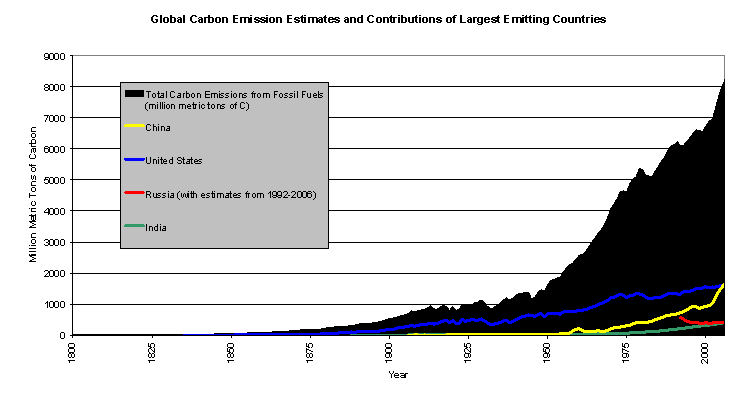
Today, that stable closed loop is long gone.  When fossil energy is burned, CO2 is released into the atmosphere.  From there, the water sink absorbs some of it, and so does the land sink.  Unfortunately, these two sinks cannot absorb CO2 as quickly as it’s now being emitted, so the growing surplus accumulates in the atmosphere.  Here is a chart that displays the explosive growth of global CO2 emissions from 1900 to 2020.  Note that what the land and ocean sinks can’t absorb builds up in the atmosphere. 

With the fantastically tragic mistake of industrialization, humankind unleashed a planet roasting monster that is raging against the vitality of life on Earth — a furious roaring bonfire of fossil carbon.  This monster had been safely and harmlessly sleeping underground for millions of years.  Unfortunately, some goofy smarty pants could not leave it alone, and all hell broke loose.  Big Mama Nature screamed!

The normal and natural balancing act of atmospheric carbon got slammed.  In 1850, the atmosphere contained 280 ppm of CO2 (parts per million).  In 2024 it’s up to 426 ppm and growing.  Consequently, the CO2 content of the atmosphere is now higher than at any time in the last 3.6 million years, and its volume is skyrocketing now.  The planet’s climate is going batshit crazy, and the worst is yet to come.  Ooops!

Global CO2 Emissions is a chart showing carbon emissions from 1800 to 2006.  The four nations that emit the most carbon are highlighted.  Note the enormous surge of carbon emissions since 1930!

As we burn fossil energy day after day, year after year, faster and faster, enormous amounts of ancient carbon are released into the atmosphere, where it constantly accumulates, clobbers climate stability, and generates heat waves, droughts, catastrophic floods, monstrous storms, and huge wildfires.  Earth is getting hotter and hotter.  Thawing permafrost is releasing huge amounts of methane.  Glaciers are shrinking, sea levels are rising, the family of life is getting brutally bludgeoned.  Circle what is wrong in this picture.

If humankind suddenly went extinct next week, the permafrost would continue thawing, releasing additional methane, trapping more heat, and further boosting the temperature of the atmosphere and oceans.  And every day we keep burning like crazy.  The pyromania genie cannot be put back into the bottle.  Sorry kids!

Friday, February 1, 2019

Wild Free and Happy Sample 08


[Note: This is the eighth sample from my rough draft of a far from finished new book, Wild, Free, & Happy.  I don’t plan on reviewing more books for a while.  My blog is home to reviews of 199 books, and you are very welcome to explore them.  The Search field on the right side will find words in the full contents of all rants and reviews, if you are interested in specific authors, titles, or subjects.] 

Domestication of Fire

Before hominins learned how create fire, they very carefully preserved the flames of a naturally caused fire by feeding it fuel.  Burning sticks could be taken to other locations and become the source of additional fires.  Folks were extremely careful to preserve the live embers because, if they ever went out, the unlucky brothers and sisters might begin to smell like cat food.

Once upon a time, in an African wilderness, we aren’t sure when, someone figured out how to conjure a dancing flame into being.  Whoa!  In the hominin saga, that first glowing ember was the equivalent of an asteroid strike — a big one.  It catapulted our ancestors outside of the family of life, and into a spooky new realm of supernatural power and danger.  It was the magic ring that gave our ancestors the ability to eventually become the dominant animal on Earth (for a while). 

Unfortunately, the powerful magic was not delivered with warning labels attached.  The gift box did not include powerful herbs and potions to inspire profound wisdom and godlike foresight.  No animal needs these abilities.  Hominins are animals.  The Great Spirit apparently had a mischievous sense of humor.

The four elements are earth, water, air, and fire.  Pyne perceived the first manmade fire to be an act of staggering ecological audacity.  Tropical primates had found the keys to the mastery of fire.  Good grief!  The event is reminiscent of the old Sorcerer’s Apprentice tale, in which a half-clever trainee recklessly conjured a hurricane of big magic that he was powerless to stop, which soon got totally out of control. 

Without domesticated fire, hominins could have remained perfectly sustainable tropical primates, like baboons.  With fire, we acquired an impossible responsibility to use it with flawless wisdom, generation after generation, wherever we went.  The ancestors of baboons effortlessly lived sustainably for several million years by simply living like baboons — brilliant!  When hominins domesticated fire, they lost the magnificent inherent stability that comes from simply being ordinary animals, like all the others.

Some scholars have speculated that if space aliens had visited Earth 100,000 years ago, our ancestors would have appeared to be nothing more than ordinary animals.  For a long time, I accepted that.  Now I don’t.  Those visiting space aliens would have noticed that one species — and only one — maintained fires in their encampments.  This practice was not the slightest bit ordinary.  Hominins were the only animals who could deliberately ignite or extinguish a fire.  By and by, when hominins go extinct, so will domesticated fire, and the monsters it conjured into existence.

Paleoanthropologists and archaeologists have endless screechy arguments about the dates when prehistoric changes happened, like the domestication of fire.  Pretty much, everyone agrees that it happened at least 400,000 years ago, and the most likely suspect was Homo erectus.  Others point to two million year old ashes in the Wonderwerk Cave in South Africa.

The Swartkrans Cave near Johannesburg is a special site.  Many years of assorted stuff has built up on the floor, and the crud has been carefully excavated.  In the oldest layers, no charcoal is found.  It is an era before fire.  At this level, there are complete skeletons of big cats, and the scattered gnawed bones of the critters they ate, including more than 100 individual hominins.  In this era, cats were the top predator.  Higher up, charcoal is found in newer layers, about 1.6 million years ago, the age of fire.  Here are found complete hominin skeletons, and the scattered bones of the critters they gnawed, including big cats — hominins were now the top predator.

Today, a growing number of scientists think it’s time to announce the end of the Holocene Epoch (from 11,700 B.P. to now), and declare the arrival of the embarrassing Anthropocene Epoch.  Epochs are time periods in geologic history that leave behind a layer of residue that is unique and recognizable.  Carboniferous was the coal era.  Jurassic was the era of petroleum and natural gas.  The Anthropocene is the era when humans conquered the Earth, and unwisely initiated massive and irreversible change.

If you ever want to start a bloody fistfight at a bar full of scruffy drunken scientists, ask this: When did the Anthropocene begin?  Some say 1945, the dawn of the nuclear age.  Some say 1800, the kickoff of the Industrial Revolution.  Some say 8000 B.C., the Agricultural Revolution.  Paul Shepard thought that the game changer was the Hunting Revolution, when hominins learned how to make and use deadly stone tipped javelins and lances, hunt in packs like wolves, kill too many large animals, and feed their energy-guzzling oversized brains with highly nutritious grass fed organic meat.  Ronald Wright called this transition “the perfection of hunting,” the first progress trap (a difficult to undo “advance”).

James Scott thought that the good old days ended with the domestication of fire.  In his mind, the nightmare world we live in is the result of four domestications — fire, animals, plants, and humans.  Domesticated fire, like livestock, required breeding, feeding, and oversight to keep it from running away from its master.  Domesticated fire was as addictive as heroin, a habit impossible to willfully quit.  The habit eventually spread around the world.  Carleton Coon noted that only a few folks made it into the nineteenth century without becoming fire makers — the Tasmanians, Andaman Islanders, and the Pygmies of the Ituri forest.

Fire altered the traditional food chain.  Man-eating predators were intimidated by all-night fires and burning torches.  So, fewer hominins were violently killed and eaten.  This diminished a population check on our ancestors, which may have disturbed the stability of functional ecosystems.  Other checks include disease, starvation, conflict, accidents, and so on.  John Reader wrote that, under ideal conditions, if two humans, and their descendants, all had large families, the clan would explode to 4 billion in just 500 years.  Man-eating predators are good for us.  They weed out the sick, elderly, injured, inattentive, and unlucky.  We all feed each other. 

Fire kept our ancestors warmer.  Humans have three million sweat glands to cool us off in hot weather.  In cold weather, the body directs more warm blood to the skin.  One thing that struck Europeans about primitive people was that they seemed to be impervious to cold.  During his famous voyage, Darwin was surprised to observe natives who wore little or no clothing during bitterly cold weather in Tierra del Fuego.

On the Kalahari, night temperatures in June and July can dip below freezing.  Elizabeth Marshall Thomas was with a group of naked San people during a night when their water froze.  Their only protection was a kaross — an animal skin wrapped around their shoulders. 

Tropical people go naked, like chimps and baboons, because clothes are unnecessary, making them requires work, and pointless work is moronic.  Modern consumers waste lots of energy, because much of their sense of “cold” is merely a belief induced by cultural programming.  Also, they want to wear shorts and tee-shirts indoors, in the middle of winter.   I’ve taught myself to be far more tolerant of cooler temperatures than I was 30 years ago.  I wear more layers, and waste far less heat.

Fire enabled folks to survive in regions having extended cold weather.  So they eventually expanded into much of the northern hemisphere, previously home to wooly mammoths, sabertooth cats, and many other species of megafauna.  By making uninhabitable regions habitable, fire increased the global carrying capacity for the hominin hordes — more territory, more food, more hominins.

Fire was used on a large scale to manage landscapes for more productive hunting and foraging.  It was used to drive animals into bogs or streams, off precipices, or into locations where they could be confined and killed.  It burned off cover that concealed hidden nests or burrows.  Flame was used for optimizing grasslands to attract more game — it consumed dead vegetation and woody brush, encouraging the growth of fresh nutritious green forage.  It left behind a banquet of roasted grasshoppers.  It discouraged visits from bloodthirsty flies and mosquitoes.

Fire enabled slash-and-burn agriculture (swidden), which replaced forest with cropland.  Crops were grown for a year or so, until soil fertility was depleted, at which point another area of forest was slashed down.  The depleted fields were left to recover for ten or twenty years, when they were slashed again.  After multiple slash-and-burn cycles, the land was rubbished.  Daniel Hillel reported that in Indonesia there are more than 39.5 million acres (16 million hectares) of land that is incapable of supporting either agriculture or forest.

Fire has long been used as a weapon of mass destruction during violent conflicts.  Cities built of wood often fed the flames of horrific firestorms that claimed many lives.  Even in peacetime, structures heated with open flame fireplaces frequently went up in smoke, often igniting the rest of the village.  For many centuries, firefighting technology was an ineffective process of hauling buckets of water by hand.  Deadly fires were very common, and a great source of fear.  The Christian concept of Hell was intensified by the terror of frequent fires in early times.

Fire had a spiritual aspect in every traditional culture.  Jacob Grimm mentioned the needfire rituals that were once common in many regions of Western Europe.  Every year at the summer solstice, each home in the village let their hearth fire die out.  A new fire was kindled into existence by a spinning drill (never flint and steel), and everyone took home a bit of the needfire to light their hearth for the coming year.  Often people and livestock were passed through the glowing embers for purification and protection.  Fire was highly sacred business.  Many old pantheons had fire gods, goddesses, and myths. 

Domesticated fire is Earth-shaking super-big juju.  James Scott concluded that the accumulated ecological impacts of manmade fire on this planet overwhelm those caused by the domestication of plants and animals.

Cooking

The domestication of fire kicked open the door to a revolutionary change in the hominin saga — a technology called cooking.  Cooking softened and pre-digested food.  Ancestors were able to extract more nutrients from each mouthful.  Better nutrition facilitated the development of bigger brains.  Infants could be weaned sooner when softened food became an option, so births could be spaced closer together.  The toothless elderly benefitted from access to soft food.  Chewing was less work, so hominins evolved smaller teeth compared to other primates.  Also, digestion took less processing, so our guts got smaller, and tummies flatter.

Cooking transformed some foods that had been toxic or indigestible into edible nourishment.  By increasing the variety of plant foods we could eat, and the amount of nutrients we could extract from them, it became possible for an area of land to feed more ancestors.  Thus, cooking boosted an ecosystem’s carrying capacity for hominins.

Cooking gave us the keys to industrial civilization.  Imagine the astonishment when early hominins watched some heavy rocks in the fire turn red and melt into a liquid form.  The first smelter was born.  Metallurgy gave us the ability to fill rivers with spilled blood, to reduce cities to ashes, and to ravage ecosystems in countless, devastating, and irreparable ways.

The ancestors also learned about cooking clay.  They were baking figurines in primitive kilns 25,000 years ago.  This knowledge eventually evolved into baking pottery and bricks.  Sand could be cooked into glass, limestone into cement, wood into charcoal, water into steam, crude oil into distillates (gasoline, diesel, kerosene, etc.), and on and on and on. 

Sunday, September 24, 2017

Against the Grain


James C. Scott teaches political science and anthropology at Yale.  He’s a smooth writer and a deep thinker.  A while back, he decided to update two lectures on agrarian societies that he had been giving for 20 years.  He began studying recent research and — gasp! — realized that significant portions of traditional textbook history had the strong odor of moldy cultural myths.  So, a quick update project turned into five years, and resulted in a manuscript that I found to be remarkably stimulating, from cover to cover —  Against the Grain: A Deep History of the Earliest States.

While the human saga is several million years old, and Homo sapiens appeared on the stage maybe 200,000 years ago, the origin myth I was taught began just 10,000 years ago, with domestication and civilization.  We were transformed from hungry, dirty, dolts into brilliant philosophers, scientists, and artists, who lived indoors, wore cool clothes, and owned lots of slaves.

As a curious animal interested in ecological sustainability, I’m amazed that every other animal species has, for millions of years, lived on this planet without destabilizing the climate, spurring mass extinctions, poisoning everything, and generally beating the <bleep> out of the planet.  These are the unintended consequences of our reckless joyride in a hotrod of turbocharged progress.  They define the primary aspects of a new geological epoch, the Anthropocene, the era when tropical primates with huge throbbing brains left permanent scars on the planet.

Experts argue about when the Anthropocene began.  Did it start with the sorcery of nuclear fission, or the curse of fossil-powered industry?  Many point to the domestication of plants and animals, and the birth of civilization.  Scott is among the few who say it began with the domestication of fire, which occurred at least 400,000 years ago, sparked by our Homo erectus ancestors.  Every other species continues to survive via the original power source, the sun’s wildfire.  Plants grow green solar panels that produce the nutrients that keep the fauna alive and happy, a perfectly brilliant design.

Imagine waving a magic wand, and eliminating everything in the world made possible by domesticated fire — no metal, no concrete, no plastic, no glowing screens.  Would humans still be around?  Fire historian Stephen Pyne concluded, “Without fire humanity sinks to a status of near helplessness.”  We wouldn’t be able to survive outside the tropics.  The plant and animal species that enabled civilization lived north of the tropics (see THIS).  Without domesticated fire, we’d still be wild and free — and far less crowded.

Scott focused on southern Mesopotamia, because it was the birthplace of the earliest genuine states.  What are states?  They are hierarchical societies, with rulers and tax collectors, rooted in a mix of farming and herding.  The primary food of almost every early state was wheat, barley, or rice.  Taxes were paid with grain, which was easier to harvest, transport, and store than yams or breadfruit.  States often had armies, defensive walls, palaces or ritual centers, slaves, and maybe a king or queen.

The moldy myths imply that domesticated plants and animals, sedentary communities, and fixed-field agriculture emerged in a close sequence.  Wrong!  There is scattered evidence of sedentary hunter-gatherers by 12,000 B.C.  Domestication began around 9000 B.C.  It took at least four thousand years (160 generations!) before agricultural villages appeared, and then another two thousand years before the first states emerged, around 3100 B.C.

Moldy myths assume that the Fertile Crescent has been a desert since humans first arrived.  Wrong!  Southern Mesopotamia used to be wetlands, a cornucopia of wild foods, a paradise for hunters and gatherers.  There was so much to eat that it was possible to quit wandering and live in settled communities.  “Edible plants included club rush, cattails, water lily, and bulrush.  They ate tortoises, fish, mollusks, crustaceans, birds, waterfowl, small mammals, and migrating gazelles.”  In a land of abundance, it would have been absolutely stupid to pursue the backbreaking drudgery of agriculture.

Moldy myths often give us the “backs-to-the-wall” explanation for the shift to agriculture, which was far more work.  Simply, we had run out of new alternatives for feeding a growing mob, while hunting was producing less meat, and wild plants were producing less food.  We had no choice!  But in the Middle East, there appears to be no firm evidence associating early cultivation with the decline of either game animals or forage. 

Cultivation seems to have emerged in regions of abundance, not scarcity.  Every year, floods deposited silt along the riverbanks, moist fertile soil ready for sowing.  So, flood-retreat farming would have required far less toil than tilling fields, while producing useful nutrients.  More nutrients enabled further population growth, which eventually pressed the shift to miserable labor-intensive irrigated agriculture.

The root of “domestication” is “domus” (the household).  In early Mesopotamia, “the domus was a unique and unprecedented concentration of tilled fields, seed and grain stores, people, and domestic animals, all coevolving with consequences no one could have possibly foreseen.”  As a result of living on the domus, animals (including humans) were changed, both physically and behaviorally.  In this process, wild species became domesticated.  Over time, some species became “fully domesticated” — genetically altered, entirely dependent on humans for their survival.  Domestication was also about deliberate control over reproduction, which “applied not only to fire, plants, and animals but also to slaves, state subjects, and women in the patriarchal family.”

Domesticated sheep have brains 24 percent smaller than their wild ancestors.  Pig brains are a third smaller.  Protected from predators, regularly fed, with restricted freedom of movement, they became less alert, less anxious, less aggressive — pudgy passive dimwit meatballs.  They reached reproductive age sooner, and produced far more offspring.

“The multispecies resettlement camp was, then, not only a historic assemblage of mammals in numbers and proximity never previously known, but it was also an assembly of all the bacteria, protozoa, helminthes, and viruses that fed on them.”  The domus was a magnet for uninvited guests: fleas, ticks, leeches, mosquitoes, lice, and mites.  Unnatural crowds of animals spent their lives walking around in poop, and drinking dirty water.  It was a devilishly brilliant incubator for infectious diseases.  Humans share a large number of diseases with other domus animals, including poultry (26), rats and mice (32), horses (35), pigs (42), sheep and goats (46), cattle (50), and dogs (65).

Other writers have noted that, prior to contact, Native Americans had no epidemic diseases.  With very few domesticated animals, they lacked state of the art disease incubators.  Scott goes one step further, asserting that prior to the domus, there was little or no epidemic disease in the Old World.  “The importance of sedentism and the crowding it allowed can hardly be overestimated. It means that virtually all the infectious diseases due to microorganisms specifically adapted to Homo sapiens came into existence only in the past ten thousand years, many of them perhaps only in the past five thousand.”  Thus, the humans that first crossed from Siberia to North America 13,000 years ago were free of disease because little or no infectious disease existed anywhere in the world!

Dense monocultures of plants also begged for trouble.  “Crops not only are threatened, as are humans, with bacterial, fungal, and viral diseases, but they face a host of predators large and small — snails, slugs, insects, birds, rodents, and other mammals, as well as a large variety of evolving weeds that compete with the cultivar for nutrition, water, light, and space.”  Once harvested and stored in the granary, grain could be lost to weevils, rodents, and fungi.  The biggest vulnerability of states was that they were almost entirely dependent on a single annual harvest of one or two staple grains.  Crops could be wiped out by drought, flood, pests, storm damage, or crop diseases.

Mesopotamian life was largely human powered.  Workers grew the grain that the tax man hauled away to the plump elites.  More workers meant more wealth and power for the big shots.  In screw-brained hierarchical cultures (including ours), it’s impossible to have too much wealth.  Therefore, peasants and slaves were husbanded like livestock.  The diabolical “more is better” disease was devastating.  Some believe that monumental walls were built as much for defense as to prevent taxpayers and slaves from escaping to freedom.

Early states were vulnerable in many ways, and they frequently collapsed.  Collapse sounds like a tragedy.  But it could simply mean breaking up into smaller components.  Larger was not necessarily better.  A drought might cause a state’s population to disperse.  For the non-elites, life in a Mesopotamian state could be oppressive and miserable.  Sometimes, collapse was a cause for celebration.  Yippee!

Anyway, the book is fascinating.  Readers also learn about the tax game, the vital slave industry, trade networks, deforestation, erosion, soil salinization, irrigation, looting and raiding, mass escapes of workers, the challenges and benefits of being surrounded by large numbers of aggressive nomadic herders, and on and on.  It’s an outstanding book!

WARNING:  The expensive Kindle edition contains numerous charts, maps, and diagrams.  When downloaded to the Kindle for PC application (v 1.20.1), most are unreadably small, even on a 24” monitor.  Clever nerds can tediously capture the images to another application, expand them, and read them.  Strong reading glasses (3.75 lens or higher) also work with a big monitor.

Scott, James C., Against the Grain: A Deep History of the Earliest States, Yale University Press, New Haven, 2017. 

Four Domestications is a free PDF download, the 48-page text of a lecture Scott gave at Harvard.  It includes some of the foundation ideas for his new book.

Seeing Like a State is a free PDF download of Scott’s 1998 book, a companion for his new book.