Showing posts with label predator. Show all posts

Saturday, February 1, 2020

Wild Free and Happy Sample 31


[Note: This is the thirty-first sample from my rough draft of a far from finished new book, Wild, Free, & Happy.  I don’t plan on reviewing more books for a while.  My blog is home to reviews of 202 books, and you are very welcome to explore them.  The Search field on the right side will find words in the full contents of all rants and reviews, if you are interested in specific authors, titles, or subjects.]

Dogs

Over the years, I’ve spent a lot of time close to nature.  The deer, bears, skunks, bats, foxes, coons, wolves, beavers, coyotes, and weasels tolerated my passing as long as I behaved calmly and respectfully.  None of these wild beings had the slightest interest in becoming my friends, or my fur children.  None depended on me in any way.  None fully trusted me.

All were absolutely free to live as they wished, every minute of every day (unlike me).  They all had a perfectly healthy relationship to the land (unlike me).  None of them ever sent anything to a landfill, or caused permanent damage to the land, water, or air (unlike me).  All of them will celebrate when the lights go out, the last car dies, and the last bullet is shot.  Hooray!

Gray Wolves

Gray wolves are the wild ancestors of dogs.  Their history is a bit misty.  One source wrote that gray wolves emerged in Eurasia maybe a million years ago, and migrated into North America maybe 750,000 years ago.  Their range spanned across the northern hemisphere, from Europe and Asia to North America.  They didn’t fancy living in tropical forests or intensely arid regions.  Instead, they adapted to grasslands, forests, and artic regions.

Humans emerged in Mother Africa, south of the equator.  Over the course of maybe two million years, in various ways, our ancestors transitioned from foragers and scavengers, to persistence hunters, to innovative weapon users, and then teams of communal hunters.  Africa was wolf-free, but it had a home team of man-eating predators, like big cats, big snakes, big crocodiles, and packs of hyenas.  They did a good job of weeding out the weak, the sick, the injured, the inattentive, and the unlucky.  They kept our clans tidy, fit, and strong.

Wolves evolved in Eurasia, north of the equator.  Barry Lopez noted that wolves shared their food with others in the pack.  They educated their young.  They could hear clouds passing, and were able to smell prey from a couple miles away.  They were expert trackers, and hunted in a state of heightened concentration, paying relentless attention to details.  Wolves generally travelled in packs of 6 to 10 animals, and could sprint as fast as 37 miles per hour (60 km/h).  Like many man-eaters, they mostly moved and hunted at night (not a great time to be out alone).

Wolves and humans likely never met one another until some human pioneers eventually wandered north out of Africa, across the equator, and into wolf country.  History is clear that wolves had no taboos against feasting on yummy tropical primates.  In many cultures, big bad wolves enjoyed starring roles in their myths, because they had to be taken very seriously in real life.  One source noted that wolves and Eskimos were equals — prior to the arrival of firearms.  For them, wolves were valuable teachers.  I have never seen a wolf in the wild, and I hope I never see one in lockdown

The Dynamic Duo

Everyone agrees that dogs were the first domesticated critters, but exactly when and where remains highly controversial.  Wolves and humans maybe began their cautious relationship while scavenging snacks from animal carcasses.  Wolves were certainly attracted to the garbage piles at human camps.  They can chew up bones that humans can’t.  Humans were also magical critters who had the fantastic ability to regularly emit indescribably delicious turds that canines cannot resist.

We’re not sure how, but canines (wolves or dogs) and humans gradually became hunting buddies.  Eventually, via a long process of selective breeding, wolves were reduced to dogs, critters less likely to rip out your throat, and kill your friends and family.  Dogs were four-legged garbage disposals that helped keep camps tidy.  Compared to a wolf of the same size, a dog’s skull is 20 percent smaller, and its brain is 10 percent smaller.  Dogs have smaller teeth and jaw muscles, after thousands of years of dining on human refuse and other soft foods.

Anyway, the hunting buddies had complementary skills.  Dogs had superb senses of smell and hearing, excelled at team hunting, and were far speedier than humans.  Humans had the advantage of weaponry.  They had the spooky ability to hurl projectiles (sticks and stones) with remarkable accuracy, often with lethal results.

So, sniffing dogs could discover the presence of coons, and chase them up a tree, where humans could then kill them.  Thus, dogs ate better, and humans ate better, while coons (and other prey) became more vulnerable to predation.  Previously, the coon’s ability to quickly climb trees was their primary defense tactic, for maybe a million years or three.  It now became less safe to be a coon.  By gaining access to more food resources, the number of both dogs and humans could grow.

Actually, “buddies” exaggerates the intimacy of the relationship.  Elizabeth Marshall Thomas spent lots of time with the San hunter-gatherers of the Kalahari.  Writing in the 1950s, she noted that the dogs in their camp were skeletal and weak from starvation.  The dogs were owned and named, but folks never fed them anything except shit.  When a mongrel made a move on the humans’ food, it was stoned or whipped.  At night, they chased away visiting hyenas, jackals, and leopards.

Louis Liebenberg also wrote about the San.  By the late 1960s, hunters were using dogs, which radically changed the game.  On their own, dogs were not top class hunters.  Sometimes they could run down small animals.  When they teamed up with humans, both could eat more meat.  And so, ancient food chain balancing acts were disrupted, and life became less safe for some.

With dogs, it became far easier for the San to kill gemsbok, because when pursued, they will eventually stop, turn around, and confront the dogs, at which point it was much easier for hunters to kill them (deer also eventually stop and surrender).  Gemsbok was a prime prey for hunters, because they were fairly large, and fairly numerous.  Despite the assistance of dogs, hunters still had to possess exceptional knowledge of tracking, animal behavior, and the ecosystem.  This traditional knowledge was vital for mindfully directing the dogs toward the most promising locations to find a hot lunch.

Wireless Voice-Activated Herding Robots

At some point in the game, clever shepherds, with abundant free time on their hands, taught dogs to quickly and accurately obey their exact instructions for controlling the herd.  With a well-trained dog, a herder on foot could manage 150 to 200 sheep.  With this great advance, humankind was well on the path to the wondrous realm of modernity.

Writing in 1902, Irishman W. G. Wood-Martin wrote: “The dog is the greatest conquest ever made by man, for the taming of the dog is the first element in human progress.  Without the dog, man would have been condemned to vegetate eternally in the swaddling clothes of savagery.  It was the dog which effected the passage of human society from the savage to the patriarchal state, in making possible the guardianship of the flock.  Without the dog there would be no flock and herds; no roast beef, no wool, no blanket, no time to spare; and, consequently, no astronomical observations, no science, no industry.  It is to the dog man owes his hours of leisure.”

The Deadly Trio

Liebenberg noted that following the introduction of dogs to hunting, some folks also added horses to the Kalahari team of hunters and dogs.  Consequently, the traditional method of persistence hunting — tirelessly chasing game for hours during the heat of the day until they collapsed — was no longer necessary.  Speedy horses made it far easier for the team to hunt speedy antelopes.  Dogs will chase anything that moves, and horses excel at high-speed pursuits.

As a result of this great advance, the hunting game got too easy.  Hunters no longer needed to possess exceptional knowledge.  At the same time, the San lost access to much of their former hunting territory.  Now, as the elders die, large portions of a two million year old knowledgebase are going extinct, including much of the original hominin software.  The San live in permanent villages.  Game over.

Around A.D. 1300, Marco Polo described how Genghis Khan used the deadly trio for an industrial scale approach for acquiring wild meat.  It included two flanks of mounted hunters, each having 10,000 men and 5,000 great mastiff dogs.  The line of hunters would extend to the length of a full day’s journey, and no wild animal would escape their dragnet.  These hunts were like a bloody vacuum cleaner.

Later, with the adoption of firearms, the deadly trio become a bloody foursome.  Guns made it much easier to kill large animals with the squeeze of a trigger.  Pita Kelekna wrote that when the breech-loading rifle arrived on the U.S. west, the buffalo herd was reduced from 60 million to 1,000.  Back east, there was high demand for buffalo robes and tongues, and new railroads delivered the profitable merchandise.  At the same time, the U.S. government was eager to clear the troublesome heathen savages from the west, and repopulate the region with respectable tax-paying, God-fearing settlers.

Here’s the issue.  All members of the family of life, in all types of ecosystems, continuously coevolve at a gradual pace.  Species at the foundation of the food chain, like insects, evolve the ability to produce massive numbers of offspring.  On the other hand, large, long-lived species that experience minimal losses to predators, like elephants and hippos, do not breed like roaches.  Hunter-gatherers were very interested in pursuing large game, rather than mayflies.  The more they came to depend on the use of the dynamic duo, the deadly trio, and the bloody foursome, the more success they could have at overhunting, and causing extinctions.  This was not a slow and gradual process of coevolution, it was more like a technological asteroid strike.

Big Juju Transition

Paul Shepard was an original thinker who could soar far above the concrete walls of consensus reality.  He perceived the Pleistocene to be the zenith of the human journey, and the high-water mark for the health of life on Earth (the Pleistocene ended 11,700 years ago).  Many professors can’t do this.  In the creative minds of wizards, an imaginative interpretation of deep history can conjure provocative visions, and sometimes blow large holes in deeply rooted cultural myths.

For nearly the entire saga of life on Earth — a 4.5 billion year pilgrimage — all critters everywhere were perfectly wild and free, as they should be.  No species anywhere owned, controlled, and selectively bred others.  Shepard perceived the emergence of domesticated dogs as something like a horrific cosmic tear in the universe.  A new and turbulent epoch was born.  He wrote, “The history of ecological catastrophe begins with the hound.”  To the conventional mindset, that sounds like a ridiculously stoopid idea.  But today the family of life is being massacred by the conventional mindset, a ridiculously stoopid rampage.

The act of gradually transforming a vicious, wild, man-eating predator into a tolerable shit-eating hunting buddy was super-big juju.  Mischievous folks discovered that the spirit of wildness was something that could be suffocated.  If you faithfully drowned the wildest pups in the litter, and allowed the wimps and dimwits to breed, over many generations you could produce genetically modified organisms (GMOs) that were the opposite of wild — mutant canines who would obey commands from domineering tropical primates.  These oddballs were highly vulnerable to wolves, coyotes, big cats, and other wild predators.  They were unlikely to survive outside the human sphere.

Over time, this understanding of control inspired some diabolical impulses.  Why should we spend so much <bleeping> time chasing wild animals all over the place?  Why don’t we just rip out their normal wild spirit and turn them into passive critters that we can keep in dense confinement near camp?  Wow!  Cool idea!

After many centuries of trial and error, the demented efforts of obsessive-compulsive control freaks succeeded in breaking wild aurochs, sheep, goats, and pigs.  For thousands of years, humans had perceived these wild animals to be sacred beings.  We painted magnificent portraits of them in caves.  Now, reduced to freakish GMOs, they were forcibly bred, castrated, branded, sheared, bobbed, hobbled, milked, slaughtered, butchered, and eaten.  Urp!

During this era, a number of groups were also fooling around with plant domestication.  By and by, territories most suitable for intensive exploitation were able to sharply increase their food production.  More and more fields were cleared on the soft floodplain soils along rivers.  Grasslands for herds were expanded by exterminating primordial forests.  Naturally, this led to growing numbers of bambinos, more tents in the camps, and increased social tensions.

Many centuries later, the last major GMO mammal emerged from the madhouse.  The domesticated horse was a critter with a far more disruptive destiny than the dog.  Shepard wrote that horses and hounds can be seen “as destroyers of nature and humankind.”  As noted, the deadly trio of hunter, dog, and steed enabled stunning advancements in wildlife extermination.  Horse power was used to accelerate soil mining, forest mining, and ore mining.  Horse power pulled wagons, plows, and war chariots.  Horse power revolutionized raiding, warfare, and empire building.  The Mongol empire was enormous [MAP].

Danish historian Saxo Grammaticus was born around A.D. 1050.  He shared many snapshots of the testosterone powered mega violence that came into full bloom during the era of domestication.  “Now the warriors, who were always pillaging the neighborhood, used often to commit great slaughters.  Plundering houses, cutting down cattle, sacking everything, making great hauls of booty, rifling houses, then burning them, massacring male and female promiscuously — these, and not honest dealings, were their occupations.”

King Gram boasted, “Singly against eight at once I drove the darts of death, and smote nine with back-swung sword, when I slew Swarin, who wrongfully assumed his honors and tried to win fame unmerited; wherefore I have oft dyed in foreign blood my blade red with death and reeking with slaughter, and have never blenched at the clash of dagger or the sheen of helmet.”

Stable, long lasting egalitarian cultures like the San, were based on sharing, cooperation, and simple sticks and stones technology.  Cultures of domestication are based on self-interest, competition, domination, and technological innovation.  The horse powered expansion of herding and farming turbocharged food production, population growth, and the size and number of horrendous bloody conflicts.  These aggressive cultures sort of behave like wildfires — as long as they can find resources to consume, and conditions remain favorable, they grow and spread.

In wild times, when wolves killed a deer, it was a perfectly normal act, and nobody soiled their britches.  When domestication arrived, and herds of my animals were grazing, wild predators immediately shape-shifted into demonic enemies that had to be exterminated — every single one of them, if possible.

In wild times, it was perfectly normal and natural for wild herbivores to munch on the greenery.  When domestication arrived, wild grasses shifted into being my grass needed by my herd to increase my wealth.  Wild critters that helped themselves to my grass were thieves that could not be tolerated.  They had no right to exist.

In wild times, there were zero fields planted with crops.  The countryside was a free all-you-can-eat buffet.  Help yourself, take what you can find.  Have a nice day!  When domestication arrived, all the birds, bunnies, coons, deer, and bears that were tempted to sample the fruits of my hard work, in my fields could not be tolerated.  Kill them all!

In normal wild ecosystems, Big Mama Nature encourages long term health.  A forest roasted by a wildfire can usually heal and recover.  In ecosystems ravaged by Big Daddy Dominator, the damage is often irreparable.  The vegetation is stripped off, wildlife erased, the land dries out, flowing springs disappear, the climate gets hotter and dryer, persistent toxins soak in, precious soil is blown away, washed away, or rendered infertile by salt buildup, and so on.  When a Big Daddy settlement is eventually reduced to wasteland, the survivors migrate elsewhere and promptly begin repeating the same cycle of mistakes.

Big Mama is sustainable and durable.  Big Daddy is a one-way death march that burns every bridge behind it.  The ecosystems he rubbishes can never fully heal, and return to their original condition.  He’ll strive to expand his domain, by any means necessary, as far as possible, but Earth is finite.  You can’t destroy more than everything (but he’ll try).  Big Daddy is well on his way to what is known as a Pyrrhic victory.  His heroic efforts for glorious conquest are terribly successful, but the losses he suffers in the process are so enormous that the final victory is meaningless.

In countless city parks and squares, it’s common to see huge bronze statues of male conquerors, holding deadly weapons, riding their snorting steeds.  They are proud monuments of the fanatical Big Daddy cult.  The message of each is “I courageously destroyed the despicable opponent that threatened our glorious way of life.”

Big Daddy is a huffing, puffing, smashing, killing, whirlwind of self-destruction, burning up the fossil energy, moving the topsoil into the sea, causing mass extinctions, poisoning the waters, and on and on.  He is the proud father of an accelerating, out of control climate disaster — a massive challenge against which the brightest nerds in the world are impotent, reduced to delivering happy rainbows of magical thinking (hopium).  On the bright side, the economy continues growing!  Hooray!  Let’s go shopping!

OK, well what would a monument celebrating Big Mama look like?  It would not be bronze.  She detests animal slavery.  She has no cannons.  What she has is the power of persistence, the power of life, the power of regeneration and healing.  Her monument would look like a wild planet.  She will someday watch Big Daddy wheeze, stumble, collapse, take his final breath, and dissolve into the ecosystem.  Then, for many thousands and thousands of years, the surviving species will strive to restore some form of ecological balance once again.

Oh!  A hand is raised in the audience, a question.  Hey, in the New World, substantial civilizations emerged that seemed to have Big Daddy DNA, but they had no horses, cattle, sheep, goats, almost no metal tools or weapons — essentially Stone Age.

Good point!  In fact, several big bloody civilizations did emerge in the horse free Americas, develop productive agriculture, and feed growing mobs.  In South America, they were making a few bronze tools, and ornaments of silver and gold.  When Cortes first arrived, the Valley of Mexico had two million residents, and Tenochtitlan was a city of 200,000 — twice the size of Paris at that time.

In 1492, compared to the Old World, the Americas still had far more wild lands, ancient forests, and abundant wildlife.  Without large herds of livestock, there was not abundant manure to optimize soil fertility and crop production.  Luckily, the lack of horses, plows, wheels, and roads limited their trade, travel, expansion, industry, and agriculture.  Like Australia, the Americas enjoyed a lack of contagious infectious diseases, because they did not have large concentrations of domesticated animals from which to acquire exotic pathogens.

In 1492, Native Americans did not discover Spain, it was the other way around.  Because Europe had horses, they had long distance trade networks which linked a variety of cultures and civilizations.  Networks enabled the spread of devious ideas, kooky religions, domesticated plants and animals, dangerous technological innovations, and deadly epidemics.

Kelekna noted that both people and ideas moved slowly in a horseless world, if they moved at all.  The brilliant mathematical achievement of the Mayans was the invention of the zero — 500 years before the Hindus.  In the Old World, the extremely useful idea of zero spread fast and far, while the Mayan zero never left home.  The voyage of Columbus depended on the existence of countless tools, resources, and skills, none of which were invented in Spain.  Some came from as far away as China, like gunpowder, forged steel, paper, and printing.  Imagine what today would look like if the concept of gunpowder had never left China, and was still only used for glittering fireworks.

Ronald Wright pointed out that in 1492, after at least 15,000 years of separation, the cultures of the Old World and New World directly met each other.  In Mexico, the invaders found “roads, canals, cities, palaces, schools, law courts, markets, irrigation works, kings, priests, temples, peasants, artisans, armies, astronomers, merchants, sports, theater, art, music, and books.”  Agriculture enables dense populations, hierarchy, and complexity.

Wright also talked about “progress traps,” beneficial innovations that were also severely addictive, like horse domestication, agriculture, metallurgy, autos, or computers.  Once you got hooked on the habit, good luck quitting.  Over time, the impacts of their unintended consequences kept ratcheting up.  The dodgy solution for problematic progress was to introduce more and bigger progress — snowballing lunacy.  Progress traps had no safe and easy Undo button.

Large predators used to provide an important check on our numbers, but many went extinct.  We got too good at killing them.  We got too good at killing large game.  We got too good at confining herds of livestock.  We got too good at producing and storing huge harvests of calorie dense grain.  We got too good at coercing dense populations of humans to obey orders and perform tedious, difficult, dangerous, soul killing work.  We got too good at perfecting insanely unsustainable technology.  Now what?  [UNDO] [UNDO] [UNDO]  Shit!

Makgabeng Cave

Mother Africa was the land where hominins first evolved two million years ago.  The human line emerged maybe 300,000 years ago.  Hominins coevolved with the ecosystems they inhabited.  Africa was blessed with good luck.  Jared Diamond noted that no crop plants were domesticated south of the equator in Africa, and there were no large herbivores that were suitable for domestication — only the guinea fowl was enslaved in this region.

Thus, the official way of life remained nomadic hunting and gathering.  Traditional wild Africans caused much less disturbance than folks who emigrated out of Africa, into exotic ecosystems, where old survival strategies met many new challenges.  Those who wandered into Eurasia discovered wild cattle, sheep, pigs, goats, and horses.  These animals were domesticated and, along with agriculture, they ignited radical change in the human saga.

Lyall Watson wrote a biography of Adrian Boshier (1939-1978), an English boy who arrived in Africa at the age of 16.  He learned to venture into the bush alone, taking just a knife and a bag of salt, in search of old Africa.  Boshier slept in caves and dined on stuff including bats and lizards.  He collected the venom of snakes and scorpions to earn some money.

At a cave in the mountains of Makgabeng, Boshier discovered ancient paintings, and some of these were terribly disturbing and depressing.  The images included sheep — peculiar critters from outer space.  Some folks had migrated back into Africa, and they imported a number of destructive habits and beliefs.

By three or four thousand years ago, this exotic invasive culture had metastasized into a widespread pastoral economy that often led to conflict and overgrazing.  This unsustainable way of life caused ever-increasing destruction.  It has now almost completely eliminated the earliest human culture — the culture of our oldest, wildest, and freest ancestors — the folks whose genes we all carry.

Extra Credit Reading

Out of courtesy to loyal readers, I’ve tried to avoid recycling earlier writing here.  My second book, Sustainable or Bust (2013), discussed dogs in three essays.  These essays are also on my blog.

Before Dogs Became Pets looked at the wolf-to-dog transition, and the shift from scavenger to hunting companion, to herding aid, to pet.  For tribal people, dogs were not beloved “fur children.”

 Stray Dog Blues talked about the soaring global dog population (900 million in 2018), of which 75 percent are strays.  Vicious dog packs are a growing problem.  Dogs eat humans, and humans eat dogs.  The pet industry makes huge profits.

 Beyond Zenith described how dogs helped hunters kill more game.  War dogs were trained to kill foes on the battlefield.  Dogs have now become pets, living toys.  Health issues with dogs are increasing.

Friday, August 16, 2019

Wild Free and Happy Sample 21


[Note: This is the twenty-first sample from my rough draft of a far from finished new book, Wild, Free, & Happy.  I don’t plan on reviewing more books for a while.  My blog is home to reviews of 201 books, and you are very welcome to explore them.  The Search field on the right side will find words in the full contents of all rants and reviews, if you are interested in specific authors, titles, or subjects.] 

Perfection of Hunting

Human pioneers continued their colonization of new regions.  Along the way, they kept learning new hunting strategies, and inventing more and better tools.  They became masters at killing big critters, and bringing home lots of meat.  But the more skillful they got, the greater the risk of unintentional overhunting.  Not only did many large herbivores gradually go extinct, but so did many of the carnivore predators that specialized in hunting them. 

For example, several large cat species had long upper canine teeth or fangs.  These cats were specialized for killing huge herbivores with very thick hides — including elephant-like species.  Big, strong, saber-tooth and scimitar-tooth cats evolved in Africa several million years ago, and eventually expanded across Eurasia and the Americas — and so did elephant-like species.  As hominin hunters gained skill, elephant-like species declined, as did the cats that killed them.  Baz Edmeades suspected that as the number of jumbo critters with thick hides declined, the cats’ long fangs may have become a handicap for hunting other types of prey. 

Evolution provided large herbivores with different self-defense strategies.  One was jumbo size and thick hides.  Another was the ability to flee at high speed.  As evolution gradually made the prey a bit faster, it also sped up the carnivores a bit, too.  Ecosystem health required that the two teams stay relative balance.  If carnivores got too fast, they would deplete their prey and starve.  If herbivores got too good at escape, they would overgraze the land and starve.  In some regions today, speedy lions, leopards, and cheetahs have managed to survive, along with a variety of fast moving herbivores.

When the sacred dance of eater and eaten drifted out of balance, trouble ensued.  Aldo Leopold wrote a famous parable that delivered a powerful ecological lesson.  The sun feeds the grass, the grass feeds the deer, the deer feeds the wolf, the wolf feeds the soil, and the soil feeds the grass.  In the family of life, we all feed each other.  The U.S. government’s predator eradication program has nearly driven wolves to extinction, much to the delight of livestock ranchers.  Leopold explained that when wolves are scarce, deer numbers soar, vegetation gets stripped off the mountain, the soil washes away, and rivers carry the future off to the sea.  The deer lived in fear of wolves, and the mountain lived in fear of deer.

Over the course of four million years, hominin hunters slowly gained some advantages via genetic evolution.  But it was cultural evolution that enabled them to begin a long journey down a powerful and dangerous path.  More and better tools and strategies amplified their ability to hunt and eat a wider variety of animals.  Their growing toolbox included gizmos specialized for killing animals of every size and shape — megafauna, small game, birds, fish, and so on.  

Saber-tooth cats were doomed by hyper specialization.  Human survival is not highly dependent on a narrow variety of food sources.  We are omnivores.  We can digest deer, rodents, eels, shellfish, locusts, worms, maggots, grass seeds, nuts, berries, roots, and so on.  Dietary flexibility, tool making, and cooking technology are important reasons why humans haven’t joined the saber-tooth cats in megafauna Valhalla.

Of course, in the good old days, the preferred prey was megafauna.  For the time and energy invested, they provided generous servings of high quality nutrients — far more than bunnies or maggots.  Of course, large game was not an infinite resource for skilled hunters.  Populations of some megafauna gradually declined, and eventually went extinct.  Plan B for human survival was to adapt to changing conditions, not be a fussy eater, and dine on whatever delicacies were handy.

In the good old days, there were no hunting licenses, regulations, or game wardens.  Hunters were free to do things that are restricted today.  In different regions, herds were sometimes driven into traps, where the killing was indiscriminate, and excess meat was left behind to be recycled by wolves, ravens, microbes, and other scavengers.  Nothing was wasted, but more animals were killed than the hunters needed.  This could weaken the herd.

In Europe, several sites indicate that hunters had focused on nursery herds, consisting of mothers and their offspring.  It was much less dangerous to kill a young mammoth than to attack its huge and powerful daddy, who could easily splatter you into a puddle of bloody mush. 

Edmeades noted that scimitar-tooth cats also preferred to dine on youngsters.  In the Friesenhahn Cave in Bexar County, Texas, excavations revealed the remains of 33 cats, and 300 to 400 young mammoths, mostly two year olds.  He added that the human youngsters in ice age Europe were similarly vulnerable.  Their homeland did not sound like traffic and sirens, it sounded like moaning lions and whooping hyenas.  Wandering away from the camp at night was dangerous and dumb.  Babies instinctively cry when left alone too long.  Even our chimp and baboon cousins have been known to snatch and devour helpless infants.

Evolution continuously learns new tricks via ongoing trial and error.  This is why every species produces surplus offspring, because they are insurance policies.  If each mating pair only had two offspring, they would be in the fast lane to extinction.  Bunnies produce many surplus offspring, and megafauna produce some extras.  This worked brilliantly for millions of years — until tropical primates acquired deadly superpowers via cultural evolution.  These dangerously clever critters developed new and unusual abilities far faster than the genes of other critters could evolve new adaptations to counteract them.  Oh-oh!

Fernando Fernandez noted that, on every continent that humans colonized, the process of driving species extinct often took at least several thousand years.  Abundant populations of megafauna could tolerate centuries of folks who sometimes hunted a bit too hard.  Over the passage of many generations, it would have been normal for the hunters to remain unaware of the gradual long-term decline in game — until the arrival of hunger times, when they slammed hard into the stone wall of resource limits.

In the good old days of abundant megafauna and simple weaponry, some bands of hunters reportedly had no sense of limits at all.  Dan Flores wrote that the Cree tribe believed that buffalo numbers were essentially infinite, and that the animals they killed in no way diminished their abundance.  Shepard Krech wrote that the Powhatan tribe hunted throughout the year, and killed animals regardless of their age, sex, or breeding state.  The Cherokee believed that every deer they killed was reanimated, each would be replaced.  Eventually, unpleasant experiences of scarcity revealed the existence of limits, which inspired a shift toward a more conservation-oriented approach.

Farley Mowat told stories about the Ihalmiut people who lived in the region around Hudson Bay in northern Canada.  When traders moved in, the natives learned that they could trade fox furs for cool stuff like guns and ammunition.  These made it far easier to kill deer, so their traditional mode of low tech hunting was abandoned.  Prior to firearms, it had never occurred to anyone that it was possible to kill too many deer.  Until then, the availability of deer was as reliable as the dance of the sun and moon.

Two factors were in play here.  (1) When each generation of hunters experienced adequate game, the sense of abundance could mask their gradual decline for centuries.  (2) Times of abundance could also absorb some growth among the hunting clans.  Dan Flores noted that the average size of coyote litters is 5.7 pups, but when food is abundant, or their numbers are dwindling, they have larger litters.  As I write today, the thundering herd of 7.7 billion humans demonstrates that, like coyotes, our numbers also grow when food resources increase.

Ronald Wallace noted that in times of abundance, intensification of hunting was normal.  When caribou herds were migrating, folks killed as many as they could, because winters were long, dark, and cold.  They could enjoy a stable (but temporary) way of life, for as long as intensification didn’t eliminate abundance.  Of course, the shadow of intensification was population growth, which had a tendency to hasten the end of easy living.  Scarcity inspired the nerds to innovate new hunting gizmos, like the leister, fish hook, net, snare, and bow and arrow.  Over time, as megafauna became scarcer, the menu expanded.  Red deer, elk, roe deer, wild pig, fish, shellfish, and waterfowl were eaten at the Maglemose site in Denmark 10,000 years ago.

Another star in this snow country soap opera was climate change.  When warmer eras moved in, ice sheets melted and retreated.  Ice was replaced by tundra, then steppe, then forest.  Much of Europe was covered with dense forest by 9,500 years ago.  Megafauna that live in herds thrive on steppe grasslands.  Forests were home to lower numbers of more solitary large game — elk, aurochs, deer, wild pigs.  Expanding forests encouraged some folks to migrate to coastlines, lake shores, wetlands, rivers, and streams.  Locations with abundant marine food resources sometimes developed into sedentary communities — like coastal tribes in the U.S. Pacific Northwest.

Some cultures understood the notion of limits, and the risks of living too hard.  Some made efforts to live more conservatively, with greater emphasis on foresight and self-restraint.  Some developed traditions and taboos intended to reduce the risks of overhunting and overbreeding. 

Other cultures became less cautious, and pursued riskier paths.  Today, it’s clear that the risk-takers have overwhelmed the cautious, careful, and conservative.  Cultures that mindfully limit their numbers often become road kill for cultures that don’t.  Sadly, the world outside your window is a monster child of the risk fiends, for whom Growth is the god word — growth by any means necessary.

Anyway, Ronald Wright wrote that maybe 12,000 years ago, hunters in some regions had become too clever, too successful, and too numerous.  It was becoming apparent that their traditional lifestyle was approaching its expiration date.  Cave painters put down their brushes and became rabbit hunters.  Wild megafauna was not an infinite resource. 

Wright called this transition “the perfection of hunting,” and he declared it to be humankind’s first progress trap.  Progress traps are the unintended consequences of brilliant innovations that permit clever folks to survive by shifting to a new and improved way of life.  Unfortunately, they also tend to burn the bridges behind them as they advance.   Returning to the good old days is no longer possible. 

For example, our transition to fossil energy has fueled explosive population growth, which makes a quick and easy return to a muscle-powered way of life impossible.  It’s like we’re helpless passengers on the Titanic.  Despite our legendary big brains, our capacity for foresight is often abominable.  Over and over we fail to anticipate what the unintended consequences of our ingenious inventions might be — agriculture, automobiles, nuclear weapons, etc.  The list is endless.

Wright concluded that the perfection of hunting put the forks to an ancient tradition, forcing humans to explore dangerous paths, like herding and farming.  Hunter-gatherer cultures mostly blinked out over time.  A few have managed to survive into modern times.  He expected that the fossil record left behind by the Anthropocene will resemble the effects of an asteroid strike.

Mark Nathan Cohen lamented the shift to plant and animal domestication.  Hominins had been hunters for four million years.  He wrote that hunting “has been the most successful and persistent adaptation man has ever achieved.”  Around 10,000 years ago, almost everyone lived on wild foods.  By 2,000 years ago, most of humankind depended on food produced on farms. 

The early days of hunting megafauna was a luxurious life.  Gradually increasing population pressure was what drove the downward spiral to surviving on domesticated crops.  These foods were less nutritious and far more labor intensive to produce.  The engines of this decline were cultural evolution and technological innovation.  These forces were highly contagious, and spread around the world. 

Wright noted that in 1492, the culture of the Old World washed up on the shores of the New World.  The two cultures had been separated for 15,000 years or more.  The similarities between the two are striking.  Both had roads, cities, palaces, schools, kings, priests, temples, armies, peasants, merchants, sports, theater, art, books, music, and so on.

Diana Muir wrote a fascinating sketch about the early human experience in New England.  After the glaciers retreated, the land became home to animals including horses, musk oxen, wolves, saber-tooth cats, bison, giant bears, giant beavers, and four species of mammoths.  By 10,000 years ago, a number of the megafauna species had gone extinct.  The menu then featured deer, bear, beaver, moose, waterfowl, turkeys, heath hens, salmon, shad, alewives, shellfish, berries, acorns, and so on.  This was a land of abundance, and the human population grew and grew.

Oysters and clams had once been famine food.  By 2,000 years ago, they became a dietary staple.  Digging them up was tedious backbreaking work, and a grown man needed to eat 100 every day.  Many thousands more were smoked and dried for winter dining.  Empty shells were dumped in huge piles.  At the lowest, oldest layers, the oyster shells were 10 to 20 inches wide (25 to 50 cm), indicating 40 year old animals.  In newer layers, the shells were much smaller.

By 800 years ago, agriculture was producing half of their food.  Staples included corn, beans, and squash.  Their slash and burn farming required tedious backbreaking work.  It also depleted the fertility of the thin, rocky soils.  The good old days had passed.

Saturday, June 1, 2019

Wild Free and Happy Sample 16


[Note: This is the sixteenth sample from my rough draft of a far from finished new book, Wild, Free, & Happy.  I don’t plan on reviewing more books for a while.  My blog is home to reviews of 201 books, and you are very welcome to explore them.  The Search field on the right side will find words in the full contents of all rants and reviews, if you are interested in specific authors, titles, or subjects.] 

Food Storage

In the tropics of Mother Africa, meat spoiled quickly, and yummy carcasses soon attracted mobs of ravenous and dangerous scavengers.  When folks fancied a juicy steak, they killed something.  Preserving and storing surplus meat was unnecessary, and highly impractical, a stupid idea that never occurred to anyone.  There was no reason to hunt heavily for a while, dry lots of meat, haul it around, and constantly protect it.

Snow country was a different story.  Winter made travel, hunting, and fishing more difficult.  Folks who accumulated and stored surplus food for the winter months were far more likely to survive and inhale the fragrant aromas of blooming springtime flowers.  For our human ancestors, fine-tuned for tropical living, long-term food storage was a weird and unnatural idea.  But once some pioneers learned how to do it, far more regions became potential locations for future colonization.  With storage, we were able to expand into lands having harsher climates.

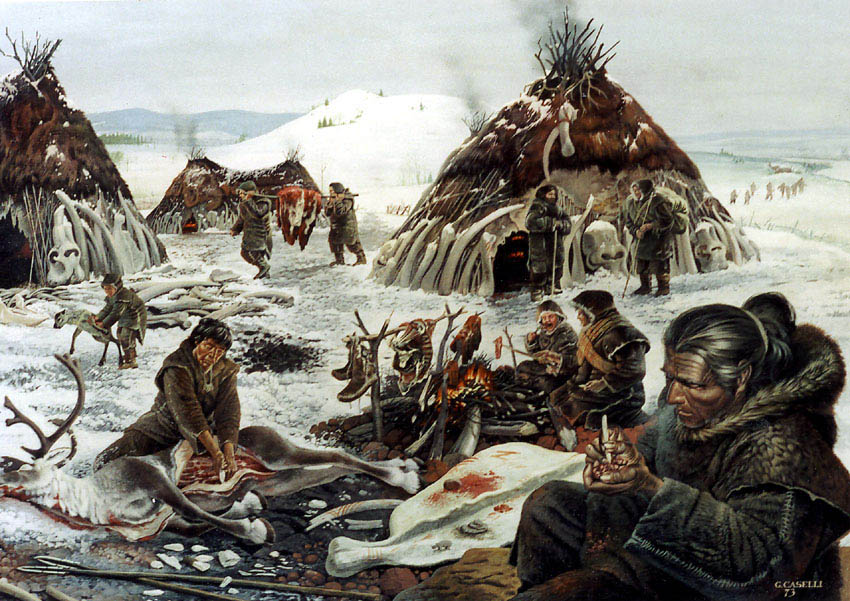
Clive Finlayson jabbered about a group of humans known as the Gravettian culture, who managed to survive in the steppe-tundra of the Eurasian Plain from 30,000 to 20,000 years ago.  Large game was abundant.  Here they invented one of the most diabolical Earth-shaking technologies of all time (gasp!), the storage pit!  Holes chopped into the frozen permafrost could be used as scavenger-resistant deep freezers, to store surplus food for the lean seasons.

Finlayson believed that food storage was a significant milestone on our long and painful descent to modernity.  Surplus made clans more secure, as long as adequate food resources remained available.  Acquiring surplus food for winter dining required intensified hunting, which could lead to waste, spoilage, unintentional overhunting, population growth, and the depletion of game over time.

An additional quirk of snow country was that folks needed to burn lots of calories to stay warm and strong in their physically active outdoor life.  So, a diet rich in fat was essential.  The fat content of game animals varied with the seasons.  Meat had the most fat in late summer and autumn.  In late winter and spring, many animals were unfit to eat due to insufficient fat.  In lean seasons, Native Americans killed buffalo just to eat their tongues, which were high in fat.

Dixie West noted that animals with minimal fat were junk food.  When humans and other carnivores eat lean meat, they can lose weight, because digesting it requires more energy than the meat contains.  Folks commonly smashed and boiled the bones that contained the most marrow, to extract the precious marrow fat.

In snow country, as long as large game remained readily available, labor intensive agriculture made zero sense.  As game became scarcer, hunting was gradually displaced by farming.  This began about 6,000 years ago.  In regions less suitable for farming, hunting persisted longer.  The focus shifted from storing meat to storing grain.  According to Finlayson, the concept of producing surplus food, and competently managing the surplus, set the stage for the birth of civilization.

The advantages of food storage in snow country encouraged the dawn of the “more is better” mindset, which eventually became a core belief in cultures engaged in agriculture or herding.  The Gravettians and other hunters stockpiled frozen or dried meat.  Farmers loaded granaries with calorie dense grains.  Herders stored their meat on the hoof, gathered milk daily, and slaughtered livestock only when needed.  They strove to accumulate as many animals as possible.  In different forms, the practice of food storage spread across snow country, eventually crossing from Siberia into the Americas.

Life was simpler for tropical hunter-gatherers, like the San people of the Kalahari.  On a really crappy day, if a gang of hyenas snatched an antelope just killed by hunters, what was lost was merely the work of a single day.  They were able to maintain their conservative traditional way of life for many, many thousands of years.  It was not a high impact way of life.

For the food hoarders of snow country, on the other hand, misfortune could suddenly eliminate months of tedious work, and endanger winter survival.  Their food stockpile could be wiped out by fire, flood, scavengers, spoilage, vermin, theft, and so on.  The whole community might starve and blink out.  Over the long run, “more is better” cultures, with their denser populations, were more likely to swerve into bloody turbulence.  Storage is big juju.

Dress for Success

Hunter-gatherer cultures differed widely in their dependence on technology.  The utterly simple Kalahari way of life was practiced by our hominin ancestors for at least two or three million years.  In the tropics of Mother Africa, evolution spent several million years fine tuning our bodies for life on the savannah, and the result was an excellent design. 

After hominins migrated out of Africa, and colonized tropical Asia and Australia, some folks decided to wander north.  It was a cool place to live, and the farther north they wandered, the cooler it got.  In snow country, tropical primates were like fish out of water.  Brrrr!  They wrapped themselves in animal hides, lived in protective shelters, and huddled around warm campfires.

In 1908, Knud Rasmussen told the story of a Greenland Eskimo named Qumangâpik, who had four wives and 15 children.  The first wife froze to death, the second was buried by an avalanche, the third died of illness, and the fourth froze to death.  Of his 15 children, one starved, four were frozen, and five died of illness.  Then, Qumangâpik froze to death, with his wife and two little children.  Three of his kids outlived him.  In frigid times, ripped or inadequate clothing could be a death sentence.

Over time, early colonists in snow country learned how to cut and sew hides into custom tailored clothing that provided better protection for both humans and their body lice companions.  Killing a deer, tanning its hide, and turning it into coats, trousers, hats, or footwear, was a time consuming process.  Deerskin attire was not especially warm, especially when soaking wet or frozen.  On the plus side, it could be boiled and eaten when starvation threatened.

The first stitching was likely done with sinew, or thin strips of leather.  Eventually, some groups learned how to spin plant fibers into thread, which could be used for stitching seams together.  In the Republic of Georgia, researchers have found spun and dyed fragments of flax fibers that were 34,000 years old. 

Needles were used for sewing clothing and tents, and for making nets.  Animal bone needles with eyes, about 25,000 years old, have been found in Central Europe.  Needles have not been found at Neanderthal sites yet, but looking for a needle in a haystack is far easier than finding an extremely old needle buried somewhere on the Eurasian land mass.

Over time, folks got better at spinning different types of high quality thread.  It was spun from plant fibers like flax, cotton, or hemp; or animal fibers like wool.  Eventually, a clever person invented weaving, a process that wove thread into cloth.  Cloth could be used to make a wide variety of useful things.

Kassia St Clair described how gathering and processing plant fibers was time consuming.  So was carefully collecting and preparing fibers from sheep, goats, silkworms, and others.  So was spinning and weaving.  In some regions, folks may have devoted more hours to their wardrobe than to acquiring food.  For hardworking people, clothing was precious, and carefully kept mended and patched.  Many owned little more than what they were wearing.

During the agricultural era, wool clothing was popular in snow country, until the eighteenth century, when new technology made cotton cloth cheaper to make, and more profitable.  Cotton was the dominant fabric until the 1970s, when synthetic fibers rose to dominance.  It won’t be long now until almost all clothing is polyester, which is exceedingly cheap to produce from petrochemicals using state of the art automation, and super cheap sweatshop labor.

Today, many consumers own enormous wardrobes of apparel, much of it rarely worn, if ever.  Modern attire is not designed for rugged durability, but to be rapidly mass produced, in order to meet the demand for the latest trendy styles.  Trendy styles have deliberately short lifespans.  This encourages radicalized consumers to maximize their apparel purchasing.  For them, nothing is more embarrassing than to be seen wearing obsolete fashions.  Landfills are stuffed with countless tons of formerly trendy attire.  Much of it is discarded while still in excellent condition.

Great Leap Forward

A number of thinkers have jabbered about a miraculous turning point in the human saga.  Before this event, humans were dim witted, knuckle dragging, mouth breathing bubbas.  And then — shazam! — we triumphantly glided across a magic bridge, from the archaic era into the modern one.  Our species was gaining momentum on the treacherous path to technological utopia and ecological dystopia.

Jared Diamond once speculated that if space aliens had visited Earth 100,000 years ago, humans would have appeared to be nothing more than ordinary animals.  But then, as the millennia passed, those critters were acting less and less ordinary.  By 40,000 years ago, our modernizing ancestors were demonstrating revolutionary changes that were both beneficial and risky.  What happened?  Diamond named this miracle the Great Leap Forward.

Of course, Diamond was raised in a crazy self-destructive wonderland of high technology — extremely clever stuff that enabled humankind to beat the living crap out of the planet’s ecosystems for no sane purpose.  Actually, those “ordinary” two-legged ancestors, observed by space aliens, were the one and only critters on Earth who were capable of conjuring domesticated fire — a fantastically revolutionary innovation.  It was close to step one on the long march to world domination.

For Diamond, the act of routinely using domesticated fire seemed ordinary and insignificant.  In his 1992 reality, even four-year olds could easily burn down the neighborhood with a cheap disposable lighter.  In addition to fire, the visiting space aliens would have also seen that the two-legged critters were unique in their ability to knap sharp stone tools, and manufacture assorted gizmos for hunting.  Our hominin ancestors had been developing these unordinary skills for more than two million years.

Extremely weird was the fact that those fire critters were at the top of the food chain, yet they had no serious fangs, claws, speed, strength, or size.  All the other top predators had naturally evolved some combination of those traits, gradually, over the course of millions of years.  But today, those traditional natural predators are being pounded into oblivion via guns, cyanide, habitat destruction, and so on.  There are not seven-plus billion lions and tigers and bears staring at cell phones.

With the Great Leap, humans began doing more and more things beyond what ordinary animals did.  They baked ceramic figurines in kilns, made flutes, wore ornamental beadwork, sewed clothing, invented new and improved tools, and built trophy homes with mammoth bone walls.  These luxurious dwellings have been found in Ukraine, Czech Republic, Poland, Romania, Belarus, and Russia.

Venus figurines have been found in Slovakia, Italy, Austria, Russia, Germany, Czech Republic, Switzerland, France, Romania, and Siberia.  They were carved in soapstone, steatite, sandstone, mammoth ivory, horse bone, serpentine, black jet, antler, limestone, and hematite.  Venus figurines date from 30,000 to 10,000 years ago.

Folks learned how to process red and yellow ochre, hematite, manganese oxide, and charcoal into pigments useful for cave painting.  Wild artists crawled far inside caverns with torches, and painted gorgeous portraits of the sacred animals for which they had the deepest respect and reverence.  Images included the horse, lion, auroch, rhinoceros, salmon, bear, mammoth, buffalo, owl, hare, ibex, auk, weasel, reindeer, chamois, and fox.  Often, artists placed their spread out hand against a wall, and sprayed paint over it, creating a hand stencil.

Those folks did not spend most of their lives indoors, isolated from the wild ecosystem, like astronauts in orbit.  They had no glowing screens.  Their world was entirely wild and alive, and they were intimately involved in it, every minute of every day, bloody hands and all.  The paintings celebrate their sacred relationship with the animals that fed them, clothed them, and sometimes killed them.

Prehistoric cave art has now been found in every continent except Antarctica.  In France and Spain, it has been found in almost 340 caves.  Famous sites include Chauvet in France (30 to 32 thousand years ago), Altamira in Spain (15,000), and Lascaux in France (18,000).  Recently, D. L. Hoffman’s team found paintings in three Spanish caves that were more than 64,800 years old — about 30,000 years before the arrival of humans.  This was the Neanderthal era.

The Great Leap Forward has also been called the Cultural Revolution or the Cognitive Revolution.  Cognition is about thought, understanding, and knowledge.  Twenty years ago, some believed that the leap was the result of miraculous genetic mutations that turbocharged our intelligence, but that theory went extinct, for lack of convincing DNA evidence.

A number of experts theorize that the leap was encouraged by powerful advances in complex language and communication, but this is impossible to prove via archaeological evidence.  Spoken words are not preserved in fossils.  We may have been singers and poets several million years ago.  We’ll never know.  Many primates and other animals are vocal.

Some sort of Great Leap certainly occurred in snow country, maybe between 50,000 and 30,000 years ago.  Our tropical primate ancestors were excited to discover lands loaded with abundant food, but challenged by a life-threatening climate for which evolution had not prepared them.  The only way they could stay, and feast on the delicious wildlife, was to cleverly invent a collection of prosthetic technology that would increase the odds of winter survival.  Eventually, the accelerating pace of cultural evolution enabled us to conquer the planet, explode in numbers, and savagely vandalize Earth in every imaginable way.

While many of the innovations of the Great Leap were survival-oriented prosthetics, others were not.  Painting, ornamentation, figurines, flutes, and so on were probably motivated by spiritual affairs, or the desire for enjoyment.  Obviously, for a while, these were not folks who were desperately struggling to survive.  Their new indulgences would seem to indicate that these folks were living in a bubble of affluence, leisure, and decadence.  They had learned and refined the skills of survival, and their food resources were temporarily abundant.  They were rich.  Life was good.

They remind me of America’s baby boomer generation, of which I am a member.  We were born at a time when industrial civilization soared to ridiculous excesses, fueled by an orgy of consuming enormous amounts of premium quality nonrenewable resources, as if they were infinite.  Some have called this joyride in self-destruction “The Blip” — a brief extreme spike in many trend lines, something equivalent to an asteroid strike. 

History repeatedly reminds us that high impact lifestyles always have an expiration date.  Yet, despite being proud descendants of the Cognitive Revolution, our clever minds routinely refuse to comprehend this simple and vital idea.  Magical thinking is always an effective cure for the unpleasant deliriums caused by occasional whiffs of reality.

Anyway, over the long run, was it truly a leap “forward” into greater joy, wisdom, health, and sustainability?  Or, was it something else?  When was the planet healthier and happier?