Showing posts with label stone tools. Show all posts

Saturday, June 1, 2019

Wild Free and Happy Sample 16


[Note: This is the sixteenth sample from my rough draft of a far from finished new book, Wild, Free, & Happy.  I don’t plan on reviewing more books for a while.  My blog is home to reviews of 201 books, and you are very welcome to explore them.  The Search field on the right side will find words in the full contents of all rants and reviews, if you are interested in specific authors, titles, or subjects.] 

Food Storage

In the tropics of Mother Africa, meat spoiled quickly, and yummy carcasses soon attracted mobs of ravenous and dangerous scavengers.  When folks fancied a juicy steak, they killed something.  Preserving and storing surplus meat was unnecessary, and highly impractical, a stupid idea that never occurred to anyone.  There was no reason to hunt heavily for a while, dry lots of meat, haul it around, and constantly protect it.

Snow country was a different story.  Winter made travel, hunting, and fishing more difficult.  Folks who accumulated and stored surplus food for the winter months were far more likely to survive and inhale the fragrant aromas of blooming springtime flowers.  For our human ancestors, fine-tuned for tropical living, long-term food storage was a weird and unnatural idea.  But once some pioneers learned how to do it, far more regions became potential locations for future colonization.  With storage, we were able to expand into lands having harsher climates.

Clive Finlayson jabbered about a group of humans known as the Gravettian culture, who managed to survive in the steppe-tundra of the Eurasian Plain from 30,000 to 20,000 years ago.  Large game was abundant.  Here they invented one of the most diabolical Earth-shaking technologies of all time (gasp!), the storage pit!  Holes chopped into the frozen permafrost could be used as scavenger-resistant deep freezers, to store surplus food for the lean seasons.

Finlayson believed that food storage was a significant milestone on our long and painful descent to modernity.  Surplus made clans more secure, as long as adequate food resources remained available.  Acquiring surplus food for winter dining required intensified hunting, which could lead to waste, spoilage, unintentional overhunting, population growth, and the depletion of game over time.

An additional quirk of snow country was that folks needed to burn lots of calories to stay warm and strong in their physically active outdoor life.  So, a diet rich in fat was essential.  The fat content of game animals varied with the seasons.  Meat had the most fat in late summer and autumn.  In late winter and spring, many animals were unfit to eat due to insufficient fat.  In lean seasons, Native Americans killed buffalo just to eat their tongues, which were high in fat.

Dixie West noted that animals with minimal fat were junk food.  When humans and other carnivores eat lean meat, they can lose weight, because digesting it requires more energy than the meat contains.  Folks commonly smashed and boiled the bones that contained the most marrow, to extract the precious marrow fat.

In snow country, as long as large game remained readily available, labor intensive agriculture made zero sense.  As game became scarcer, hunting was gradually displaced by farming.  This began about 6,000 years ago.  In regions less suitable for farming, hunting persisted longer.  The focus shifted from storing meat to storing grain.  According to Finlayson, the concept of producing surplus food, and competently managing the surplus, set the stage for the birth of civilization.

The advantages of food storage in snow country encouraged the dawn of the “more is better” mindset, which eventually became a core belief in cultures engaged in agriculture or herding.  The Gravettians and other hunters stockpiled frozen or dried meat.  Farmers loaded granaries with calorie dense grains.  Herders stored their meat on the hoof, gathered milk daily, and slaughtered livestock only when needed.  They strove to accumulate as many animals as possible.  In different forms, the practice of food storage spread across snow country, eventually crossing from Siberia into the Americas.

Life was simpler for tropical hunter-gatherers, like the San people of the Kalahari.  On a really crappy day, if a gang of hyenas snatched an antelope just killed by hunters, what was lost was merely the work of a single day.  They were able to maintain their conservative traditional way of life for many, many thousands of years.  It was not a high impact way of life.

For the food hoarders of snow country, on the other hand, misfortune could suddenly eliminate months of tedious work, and endanger winter survival.  Their food stockpile could be wiped out by fire, flood, scavengers, spoilage, vermin, theft, and so on.  The whole community might starve and blink out.  Over the long run, “more is better” cultures, with their denser populations, were more likely to swerve into bloody turbulence.  Storage is big juju.

Dress for Success

Hunter-gatherer cultures differed widely in their dependence on technology.  The utterly simple Kalahari way of life was practiced by our hominin ancestors for at least two or three million years.  In the tropics of Mother Africa, evolution spent several million years fine tuning our bodies for life on the savannah, and the result was an excellent design. 

After hominins migrated out of Africa, and colonized tropical Asia and Australia, some folks decided to wander north.  It was a cool place to live, and the farther north they wandered, the cooler it got.  In snow country, tropical primates were like fish out of water.  Brrrr!  They wrapped themselves in animal hides, lived in protective shelters, and huddled around warm campfires.

In 1908, Knud Rasmussen told the story of a Greenland Eskimo named Qumangâpik, who had four wives and 15 children.  The first wife froze to death, the second was buried by an avalanche, the third died of illness, and the fourth froze to death.  Of his 15 children, one starved, four were frozen, and five died of illness.  Then, Qumangâpik froze to death, with his wife and two little children.  Three of his kids outlived him.  In frigid times, ripped or inadequate clothing could be a death sentence.

Over time, early colonists in snow country learned how to cut and sew hides into custom tailored clothing that provided better protection for both humans and their body lice companions.  Killing a deer, tanning its hide, and turning it into coats, trousers, hats, or footwear, was a time consuming process.  Deerskin attire was not especially warm, especially when soaking wet or frozen.  On the plus side, it could be boiled and eaten when starvation threatened.

The first stitching was likely done with sinew, or thin strips of leather.  Eventually, some groups learned how to spin plant fibers into thread, which could be used for stitching seams together.  In the Republic of Georgia, researchers have found spun and dyed fragments of flax fibers that were 34,000 years old. 

Needles were used for sewing clothing and tents, and for making nets.  Animal bone needles with eyes, about 25,000 years old, have been found in Central Europe.  Needles have not been found at Neanderthal sites yet, but looking for a needle in a haystack is far easier than finding an extremely old needle buried somewhere on the Eurasian land mass.

Over time, folks got better at spinning different types of high quality thread.  It was spun from plant fibers like flax, cotton, or hemp; or animal fibers like wool.  Eventually, a clever person invented weaving, a process that wove thread into cloth.  Cloth could be used to make a wide variety of useful things.

Kassia St Clair described how gathering and processing plant fibers was time consuming.  So was carefully collecting and preparing fibers from sheep, goats, silkworms, and others.  So was spinning and weaving.  In some regions, folks may have devoted more hours to their wardrobe than to acquiring food.  For hardworking people, clothing was precious, and carefully kept mended and patched.  Many owned little more than what they were wearing.

During the agricultural era, wool clothing was popular in snow country, until the eighteenth century, when new technology made cotton cloth cheaper to make, and more profitable.  Cotton was the dominant fabric until the 1970s, when synthetic fibers rose to dominance.  It won’t be long now until almost all clothing is polyester, which is exceedingly cheap to produce from petrochemicals using state of the art automation, and super cheap sweatshop labor.

Today, many consumers own enormous wardrobes of apparel, much of it rarely worn, if ever.  Modern attire is not designed for rugged durability, but to be rapidly mass produced, in order to meet the demand for the latest trendy styles.  Trendy styles have deliberately short lifespans.  This encourages radicalized consumers to maximize their apparel purchasing.  For them, nothing is more embarrassing than to be seen wearing obsolete fashions.  Landfills are stuffed with countless tons of formerly trendy attire.  Much of it is discarded while still in excellent condition.

Great Leap Forward

A number of thinkers have jabbered about a miraculous turning point in the human saga.  Before this event, humans were dim witted, knuckle dragging, mouth breathing bubbas.  And then — shazam! — we triumphantly glided across a magic bridge, from the archaic era into the modern one.  Our species was gaining momentum on the treacherous path to technological utopia and ecological dystopia.

Jared Diamond once speculated that if space aliens had visited Earth 100,000 years ago, humans would have appeared to be nothing more than ordinary animals.  But then, as the millennia passed, those critters were acting less and less ordinary.  By 40,000 years ago, our modernizing ancestors were demonstrating revolutionary changes that were both beneficial and risky.  What happened?  Diamond named this miracle the Great Leap Forward.

Of course, Diamond was raised in a crazy self-destructive wonderland of high technology — extremely clever stuff that enabled humankind to beat the living crap out of the planet’s ecosystems for no sane purpose.  Actually, those “ordinary” two-legged ancestors, observed by space aliens, were the one and only critters on Earth who were capable of conjuring domesticated fire — a fantastically revolutionary innovation.  It was close to step one on the long march to world domination.

For Diamond, the act of routinely using domesticated fire seemed ordinary and insignificant.  In his 1992 reality, even four-year olds could easily burn down the neighborhood with a cheap disposable lighter.  In addition to fire, the visiting space aliens would have also seen that the two-legged critters were unique in their ability to knap sharp stone tools, and manufacture assorted gizmos for hunting.  Our hominin ancestors had been developing these unordinary skills for more than two million years.

Extremely weird was the fact that those fire critters were at the top of the food chain, yet they had no serious fangs, claws, speed, strength, or size.  All the other top predators had naturally evolved some combination of those traits, gradually, over the course of millions of years.  But today, those traditional natural predators are being pounded into oblivion via guns, cyanide, habitat destruction, and so on.  There are not seven-plus billion lions and tigers and bears staring at cell phones.

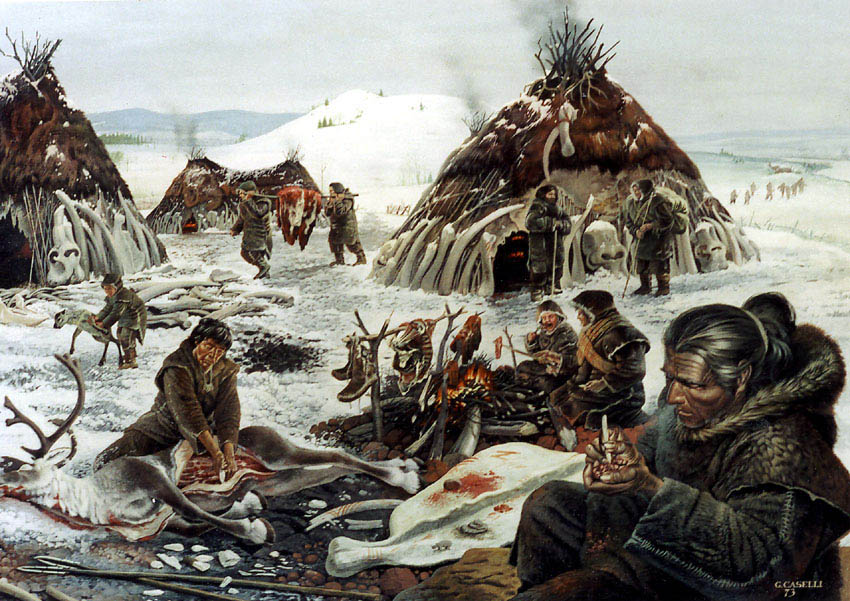
With the Great Leap, humans began doing more and more things beyond what ordinary animals did.  They baked ceramic figurines in kilns, made flutes, wore ornamental beadwork, sewed clothing, invented new and improved tools, and built trophy homes with mammoth bone walls.  These luxurious dwellings have been found in Ukraine, Czech Republic, Poland, Romania, Belarus, and Russia.

Venus figurines have been found in Slovakia, Italy, Austria, Russia, Germany, Czech Republic, Switzerland, France, Romania, and Siberia.  They were carved in soapstone, steatite, sandstone, mammoth ivory, horse bone, serpentine, black jet, antler, limestone, and hematite.  Venus figurines date from 30,000 to 10,000 years ago.

Folks learned how to process red and yellow ochre, hematite, manganese oxide, and charcoal into pigments useful for cave painting.  Wild artists crawled far inside caverns with torches, and painted gorgeous portraits of the sacred animals for which they had the deepest respect and reverence.  Images included the horse, lion, auroch, rhinoceros, salmon, bear, mammoth, buffalo, owl, hare, ibex, auk, weasel, reindeer, chamois, and fox.  Often, artists placed their spread out hand against a wall, and sprayed paint over it, creating a hand stencil.

Those folks did not spend most of their lives indoors, isolated from the wild ecosystem, like astronauts in orbit.  They had no glowing screens.  Their world was entirely wild and alive, and they were intimately involved in it, every minute of every day, bloody hands and all.  The paintings celebrate their sacred relationship with the animals that fed them, clothed them, and sometimes killed them.

Prehistoric cave art has now been found in every continent except Antarctica.  In France and Spain, it has been found in almost 340 caves.  Famous sites include Chauvet in France (30 to 32 thousand years ago), Altamira in Spain (15,000), and Lascaux in France (18,000).  Recently, D. L. Hoffman’s team found paintings in three Spanish caves that were more than 64,800 years old — about 30,000 years before the arrival of humans.  This was the Neanderthal era.

The Great Leap Forward has also been called the Cultural Revolution or the Cognitive Revolution.  Cognition is about thought, understanding, and knowledge.  Twenty years ago, some believed that the leap was the result of miraculous genetic mutations that turbocharged our intelligence, but that theory went extinct, for lack of convincing DNA evidence.

A number of experts theorize that the leap was encouraged by powerful advances in complex language and communication, but this is impossible to prove via archaeological evidence.  Spoken words are not preserved in fossils.  We may have been singers and poets several million years ago.  We’ll never know.  Many primates and other animals are vocal.

Some sort of Great Leap certainly occurred in snow country, maybe between 50,000 and 30,000 years ago.  Our tropical primate ancestors were excited to discover lands loaded with abundant food, but challenged by a life-threatening climate for which evolution had not prepared them.  The only way they could stay, and feast on the delicious wildlife, was to cleverly invent a collection of prosthetic technology that would increase the odds of winter survival.  Eventually, the accelerating pace of cultural evolution enabled us to conquer the planet, explode in numbers, and savagely vandalize Earth in every imaginable way.

While many of the innovations of the Great Leap were survival-oriented prosthetics, others were not.  Painting, ornamentation, figurines, flutes, and so on were probably motivated by spiritual affairs, or the desire for enjoyment.  Obviously, for a while, these were not folks who were desperately struggling to survive.  Their new indulgences would seem to indicate that these folks were living in a bubble of affluence, leisure, and decadence.  They had learned and refined the skills of survival, and their food resources were temporarily abundant.  They were rich.  Life was good.

They remind me of America’s baby boomer generation, of which I am a member.  We were born at a time when industrial civilization soared to ridiculous excesses, fueled by an orgy of consuming enormous amounts of premium quality nonrenewable resources, as if they were infinite.  Some have called this joyride in self-destruction “The Blip” — a brief extreme spike in many trend lines, something equivalent to an asteroid strike. 

History repeatedly reminds us that high impact lifestyles always have an expiration date.  Yet, despite being proud descendants of the Cognitive Revolution, our clever minds routinely refuse to comprehend this simple and vital idea.  Magical thinking is always an effective cure for the unpleasant deliriums caused by occasional whiffs of reality.

Anyway, over the long run, was it truly a leap “forward” into greater joy, wisdom, health, and sustainability?  Or, was it something else?  When was the planet healthier and happier?

Monday, April 1, 2019

Wild Free and Happy Sample 12


[Note: This is the twelfth sample from my rough draft of a far from finished new book, Wild, Free, & Happy.  I don’t plan on reviewing more books for a while.  My blog is home to reviews of 199 books, and you are very welcome to explore them.  The Search field on the right side will find words in the full contents of all rants and reviews, if you are interested in specific authors, titles, or subjects.]

Technological Innovation

When a hungry chimp snatches a small monkey, termite, or bird egg, all she needs to eat it are fingers and teeth.  When a hungry baboon discovers a carcass abandoned by lions, he can chew the meat and fat off the bones and hide.  It’s very different when a persistence hunter chases a large kudu until it is exhausted, and then suffocates it.  What now?  Imagine turning a road kill deer into a feast without a knife.  Have a bloody good time!

Chimps use slender sticks to fish for termites.  They use clubs and rocks to aggressively attack critters that annoy them.  Macaques use stones to smash open shellfish.  Vultures use rocks to open ostrich eggs.  Ravens use gravity to crack open the nuts they drop.  This is not complex technology.

Our ancestors began a transition from found tools to manufactured ones.  The oldest ones discovered so far, mostly simple choppers, were found in Africa, and date to about 2.5 million years ago.  A major advance emerged around 1.5 million years ago — biface knapping.  Some types of rocks, like obsidian or flint, can be carefully knapped to knock off flakes having razor sharp edges.  These were useful as scrapers, knives, and choppers.  Later, ancestors learned how to knap long sharp blades, and attach them to handles.  Still later, they became skilled at chipping flakes into delicately shaped spear points and arrowheads.

We glowing screen people arrogantly smirk at the primitive technology of our early Stone Age ancestors.  In reality, stone tools were revolutionary inventions that shifted the hominin saga onto a new, unusual, and risky path.  For the first time, folks could effectively skin and butcher large animals — an ability that greatly expanded their food resources, and provided high quality nutrients for their jumbo-sized energy-guzzling brains.  Imagine a world in which teeth were the only cutting edges for any purpose.  Civilization would be impossible, and hominins may have never evolved.

Kathy Schick and friends once successfully butchered a dead elephant with stone tools.  A mature adult’s rugged hide is about one inch thick (2.4 cm).  Scavengers like hyenas don’t even bother trying to chew into the carcass of an elephant that recently died.  They let it bake in the sun for a few days, allowing decay to soften it up.

Our ancestors used sharp cutters to remove hides, cut meat off bones, and dismember the carcass into portions easier to haul back to camp.  They used stone hammers to smash open bones, to extract the marrow, which was rich with fat.  Fat is an essential nutrient, and the meat of wild game has only one-seventh of the fat found in supermarket beef, according to Schick.  Ancestors may have scavenged elephant carcasses, but adult pachyderms may not have been prime targets for hunters.  Once you strip the meat off of the exposed side, flipping over a dead elephant is a huge challenge.  Smaller game takes less effort.

We have no idea when spear technology was first developed.  It could have been two or three million years ago.  Wooden artifacts are highly prone to decompose over time.  Spears were also revolutionary.  They made it easier to kill large game, and allowed the ancestors to be less dependent on scavenging.  Spears were also useful for discouraging attacks from man-eating predators.

Thrusting spears, or lances, were driven directly into the prey by hungry hunters, at close range.  Javelins were thrown spears that could kill from a distance, which was much safer.  Carleton Coon mentioned a tribe that could hurl long spears with deadly accuracy from up to 180 feet away (55 m).

The oldest spears found so far were discovered in a coal mine at Schöningen, Germany.  Frederick Coolidge wrote that seven spruce spears, a throwing stick, and other tools were found near ten butchered horse carcasses.  The spears were 400,000 years old, up to 6.5 feet long (2 m), scraped smooth, and pointed at both ends.  They were made by the ancestors of Neanderthals (Homo heidelbergensis).  The fact that Neanderthals could survive for hundreds of thousands of years using such simple weapons is evidence that they lived in a time when large game was abundant, and it was proof that they were not dummies.

The killing power of spears was boosted by the invention of the atlatl, a spear-throwing device that enabled the weapon to be hurled farther and faster.  Alfred Crosby noted that in Peru, an Incan warrior with an atlatl could send a short spear completely through a conquistador wearing metal armor. 

Eventually, nobody is sure when, the bow and arrow was invented.  Like the spear, this deadly technology spread around the world, and over time enabled the slaughter of countless millions of animals.  Of course, with state of the art weaponry, well fed clans grew in number, conflicts increased, and hunters increasingly had to also turn their weapons on strangers who encroached into their territory.

A bloodless alternative to conflict was migration into lands uninhabited by hominin competitors.  Many frontier regions introduced the ancestors to new species of prey, and clever folks invented specialized technology for killing them.  Joe Kane spent time with the Huaorani people of the Amazon rainforest.  Their armory included spears and blowguns.  Poison darts would kill monkeys in the branches above, requiring the hunter to climb up and retrieve them.  Over time, lads who did a lot of tree climbing developed odd-shaped feet.  Their big toes bent outward, providing a tighter grip.

Carleton Coon mentioned other tribes using different poisons that relaxed the muscles of monkeys, so they would fall from the trees.  No climbing needed.  Pygmy poisons were a potion made from ten different plants, beetle larvae, and snake venom.  They paralyzed muscles and stopped the heart.  In Japan, the Ainu built booby traps, in which deer tripped on a cord, and a bow shot a poison tipped arrow into the animal. 

When marine mammals were speared, their corpses often sank into deep waters, never to be retrieved and consumed.  The solution was to carve barbed detachable harpoon heads which would not pull out of the animal’s flesh.  The embedded head was attached to a cord linked to the hunter above.  When the dead animal sank, it could then be retrieved and invited to lunch.

Innovation also led to the use of rock-throwing slings, bolas, hunting nets, traps, and on and on.  You could fill a book on this subject, and Alfred Crosby did, covering the entire spectrum from rocks to nuclear weapons.  Humans are remarkably creative when it comes to devising an endless stream of new and improved systems for killing things.  It’s been a nonstop arms race.

The wheels of innovation spin faster when populations grow, and become able to support more and more nerdy specialists.  Also, trade with other regions brings distant groups into contact, where they are exposed to the gizmos and ideas from other cultures, and this can greatly stimulate the imaginations of anxious nerds.  The velocity of change in my lifetime has been dizzying, impossible to keep up with.

Craig Dilworth described what he called the Vicious Circle Principle (VCP), a cycle in which (1) scarcity spurred technological innovation, (2) innovation increased access to more resources, (3) more resources increased consumption, (4) increased consumption fueled population growth, (5) population growth led to resource depletion, and (6) resource depletion led to scarcity once again. 

The VCP cycle keeps repeating, each time ratcheting up the impact, until it eventually slams into firm resource limits, or chokes to death on its own pollution.  Some hunter-gatherer cultures managed to survive into recent times in a low impact manner — until the radicalized VCP mob barged into their world via loggers, miners, missionaries, and so on.

Dilworth noted that, from its beginning, technological development has degraded ecological sustainability.  Should we be proud of our legendary wizardry?  Species that don’t manufacture tools, like chimps, never experience this predicament.  Our current technological utopia, swarming with billions of hominins, continues to work tirelessly to destroy the ecological basis upon which it depends, a one-way dead-end path.  How smart is that?

Evolution is brilliant!  When predators are free to perform their natural ecosystem services, their prey do not experience population outbursts.  Chimps make no effort to exterminate the big cats that prey on them, consequently there are not seven billion chimps pounding the stuffing out of the planet.  The sacred dance of predator and prey works beautifully until it gets blindsided by technological innovation.  Technology improved our abilities at offence (killing game) as well as defense (exterminating competing predators).  Balance got blown out of the water.

Dilworth mentioned that by 200 B.C. the leopards and lions of Greece, and along the coast of the Near East, were gone.  Several centuries later, tigers no longer survived in northern Persia and Mesopotamia.  Predator extermination is a standard process in cultures that enslave domesticated animals.  Today, few wild high-level predators survive in most of the civilized world.

Environmentalists tend to focus their campaigns primarily on problems related to modern technology, because they think it’s especially terrible.  Dilworth’s VCP sees all technology as dangerous and unnecessary.  Across Eurasia and the Americas, megafauna extinctions surged between 10,000 and 30,000 years ago — in the Stone Age, prior to agriculture and civilization, when fewer than ten million humans likely wandered the Earth.  It was an enormous ecological holocaust that our culture has largely swept under the rug.  Today, few consumers wake up screaming from nightmares about the bloody extermination of mastodons, saber-tooth cats, or woolly rhinos by high-tech hunters.  We are also careful not to think about the mass extinctions happening right now, as we pedal to work.

The bottom line for Dilworth is that if technological development was truly wisdom-driven, intelligent, and beneficial, it would not have transformed the planet’s healthy genuinely sustainable wild ecosystems into toxic devastated wastelands, depleted countless precious resources, and sabotaged the climate.  Why do we continue proudly teaching children about our magnificent big brains and the wonders of progress?  The good news is that the VCP cycle is unsustainable, and will eventually blink out.  What will be left when it does?

Saturday, November 3, 2018

The Rise of Homo Sapiens


The Rise of Homo Sapiens, by Frederick Coolidge (psychologist) and Thomas Wynn (anthropologist), is a book about the evolution of human cognition.  It describes the seven million year voyage that resulted in the magnificent mind that’s throbbing between your ears right now.  This voyage began with the first hominins — bipedal (two legged) apes who were either our direct ancestors, or our long lost cousins.

Note that the details of human evolution are the cause of endless barroom brawls among rowdy paleoanthropologists and archaeologists.  They constantly argue about the members of our family tree, the transitions between one species and the next, and the dates when changes happened.  To keep it simple here, the first brainy hominin was Homo erectus, who arrived on the African stage 1.8 million years ago.  Erectus probably evolved into Homo heidelbergensis, who was maybe the common ancestor of both Homo neanderthalensis and Homo sapiens (our hero!).  Neanderthals are our cousins, not our direct ancestors (we share at least 99.5 percent of our DNA).

The authors believe that there were two significant surges in cognition, (1) Homo erectus 1.5 million years ago, and (2) Homo sapiens 40,000 years ago.  Erectus had a large brain, knapped stone tools, and was the first to move beyond woodland habitats.  They were able to survive in everything from dry savannahs to tropical rainforests.  From Africa, they spread to southern Europe and much of Asia.  Around 1.5 million years ago, they invented a major advance in stone tools — biface knapping.  These were hand axes and cleavers that had two cutting edges.  For the first time, folks could now effectively butcher large animals — an ability that greatly expanded their food resources.

Razor sharp stone tools were revolutionary.  Great apes, monkeys, and other mammals can only cut and chop with their teeth.  This book made me appreciate, for the first time, the huge importance of stone tools.  Cutting is big juju!  Imagine a world in which teeth were the only cutting edges for any purpose.  Civilization would be impossible, and you and I would be naked wild things on a sunny African savannah.

Another revolutionary technological discovery was the domestication of fire, which kicked open the gate to life as we know it.  The earliest evidence of fire was found in an African cave, dating to 1.4 million years ago.  Erectus was probably a fire user.  Prior to manufactured tools and domesticated fire, our ancestors were still ordinary animals, like baboons — wild, free, and happy.  These two changes shoved them outside the community of all other animals, and put them on an ominous new path.

In the million years following the invention of biface cutters, Homo erectus artifacts reveal no evidence of further innovation.  Maybe they now had everything they needed, and life was grand.  But the book’s authors live in a culture that is constantly disrupted by hurricanes of innovation.  To them, a million years of stability and sustainability is glaring evidence of feeblemindedness. 

Both authors are shameless out-of-the-closet human supremacists, and their book is a flag-waving celebration of human brilliance.  They write, “Homo sapiens has transformed the natural world into one of culture and civilization that our distant ancestors, let alone members of other species, possibly could not imagine.”  No kidding! 

The authors are also masters at the mysterious art of academic writing.  Behold: “The allometric trajectory that best distinguished anatomically modern Homo sapiens and Neanderthals was a tendency towards klinorhynchy or globularity in modern humans.”  The book was not a pleasure read for a general reader like me.  I was not the intended audience.

In the book, hominins are essentially presented as being biological machines.  Much attention is devoted to brain size, brain components, brain processes, and genetic evolution.  Subjects include decision making, planning, memory, learning, abstract thinking, language, communication.  Bones and artifacts reveal little or nothing about stuff like thinking, memory, or speaking, so the book indulges in a lot of speculating, which could get quite frisky, sometimes hopping over the fence of credibility.

Homo sapiens maybe emerged around 200,000 years ago.  Somewhere around 30,000 to 40,000 years ago, there is evidence of a significant shift that is often referred to as the Great Leap Forward.  It was an era of breathtaking cave paintings, decorative ornaments, ceramics, carvings, and innovation in hunting technology.  The authors make the highly controversial assertion that this big shift “developed because of an additive genetic mutation or epigenetic event that affected the neural organization of the brain.”  And so, a new and turbulent chapter in the human saga was the result of random genetic juju that scrambled our thinkers.

Far less attention is devoted to significant factors that were external to the brain machines and their magic genes.  By the time of the Great Leap, folks had struggled to overcome a number of major challenges.  They had figured out how to survive in a chilly temperate climate — warm clothing, secure shelters, food storage.  Utilizing the latest state of the art technology, they had become highly skilled at team hunting.  They lived in regions having abundant game.  People who are struggling to survive are not going to have time to fool around with nonessential amusements.  But people living in times of prosperity, like the Baby Boomers, or the cave painters, can indulge in fanciful excesses and extravagances.

In the Great Leap era, the world was unimaginably alive and a spectacular, breathtaking miracle.  Modern folks would eagerly pay big money, and get on a 40-year waiting list to experience a pure, thriving wilderness filled with mammoths, lions, aurochs, and buffalo.  To gasp with wonder at vast clouds of birds filling the skies with beautiful music and motion.  To listen to rivers thrashing with countless salmon.  To see, hear, and feel the powerful vitality of the reality in which our species evolved, the type of world that the genes of every newborn baby expects to inhabit — a healthy, sane, beautiful, wild paradise.

Craig Dilworth wrote that the cave painting tribes were the luckiest humans of all, because they lived at the zenith of the entire human experience.  A number of revolutionary innovations had provided them with a temporary opportunity to experience a magnificent way of life.  But the road ahead was a rough one.  Another ice age was approaching, and Europe would get colder than it had been in 100,000 years.  Large game would become less abundant due to habitat change, and to the long-term consequences of, century after century, killing a few too many big critters that did not breed like bunnies.

Technological innovation has a regular habit of sharply biting its clever inventors, and their societies, on the ass.  Patching up the damage caused by the unintended consequences of progress typically inspires even more innovation, leading to even more unintended consequences, resulting in a treacherous downward spiral. 

Humans have retained some characteristics of ordinary animals — our minds are focused on the here and now, our capacity for acute foresight is flaccid, and we often become prisoners of habitual thoughts and behaviors.  Over time, human numbers grew, and food resources diminished.  Storms of devastating cleverness eventually led to the domestication of plants and animals, a transition that many anthropologists refer to as the Great Leap Backward. 

And now, dear reader, here we are, standing in the growing shadow of an era of climate change helter-skelter, a painful withdrawal from a total addiction to energy guzzling, and the eventual obliteration of life as we know it.  And, here we are talking about a book that celebrates the miracle of human cognition.  Oy!

A year ago, I spent a few hours with this book, and set it aside.  Recently, I looked at it again, because I was interested in some anthropological information.  I contemplated reviewing it, but decided not to.  Then, my muse gave me a dope slap (SMACK!).  The book is perfect!  It’s a haunting mug shot of the mindset that is engaged in a full-scale war against all life — yet refuses to notice it, or care.

This is the mindset in which educated brains are thoroughly marinated from childhood onward.  Like standing in front of a curvy funhouse mirror, the distorted reflection we see is Superman or Superwoman, powerful beings of greatness and goodness.  Thus, the notion of superheroes knowingly engaging in pathological mass destruction is perfectly ridiculous.  We much prefer the flattering portrait to the lost and confused critter behind the mask.  This may not be the path to a happy ending.

One passage noted that, “excepting humans,” today’s great apes are in decline (chimps, bonobos, gorillas, orangutans).  Could their big brains have doomed them?  “Large brains are expensive and have profound life-history consequences.  If they no longer yield a competitive edge, their owners will, predictably, go extinct.”  Do you think that humans truly are the exception?  Is our ever-growing cleverness rotting out our competitive edge, as it undermines the ecosystems that make our existence possible?  Will our superhero brains ever snap out of their trance, open their eyes, and become fully present in reality?  Stay tuned.  And now, a message from our sponsor…

Coolidge, Frederick L., and Thomas Wynn, The Rise of Homo Sapiens: The Evolution of Modern Thinking, Wiley-Blackwell, Chichester, U.K., 2009.