Showing posts with label intelligence. Show all posts

Saturday, December 4, 2021

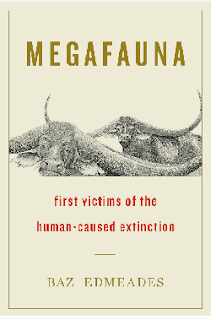
Megafauna Review


Megafauna is an important, fascinating, unforgettable, one-of-a-kind book.  It primarily focuses on prehistoric megafauna extinctions around the world, and how they happened.  Baz Edmeades (“ed-meedz”) has been working on this book for 20+ years, and it is impressively thorough.  His grandfather was a professor who found a unique human-like skull that was about 259,000 years old.

Megafauna are mammals weighing more than 100 pounds (46 kg).  Hominins are primates that walk on two legs, like you and I.  Hominins have been around for several million years.  Humans have been around for 250,000 to 400,000 years, depending on who you ask. 

During the last two or three million years, lots of megafauna species, all around the world, have moved off the stage forever.  Why?  A heated debate has been buzzing for 50+ years.  Was it an asteroid strike?  No evidence.  Were they zapped by diseases?  No evidence.  Was it climate change?  It probably strained some regional situations.  Was it human activities?  The evidence strongly supports this.  In 1966, Paul Martin presented his megafauna overkill theory (humans did it), which ignited big controversy in academia.  Edmeades became friends with Paul Martin, and learned a lot from him. 

Hominins originated in Mother Africa, where there used to be at least nine species of big cats (three today), nine types of elephants (one today), and four hippos (one today).  There were giant antelopes, giant hyenas, giant pigs, giant monkeys, and giant baboons — all gone.  Extinction spasms especially surged as humans wandered out of Africa, and gradually colonized the planet.  They migrated across Southern Asia, to Australia, then Eurasia, and finally the Americas. 

Paul Martin coined the misleading term “blitzkrieg overkill,” which angered quite a few folks.  As humans colonized new regions, the megafauna declined in number, in a process that could take a thousand years or more, multiple generations.  It was not a high-speed massacre.  These hunters were Stone Age people, using simple tools.  Many of the large game they hunted had low reproductive rates, which made them extremely vulnerable to extinction.

There is a clear pattern that when hunters migrated into continental land masses, stuff went extinct — except on uninhabited (human-free) offshore islands of the Mediterranean, Caribbean, and elsewhere.  On these islands, extinctions didn’t begin until humans eventually stepped ashore, sometimes thousands of years later.  Understand that offshore islands have a climate quite similar to the nearby mainland.  Climate was not a factor here.  Many of the megafauna species that blinked out had survived multiple ice ages over the passage of several million years.

In 2015, I stumbled across early sections of the Edmeades book online, and they blindsided me.  I never understood how incredibly alive this planet once was, and how tragically damaged it now is.  None of my teachers ever explained this, because they never learned it.  Our cultural myths celebrate the upward spiral of humankind’s brilliant achievements.  We live in a technological wonderland, not an ecological graveyard.  Life has never been better, and the best is yet to come.

The ancestors of hominins were originally tree dwellers.  Our closest living relatives are chimps, with whom we share 98.8 percent of our DNA.  Long ago, when the climate changed, and forests shrank, our ancestors were forced to survive as ground dwellers, a lifestyle for which evolution had not prepared them.

Over the course of several billion years, evolution has been a remarkable force that guided the journey of the family of life.  When frigid eras arrived, critters evolved fur coats.  When foxes became faster, evolution selected for faster bunnies.  It was a balancing act.  Foxes needed bunnies, and bunnies needed foxes.  The family of life was continuously fine-tuned at the speed of evolution, an extremely slow process.  Alterations could take many thousands of years.

Over millions of years, evolution provided giant tortoises with large bodies, invincible lion-proof shells, and long lifespans.  In the blink of an eye, these advantages were rubbished when hominins moved into the neighborhood, and began killing 200-year-old tortoises with big rocks.  This hunting method was not fine-tuned by evolution.  It was a sudden innovation that popped into the mind of a hungry hominin — and it worked!  Invincible tortoises were immediately transformed into helpless sitting ducks that didn’t have a bright future.  Evolution was yanked out of the driver’s seat.  Ancient rules no longer mattered. 

Hominin cleverness changed the world.  It made it far easier to grab essential resources, grow in numbers, and avoid becoming cat food.  Cleverness had the long term impact of an asteroid strike.  Cleverness enabled hominins to domesticate fire, plants, and animals.  We colonized the planet, developed industrial civilization, zapped the forests, polluted everything, and destabilized the climate.

Many folks in the human herd suffer from a blind faith that the miraculous power of cleverness can easily overcome all challenges.  Their vision is to keep our maximum impact way of life on life support, as long as possible, and hope for the best.  Edmeades presents no solutions, but this is a story that was important to tell.  He laments that cleverness “has given our species the power to transform the biosphere so profoundly that no other organism on this planet may get the opportunity of evolving it again.” 

His book does an excellent job of discussing the megafauna extinctions in an understandable way, with up-to-date information.  Its bitter medicine, and good medicine.  Many misperceive evolution to be a divine competition, in which species fight relentlessly to reach the top of the hierarchy, seeking to wear the Dominant Animal crown.  This pyramid-climbing quest for domination is the engine of civilization.  By the end of the book, you understand that evolution is more about adapting to changing conditions in a way that is as smooth and balanced as possible. 

Evolution has been the great friend of the family of life.  The Dominant Animal game has been its grim reaper.  While the wild megafauna are now sharply diminished, human-caused extinctions of many other species continue at an accelerating rate.  Cleverness never sleeps.  I’ve spent 69 years in a roaring hurricane of devastating cleverness.  Edmeades book reminded me that this planet was once a healthy and amazing living paradise.  Some of my genes have their roots in those good old days of abundant life.  That’s a comforting notion.

Edmeades, Baz, Megafauna: First Victims of the Human-Caused Extinction, Houndstooth Press, 2021.


Monday, April 15, 2019

The Smart Neanderthal


Clive Finlayson is especially fascinated by two things, Neanderthals and birds.  Since 1989, he has been excavating caves in Gibraltar, on the north shore of the Mediterranean, where Neanderthals lived from 127,000 to 32,000 years ago.  Gibraltar is the place where the last Neanderthals tearfully bid farewell to this magnificent planet.  Later, after they were gone, Homo sapiens lived in these caves, beginning maybe 30,000 years ago.  There is no evidence of them being in living contact at the Gibraltar site.

For decades, many scholars have adopted the belief that we Homo sapiens were superior to Neanderthals.  They imagine that when humans invaded Neanderthal territory, the inferior species was helplessly overwhelmed and exterminated.  This belief is known as the replacement model, which assumed that we could never meet other humans without wiping them out.  History is loaded with replacement stories.

Beliefs are based on assumptions, which are sometimes daffy balderdash.  Over time, beliefs that pass from one generation to the next can mutate into illusions that are perceived to be certain truths.  Human supremacists really annoy Finlayson, and he has written three books to spank them — Neanderthals and Modern Humans (2004), The Humans Who Went Extinct (2009), and The Smart Neanderthal (2019).  The new book is an enjoyable, well written mystery story, in which the brainy hero (Finlayson) confronts the dodgy beliefs held by many mainstream scholars.

It’s not surprising that folks who have spent more than 30 years studying Neanderthals actually accumulate a lot of experiences and insights.  They learn things that scholars in faraway college towns never do.  The myth of progress is only a few centuries old, and it perceives that all previous generations were inferior — especially our prehistoric relatives.  The human supremacists in academia have generated a list of advanced characteristics that Neanderthals lack.  In his new book, Finlayson examines this list, item by item, and presents evidence to the contrary.  He concludes that humans and Neanderthals were equally intelligent, but not equally lucky in the survival lottery.

Of all the prehistoric hominins, we know Neanderthals best, because we have discovered a number of sites where they lived in Eurasia.  In caves, evidence of days past is far less likely to be blown or washed away, and more likely to be preserved and found.  Over time, layers of stuff build up, with newer ones covering the old.  Scientists assign dates to each layer, and document the artifacts found.

What makes the book especially interesting is that he uses his love of birds to support a number of his arguments.  The caves at Gibraltar contain the remains of 160 species of birds.  The region was once a wonderland for the winged ones, but not now.  “Their world has been destroyed by civilized man in a few centuries.”

Human supremacists assert that dimwitted Neanderthals were incapable of catching speedy prey, like birds or hares.  So Finlayson visited Spain, and watched an old gent attract 300 large vultures by putting out some carrion.  They surrounded him, and happily took food from his hand.  Another time, he went to an island off the coast of Scotland, where it was the breeding season for 150,000 gannets.  None took flight as he strolled through them, instead they pecked his legs bloody.

Some birds respond to danger by flying away.  Others, like the stone curlews, have natural coloration that provides excellent camouflage.  When danger appears, they freeze, and become nearly invisible to predators.  They only take flight if the intruder makes a sudden movement.  Finlayson has calmly walked right past frozen curlews, and could have easily snatched them.  Sometimes speedy hares will freeze in the presence of danger, allowing their camouflage to render them invisible.  Finlayson has walked very close to frozen hares.

The 300,000+ year saga of Neanderthals was an era of roller coaster climate shifts.  Most of their time on Earth was colder than average.  Some climate shifts happened suddenly and sharply.  Children were sometimes born in a steppe habitat which, decades earlier, had been woodland when their grandparents lived there. 

Between the Arctic, and the Mediterranean, there were several climate zones — ice, tundra, steppe, and woodland.  When the climate plunged into frigid periods, glaciers and ice sheets expanded in the north, which compressed the zones to the south.  There were times when the ice sheet extended from Scandinavia to northern Germany, and covered most of the British Isles.  At times, large areas of France were tundra.  The Mediterranean Sea, a large body of warm water, moderated the climate of southern Europe, so the temperature swings were less intense in Gibraltar, and wild foods remained abundant.

One indicator of climate shifts is the types of bones found at various time periods in the layers of cave crud.  The layers associated with Neanderthals usually indicated warm, moist, woodland or forest.  Woodland conditions were identified by the bones of aurochs, red deer, boar, cave bear, leopard, giant deer, and temperate rhinoceros. 

It’s important to understand that the more recent sites, which are associated with humans, often indicate steppe-tundra conditions, when the land was cold, dry, open, and treeless.  Steppe-tundra conditions were identified by the bones of woolly mammoth, woolly rhinoceros, horse, musk ox, ibex, moose, Artic fox, and reindeer.

The human supremacists regularly ridicule Neanderthals for displaying little innovation.  For 300,000+ years, their primary weapon was the thrusting spear.  Obviously, a stable and functional way of life was glaring evidence of low intelligence!  But Neanderthals were woodland creatures who excelled at ambush hunting.  For them, a thrusting spear was the perfect tool.  For humans, who lived in steppe-tundra habitat, it was the opposite of excellent, because a wide open landscape had no trees or brush to conceal their presence.  Their weapon was the javelin.

The latest technology is giving archaeologists the ability to extract more information from the stuff they dig up.  For example, plant pollen.  Long ago, hyenas ravenously devoured carcasses, including their intestines, which contained pollen from the surrounding vegetation.  Fossilized hyena turds (coprolites) have preserved this pollen, allowing scientists to discover the mix of plants in the ecosystem during different time windows.  This indicated current climate conditions.

Finlayson dismisses the notion that Neanderthals were driven to extinction by humans, and wonders if they may have resisted human expansion.  He believes that an increasingly cold climate was shrinking their traditional woodland habitat, and fragmenting their population.  After surviving numerous eras of cold, the latest one pushed them a bit too hard — bad luck drove them extinct.

One point Finlayson doesn’t mention is that Neanderthals emerged 300,000+ years ago in Eurasia, where they evolved in a temperate climate.  Their bodies were stockier to give them better cold tolerance.  Humans emerged in Africa maybe 300,000 years ago.  They evolved in a tropical climate, where they developed better tolerance of heat, and became skilled at grassland hunting. 

When humans wandered into the grasslands of Eastern Europe 36,000 years ago (the “European Serengeti”), their tropical bodies were not fine-tuned for freezing weather.  At this point, their choices were to either to turn around and return to home sweet home, or innovate like crazy and struggle to survive in a hostile climate where large game was abundant.

The human supremacists shout that the humans were simply too smart to fail.  They claim that a miracle occurred 50,000 years ago, when genetic mutations caused human intelligence to skyrocket.  This was called the Great Leap Forward, or the Cognitive Revolution.  Finlayson says “Bullshit!”  Genetic research has found zero evidence of this.

What genetic research has found is clear evidence that Neanderthals and non-African humans interbred.  East Asians have 2.3 to 2.6 percent Neanderthal DNA, and Western Eurasians have 1.8 to 2.5 percent.  Markers of these hot romances are as old as 100,000 years ago, and as recent as 37,000 years.  Today, humans of various ancestries carry different segments of Neanderthal DNA.  Thus, up to 20 percent of the Neanderthal genome might still exist, scattered throughout the vast human herd.

Supremacists assert that only humans were brilliant enough to dine on marine life.  Oddly, the Neanderthals at Gibraltar ate mollusks, seals, dolphins, herbivorous mammals, tortoises, and birds.  But, but, but… only humans were smart enough to paint caves and make ornaments.  Recent research is raising doubts (someone was apparently painting caves 64,800 years ago).  Indeed, humans likely learned many tricks from the Neanderthals. 

To make claims of cognitive superiority based on the artifacts of material culture is silly.  The writing tools I used in 1970 were extremely crude compared to the laptop I’m using now.  Has my brain become far more powerful?  Compared to my grandparents, is my brain actually better?

Uncomfortable doubts are growing, with regard to the ultimate value of intelligence.  Neanderthals lived for 300,000+ years, in a manner that had the appearance of genuine sustainability.  They have not been associated with megafauna extinctions.  Following the human colonization of Europe, there was a wave of megafauna extinctions, which occurred between 30,000 to 12,000 years ago. 

Since then, aggressive cultures of our godlike species have blindsided every ecosystem on Earth.  The supremacists leap to their feet, clapping, cheering, and celebrating the wonders of perpetual growth and progress.  Big Mama Nature laughs and laughs, as she prepares some potent surprises to rubbish our illusions of grandiosity.  Soon she’ll be serving us an all-you-can-eat banquet of humble pie.

Finlayson, Clive, The Smart Neanderthal, Oxford University Press, Oxford, 2019.

Thursday, February 14, 2019

Wild Free and Happy Sample 09


[Note: This is the ninth sample from my rough draft of a far from finished new book, Wild, Free, & Happy.  I don’t plan on reviewing more books for a while.  My blog is home to reviews of 199 books, and you are very welcome to explore them.  The Search field on the right side will find words in the full contents of all rants and reviews, if you are interested in specific authors, titles, or subjects.] 

The Dance of Hominin Evolution

Experts have endless lively disputes about many aspects of hominin evolution.  There were many predecessors to Homo sapiens, but an accurate lineage of the hominin family tree does not exist, and probably never will.  The physical evidence discovered so far is extremely incomplete.  It’s like a million piece jigsaw puzzle where more than 99 percent of the pieces are missing, and most of these have disintegrated over time.

Evolution does not resemble automobile assembly plants, where production of 2018 models completely ends on a fixed date, and the process of building new and improved 2019 models begins.  The transition from one species to the next is a blurry process that can take hundreds of thousands of years, and isolated groups of the same species can evolve in significantly different ways. 

In addition to arguments over the branches of the family tree, the dates assigned to specific events are also controversial and inconsistent.  Technology for dating specimens has advanced over the years, and different technologies often produce very different dates for the same bone or artifact.  Also, ongoing field work continues to make new discoveries.  So, did Homo sapiens emerge 190,000 years ago, or 300,000?  Did they arrive in Europe 50,000 years ago or 36,000?  And so on.  Numbers are slippery.

If we step back a bit, and disregard numeric dates, there is general agreement on a number of big picture trends.  Homo erectus is much older than Neanderthal, and both are older than Homo sapiens.  Homo sapiens evolved in Africa, and Neanderthals did not.  Erectus and Neanderthals are not associated with megafauna extinctions, but our species certainly is.  For the purposes of this book, the trajectory of trends is important — event A preceded event B.  All numeric dates presented here are controversial.

Although the Earth Crisis has roots much older than Homo sapiens, our species is playing a starring role in this catastrophic tragedy.  For this reason, the following chapters will primarily focus on humans, and the emergence and expansion of some highly destructive cultures.  But first, a few comments on two notable cousins.

Erectus and Neanderthal

Homo erectus emerged maybe 1.9 million years ago, and eventually spread across some of the warmer regions of Africa, Asia, and Europe.  They may have been an early ancestor of modern humans.  Erectus hunted, gathered, and used stone tools.  They were the first hominins to evolve a larger than average brain, and they may have been the first to domesticate fire.  Erectus maybe walked off the stage somewhere between 200,000 and 50,000 years ago.  Their long era of existence does not correspond to extinction spasms or serious ecological injuries.  Erectus apparently lived on Earth much longer than Neanderthals did.

Neanderthals probably evolved north of the Mediterranean, not in Africa.  Their remains have been found in Siberia, the Middle East, and Europe.  The earliest discoveries date to maybe 350,000 years ago.  We share up to 99.9 percent of our DNA with them.  Because they lived in non-tropical regions, they evolved thick bodies with large bones that provided greater strength and better cold tolerance.  Elizabeth Kolbert noted that modern humans have up to four percent Neanderthal DNA. 

Erectus, on average, had 1,000 cc brains.  Neanderthals were the brainiest hominins, at 1,600 cc.  Sapiens averages a modest 1,350 cc.  Could our smaller brains be the result of having access to cutting edge new technology (javelins, harpoons, bows and arrows, etc.)? 

Kathleen McAuliffe reported on research finding that human brains have shrunk about 10 percent in the last 20,000 years.  The Homo sapiens with the biggest brains lived in Europe 20,000 to 30,000 years ago.  They were the Cro-Magnons, who had to overcome the many new challenges of surviving in snowy ecosystems, while fending off hungry cave lions, cave hyenas, and saber-tooth cats.  The shrinking brain trend has been found in China, Europe, Africa, and even Australia, which remained Stone Age until 1788.  Why?  Perplexed experts propose some theories, but they don’t know for sure. 

One study found that brains get smaller as population density increases.  Tim Flannery suggests that modern consumers live like cattle on a feedlot, all our needs conveniently provided.  We no longer have the skills or knowledge to survive in the wild.  Thirty species of animals have been domesticated, and for every one of them their brain volume was 10 to 15 percent smaller than their wild ancestors.  Some think that humans domesticated themselves.

Anyway, the trademark Neanderthal weapon was a heavy thrusting lance.  Hunters had to slowly, silently, and very skillfully approach the prey undetected, then suddenly charge the animal, firmly gripping the spear with both hands, and ram it deep into its flesh.  Readers who have hunted hippos with wooden thrusting spears know that this can be very dangerous.  One site in Croatia contained the remains of 75 Neanderthals, and none were older than 35.  Many of their bones had healed fractures, suggesting painful accidents or encounters with fierce animals.  Dying of old age was unlikely.

The climate of the Neanderthal era was like a roller coaster.  In Europe, they were pounded by an era of extreme cold maybe 70,000 years ago.  From maybe 50,000 to 30,000 years ago, the climate was a spastic freak show.  Clive Finlayson noted that the climate often flip-flopped between warm periods and intensely frigid.  Radical shifts could arrive suddenly, and last hundreds or thousands of years, all across Eurasia.  Youngsters might grow up in a chilly steppe ecosystem that used to be a comfortable forest in the days of their grandparents.

Would Neanderthals have become the modern global primate if Homo sapiens had blinked out in Africa?  I sometimes wonder if real estate was a significant limiting factor.  Caves were luxurious addresses during glacial centuries, compared to hide-covered teepees or huts.  The primo caves were south (sun) facing, and ideally overlooked the seasonal migration routes of animal herds.  But there was a limited number of caves, and many were not vacant.  Neanderthals were always welcome dinner guests when they stumbled into caverns inhabited by hungry, jumbo-sized cave lions, cave hyenas, and cave bears.

In warmer and wetter periods, glaciers retreated, and tundra transformed into forest and grassland, habitat for critters like red deer, horses, and moose.  In colder and drier periods, glaciers advanced, forest retreated, and tundra returned, as did mammoths, woolly rhinos, and reindeer.  Neanderthals listened to their growling tummies, and went where the meat was.  They migrated northward in warmer eras, and retreated south when blast freezers returned.  The last Neanderthals died on the sunny shores of the Mediterranean, in Gibraltar, maybe 40,000 to 28,000 years ago.  This was definitely after the arrival of humans in Western Europe, and before the spasm of megafauna extinctions on the continent.

Our human supremacist culture routinely preaches that Neanderthals were pathetic dullards.  During their long vacation in Europe, maybe 270,000 years, Neanderthal technology didn’t change much.  From the supremacist perspective, Neanderthals’ 350,000 year era of stable, low impact, ecological sustainability was indisputable proof of low intelligence. 

Elizabeth Kolbert absolutely disagreed.  Neanderthals lived in Europe for a very long time while affecting their ecosystem no more than any other large mammals.  Flannery noted that, for hundreds of thousands of years, Neanderthals coexisted with straight-tusked elephants, mammoths, and woodland rhinos — without driving them extinct.  If humans had never wandered in from the Middle East, Europe might still be a wild, free, and happy celebration of Neanderthals, Irish elk, saber-tooth cats, straight tusk elephants, and aurochs.  What’s wrong with that?

Everything!  The supremacists leap to their feet, jump up and down, spitting, shouting, smashing bottles.  Humans are blessed by incredible intelligence, brilliant innovation, complex hunting weapons, sophisticated language skills, artistic creativity, decorative ornaments, and the powerful ability to invent totally irrational beliefs, accept them as absolute truth, and exterminate large numbers of nonbelievers.  Ancient mystical stories invented by Homo sapiens proudly assert that Homo sapiens is the absolute Crown of Creation, and the rest of the family of life was provided for our sustenance, amusement, and assorted perversions.

OK.  Stop right here.  Reread the list of human blessings in the previous paragraph.  For the most part, these are not characteristics of species that managed to live sustainably for more than a million years, like the chimps, baboons, lions, horses, and on and on — “ordinary animals” in other words.  In the big picture, it’s not irrational to conclude that the unusual intelligence we have acquired is powerful, dangerously irrational and destructive, and has become the primary threat to our continued existence.

For 150+ years, it has been a normal and respectable tradition for scholars and theologians to line up and urinate on the stupid Neanderthals.  European intellectuals were quite sure that the Garden of Eden was located rather close to London.  They were stunned and bewildered by the growing evidence that the ancestors of all hominins trace back to Mother Africa.  All Homo sapiens living 50,000 years ago had beautiful dark skins.   Oh my God!  It can’t be true!  Horror!

In 2014, Paola Villa and Wil Roebroeks reexamined the traditional beliefs in Neanderthal inferiority, to see if the latest archaeological research still supported them.  They did not find compelling data.  They also pointed out that the traditional beliefs of human superiority in language, symbolic communication, cognitive abilities, and abstract thinking were impossible to prove via archaeological data.  These were the biased opinions of supremacist imaginations.  Science is not required to be rational, and very often isn’t.

Sustainability Doesn’t Suck

Anyway, Neanderthals demonstrated that bipedal primates with huge brains can live sustainably for several hundred thousand years, in extremely challenging conditions, without agriculture, metal making, animal enslavement, fish mining, deforestation, or writing.  In fact, stability is not a problem or flaw.  Stability sounds like a fun and healthy alternative to mindless perpetual growth, fanatical eco-destruction, and devastating hurricanes of irrational illusions.

Clive Finlayson reminded us that no animal species can foretell the future.  When life is comfortable, and the ecosystem is not being ravaged, the safe and intelligent option is to be conservative, and remain on the well-worn time-proven path.  But when the <bleep> hits the fan, and traditions totally fail, innovation might be a less dangerous option.  The path of innovation is risky, often leading to unintended consequences and bloody surprises.  In worst case scenarios, innovation can backfire spectacularly, as 7+ billion people are now painfully discovering.  Yikes!

Chris Stringer reminded us that the myth of progress is a new idea.  The notion of utopia-bound continuous improvement is a bit over 200 years old.  Civilization was imagined to be an upward spiral. 

But in earlier civilizations, mobs of loonies were furiously mowing down ancient forests, triggering landslides, flash floods, and harbors choked with silt.  Each new generation inherited an ecosystem that was obviously in worse condition.  The passage of time was seen as a downward spiral of decay and decline, an inevitable one-way descent into social and ecological Armageddon. 

Hesiod, an ancient Greek thinker, described the glorious days of his venerable ancestors as the Golden Age, when men were pure and lived like gods.  It was followed by a descent into the Silver Age, the Copper Age, the Bronze Age, and finally the Iron Age, when men were violent, foul-mouthed, and fascinated by every form of evil.

Stringer noted that the wizards of modern society are possessed by an overwhelming and irrational blind faith in progress and perpetual growth.  We are far more advanced than Neanderthals, and they were better than Erectus.  You and I are lucky to enjoy the amazing pinnacle of billions of years of evolution.  Stringer does not see this as proof of divine destiny.  He believes that the fact that Neanderthals blinked out, and we didn’t, was largely a result of chance.  We survivors were assisted by the good fortune of being in the right place at the right time.

For example, about 70,000 to 75,000 years ago, the Mount Toba super volcano erupted on the island of Sumatra, spreading enormous amounts of ash.  In some regions of India, up to 19 feet (6 m) of ash accumulated.  Much incoming sunlight was blocked, and global temperatures may have dropped by 3° to 5°C for several years.  Others imagine an intense thousand year instant ice age.  Still others suspect far less global impact.  One theory, presented by geneticists, asserts that the human population plunged to 5,000 to 10,000 individuals — implying that we nearly went extinct.  Others point out that there is no evidence of extinction spasms among mammals at this time.  It’s not easy being an expert on days long past.

Anyway, Stringer suggests that if a similar eruption had happened closer to Africa, instead of Sumatra, it could have been game over for our species, but maybe not Neanderthals, who resided north of Africa.  Or, today might look very different if the rollercoaster of ice ages had occurred in a slightly different pattern over the last 200,000 years.  The outcome could have easily been quite different.  Chance is powerful juju.  Stringer is not a member of the progress cult.  He believes that our long-term future is entirely unpredictable.   I agree.
Saturday, November 3, 2018

The Rise of Homo Sapiens


The Rise of Homo Sapiens, by Frederick Coolidge (psychologist) and Thomas Wynn (anthropologist), is a book about the evolution of human cognition.  It describes the seven million year voyage that resulted in the magnificent mind that’s throbbing between your ears right now.  This voyage began with the first hominins — bipedal (two legged) apes who were either our direct ancestors, or our long lost cousins.

Note that the details of human evolution are the cause of endless barroom brawls among rowdy paleoanthropologists and archaeologists.  They constantly argue about the members of our family tree, the transitions between one species and the next, and the dates when changes happened.  To keep it simple here, the first brainy hominin was Homo erectus, who arrived on the African stage 1.8 million years ago.  Erectus probably evolved into Homo heidelbergensis, who was maybe the common ancestor of both Homo neanderthalensis and Homo sapiens (our hero!).  Neanderthals are our cousins, not our direct ancestors (we share at least 99.5 percent of our DNA).

The authors believe that there were two significant surges in cognition, (1) Homo erectus 1.5 million years ago, and (2) Homo sapiens 40,000 years ago.  Erectus had a large brain, knapped stone tools, and was the first to move beyond woodland habitats.  They were able to survive in everything from dry savannahs to tropical rainforests.  From Africa, they spread to southern Europe and much of Asia.  Around 1.5 million years ago, they invented a major advance in stone tools — biface knapping.  These were hand axes and cleavers that had two cutting edges.  For the first time, folks could now effectively butcher large animals — an ability that greatly expanded their food resources.

Razor sharp stone tools were revolutionary.  Great apes, monkeys, and other mammals can only cut and chop with their teeth.  This book made me appreciate, for the first time, the huge importance of stone tools.  Cutting is big juju!  Imagine a world in which teeth were the only cutting edges for any purpose.  Civilization would be impossible, and you and I would be naked wild things on a sunny African savannah.

Another revolutionary technological discovery was the domestication of fire, which kicked open the gate to life as we know it.  The earliest evidence of fire was found in an African cave, dating to 1.4 million years ago.  Erectus was probably a fire user.  Prior to manufactured tools and domesticated fire, our ancestors were still ordinary animals, like baboons — wild, free, and happy.  These two changes shoved them outside the community of all other animals, and put them on an ominous new path.

In the million years following the invention of biface cutters, Homo erectus artifacts reveal no evidence of further innovation.  Maybe they now had everything they needed, and life was grand.  But the book’s authors live in a culture that is constantly disrupted by hurricanes of innovation.  To them, a million years of stability and sustainability is glaring evidence of feeblemindedness. 

Both authors are shameless out-of-the-closet human supremacists, and their book is a flag-waving celebration of human brilliance.  They write, “Homo sapiens has transformed the natural world into one of culture and civilization that our distant ancestors, let alone members of other species, possibly could not imagine.”  No kidding! 

The authors are also masters at the mysterious art of academic writing.  Behold: “The allometric trajectory that best distinguished anatomically modern Homo sapiens and Neanderthals was a tendency towards klinorhynchy or globularity in modern humans.”  The book was not a pleasure read for a general reader like me.  I was not the intended audience.

In the book, hominins are essentially presented as being biological machines.  Much attention is devoted to brain size, brain components, brain processes, and genetic evolution.  Subjects include decision making, planning, memory, learning, abstract thinking, language, communication.  Bones and artifacts reveal little or nothing about stuff like thinking, memory, or speaking, so the book indulges in a lot of speculating, which could get quite frisky, sometimes hopping over the fence of credibility.

Homo sapiens maybe emerged around 200,000 years ago.  Somewhere around 30,000 to 40,000 years ago, there is evidence of a significant shift that is often referred to as the Great Leap Forward.  It was an era of breathtaking cave paintings, decorative ornaments, ceramics, carvings, and innovation in hunting technology.  The authors make the highly controversial assertion that this big shift “developed because of an additive genetic mutation or epigenetic event that affected the neural organization of the brain.”  And so, a new and turbulent chapter in the human saga was the result of random genetic juju that scrambled our thinkers.

Far less attention is devoted to significant factors that were external to the brain machines and their magic genes.  By the time of the Great Leap, folks had struggled to overcome a number of major challenges.  They had figured out how to survive in a chilly temperate climate — warm clothing, secure shelters, food storage.  Utilizing the latest state of the art technology, they had become highly skilled at team hunting.  They lived in regions having abundant game.  People who are struggling to survive are not going to have time to fool around with nonessential amusements.  But people living in times of prosperity, like the Baby Boomers, or the cave painters, can indulge in fanciful excesses and extravagances.

In the Great Leap era, the world was unimaginably alive and a spectacular, breathtaking miracle.  Modern folks would eagerly pay big money, and get on a 40-year waiting list to experience a pure, thriving wilderness filled with mammoths, lions, aurochs, and buffalo.  To gasp with wonder at vast clouds of birds filling the skies with beautiful music and motion.  To listen to rivers thrashing with countless salmon.  To see, hear, and feel the powerful vitality of the reality in which our species evolved, the type of world that the genes of every newborn baby expects to inhabit — a healthy, sane, beautiful, wild paradise.

Craig Dilworth wrote that the cave painting tribes were the luckiest humans of all, because they lived at the zenith of the entire human experience.  A number of revolutionary innovations had provided them with a temporary opportunity to experience a magnificent way of life.  But the road ahead was a rough one.  Another ice age was approaching, and Europe would get colder than it had been in 100,000 years.  Large game would become less abundant due to habitat change, and to the long-term consequences of, century after century, killing a few too many big critters that did not breed like bunnies.

Technological innovation has a regular habit of sharply biting its clever inventors, and their societies, on the ass.  Patching up the damage caused by the unintended consequences of progress typically inspires even more innovation, leading to even more unintended consequences, resulting in a treacherous downward spiral. 

Humans have retained some characteristics of ordinary animals — our minds are focused on the here and now, our capacity for acute foresight is flaccid, and we often become prisoners of habitual thoughts and behaviors.  Over time, human numbers grew, and food resources diminished.  Storms of devastating cleverness eventually led to the domestication of plants and animals, a transition that many anthropologists refer to as the Great Leap Backward. 

And now, dear reader, here we are, standing in the growing shadow of an era of climate change helter-skelter, a painful withdrawal from a total addiction to energy guzzling, and the eventual obliteration of life as we know it.  And, here we are talking about a book that celebrates the miracle of human cognition.  Oy!

A year ago, I spent a few hours with this book, and set it aside.  Recently, I looked at it again, because I was interested in some anthropological information.  I contemplated reviewing it, but decided not to.  Then, my muse gave me a dope slap (SMACK!).  The book is perfect!  It’s a haunting mug shot of the mindset that is engaged in a full-scale war against all life — yet refuses to notice it, or care.

This is the mindset in which educated brains are thoroughly marinated from childhood onward.  Like standing in front of a curvy funhouse mirror, the distorted reflection we see is Superman or Superwoman, powerful beings of greatness and goodness.  Thus, the notion of superheroes knowingly engaging in pathological mass destruction is perfectly ridiculous.  We much prefer the flattering portrait to the lost and confused critter behind the mask.  This may not be the path to a happy ending.

One passage noted that, “excepting humans,” today’s great apes are in decline (chimps, bonobos, gorillas, orangutans).  Could their big brains have doomed them?  “Large brains are expensive and have profound life-history consequences.  If they no longer yield a competitive edge, their owners will, predictably, go extinct.”  Do you think that humans truly are the exception?  Is our ever-growing cleverness rotting out our competitive edge, as it undermines the ecosystems that make our existence possible?  Will our superhero brains ever snap out of their trance, open their eyes, and become fully present in reality?  Stay tuned.  And now, a message from our sponsor…

Coolidge, Frederick L., and Thomas Wynn, The Rise of Homo Sapiens: The Evolution of Modern Thinking, Wiley-Blackwell, Chichester, U.K., 2009.

Tuesday, January 2, 2018

The Inner Life of Animals


In his bestselling book, The Hidden Life of Trees, Peter Wohlleben revealed the fascinating magic and mystery of trees.  He spent his childhood close to nature, where he was fascinated by the family of life.  In his adult years, he has been a forest manager in Germany, continually striving to nurture the health of the land, and minimize harms.  He has spent much of his life outdoors.  Consequently, he has developed a perception of reality that is quite different from the herd.

In his new book, The Inner Life of Animals, he directs his attention to animal life, which is also little understood by mainstream society — the folks who spend most of their lives in climate controlled compartments.  For them, the natural world is often just a meaningless blur of scenery along the freeway, and wildlife sightings are mostly on glowing screens.  The new book is a pleasant voyage into a kinder and gentler mindset.  Readers are served a banquet of interesting ideas, mostly.

Wohlleben is a caring man who wishes that humans would cause far less damage and suffering in the world.  That’s his message.  At his home in the woods, he keeps goats, horses, rabbits, dogs, and chickens.  He apparently treats them with kindness until they drop dead from old age, or become terminally ill.  He confesses to drinking goat milk and making cheese, but says not a peep about meat (a touchy subject these days).  He detests factory farms, hunters, and industrial forest miners.

He has a deep appreciation for the coherence of wild ecosystems, and the remarkable relationships that coevolution has produced.  A primary focus of his book is to confront the cult of human supremacy.  Like patriarchy, and get-rich-quick fever, human supremacist beliefs intensify the madness of modern society.  The cult asserts that anything non-human is below us.  It’s perfectly OK to cram 20,000 chickens, shoulder to shoulder, inside a metal shed, without guilt or shame.  They are mindless machines that can feel no pain, organisms incapable of thoughts or feelings.

Supremacism has left a boot print on the English language.  Throughout the book, there are two categories of critters, “humans” and “animals,” implying that humans are not animals.  Of course, that’s not true.  Take off your clothes and look in a mirror, and you will see an animal that looks a lot like a chimp or bonobo, our closest living relatives.

In the mirror you will see a furless tropical primate that evolved an upright bipedal stance fine-tuned for long distance running.  This enabled us to survive via persistence hunting — chasing animals across the savannah for hours, until they collapsed from exhaustion.  Louis Liebenberg wrote about this.  Our ancestors have been hunters for several million years, long before we became Homo sapiens.  As every gardener knows, our bodies are poorly designed for gathering seeds, nuts, melons, and berries — too much bending and backaches.

Wohlleben hates hunting, which in its current form is “no longer appropriate.”  During the season, the woods are crowded with hunters, hiding close to bait piles, with high-powered rifles.  Bullets are whizzing all over the place, and up to 650,000 wild boars die every year.  Some animals are merely wounded, and suffer agonizing deaths.  He doesn’t describe what “appropriate” hunting would be.  Society has vigorously exterminated wild carnivores, whilst growing staggering amounts of boar food.  Is boar overpopulation appropriate?

Wohlleben owns a number of domesticated animals, and they spend their days in locations enclosed by electric fences.  They cannot go where they please, and the fences discourage the indigenous wild lynx from dining on his exotic invasive critters.  This disturbs him a bit.  “Nature didn’t intend for goats and horses to spend their whole lives as prisoners behind a fence.  Let’s not pretend: these animals would hightail it in a heartbeat if they could.”  (Did nature intend the existence of domesticated animals?)  The best he can do is treat them respectfully.

He lives in the twenty-first century, when many people own domesticated animals, a source of wealth and status.  For these folks, wild predators are evil.  Chickens are fox food, and foxes are demonic anti-capitalist anarchists.  Many also plant large fields of boar food, and get quite upset when boars come to enjoy their generous offering.  Some farmers surround their corn fields with electric fences to keep them out.  In the good old days, before domestication, nobody owned the large game and edible plants.  Nobody got upset when wild predators consumed wild herbivores, because nobody’s status was diminished.  In egalitarian societies, all people were equal, and status consciousness was totally inappropriate.

In The Others, Paul Shepard brilliantly described how important it is for all humans to spend their entire lives in healthy wild ecosystems, surrounded by many species of wild animals.  He also explained the many ugly consequences of capturing, confining, and domesticating “goofies” and “hooved locusts.”  Civilized primates are seriously deformed and traumatized by spending their lives in isolation from their wild relatives.

It’s easy to gobble a Big Mac when you have been taught that animals are like rutabagas, dumb organisms.  Now, we’re learning how sensitive and intelligent animals are.  To complicate matters, in his tree book, Wohlleben revealed that plants are also not dumb machines.  How can we feed ourselves in a morally acceptable manner?  Chimps and bonobos happily beat small animals to death, eat them raw, with no guilt at all.  A robin eating a worm is not evil.  We all feed one another.

Wohlleben is a fountain of stories.  Foxes lie down, tongues out, and play dead to attract hungry crows.  Goats move away from the herd when it’s time for them to die, because their corpse will attract predators.  Hives of bees with insufficient honey for the winter will attack weaker hives, kill defenders, and swipe their stash.  Swifts rarely stand on the ground, they sleep while soaring.  The book is loaded with hundreds of anecdotes like these.  I shall let you discover them on your own.

According to the human supremacist myths, animals do not have consciousness, self-awareness, or emotions.  They cannot feel pain, communicate, remember events, grieve, express gratitude, or recognize individual humans.  Today, the core of the controversy over animal intelligence is whether or not they are capable of thinking. 

Humans, of course, can think like crazy.  In our brains, the neocortex is the engine of self-awareness, consciousness, and thinking — and humans have the greatest neocortex of all.  Oddly, while most of the book is dedicated to challenging human supremacy, Wohlleben refers to our neocortex as the “crowning achievement of creation.”  Indeed, no other species is capable of experiencing so much cognitive dissonance.

Folks who understand environmental history and ecological sustainability, and have learned how to engage in critical thinking, can readily detect enormous flaws in the core myths of our culture.  The view from their mountaintop, far above the thick smog of dodgy beliefs, perceives that thinking is at least as much of a curse as a blessing.  We can live without glowing screens, but we can’t live in a toxic wasteland, with a hostile climate.  Supremacist myths trump common sense.  You can lead the herd to the pool of knowledge, but you can’t make them think.

“Mommy?”  “Yes, dear?”  “What is intelligence?”  “Sweetheart, intelligence is turning old growth forests into money, destabilizing the climate, acidifying the oceans, driving many species to extinction — and not caring.  Intelligence is speeding across the land in motorized wheelchairs, dumping trash on the moon, creating vast coastal dead zones, and developing miracle cures for the infectious and degenerative diseases that emerged with the birth of civilization.”  “Mommy?”  “Yes, dear?”  “I don’t want to be intelligent.  Can I be wild, free, and happy?”

Wohlleben, Peter, The Inner Life of Animals, Greystone Books, Berkeley, 2017.

Wednesday, April 12, 2017

The Origin of Science


NOTE: To better understand the following, you might read my review of The Art of Tracking first.

Back in the 1800s, folks on the cutting edge of Western science were perplexed.  Evolution had apparently provided hunter-gatherers with essentially the same brains that we moderns have, yet they appeared to be severely retarded — no clear-cuts, mines, cities, insane asylums.  What was wrong with them?  This abnormality led Alfred Wallace to wonder if the theory of evolution was a hoax. 

At the time, he and his peers believed that science originated in ancient Greece, but none of them knew anything about the wild people of the Kalahari Desert in Botswana.  Around 1950, anthropologists began spending time with these hunter-gatherers.  Their studies noted that the hunters carried small bows, which shot poison-tipped arrows.  Poisons were made from plants, snakes, scorpions, spiders, or beetle larvae.  They took from 6 hours to 3 days to kill the animal.  Because anthropologists could see the bows and arrows, they asked questions about them. 

What they could not see was enormous — a two million year tradition, a primary reason why humans walk upright, the mother of our high-powered brains — persistence hunting.  The researchers were attuned to cozy civilized living, not running barefoot across a thorny scorching hot desert for hours at a time.  Consequently, they missed a great deal.

Persistence hunting involved doggedly chasing game for hours until the animal collapsed from heat stroke and died.  Prey could run faster than hunters, for a while, until they became exhausted, overheated, and collapsed.  Their speedy escape left tracks that the less speedy hunters could follow.  Some hunters had fantastic skills in the art of tracking.  HERE is a 7-minute BBC video of a persistence hunt.

Louis Liebenberg is a South African lad, a “citizen scientist,” not a highly paid professional scientist from a luxurious education factory.  He has spent many years learning from the trackers of the Kalahari.  Because skilled trackers utilize an impressive variety of reasoning processes, he believes that tracking could have been the birth of science.  His first book, The Art of Tracking, was published in 1990.  It provides readers with an amazing collection of ideas.  The following commentary is on his 2013 book, The Origin of Science, which focuses on the relationship between tracking and science history.

Tracking requires accumulating an immense amount of knowledge about animal behavior and their spoor (tracks and other signs), an endless lifelong learning process.  In addition, while jogging across the desert in extreme heat, trackers must rapidly process complex inputs into accurate hypotheses.  The most gifted trackers excel at remembering, attention, reasoning, intuition, and imagination.  Their ancient culture enables them to survive in a vast desert that would promptly doom suburban consumers.

These wild super-survivors are nearly naked, unschooled, illiterate, unemployed, uninsured, homeless, penniless heathens who rarely take a bath.  Yet their culture remained sustainable for 100,000 years or more.  Their way of life is possible because they know how to engage in high quality scientific reasoning.  Tracking is about creative problem solving.  All trackers use inductive-deductive reasoning — track and sign recognition.  Advanced trackers also use hypothetico-deductive reasoning — track and sign interpretation, which requires more creativity.  Modern science continues to depend on both types of reasoning today.

Liebenberg has had years of direct experience with both wild people and modern people.  Tracking encourages wild people to develop heightened abilities for intuitive thinking, because the tracks of their prey are rarely clear and complete.  Intuition helps to fill in the blanks and suggest possible conclusions.  It is fast, automatic, effortless, and often unconscious.  Intuition also enhances social relationships.  Wild people are far more sensitive to each other than are folks in the modern world, “where perceptions of others have been blunted by fragmented and shallow relationships.”

For Liebenberg, “education” is a four-letter word, because it is so authoritarian.  Inmates are forced to sit indoors, in rows of hard seats, to have their brains filled with the infallible knowledge of modern science.  Truth is based on the authority of teachers and textbooks, and students on the golden path to success know better than to question authority.

“Modern societies in general, and education in particular, does more to stifle than to encourage intuitive thinking.”  Modern science is often hierarchical, elitist, and less accessible to non-specialist commoners.  On the Kalahari, tracking science is informal and accessible to everyone.  A youth can disagree with how an experienced elder has interpreted tracks, and suggest a different conclusion.  From childhood, youths are regularly exposed to the scientific process.

Modern human brains are probably little different from those of early Homo sapiens.  Liebenberg believes that “some trackers in the past probably were, and perhaps today are, just as ingenious as the most ingenious modern mathematicians and physicists.”  At the same time, both trackers and physicists are capable of being stunningly irrational.  “Cultures may go into decline when scientific knowledge is undermined by irrational belief systems.”

We believe that our industrial civilization is too smart to collapse, perpetual growth is possible, innovation will create “clean” sources of abundant energy, climate change can be reversed, eleven billion can be fed, and the best is yet to come.  He warns us that, “Political leaders who hold irrational and superstitious beliefs, and may even be anti-science, clearly may have serious negative implications for human welfare.”  (Gulp!)

The goal of this book is to argue that science began with prehistoric bipedal trackers.  I wonder if scientific processes aren’t even older than bipedal primates.  Who taught our ancestors the art of hunting — locating prey by scent, sight, sounds, tracks, and knowledge of prey behavior?  Who taught us concealment, stalking, silent movement, deception, ambush, and approaching prey from downwind?  Lions don’t sit in the grass with their mouths open, waiting for breakfast to prance in.  They survive because they have teamwork and powerful minds.  “The /Gwi believe that some species possess knowledge that transcends that of humans.”  In Alaska, the Koyukon proverb is, “Every animal knows way more than you do.”

On the Kalahari, the traditional wild culture is being driven to extinction by growing contact with you-know-who.  Herders are moving in, fencing off lands.  In the 1960s, hunters began using dogs.  Much more game was killed, but the tracking skills of the hunters declined.  More recently, horses have also been added.  The diabolical trio of hunters, horses, and dogs makes it much easier to overhunt and deplete wildlife populations.  Far less skill is needed.  Younger generations have shifted to making souvenirs for tourists, as their ancient culture is pounded against the rocks.

Liebenberg is working with Kalahari elders to encourage younger folks to learn tracking, in hopes that skilled trackers can gain employment collecting wildlife data for use in scientific research.  He has created CyberTracker, a smart phone app that can be used to collect data in the field.  The interface is icon-based, so it can be used by illiterate people.  It is now being used in research around the world, and is helpful in documenting ecological trends, like the welfare of endangered species.  It also encourages the survival and preservation of the art of tracking.

Liebenberg, Louis, The Origin of Science, CyberTracker, Cape Town, South Africa, 2013.

Free PDF downloads of Liebenberg’s books, The Art of Tracking, and The Origin of Science, are available HERE.  Amazon sells a Kindle version of The Origin of Science for $1.00.