Showing posts with label communication. Show all posts

Monday, April 15, 2019

Wild Free and Happy Sample 13


[Note: This is the thirteenth sample from my rough draft of a far from finished new book, Wild, Free, & Happy.  I don’t plan on reviewing more books for a while.  My blog is home to reviews of 200 books, and you are very welcome to explore them.  The Search field on the right side will find words in the full contents of all rants and reviews, if you are interested in specific authors, titles, or subjects.]

Modes of Communication

All forms of life, both plants and animals, seem to communicate in various ways, sending and receiving information with the life around them, via sounds, smells, chemicals, behaviors, gestures, and so on.  When I walk through a forest, I often hear warnings of my arrival being announced by noisy birds or squirrels.  On dark nights, when I quietly wander past a pond where the spring peepers are roaring in celebration, they all suddenly become silent.  In a rainforest, some calls warn of an approaching leopard, while different calls broadcast a snake alert. 

Modern humans do not perceive or understand most of the constant communication taking place in the natural world.  Jon Young learned nature awareness from his mentor, Tom Brown, and became highly attuned to bird language.  One time, he went along on a field trip with ornithology students.  He heard a call that warned of an approaching Cooper’s hawk, and mentioned this to the others.  The professor winced and hissed “that’s impossible!”  A minute later, the bird flew by.  The students were amazed.  They wondered why their highly educated professor did not understand bird language.

Clive Finlayson mentioned that hunters in Spain still use traditional technology to attract birds.  During breeding season, they blow on rabbit bone whistles that imitate the mating calls of quails.  Upon hearing the fake urgent pleas for hot romance, lust-crazed males would speed to the hunters, who could then catch them with their bare hands.

Nonhuman animals communicate about the here and now: “tiger coming.”  Without words, baboons can communicate irritation, contentment, excitement, and so on.  In addition to this basic mode, humans also have the ability to vocalize unusual sequences of grunts, clicks, gasps, and moans.  Words enable the possibility of extremely complex communication.  We can jabber about the here and now, the future, the past, events in other places, and a million other subjects.

Communication is sometimes mysteriously telepathic.  Robert Wolff was astonished by the Sng’oi people of Malaysia.  Whenever he made a rare unannounced visit, someone would be waiting for him on the trail, ready to lead him to their current camp.  How did they know he was coming?  They said that a feeling inspired them to go to the trail, be there, and respond to what happened.  Jon Young told a similar story about the Bushmen of the Kalahari.  Whenever you came to visit them, someone would be waiting.

We are the word critters.  Words bounce off our lips and tongues, zoom through the air, and plunge into the ears of others.  We learn words, speak words, hear words, think words, dream words.  Nobody knows exactly when hominins began using words, but many scholars have imaginative opinions, none of which are supported by compelling archaeological evidence.

The first words babies learn are nouns (mama, dada).  Then comes verbs, stuff to do (pee, poop, eat).  Later comes feelings (happy, sad, tired, afraid), and abstractions (good, bad, progress, capitalism).  At about 18 months, we begin assembling words into sequences.  Everything significant to us has a name — other people, species of plants and animals, rivers, hills, stone formations, stars, tools, and countless others.

Paul Shepard wrote about two scientists who raised young chimps in their home, along with their own children of similar age.  The chimps were at least as intelligent as children, until the children were three or four, learned language, and left the chimps in the dust.  If the kids had been raised by wild chimps, they would have grown up to be intelligent animals, free from the enormous burdens of our cultural baggage, much of it unwholesome and crazy making.

Complex language was certainly an asset for survival in the hunter-gatherer days.  It increased our ancestors’ ability to conjure clever new tricks and accumulate them.  Over time, the power of the word critters intensified.  At some point in the long journey, excess cleverness forced them to swerve over the line of ecological balance, and into the helter-skelter lane.  Hominins got too big for their britches in the dance of the family of life.

 Cleverness never rests.  The growing herd developed a growing ecological footprint.  Food resources became more and more scarce, forcing the transition into plant and animal domestication.  By and by, this led to a huge escalation in the power of the word critters.  They learned how to encode words into visual symbols that could be penned or painted onto papyrus, scratched into clay, chiseled into stone, cast into metal, converted into digital pixels, and so on.  Then the word symbols could be arranged into sequences that conveyed important, detailed, informative meanings (similar to the fascinating stories told to hungry San trackers by the spoor of horny warthogs).

It’s interesting that the oldest written story found so far is the Epic of Gilgamesh, the saga of a lunatic king who built the imperial city of Uruk, in what is now Iraq, in about 2700 B.C.  The story, scratched into clay tablets, describes a lecherous slime ball who worked hard to expand organic agriculture by deforesting lands along the Euphrates River, which triggered catastrophic erosion and flooding, and pissed off the gods.  By 3200 B.C., Uruk was the biggest city in the world, home to 25,000+ people.  Today, Uruk is a crude pile of brown rubble sitting amidst a desolate barren moonscape.  Its spoor has an important message for ambitious glory seekers: “Don’t live like we did.”

In a previous section, we jabbered about how the rate of technological innovation was accelerated when people lived in dense populations, and were exposed to ideas and gizmos from other cultures, via long distance exploration, trade, and conflict.  In the digital age, the flow of exotic information has shifted into warp drive.  Technology enables written words, spoken words, and images to be sent to the other side of the planet in a second, with the click of a mouse.

On my bookshelves are rows of manuscripts written by many thinkers, from different cultures, from different eras — a crowd of interesting minds and stories.  We have never before been able to store such vast amounts of information.  And we have never before lived in such a destructive manner.  This is not a coincidence.  Almost all of that information is about stuff that is unhealthy, unnecessary, and unsustainable.

Industrial civilization is already in the early stages of collapse, and this is obvious to folks who are paying close attention to reality.  Some worry that collapse will lead to a catastrophic loss of accumulated information.  Some day in the coming decades, the grid, the lights, the laptops, and the cell phones will go dark forever.  I expect that there are folks alive today who will see the last car die, and the last supermarket close.  Without ongoing maintenance, time will eventually compost our wonderful libraries.  When the oceans of modern data evaporate and fade from memory, our information will come from fireside stories, the here and now, and the ecosystem we inhabit.

Jon Young has devoted his life to helping people restore three types of severed connections — connection with others, connection with self, and connection with nature.  My generation grew up playing outdoors with the neighbor kids.  I was lucky to live close to forests, lakes, and open land.  We had no iPods, cell phones, video games, or laptops.  Our social networking was face to face, in the here and now, and preferably outdoors. 

We were at home in nature.  We built forts, climbed trees, went swimming, and caught frogs, turtles, salamanders, night crawlers, and fish.  We played until mom called us home.  Where I live now, it’s common to see tweakers, junkies, and other homeless folks camping amidst trash piles throughout the neighborhood.  It’s getting unusual to see children playing.

Most of us spend most of our lives indoors, and our visits outdoors usually take place in manmade surroundings.  Few of us spend our entire lives in the place we were born, and develop an intimate and reverent relationship with the wild ecosystem around us.  This is a most unusual situation for tropical primates, or any other animals.  We’re like the lads who walked on the moon in their silver spacesuits — lost, disconnected, homeless wanderers.

Folks in a post-collapse world are going to be devoting most of their attention to daily survival.  This will require them to actually wander out into their ecosystem, on foot, and attempt to blend into it.  When the land provides you with fish, nuts, and berries, you develop a spirit of gratitude and respect — connection.  Your life will come into communication with the family of life around you.

Collapse is a strong medicine that will delete us or cure us.  It will liberate us from countless toxic addictions, behaviors, beliefs, and relationships that have led us to the brink.  So, cheer up!  Time is running out for the most insane and destructive experiment in Earth’s history.  Better days are coming.  One way or another, healing will begin.

Saturday, November 3, 2018

The Rise of Homo Sapiens


The Rise of Homo Sapiens, by Frederick Coolidge (psychologist) and Thomas Wynn (anthropologist), is a book about the evolution of human cognition.  It describes the seven million year voyage that resulted in the magnificent mind that’s throbbing between your ears right now.  This voyage began with the first hominins — bipedal (two legged) apes who were either our direct ancestors, or our long lost cousins.

Note that the details of human evolution are the cause of endless barroom brawls among rowdy paleoanthropologists and archaeologists.  They constantly argue about the members of our family tree, the transitions between one species and the next, and the dates when changes happened.  To keep it simple here, the first brainy hominin was Homo erectus, who arrived on the African stage 1.8 million years ago.  Erectus probably evolved into Homo heidelbergensis, who was maybe the common ancestor of both Homo neanderthalensis and Homo sapiens (our hero!).  Neanderthals are our cousins, not our direct ancestors (we share at least 99.5 percent of our DNA).

The authors believe that there were two significant surges in cognition, (1) Homo erectus 1.5 million years ago, and (2) Homo sapiens 40,000 years ago.  Erectus had a large brain, knapped stone tools, and was the first to move beyond woodland habitats.  They were able to survive in everything from dry savannahs to tropical rainforests.  From Africa, they spread to southern Europe and much of Asia.  Around 1.5 million years ago, they invented a major advance in stone tools — biface knapping.  These were hand axes and cleavers that had two cutting edges.  For the first time, folks could now effectively butcher large animals — an ability that greatly expanded their food resources.

Razor sharp stone tools were revolutionary.  Great apes, monkeys, and other mammals can only cut and chop with their teeth.  This book made me appreciate, for the first time, the huge importance of stone tools.  Cutting is big juju!  Imagine a world in which teeth were the only cutting edges for any purpose.  Civilization would be impossible, and you and I would be naked wild things on a sunny African savannah.

Another revolutionary technological discovery was the domestication of fire, which kicked open the gate to life as we know it.  The earliest evidence of fire was found in an African cave, dating to 1.4 million years ago.  Erectus was probably a fire user.  Prior to manufactured tools and domesticated fire, our ancestors were still ordinary animals, like baboons — wild, free, and happy.  These two changes shoved them outside the community of all other animals, and put them on an ominous new path.

In the million years following the invention of biface cutters, Homo erectus artifacts reveal no evidence of further innovation.  Maybe they now had everything they needed, and life was grand.  But the book’s authors live in a culture that is constantly disrupted by hurricanes of innovation.  To them, a million years of stability and sustainability is glaring evidence of feeblemindedness. 

Both authors are shameless out-of-the-closet human supremacists, and their book is a flag-waving celebration of human brilliance.  They write, “Homo sapiens has transformed the natural world into one of culture and civilization that our distant ancestors, let alone members of other species, possibly could not imagine.”  No kidding! 

The authors are also masters at the mysterious art of academic writing.  Behold: “The allometric trajectory that best distinguished anatomically modern Homo sapiens and Neanderthals was a tendency towards klinorhynchy or globularity in modern humans.”  The book was not a pleasure read for a general reader like me.  I was not the intended audience.

In the book, hominins are essentially presented as being biological machines.  Much attention is devoted to brain size, brain components, brain processes, and genetic evolution.  Subjects include decision making, planning, memory, learning, abstract thinking, language, communication.  Bones and artifacts reveal little or nothing about stuff like thinking, memory, or speaking, so the book indulges in a lot of speculating, which could get quite frisky, sometimes hopping over the fence of credibility.

Homo sapiens maybe emerged around 200,000 years ago.  Somewhere around 30,000 to 40,000 years ago, there is evidence of a significant shift that is often referred to as the Great Leap Forward.  It was an era of breathtaking cave paintings, decorative ornaments, ceramics, carvings, and innovation in hunting technology.  The authors make the highly controversial assertion that this big shift “developed because of an additive genetic mutation or epigenetic event that affected the neural organization of the brain.”  And so, a new and turbulent chapter in the human saga was the result of random genetic juju that scrambled our thinkers.

Far less attention is devoted to significant factors that were external to the brain machines and their magic genes.  By the time of the Great Leap, folks had struggled to overcome a number of major challenges.  They had figured out how to survive in a chilly temperate climate — warm clothing, secure shelters, food storage.  Utilizing the latest state of the art technology, they had become highly skilled at team hunting.  They lived in regions having abundant game.  People who are struggling to survive are not going to have time to fool around with nonessential amusements.  But people living in times of prosperity, like the Baby Boomers, or the cave painters, can indulge in fanciful excesses and extravagances.

In the Great Leap era, the world was unimaginably alive and a spectacular, breathtaking miracle.  Modern folks would eagerly pay big money, and get on a 40-year waiting list to experience a pure, thriving wilderness filled with mammoths, lions, aurochs, and buffalo.  To gasp with wonder at vast clouds of birds filling the skies with beautiful music and motion.  To listen to rivers thrashing with countless salmon.  To see, hear, and feel the powerful vitality of the reality in which our species evolved, the type of world that the genes of every newborn baby expects to inhabit — a healthy, sane, beautiful, wild paradise.

Craig Dilworth wrote that the cave painting tribes were the luckiest humans of all, because they lived at the zenith of the entire human experience.  A number of revolutionary innovations had provided them with a temporary opportunity to experience a magnificent way of life.  But the road ahead was a rough one.  Another ice age was approaching, and Europe would get colder than it had been in 100,000 years.  Large game would become less abundant due to habitat change, and to the long-term consequences of, century after century, killing a few too many big critters that did not breed like bunnies.

Technological innovation has a regular habit of sharply biting its clever inventors, and their societies, on the ass.  Patching up the damage caused by the unintended consequences of progress typically inspires even more innovation, leading to even more unintended consequences, resulting in a treacherous downward spiral. 

Humans have retained some characteristics of ordinary animals — our minds are focused on the here and now, our capacity for acute foresight is flaccid, and we often become prisoners of habitual thoughts and behaviors.  Over time, human numbers grew, and food resources diminished.  Storms of devastating cleverness eventually led to the domestication of plants and animals, a transition that many anthropologists refer to as the Great Leap Backward. 

And now, dear reader, here we are, standing in the growing shadow of an era of climate change helter-skelter, a painful withdrawal from a total addiction to energy guzzling, and the eventual obliteration of life as we know it.  And, here we are talking about a book that celebrates the miracle of human cognition.  Oy!

A year ago, I spent a few hours with this book, and set it aside.  Recently, I looked at it again, because I was interested in some anthropological information.  I contemplated reviewing it, but decided not to.  Then, my muse gave me a dope slap (SMACK!).  The book is perfect!  It’s a haunting mug shot of the mindset that is engaged in a full-scale war against all life — yet refuses to notice it, or care.

This is the mindset in which educated brains are thoroughly marinated from childhood onward.  Like standing in front of a curvy funhouse mirror, the distorted reflection we see is Superman or Superwoman, powerful beings of greatness and goodness.  Thus, the notion of superheroes knowingly engaging in pathological mass destruction is perfectly ridiculous.  We much prefer the flattering portrait to the lost and confused critter behind the mask.  This may not be the path to a happy ending.

One passage noted that, “excepting humans,” today’s great apes are in decline (chimps, bonobos, gorillas, orangutans).  Could their big brains have doomed them?  “Large brains are expensive and have profound life-history consequences.  If they no longer yield a competitive edge, their owners will, predictably, go extinct.”  Do you think that humans truly are the exception?  Is our ever-growing cleverness rotting out our competitive edge, as it undermines the ecosystems that make our existence possible?  Will our superhero brains ever snap out of their trance, open their eyes, and become fully present in reality?  Stay tuned.  And now, a message from our sponsor…

Coolidge, Frederick L., and Thomas Wynn, The Rise of Homo Sapiens: The Evolution of Modern Thinking, Wiley-Blackwell, Chichester, U.K., 2009.

Saturday, January 13, 2018

The Horse in Human History


Our ancestors evolved on the savannahs of tropical Africa, arid grasslands home to herds of large herbivores.  Later, some ancestors migrated out of Africa, into non-tropical Eurasia, a cooler climate for which evolution and experience had not carefully prepared them.  They discovered northern grasslands, called steppes, home to herds of gazelles, argali sheep, saiga antelope, reindeer, and wild horses.  These shortgrass prairies extended 5,000 miles (8,000 km) from Hungary to Manchuria.  The struggle to survive on the steppes encouraged innovation (warm clothing, tighter shelters, food storage, etc.).  Groups that developed better stuff were less likely to become buzzard food.

The first species of the horse genus (Equus) emerged in North America about 4.5 million years ago.  Some migrated to South America, and others crossed the land bridge to Eurasia, and spread as far as Western Europe.  Maybe 15,000 years ago, hunters from Siberia discovered America.  Over the following centuries, a surge of megafauna extinctions occurred.  The last horse in the Americas died in Patagonia about 7000 B.C.  In 1493, Spaniards brought domesticated horses back to America, and by 1550, there were 10,000 roaming the golden plains.

In Pleistocene Europe, humans loved to hunt horses.  At the Roche de Solutré site, near Mâcon, France, archaeologists have found the bones of up to 100,000 horses, with dates ranging from 37,000 to 10,000 years ago.  During seasonal migrations, horses were trapped, butchered, and smoked.  By the sixth millennium B.C., the once plentiful wild horses of Western and Central Europe’s river valleys were apparently eliminated by overhunting.  To the east, large numbers of wild horses managed to survive on the vast open steppes, where they were less vulnerable to traps.  Hunters on foot were much slower than speedy critters so, prior to horse domestication, few humans could survive in the steppe ecosystem.

Cattle, goats, and sheep were domesticated in the Middle East, but horses were domesticated much later (4000 B.C.), on the Pontic-Caspian steppe, which spans from the Ukraine to western Kazakhstan, along the north coasts of the Black Sea and Caspian Sea.  Wild horses were big, strong, fast, intelligent, and aggressive.  When spooked, they attack, and swift kicks can be fatal.  They were not easy to domesticate.  Zebras, their Equus cousins, have never been tamed — the older they get, the meaner.

Prior to the enslavement of horses, society was powered by human muscles.  The addition of horse power was a tremendous boost.  They could move much larger loads.  On horseback, humans could move rapidly, and travel long distances.  The Horse in Human History, by anthropologist Pita Kelekna, is a mind-altering book.  It describes our turbulent 6,000 year relationship with domesticated horses.

Few readers were raised in tribes of nomadic pastoralists.  Our civilized world teaches us grand stories of magnificent empires, and their ongoing conflicts with scruffy bloodthirsty barbarians.  Kelekna reveals the missing half of the story that our culture has bleeped out — the tremendous impact these nomadic horsemen have had in shaping the world of today.  As they grew in scale, both the sedentary farmers and nomadic horsemen caused injuries to the ecosystem.  The earlier hunter-gatherers of the steppe caused far less disturbance.

At first, domesticated horses were kept for meat, milk, and hides.  Compared to other livestock, horses were more tolerant of snowy conditions, better able to survive on low quality forage, and required less pampering.  Because horses were highly mobile, and could go up to four days without water, herders could utilize grasslands farther from rivers, and maintain larger herds.  Nomadic life was an ongoing quest to move hungry herds to greener pastures, so agriculture was rarely an option.  They learned to survive largely on milk, milk products, and wild foods.

Eventually, folks figured out how to utilize horse power for hauling packs, and for pulling carts, wagons, chariots, and plows.  By and by, they transported trade goods, technologies, religions, ideas, and infectious diseases over long distances.  Bridle, saddle, and stirrup innovations eventually enabled humans to ride horses, at high speed, while effectively using deadly weapons.

One herder on foot could oversee 150 to 200 sheep, but a mounted herder could manage 500.  Horse domestication promoted the expansion of farming and herding, spurring population growth and conflict.  Mounted prospectors were better able to explore remote regions, and horse power was a tremendous asset for labor intensive mining operations.  This set the stage for the emergence of the Iron Age on the Anatolian steppe (Turkey).  Iron was history-altering big juju.

Warning!  Before you sit down with this book, be sure to have an inflatable raft nearby, because you’ll soon be up to your neck in blood.  Kelekna thoroughly documents how horsepower led to “bloodshed, massacres, deportations, enslavement, amputation, beheadings, torture, incineration, rape, castration, famine, pestilence, and destruction.”

Old fashioned warriors on foot became sitting ducks for speeding war chariots.  Later came mounted cavalry, which was even more deadly.  Then, armored knights on armored horses.  Then, infantry soldiers got halberds, pikes, and crossbows, which reduced knights to wolf chow.  Then, cannons.  And so on.  In an endless arms race, every brilliant innovation was inevitably trumped by something even more deadly.  Societies that did not maintain cutting edge capabilities were doomed to be dismembered by the cutting edge.

Readers learn about the Mongol blitzkrieg that rapidly created the largest contiguous land empire in history, spanning the steppes from the Baltic to the Pacific.  It survived for a few centuries until the Ottomans stomped them.  The spread of Islam spilled oceans of blood, as did the Christian Crusades.  Kelekna’s tireless recital of bloodbath after bloodbath, the rise and fall of countless cocky gangbangers, is stunning, and before long, absurd.

The words you are reading right now are English, another inheritance from the steppe nomads.  English is one of many Indo-European languages that branched off from the nomads’ ancient mother tongue, proto Indo-European (PIE).  Around 3000 B.C., PIE split into two language families, as people zoomed off in many directions in their new horse drawn carts.  The satem group includes Baltic, Slavic, Albanian, Armenian, Iranian, Punjabi, Hindi, Urdu, Bengali, and Nepali.  The centum group includes Celtic, Italic, Germanic, Greek, Anatolian, and Tocharian.  Today, the first language of more than a third of humankind is one of the Indo-European offshoots.

Multinational religions absorbed spiritual beliefs of the steppe nomads.  Zoroastrianism originated among Iranian tribes.  Their beliefs included one supreme god, a seven day creation, angels and demons, a coming savior, virgin birth, heaven and hell, and judgment day — which influenced Judaism, Buddhism, Christianity, and Islam.  These four religions emerged between 2000 B.C. and A.D. 1000, the era of equestrian empires.  Today, their believers include 72 percent of humankind.

To better appreciate the impact of horses in the Old World, it’s interesting to look at the horseless Americas.  Llamas and alpacas were the only two large animals domesticated, and neither were suitable for riding.  Incas had no wheels, so they had no carts or wagons, and no need for smooth roads.  They did build bridges, dig tunnels, and cut steps up steep hillsides.  “Without the horse, the central steppes of the Americas — the prairies and pampas — remained undeveloped for agriculture and largely uninhabited.”

Pack trains of llamas could travel up to 12 miles per day (19 km), with each animal carrying up to 101 pounds (46 kg).  Horses, donkeys, and mules were far better pack animals.  Speedy long-distance communication was provided by messages relayed from one Inca runner to the next.  This was much slower than Genghis Khan’s pony express system, which could move messages 248 miles (400 km) per day.

Up north in Mesoamerica, they had wheels, but they were only used on tiny clay toys.  Northern pack animals had two legs.  On a good day, a healthy lad might carry 50 pounds (23 kg) for 13 to 17 miles (21 to 28 km).  Without carts or pack animals, Mesoamericans could not create vast sprawling empires like Rome.  While the Mayans built some roads, hiking in Mexico was via dirt paths, where they existed.

Military activities were restricted.  Each soldier had to carry his own provisions, which limited load size and distance travelled.  Thus, if supplies could not be snagged from villagers along the way, adventures would have been limited to round trips of eight days or so.  In Eurasia, huge Mongol cavalries could zoom across the steppe at 68 miles (110 km) per day.

Ideas also moved slowly in a horseless world, if they moved at all.  The brilliant mathematical achievement of the Mayans was the invention of the zero — 500 years before the Hindus.  In the Old World, the extremely useful idea of zero spread fast and far, while the Mayan zero never left home.  The voyage of Columbus depended on the existence of countless tools, resources, and skills, none of which were invented in Spain.  Some came from as far away as China, like gunpowder, forged steel, paper, and printing.  Imagine what today would look like if the concept of gunpowder had never left China.

Bottom line, if horses had never been domesticated, the world of today would be unimaginably different, and far less trashed — maybe.  In fact, big bloody civilizations did emerge in horse free America, develop productive agriculture, and feed growing mobs.  In South America, they were making bronze tools, and ornaments of silver and gold.  When Cortes first arrived, the Valley of Mexico had two million residents, and Tenochtitlan was a city of 200,000 — twice the size of Paris at that time.

By 1705, on the buffalo rich plains of Texas, the Comanche acquired horses.  “Like the Eurasian steppes, before the horse, the prairie had few human inhabitants.  Tough sod discouraged farming, and hunting speedy large mammals on foot in open country was not easy.”  Comanche horsemen could now ride faster than buffalo, and kill as many as they wanted.  Many more people could be fed.  Other tribes got into the game, and grew in size.  Like any ecosystem, grasslands have limited carrying capacity — growth is the mother of conflict.

The domestication of plants and animals, especially the horse, radically altered the human saga.  Hunter-gatherers were egalitarian, non-hierarchical.  Personal belongings were minimal, and sharing was the key to survival.  For pastoralists, domesticated horses were perceived to be personal property, and status symbols.  A new, toxic, and highly contagious belief was born — you are what you own.  Stealing horses became a get-rich-quick scheme.  Raiding led to counter raids, blood was often spilled, and an era of intertribal warfare emerged, in both the Old World and New.  Today, the insatiable and idiotic hunger for status is pounding the planet to pieces.

I’ve only scratched the surface here.  Kelekna did an outstanding job of giving us a long, powerful, and sobering look in the mirror.  Thankfully, she does not visit the fairy pool of magical solutions, fill the obligatory slop bucket, and dump it over our heads.  The traditional path of endless escalating growth and conflict isn’t taking us anywhere good.  She suggests that contemplation, communication, and cooperation might provide an antidote for the urge to self-destruct.  We haven’t tried that.  Hey!

Kelekna, Pita, The Horse in Human History, Cambridge University Press, New York, 2009.

Today, horse power has been replaced with machines powered by fossil energy, a nonrenewable resource that does not have a long and rosy future.  Can seven-point-something billion humans return to horses?  By 1900, modern cities had become horrid smelly nightmares.  Read this:  From Horse Power to Horsepower.

Tuesday, January 2, 2018

The Inner Life of Animals


In his bestselling book, The Hidden Life of Trees, Peter Wohlleben revealed the fascinating magic and mystery of trees.  He spent his childhood close to nature, where he was fascinated by the family of life.  In his adult years, he has been a forest manager in Germany, continually striving to nurture the health of the land, and minimize harms.  He has spent much of his life outdoors.  Consequently, he has developed a perception of reality that is quite different from the herd.

In his new book, The Inner Life of Animals, he directs his attention to animal life, which is also little understood by mainstream society — the folks who spend most of their lives in climate controlled compartments.  For them, the natural world is often just a meaningless blur of scenery along the freeway, and wildlife sightings are mostly on glowing screens.  The new book is a pleasant voyage into a kinder and gentler mindset.  Readers are served a banquet of interesting ideas, mostly.

Wohlleben is a caring man who wishes that humans would cause far less damage and suffering in the world.  That’s his message.  At his home in the woods, he keeps goats, horses, rabbits, dogs, and chickens.  He apparently treats them with kindness until they drop dead from old age, or become terminally ill.  He confesses to drinking goat milk and making cheese, but says not a peep about meat (a touchy subject these days).  He detests factory farms, hunters, and industrial forest miners.

He has a deep appreciation for the coherence of wild ecosystems, and the remarkable relationships that coevolution has produced.  A primary focus of his book is to confront the cult of human supremacy.  Like patriarchy, and get-rich-quick fever, human supremacist beliefs intensify the madness of modern society.  The cult asserts that anything non-human is below us.  It’s perfectly OK to cram 20,000 chickens, shoulder to shoulder, inside a metal shed, without guilt or shame.  They are mindless machines that can feel no pain, organisms incapable of thoughts or feelings.

Supremacism has left a boot print on the English language.  Throughout the book, there are two categories of critters, “humans” and “animals,” implying that humans are not animals.  Of course, that’s not true.  Take off your clothes and look in a mirror, and you will see an animal that looks a lot like a chimp or bonobo, our closest living relatives.

In the mirror you will see a furless tropical primate that evolved an upright bipedal stance fine-tuned for long distance running.  This enabled us to survive via persistence hunting — chasing animals across the savannah for hours, until they collapsed from exhaustion.  Louis Liebenberg wrote about this.  Our ancestors have been hunters for several million years, long before we became Homo sapiens.  As every gardener knows, our bodies are poorly designed for gathering seeds, nuts, melons, and berries — too much bending and backaches.

Wohlleben hates hunting, which in its current form is “no longer appropriate.”  During the season, the woods are crowded with hunters, hiding close to bait piles, with high-powered rifles.  Bullets are whizzing all over the place, and up to 650,000 wild boars die every year.  Some animals are merely wounded, and suffer agonizing deaths.  He doesn’t describe what “appropriate” hunting would be.  Society has vigorously exterminated wild carnivores, whilst growing staggering amounts of boar food.  Is boar overpopulation appropriate?

Wohlleben owns a number of domesticated animals, and they spend their days in locations enclosed by electric fences.  They cannot go where they please, and the fences discourage the indigenous wild lynx from dining on his exotic invasive critters.  This disturbs him a bit.  “Nature didn’t intend for goats and horses to spend their whole lives as prisoners behind a fence.  Let’s not pretend: these animals would hightail it in a heartbeat if they could.”  (Did nature intend the existence of domesticated animals?)  The best he can do is treat them respectfully.

He lives in the twenty-first century, when many people own domesticated animals, a source of wealth and status.  For these folks, wild predators are evil.  Chickens are fox food, and foxes are demonic anti-capitalist anarchists.  Many also plant large fields of boar food, and get quite upset when boars come to enjoy their generous offering.  Some farmers surround their corn fields with electric fences to keep them out.  In the good old days, before domestication, nobody owned the large game and edible plants.  Nobody got upset when wild predators consumed wild herbivores, because nobody’s status was diminished.  In egalitarian societies, all people were equal, and status consciousness was totally inappropriate.

In The Others, Paul Shepard brilliantly described how important it is for all humans to spend their entire lives in healthy wild ecosystems, surrounded by many species of wild animals.  He also explained the many ugly consequences of capturing, confining, and domesticating “goofies” and “hooved locusts.”  Civilized primates are seriously deformed and traumatized by spending their lives in isolation from their wild relatives.

It’s easy to gobble a Big Mac when you have been taught that animals are like rutabagas, dumb organisms.  Now, we’re learning how sensitive and intelligent animals are.  To complicate matters, in his tree book, Wohlleben revealed that plants are also not dumb machines.  How can we feed ourselves in a morally acceptable manner?  Chimps and bonobos happily beat small animals to death, eat them raw, with no guilt at all.  A robin eating a worm is not evil.  We all feed one another.

Wohlleben is a fountain of stories.  Foxes lie down, tongues out, and play dead to attract hungry crows.  Goats move away from the herd when it’s time for them to die, because their corpse will attract predators.  Hives of bees with insufficient honey for the winter will attack weaker hives, kill defenders, and swipe their stash.  Swifts rarely stand on the ground, they sleep while soaring.  The book is loaded with hundreds of anecdotes like these.  I shall let you discover them on your own.

According to the human supremacist myths, animals do not have consciousness, self-awareness, or emotions.  They cannot feel pain, communicate, remember events, grieve, express gratitude, or recognize individual humans.  Today, the core of the controversy over animal intelligence is whether or not they are capable of thinking. 

Humans, of course, can think like crazy.  In our brains, the neocortex is the engine of self-awareness, consciousness, and thinking — and humans have the greatest neocortex of all.  Oddly, while most of the book is dedicated to challenging human supremacy, Wohlleben refers to our neocortex as the “crowning achievement of creation.”  Indeed, no other species is capable of experiencing so much cognitive dissonance.

Folks who understand environmental history and ecological sustainability, and have learned how to engage in critical thinking, can readily detect enormous flaws in the core myths of our culture.  The view from their mountaintop, far above the thick smog of dodgy beliefs, perceives that thinking is at least as much of a curse as a blessing.  We can live without glowing screens, but we can’t live in a toxic wasteland, with a hostile climate.  Supremacist myths trump common sense.  You can lead the herd to the pool of knowledge, but you can’t make them think.

“Mommy?”  “Yes, dear?”  “What is intelligence?”  “Sweetheart, intelligence is turning old growth forests into money, destabilizing the climate, acidifying the oceans, driving many species to extinction — and not caring.  Intelligence is speeding across the land in motorized wheelchairs, dumping trash on the moon, creating vast coastal dead zones, and developing miracle cures for the infectious and degenerative diseases that emerged with the birth of civilization.”  “Mommy?”  “Yes, dear?”  “I don’t want to be intelligent.  Can I be wild, free, and happy?”

Wohlleben, Peter, The Inner Life of Animals, Greystone Books, Berkeley, 2017.

Wednesday, April 12, 2017

The Art of Tracking


Right now, your eyes are following a track of squiggly scratches, and your mind is comprehending meaning from them.  This morning, my mental processes created those tracks, and they contain specific meaning for those who have learned the ability to interpret them.  The farther you are able to follow my tracks, the more you will learn.

Similarly, animals leave behind tracks and other signs as they move across the land, and folks who are skilled at reading this information can accumulate pieces of a story.  The indigenous trackers of the Kalahari Desert in Botswana can perceive a fantastic amount of information by studying spoor — footprints, urine, feces, saliva, blood, fur bits, feeding signs, smells, sounds, and so on.  Spoor provides clues about the animal’s species, gender, size, behavior, direction of travel, time of passage, and so on.

There are large regions of the Kalahari that are quite flat, an endless landscape having no notable landmarks for a white boy like me, who would quickly become hopelessly lost, and turn into cat food.  Hunter-gatherers, on the other hand, always know exactly where they are, because they orient themselves by the layout of plant communities, noting their size, shape, position, and unique features.  They know the face of their land as well as they know the faces of their family.

Louis Liebenberg is a South African lad who has spent years with Kalahari trackers, learning their art.  He calls himself a citizen scientist, not a professional, and he has special gifts for thinking outside the box.  His work has impressed famous academic heavyweights at Harvard.  In 1990, he published The Art of Tracking.

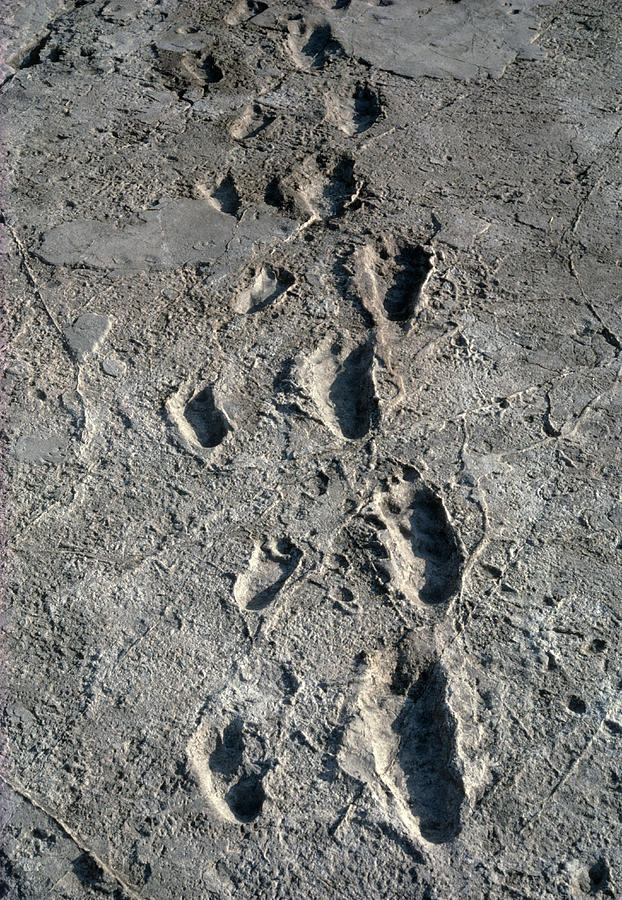
After our primate ancestors moved out of the trees, they eventually evolved for bipedal travel — walking upright on two legs.  In Tanzania, 3.6 million years ago, two bipedal ancestors left their footprints in wet volcanic ash.  In 1978, scientists discovered 70 of their fossilized footprints, in a sequence that was 88 feet long (27m).  [Image]  These ancestors were probably Australopithecus afarensis.

Today, our living primate relatives are quadrupeds, four legs.  Chimps can sprint much faster than humans, but we excel at running long distances.  Moving on two legs is more energy efficient than on four.  Evolution optimized our feet and legs for the spring-like mechanics of running, not walking.  Over time, we lost our fur coats, and developed the ability to sweat profusely, so we excelled at shedding body heat.  Standing upright gave us a better view of the surroundings.

Many game animals can move much faster than humans, for short bursts, then they must stop to cool off.  The desert is especially hot at midday.  Humans are unusual because we can run for hours in the heat of the day.  We can doggedly follow the tracks of speedy prey, not giving them a chance to rest, until heat stroke brings them down, and often kills them.  Hunters also carried spears or clubs, to finish the job, if needed.  HERE is a 7-minute video.

This is called persistence hunting, and Liebenberg was apparently the first civilized scientist to participate in this (he nearly died from heat stroke).  In other regions, this method has been used to hunt reindeer, kangaroos, deer, and pronghorn antelope.  Our ancestors have likely practiced persistence hunting for two million years or more.  It played a central role in the evolution of the person you see in the mirror.

Gorillas are vegetarians, spending long hours stuffing their faces at the salad bar.  They have evolved large guts in order to digest this bulky fibrous diet.  In addition to plant foods, chimps, bonobos, and baboons also eat meat, an excellent source of nutrients and calories.  They are good at predation, killing small animals without weapons.

In the early days, our bipedal ancestors likewise killed small critters with their bare hands.  Eventually, they became hunters.  Early hunters used pointed sticks, stones, and clubs to stun small mammals and birds.  By and by, the ancestors learned how to kill large game, via persistence hunting, javelins, spears, bows and arrows, and so on.  Meat maybe provided forty percent of their calories.

In addition to predation and hunting, our ancestors also acquired meat by scavenging.  Large carnivores often kill large game, devour as much as possible, and then abandon a partially eaten carcass.  On the Kalahari, hunters always note vultures circling in the distance.  They indicate the location of a dying animal, or a yummy carcass.  With luck, our ancestors’ running abilities sometimes enabled them to beat the hyenas to lunch.  Hyenas are not as good at shedding heat.  They periodically need to stop and pant to cool off.

Because game animals can move faster than humans, for limited distances, the success of persistence hunting largely depended on tracking skills — following the spoor of their chosen prey who might be out of sight.  Kalahari people had exceptional tracking skills.  Women were as good as men, or better, at interpreting spoor.  Everyone in a band, both men and women, could observe human tracks, and accurately identify the individual person who made them.

One time, Liebenberg asked some trackers if they could actually recognize the spoor of an individual antelope.  “They found it very amusing that I should ask them such a stupid question.  To them it is difficult to understand that some people can not do it.”  Liebenberg described three levels of tracking strategies.

(1) Simple tracking is just following the prey’s footprints, under ideal conditions, when the prints are clear and easy to follow.

(2) Systematic tracking is used when the spoor trail is less than complete.  Using reasoning and deduction (inductive-deductive reasoning), the tracker can then develop a hypothesis of what the prey was doing, and the most likely direction of its escape route.  This is solely based on real evidence.  Then, the hunter proceeds in the prey’s probable direction, in hope of picking up the track again. 

(3) Speculative tracking is the most advanced and creative.  “Anticipating the animal’s movements, by looking at the terrain ahead and identifying themselves with the animal on the basis of their knowledge of the animal’s behavior, the trackers may follow an imaginary route, saving much time by only looking for signs where they expect to find them (hypothetico-deductive reasoning).  By predicting where the animal may have been going, the trackers can leave the spoor, take a shortcut, and look for the spoor further ahead.”

Like vervets, baboons, jackals, and most other species, our ancestors learned ways of communicating with each other, via sounds and gestures.  Some birds make one warning call for lions, and a different one for snakes.  Many species, including humans, pay careful attention to the vocalizations of other species.  It’s good to know when a lion is approaching, long before it can be seen.

At some point, nobody knows when, the ancestors developed complex language.  As social animals, they lived in small bands.  Each member collected and shared information, and the group developed a body of wisdom.  Language made it easier for them to relay accumulated wisdom to the next generation.

Biological evolution (genes) moves at a snail’s pace, but cultural evolution (knowledge) can boogie like gazelles on meth.  With spears and javelins, the ancestors didn’t need to spend hundreds of thousands years evolving claws and fangs.

A few million years of scampering through the rainforest canopy, followed by a few million years of persistence hunting and tracking, fundamentally directed the evolution of our bodies and minds.  Today, we have abandoned our ancient way of life; it’s nearly extinct.  Imagine what we’d look like after 500,000 years of sitting on couches, entranced by glowing screens, chugging sugar water.

I’ve now given you a wee whiff of this book.  When I write reviews, I usually select a few subjects that especially interest me.  This one was especially interesting from one end to the other.  It carries readers off to a sacred mountaintop, where we can get a better view of the big picture.  If we want to live sustainably for hundreds of thousands of years, simple living is the only option.  What good are all our amazing gizmos if they require an insanely unsustainable flash-in-the-pan culture?

In every way, the wild people of the Kalahari were completely in tune with their ecosystem.  In my world today, I observe the opposite — a society that could not possibly be more alienated.  Recent DNA mapping strongly suggests that the hunter-gatherers of the Kalahari are the ancestors of all humans now on Earth.  You and I carry their genes.  Liebenberg pulls back the curtains of modernity and provides readers with a mind-expanding peek into distant corners of our family tree — the ancestors we have forgotten, and would be wise to remember.

In 2013, Liebenberg published The Origin of Science, which furthers his discussion of our Kalahari relatives.  My review is HERE.  There is some subject matter overlap between the two books, and my two reviews.  Sorry!  Take your anxiety meds.

Free PDFs of two Liebenberg books can be downloaded HERE.  YouTube has many Kalahari documentaries.

Liebenberg, Louis, The Art of Tracking, David Philip Publishers, Claremont, South Africa, 1990.

Tuesday, January 24, 2017

Baboon Metaphysics

 
Baboons are a fascinating branch of the family tree.  We humans have big brains, complex language, and a staggering collection of tools.  Yet, with smaller brains, grunt communication, and no tools, baboons have brilliantly lived sustainably for millions of years — like every other species of animals, except you-know-who.

Long ago, primates began as cute insect eating tree critters.  Climate change has always been a mischievous rascal, periodically redefining the rules of survival.  Two to four million years ago, east Africa, the “cradle of humankind,” became cooler and dryer.  Rainforests shrank, and grasslands expanded.  Many forest species went extinct.  Chimps and bonobos were lucky.  They remained in the forest and managed to adapt to changing conditions.

Baboons are interesting because, like humans, their ancestors moved out of the forest and adapted to savannah-woodland ecosystems.  They have managed to survive in a rough neighborhood that includes lions, hyenas, leopards, cheetahs, crocodiles, and trigger happy farmers.  Baboons demonstrate that primates can survive in a dangerous habitat without spears, fire, complex language, or throbbing big brains — and they can do this without causing irreversible degradation.

Baboons evolved in a tropical ecosystem.  They don’t need protective clothing or shelters.  They have a year-round supply of food, so they don’t need to hibernate, or stash nutrients for lean seasons.  Their diet majors in plant foods, including palm nuts, jackal berries, figs, and sausage fruit.  They also consume animal foods like insects, rodents, fish, shellfish, hares, birds, vervet monkeys, antelopes, and human infants.

Anyway, my muse gave me a dope slap and told me to pay more attention to baboons, so I read Baboon Metaphysics, by Dorothy Cheney and Robert Seyfarth.  The authors have joined the animal intelligence crusade, and are working to discredit the common misconception that nonhuman animals are little more than mindless stimulus-response automatons.  Their research was performed by intruding into wild baboon communities and performing annoying experiments on them.

Modern humans have been lobotomized by their extreme disconnection from the living world.  If folks spent their days in continuous contact with wild animals, no research would be needed to certify their obvious intelligence.

Metaphysics is defined as “the part of philosophy that is about understanding existence and knowledge.”  This is much like intelligence, which is intellect, the faculty of understanding.  Cheney is a biologist, and Seyfarth is a psychologist.  Their objective is to persuade readers that nonhuman animals, like baboons, supplement their instincts with aspects of genuine intelligence.

My focus is ecological sustainability, and I see “animal intelligence” from a different perspective.  All wild nonhuman animals adapt to their ecosystem and go with the flow.  They have lived sustainably for millions of years.  What could possibly be more intelligent?  It doesn’t seem intelligent to knowingly destroy the ecosystem, and radically destabilize the climate, whilst stumbling around staring at glowing screen thingies.

Here are three reasons why there aren’t seven-point-something billion baboons in the world.  (1) They didn’t exterminate most of their predators.  (2) They made no effort to increase the volume of food produced in their habitat via soil mining; they adapted to the wild food supply provided by nature.  (3) They lived as evolution had prepared them to live, wisely avoiding the toxic tar baby of innovation and technology — the express lane to extinction.  Birds evolved to fly; baboons did not.

All nonhuman species live in accordance with these three principles, whilst the human population continues to grow explosively.  It is out of control because modern folks generally lack foresight, and the wisdom to practice mindful self-restraint.  They lack the intelligence to comprehend the ecological foolishness of relentless campaigns of predator extermination.  Naturally, living in vast crowds conjures a new class of predators — infectious diseases and degenerative diseases.

Meanwhile, baboons have no need for wisdom.  They enjoy the management services provided by Big Mama Nature.  Predators happily keep their groups stable.  In the great dance of life, we all feed one another.  The authors note, “Predation accounts for the vast majority of deaths among male, female, and juvenile baboons.”  Baboons do not spend the last years of their lives decaying; they feed the lions.

Baboons intelligently avoid predators by sleeping in trees, or at the top of steep cliffs.  In daylight hours, they return to the savannah to forage.  (YouTube has many fascinating baboon documentaries.)  Males are much larger than females, and when predators visit, it is their responsibility to rush in and be as loud and belligerent as possible.  Males have large canine teeth, and predators are careful to avoid being wounded; they prefer sneaky low-risk surprise attacks.  Males hold off predators whilst the females and young try to escape.  The lives of males are nasty, brutish, and short.  Females can live 20 years.

Powerful aggressive males encourage group survival.  The alpha male baboon is the primary sperm donor in each group.  His evolutionary mission is to father as many offspring as possible, but his time in office is usually brief.  A new alpha, on average, is master of the harem for just seven to eight months.  Consequently, he promptly tries to kill the offspring of all lactating females, so these mothers will be freed to produce offspring with his genes.  This infanticide custom provides a secondary control on population growth, and encourages the production of badass defender daddies.

Like many other species, baboon society is hierarchical.  There are many levels of rank in the group, and every individual knows his or her current position.  Among female baboons, ranking is fairly stable.  They spend their entire lives in the group of their birth.  Males, on the other hand, migrate to other groups as young adults.  The arriving young lads are a threat to the status of the current alpha.  Challenges usually involve macho posturing, loud shrieks, and high-speed chases — not injurious beatings.  An individual male’s rank can change frequently.

Paul Shepard once asserted that ground monkeys (like baboons) are “the most aggressively status-conscious creatures on Earth.”  I wonder if humans are even more so.  Baboons play the status game without rubbishing their ecosystem.  Modern humans devote their entire lives to hoarding manufactured status trinkets.  Countless landfills are piled deep with discarded trinkets, thrown out to make space for our newer, bigger, flashier, trendier foolishness.  We cannot wean ourselves from habitual car driving, because travelling intelligently would take a huge toll on our social status (sorry kids!).

We are not doomed by faulty genes.  We’re doomed by mindlessly marching to the beat of screwy beliefs, but belief is voluntary.  We do not have to shop till we drop.  Thinking outside the box is a sign of intelligence.  It’s OK to question consensus reality.  It’s OK to stand strong against the powerful currents of our insane culture.  It’s OK to leap over the fence and pursue a meaningful and rewarding life.  This may be the only life you ever live.  Live well!

Cheney, Dorothy L., and Robert M. Seyfarth, Baboon Metaphysics — The Evolution of the Social Mind, University of Chicago Press, Chicago, 2007.