Showing posts with label spoor. Show all posts

Wednesday, December 19, 2018

Wild Free and Happy Sample 05


[Note: This is the fifth sample from my rough draft of a far from finished new book, Wild Free & Happy.  I don’t plan on reviewing more books for a while.  My blog is home to reviews of 199 books, and you are very welcome to explore them.  The Search field on the right side will find words in the full contents of all rants and reviews, if you are interested in specific authors, titles, or subjects.] 

Savannah Pioneers

When our ancestors moved from the forest to the savannah, they began a journey into an entirely different way of life.  Critters that evolution had fine-tuned for arboreal living were poorly prepared for surviving on open grassland.  They were not big, strong, or speedy.  They didn’t have horns, fangs, or claws.  They couldn’t digest grass.  They had to adapt to different sources of food, and different threats to their survival.  It took centuries of trial and error to develop new ways of living, and hundreds of thousands of years to evolve new and improved bodies fine-tuned for their unique experiment.

In the early days, our ancestors were not apex (top level) predators, they may have been more like walking meatballs, easy prey for big cats, packs of hyenas, huge crocodiles, and other hungry carnivores.  Chris Stringer mentioned genetic research indicating that today’s Earth-pounding mob of Homo sapiens trace back to an ancestral population of about 10,000 breeding individuals.  Earlier, a million years ago, in the Homo erectus era, there were just 20,000 breeding individuals.  For a very long time, our ancestors existed not too far from the brink of extinction.  It wasn’t easy being a highly vulnerable ground-dwelling primate.

Scavenging and Primitive Hunting

Our ancestors on the African savannah were hunter-gatherers, and their diet majored in plant foods, with a regular supplement of highly nutritious animal foods.  In the early chapters of the great hominin adventure, they were not expert hunters with effective weapons.  Meat was acquired via scavenging and primitive hunting.  With bare hands, they could grab critters like grubs, grasshoppers, termites, maggots, snails, shellfish, lizards, and frogs.  They could kill animals sleeping under bushes, dig up others from their burrows, chase down slow moving aardvarks and porcupines, and snatch immature youngsters.  Large birds could be knocked down by throwing clubs.

It’s easy to forget that rocks can be lethal weapons.  Wendell Bennett wrote that the Tarahumara people of Mexico threw stones with remarkable accuracy, killing rabbits, birds, and animals up to the size of coyotes.  Some of their groups did more hunting with stones than with bows and arrows.

Alfred Crosby wrote that any human more than eight years old, male or female, can throw projectiles farther and more accurately than any other species.  This ability gave us the power to effect change from a distance.  Well-thrown projectiles could drive away hungry predators or kill a plump bunny for dinner.  Researcher Frans de Waal noted that stone throwing chimps also have “impressive long-range aim.”  (Ouch!)

Crosby noted that a few hundred years ago, Europeans visiting Samoa got a painful lesson in the superb stone-throwing skills of the natives.  Of the 61 men sent ashore, 12 were killed by well-thrown rocks.  Humans also invented the rock-throwing sling, which was even more deadly, especially when loaded with lumps of lead.  Many of the conquistadors visiting Mexico had life-changing experiences while getting stoned by the angry sling-twirling Indians.

Scavenging is getting meat from carcasses that you didn’t kill — leftovers from large carnivores, or animals that died from other causes.  In later times, as the ancestors became more skilled at hunting, scavenging was not abandoned.  Meat is treasure, no matter how it is acquired.  Scavenging was often less work and less dangerous than pursuing and killing an animal.

During the day, our ancestors paid careful attention to the skies.  When vultures flew in a specific direction, they might be en route to a fresh carcass.  Circling vultures were strong evidence of a banquet directly below.  Once you got a hot tip, it was best to move quickly, in an effort to beat other scavengers to the banquet.

Hyenas work in gangs, and can quickly strip the scraps off carcasses, leaving few leftovers, if any.  Their arrival time was sometimes delayed by their need to stop, pant, and cool off from time to time.  Our ancestors were far better at shedding heat, an important advantage.  If hyenas or jackals arrived first, it was sometimes possible to mob them and drive them off.  On lucky days, it was possible to steal lunch from a lone cheetah.

Lions were another story.  To drive them away from a kill, surprise was important.  You and your buddies should suddenly charge, waving your arms, shouting, throwing rocks, swinging clubs, or maybe start a grass fire upwind.  Smart scavengers never tried this when lions were just beginning their lunch feast, and were still very hungry.  It was best to wait until they were full and ready for a nap.  Lions rarely consume brains or marrow, and sometimes leave some meat scraps for the intrepid.

It was also important for scavengers to pay attention to trees.  When leopards didn’t completely consume a kill at one sitting, they stored the leftovers up in the branches.  Leopards are night creatures.  If you found their unguarded stash in the daytime, there was less chance of getting shredded and devoured by an angry cat.

Right now, your eyes are following a track of squiggly scratches, and your mind is comprehending meaning from them.  My thoughts and actions created those tracks, and they contain specific meaning for those who have learned how to interpret them.  The farther you are able to follow my tracks, the more you will learn about me.

Similarly, animals leave behind tracks and other signs as they move across the land.  Folks who are skilled at reading this information can accumulate pieces of a story.  They can perceive a fantastic amount of information by studying spoor — footprints, urine, feces, saliva, blood, fur bits, feeding signs, smells, sounds, and so on.  Spoor provides clues about the animal’s species, gender, size, behavior, direction of travel, time of passage, and so on. 

Fresh tracks left by a game animal indicated that it had passed through the area, and the direction it was moving — essential information for hungry hunters.  Also, spoor left by large carnivores indicated predators on the move.  Following their tracks might eventually lead to a recent kill, and a carcass to scavenge.

The San

Louis Liebenberg is a South African lad who has spent years on the Kalahari Desert with the San people (other names include Khoisan, Bushmen, !Kung).  He was not a nerdy anthropologist, he directly participated in hunts, and eventually became a skilled tracker.  He wrote two outstanding books about tracking, scavenging, and persistence hunting.

One time, Liebenberg asked some San trackers if they could actually recognize the spoor of an individual antelope.  They burst out laughing at his incredibly stupid question.  They couldn’t imagine anyone not being able to do this.  When they see a human footprint, they immediately know which individual in their band made it.  Children can identify the tracks of their parents.  Footprints are as unique and recognizable as faces.  To see the footprints of an unknown stranger was highly unusual, and would inspire caution. 

More anthropology books have been written about the San than any other wild people.  Geneticists have found that they have the oldest DNA of any living culture — it is the genetic foundation of nearly all modern humans.  Their genes are the closest to the ancient female from whom all living humans descend, known as Mitochondrial Eve.  Thus, your family tree likely leads back to ancestors similar to the San.  (Pygmies are the second oldest living culture.)

The San have been hunter-gatherers since the dawn of humankind, and they enjoyed a way of life that managed to survive into the 1970s.  Eight hundred years ago, the San homeland included all of southern Africa.  Since then, Bantu and European herders and farmers have displaced them from lands suitable for grazing and agriculture, forcing the San into the Kalahari where, on average, two of every five years are drought years, and severe droughts occur one in every four years.

There are large regions of the Kalahari that are quite flat, an endless landscape having no notable landmarks for a white boy like me, who would quickly become hopelessly lost, and turn into vulture chow.  The San, on the other hand, always know exactly where they are, across large regions, because they orient themselves by the layout of plant communities, noting their size, shape, position, and unique features.  They know the face of their land as well as they know the faces of their family.

Richard Lee wrote about the San.  Their primary food was mongongo nuts, which dropped once a year, but could be gathered all year long.  Meat was their second most desired food.  The Kalahari provided them with about 100 edible plant species, which they were careful not to overuse.  The San expected periodic times of scarcity, so they reserved some plant species for drought food.  Portions of their territory were set aside for lean times.

John Reader wrote about an extreme drought in Botswana that lasted three years, resulting in the deaths of 250,000 cattle and 180,000 people.  The San didn’t starve.  Each week they spent 12 to 19 hours foraging for their sustenance.  They lived in one of the harshest environments on Earth.  At the same time, hungry farming people had shifted to foraging during the drought, so the San lands were supporting a larger population than that of normal times.

Elizabeth Marshall Thomas has spent a lot of time with the San.  She wrote her first book on them in 1958, and her third in 2006.  Like any intelligent culture, their safety net included mindful family planning, to avoid the problems caused by overpopulation, and its trusty companions: environmental degradation, hunger, and conflict.

Because of low body fat and vigorous physical activities, San women began menstruating later.  Some did not have regular monthly periods.  Children were usually nursed for about four years, which further reduced their mom’s fertility.  Most of the women had one to four offspring.  Nomads moved frequently, and belongings and infants often had to be hauled long distances.  A woman could only carry one infant, so just one twin was kept.

When a child could not be kept, the woman gave birth alone, away from the camp, and buried the newborn before it drew breath.  In their culture, a newborn did not immediately become alive, so disposing it was OK.  Crippled or badly deformed infants were not kept, because they would be a drain on the wellbeing of the band.  To avoid unwanted pregnancies in harsh times, it was common for folks to abstain from intercourse. 

Jon Young is the star of several YouTube videos on nature connection.  He was an early student of Tom Brown, the famous author of many books on tracking and nature awareness.  Young visited a number of wild cultures to find those that remain most closely connected to nature.  He discovered that the San people were incredibly well connected.  They refuse to enter houses, because people who live indoors go insane.

Young says that with the San, you always feel safe.  They are super intelligent, super happy, super vital, and great problem solvers.  You never feel competition.  The people are in love with every aspect of the ecosystem around them, celebrating with childlike wonder through all stages of their life.  Every person in that community is committed to the flowering of every other person.  They are incredibly aware of their surroundings at all times, because a brief lapse of attention can kill you in lion country.

Wednesday, April 12, 2017

The Origin of Science


NOTE: To better understand the following, you might read my review of The Art of Tracking first.

Back in the 1800s, folks on the cutting edge of Western science were perplexed.  Evolution had apparently provided hunter-gatherers with essentially the same brains that we moderns have, yet they appeared to be severely retarded — no clear-cuts, mines, cities, insane asylums.  What was wrong with them?  This abnormality led Alfred Wallace to wonder if the theory of evolution was a hoax. 

At the time, he and his peers believed that science originated in ancient Greece, but none of them knew anything about the wild people of the Kalahari Desert in Botswana.  Around 1950, anthropologists began spending time with these hunter-gatherers.  Their studies noted that the hunters carried small bows, which shot poison-tipped arrows.  Poisons were made from plants, snakes, scorpions, spiders, or beetle larvae.  They took from 6 hours to 3 days to kill the animal.  Because anthropologists could see the bows and arrows, they asked questions about them. 

What they could not see was enormous — a two million year tradition, a primary reason why humans walk upright, the mother of our high-powered brains — persistence hunting.  The researchers were attuned to cozy civilized living, not running barefoot across a thorny scorching hot desert for hours at a time.  Consequently, they missed a great deal.

Persistence hunting involved doggedly chasing game for hours until the animal collapsed from heat stroke and died.  Prey could run faster than hunters, for a while, until they became exhausted, overheated, and collapsed.  Their speedy escape left tracks that the less speedy hunters could follow.  Some hunters had fantastic skills in the art of tracking.  HERE is a 7-minute BBC video of a persistence hunt.

Louis Liebenberg is a South African lad, a “citizen scientist,” not a highly paid professional scientist from a luxurious education factory.  He has spent many years learning from the trackers of the Kalahari.  Because skilled trackers utilize an impressive variety of reasoning processes, he believes that tracking could have been the birth of science.  His first book, The Art of Tracking, was published in 1990.  It provides readers with an amazing collection of ideas.  The following commentary is on his 2013 book, The Origin of Science, which focuses on the relationship between tracking and science history.

Tracking requires accumulating an immense amount of knowledge about animal behavior and their spoor (tracks and other signs), an endless lifelong learning process.  In addition, while jogging across the desert in extreme heat, trackers must rapidly process complex inputs into accurate hypotheses.  The most gifted trackers excel at remembering, attention, reasoning, intuition, and imagination.  Their ancient culture enables them to survive in a vast desert that would promptly doom suburban consumers.

These wild super-survivors are nearly naked, unschooled, illiterate, unemployed, uninsured, homeless, penniless heathens who rarely take a bath.  Yet their culture remained sustainable for 100,000 years or more.  Their way of life is possible because they know how to engage in high quality scientific reasoning.  Tracking is about creative problem solving.  All trackers use inductive-deductive reasoning — track and sign recognition.  Advanced trackers also use hypothetico-deductive reasoning — track and sign interpretation, which requires more creativity.  Modern science continues to depend on both types of reasoning today.

Liebenberg has had years of direct experience with both wild people and modern people.  Tracking encourages wild people to develop heightened abilities for intuitive thinking, because the tracks of their prey are rarely clear and complete.  Intuition helps to fill in the blanks and suggest possible conclusions.  It is fast, automatic, effortless, and often unconscious.  Intuition also enhances social relationships.  Wild people are far more sensitive to each other than are folks in the modern world, “where perceptions of others have been blunted by fragmented and shallow relationships.”

For Liebenberg, “education” is a four-letter word, because it is so authoritarian.  Inmates are forced to sit indoors, in rows of hard seats, to have their brains filled with the infallible knowledge of modern science.  Truth is based on the authority of teachers and textbooks, and students on the golden path to success know better than to question authority.

“Modern societies in general, and education in particular, does more to stifle than to encourage intuitive thinking.”  Modern science is often hierarchical, elitist, and less accessible to non-specialist commoners.  On the Kalahari, tracking science is informal and accessible to everyone.  A youth can disagree with how an experienced elder has interpreted tracks, and suggest a different conclusion.  From childhood, youths are regularly exposed to the scientific process.

Modern human brains are probably little different from those of early Homo sapiens.  Liebenberg believes that “some trackers in the past probably were, and perhaps today are, just as ingenious as the most ingenious modern mathematicians and physicists.”  At the same time, both trackers and physicists are capable of being stunningly irrational.  “Cultures may go into decline when scientific knowledge is undermined by irrational belief systems.”

We believe that our industrial civilization is too smart to collapse, perpetual growth is possible, innovation will create “clean” sources of abundant energy, climate change can be reversed, eleven billion can be fed, and the best is yet to come.  He warns us that, “Political leaders who hold irrational and superstitious beliefs, and may even be anti-science, clearly may have serious negative implications for human welfare.”  (Gulp!)

The goal of this book is to argue that science began with prehistoric bipedal trackers.  I wonder if scientific processes aren’t even older than bipedal primates.  Who taught our ancestors the art of hunting — locating prey by scent, sight, sounds, tracks, and knowledge of prey behavior?  Who taught us concealment, stalking, silent movement, deception, ambush, and approaching prey from downwind?  Lions don’t sit in the grass with their mouths open, waiting for breakfast to prance in.  They survive because they have teamwork and powerful minds.  “The /Gwi believe that some species possess knowledge that transcends that of humans.”  In Alaska, the Koyukon proverb is, “Every animal knows way more than you do.”

On the Kalahari, the traditional wild culture is being driven to extinction by growing contact with you-know-who.  Herders are moving in, fencing off lands.  In the 1960s, hunters began using dogs.  Much more game was killed, but the tracking skills of the hunters declined.  More recently, horses have also been added.  The diabolical trio of hunters, horses, and dogs makes it much easier to overhunt and deplete wildlife populations.  Far less skill is needed.  Younger generations have shifted to making souvenirs for tourists, as their ancient culture is pounded against the rocks.

Liebenberg is working with Kalahari elders to encourage younger folks to learn tracking, in hopes that skilled trackers can gain employment collecting wildlife data for use in scientific research.  He has created CyberTracker, a smart phone app that can be used to collect data in the field.  The interface is icon-based, so it can be used by illiterate people.  It is now being used in research around the world, and is helpful in documenting ecological trends, like the welfare of endangered species.  It also encourages the survival and preservation of the art of tracking.

Liebenberg, Louis, The Origin of Science, CyberTracker, Cape Town, South Africa, 2013.

Free PDF downloads of Liebenberg’s books, The Art of Tracking, and The Origin of Science, are available HERE.  Amazon sells a Kindle version of The Origin of Science for $1.00.

The Art of Tracking


Right now, your eyes are following a track of squiggly scratches, and your mind is comprehending meaning from them.  This morning, my mental processes created those tracks, and they contain specific meaning for those who have learned the ability to interpret them.  The farther you are able to follow my tracks, the more you will learn.

Similarly, animals leave behind tracks and other signs as they move across the land, and folks who are skilled at reading this information can accumulate pieces of a story.  The indigenous trackers of the Kalahari Desert in Botswana can perceive a fantastic amount of information by studying spoor — footprints, urine, feces, saliva, blood, fur bits, feeding signs, smells, sounds, and so on.  Spoor provides clues about the animal’s species, gender, size, behavior, direction of travel, time of passage, and so on.

There are large regions of the Kalahari that are quite flat, an endless landscape having no notable landmarks for a white boy like me, who would quickly become hopelessly lost, and turn into cat food.  Hunter-gatherers, on the other hand, always know exactly where they are, because they orient themselves by the layout of plant communities, noting their size, shape, position, and unique features.  They know the face of their land as well as they know the faces of their family.

Louis Liebenberg is a South African lad who has spent years with Kalahari trackers, learning their art.  He calls himself a citizen scientist, not a professional, and he has special gifts for thinking outside the box.  His work has impressed famous academic heavyweights at Harvard.  In 1990, he published The Art of Tracking.

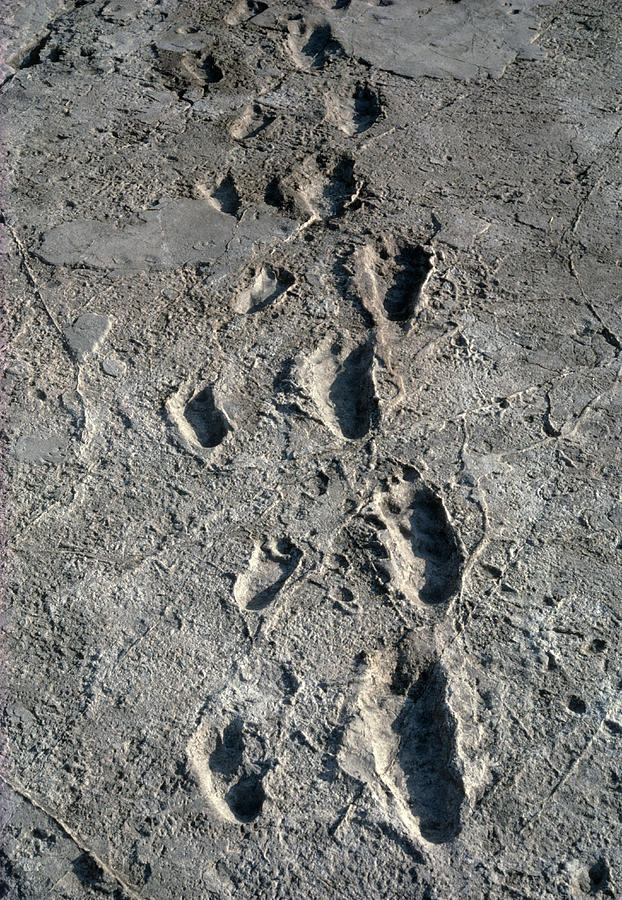
After our primate ancestors moved out of the trees, they eventually evolved for bipedal travel — walking upright on two legs.  In Tanzania, 3.6 million years ago, two bipedal ancestors left their footprints in wet volcanic ash.  In 1978, scientists discovered 70 of their fossilized footprints, in a sequence that was 88 feet long (27m).  [Image]  These ancestors were probably Australopithecus afarensis.

Today, our living primate relatives are quadrupeds, four legs.  Chimps can sprint much faster than humans, but we excel at running long distances.  Moving on two legs is more energy efficient than on four.  Evolution optimized our feet and legs for the spring-like mechanics of running, not walking.  Over time, we lost our fur coats, and developed the ability to sweat profusely, so we excelled at shedding body heat.  Standing upright gave us a better view of the surroundings.

Many game animals can move much faster than humans, for short bursts, then they must stop to cool off.  The desert is especially hot at midday.  Humans are unusual because we can run for hours in the heat of the day.  We can doggedly follow the tracks of speedy prey, not giving them a chance to rest, until heat stroke brings them down, and often kills them.  Hunters also carried spears or clubs, to finish the job, if needed.  HERE is a 7-minute video.

This is called persistence hunting, and Liebenberg was apparently the first civilized scientist to participate in this (he nearly died from heat stroke).  In other regions, this method has been used to hunt reindeer, kangaroos, deer, and pronghorn antelope.  Our ancestors have likely practiced persistence hunting for two million years or more.  It played a central role in the evolution of the person you see in the mirror.

Gorillas are vegetarians, spending long hours stuffing their faces at the salad bar.  They have evolved large guts in order to digest this bulky fibrous diet.  In addition to plant foods, chimps, bonobos, and baboons also eat meat, an excellent source of nutrients and calories.  They are good at predation, killing small animals without weapons.

In the early days, our bipedal ancestors likewise killed small critters with their bare hands.  Eventually, they became hunters.  Early hunters used pointed sticks, stones, and clubs to stun small mammals and birds.  By and by, the ancestors learned how to kill large game, via persistence hunting, javelins, spears, bows and arrows, and so on.  Meat maybe provided forty percent of their calories.

In addition to predation and hunting, our ancestors also acquired meat by scavenging.  Large carnivores often kill large game, devour as much as possible, and then abandon a partially eaten carcass.  On the Kalahari, hunters always note vultures circling in the distance.  They indicate the location of a dying animal, or a yummy carcass.  With luck, our ancestors’ running abilities sometimes enabled them to beat the hyenas to lunch.  Hyenas are not as good at shedding heat.  They periodically need to stop and pant to cool off.

Because game animals can move faster than humans, for limited distances, the success of persistence hunting largely depended on tracking skills — following the spoor of their chosen prey who might be out of sight.  Kalahari people had exceptional tracking skills.  Women were as good as men, or better, at interpreting spoor.  Everyone in a band, both men and women, could observe human tracks, and accurately identify the individual person who made them.

One time, Liebenberg asked some trackers if they could actually recognize the spoor of an individual antelope.  “They found it very amusing that I should ask them such a stupid question.  To them it is difficult to understand that some people can not do it.”  Liebenberg described three levels of tracking strategies.

(1) Simple tracking is just following the prey’s footprints, under ideal conditions, when the prints are clear and easy to follow.

(2) Systematic tracking is used when the spoor trail is less than complete.  Using reasoning and deduction (inductive-deductive reasoning), the tracker can then develop a hypothesis of what the prey was doing, and the most likely direction of its escape route.  This is solely based on real evidence.  Then, the hunter proceeds in the prey’s probable direction, in hope of picking up the track again. 

(3) Speculative tracking is the most advanced and creative.  “Anticipating the animal’s movements, by looking at the terrain ahead and identifying themselves with the animal on the basis of their knowledge of the animal’s behavior, the trackers may follow an imaginary route, saving much time by only looking for signs where they expect to find them (hypothetico-deductive reasoning).  By predicting where the animal may have been going, the trackers can leave the spoor, take a shortcut, and look for the spoor further ahead.”

Like vervets, baboons, jackals, and most other species, our ancestors learned ways of communicating with each other, via sounds and gestures.  Some birds make one warning call for lions, and a different one for snakes.  Many species, including humans, pay careful attention to the vocalizations of other species.  It’s good to know when a lion is approaching, long before it can be seen.

At some point, nobody knows when, the ancestors developed complex language.  As social animals, they lived in small bands.  Each member collected and shared information, and the group developed a body of wisdom.  Language made it easier for them to relay accumulated wisdom to the next generation.

Biological evolution (genes) moves at a snail’s pace, but cultural evolution (knowledge) can boogie like gazelles on meth.  With spears and javelins, the ancestors didn’t need to spend hundreds of thousands years evolving claws and fangs.

A few million years of scampering through the rainforest canopy, followed by a few million years of persistence hunting and tracking, fundamentally directed the evolution of our bodies and minds.  Today, we have abandoned our ancient way of life; it’s nearly extinct.  Imagine what we’d look like after 500,000 years of sitting on couches, entranced by glowing screens, chugging sugar water.

I’ve now given you a wee whiff of this book.  When I write reviews, I usually select a few subjects that especially interest me.  This one was especially interesting from one end to the other.  It carries readers off to a sacred mountaintop, where we can get a better view of the big picture.  If we want to live sustainably for hundreds of thousands of years, simple living is the only option.  What good are all our amazing gizmos if they require an insanely unsustainable flash-in-the-pan culture?

In every way, the wild people of the Kalahari were completely in tune with their ecosystem.  In my world today, I observe the opposite — a society that could not possibly be more alienated.  Recent DNA mapping strongly suggests that the hunter-gatherers of the Kalahari are the ancestors of all humans now on Earth.  You and I carry their genes.  Liebenberg pulls back the curtains of modernity and provides readers with a mind-expanding peek into distant corners of our family tree — the ancestors we have forgotten, and would be wise to remember.

In 2013, Liebenberg published The Origin of Science, which furthers his discussion of our Kalahari relatives.  My review is HERE.  There is some subject matter overlap between the two books, and my two reviews.  Sorry!  Take your anxiety meds.

Free PDFs of two Liebenberg books can be downloaded HERE.  YouTube has many Kalahari documentaries.

Liebenberg, Louis, The Art of Tracking, David Philip Publishers, Claremont, South Africa, 1990.