Showing posts with label science. Show all posts

Sunday, September 10, 2017

Surviving the 21st Century


In the old Three Stooges comedies, whenever Curly did something dumb, angry Moe gave him a dope slap (SMACK!).  With regard to humankind’s war on the future, a number of thinkers have been inspired to write passionate dope slap books, including Man and Nature (1864), Conservation of Natural Resources (1910), Checking the Waste (1911), Our Vanishing Wild Life (1913).  Dope slap books are a two-step: (1) describe the terrible growing harms, and (2) provide a motivating pep talk loaded with rational solutions — based on the assumption that the society is rational.

In the last 30 years, a tsunami of dope slap books have flooded the market.  The latest comes from Australian science writer Julian Cribb, Surviving the 21st Century.  He does a great job of providing a competent and sobering introduction to ecological reality in 2017 — vital knowledge that every 16-year old (and their teachers) should know (but don’t).  He’s good at explaining complex challenges in an understandable way.

The book has ten chapters, each discussing a category of serious risks.  (1) Dangerous overconfidence in human brilliance.  (2) Mass extinctions.  (3) Degrading the planet.  (4) Industrial warfare.  (5) Climate change.  (6) Pollution.  (7) Feeding an overgrown herd.  (8) Urban growth and disease.  (9) Moronic beliefs that trump scientific facts.  (10) It’s time for action — think like a species.

Humankind’s current mass hysteria has an oxymoronic name, Sustainable Growth™, and its destination is oblivion.  We are going to be slamming head-on, at high speed, into crucial limits — a magnificently irrational course of action.  Cribb prefers a mindful Plan B, a gradual, managed, and cooperative path to a slower, simpler, far less crowded future.

All humans have a hardcore addiction to food.  In his 2010 book, The Coming Famine (reviewed HERE), Cribb described the enormous degradation caused by feeding an ever growing population, and presented readers with many rational suggestions.  In the following seven years, the naughty world largely disregarded his recommendations.

In this new book, Cribb dreams of miraculously doubling food production, and feeding the growing mob until we hit Peak People, at ten or twelve billion, in 2060.  All nations will heroically cooperate in rapidly making many rational (and extremely radical) changes, we’ll avoid total catastrophe, and proceed with a bumpy but tolerable decline to a sustainable population of somewhere between two and four billion by 2100.  That’s a big dream.

Is it really possible to feed ten billion?  Readers learn that there are no new plant breeding miracles on the horizon.  In the 1960s, the Green Revolution research had noble intentions — temporarily boost food production, so humankind would have an extra ten years to resolve its embarrassing orgy of overbreeding.  It was a beautiful dream.  Food production actually doubled.  Unfortunately, the population problem was swept under the bed, and the human herd more than doubled, intensifying the original problem.

Hopium addicts have no doubt that the wizards of science will save the day.  GMO plants have been a stunning success at boosting the sales of toxic agrochemicals, but they have had minimal impact on harvest volumes.  The current rate at which we are depleting underground aquifers, and other freshwater resources, is going to crash into limits before 2030.  Destruction of the planet’s remaining topsoil continues at an impressive rate.  Food production trends are not encouraging.

“Outside of a nuclear war or asteroid collision, the biggest shock in store for the human population in the 21st Century will be the impact of climate change on the food supply.”  Luckily, readers discover a plan for doubling food production by solving big problems.  We’ll create a new form of agriculture that can survive in an unstable climate, produce lots of excellent food, and do so sustainably — without using a spoonful of fossil fuel!  We’ll make sustainable oil from algae.

The required inputs for algae farms are sunshine, salt water, and urban wastes.  “Algal oil… can be made into anything you can make from fossil petroleum — ‘green’ fuel, plastics, textiles, chemicals, drugs, food additives.  Furthermore, researchers have calculated, algae could supply the world’s entire transport fuel requirement from an area of 57 million hectares — which is a bit smaller than Switzerland — and can mostly be in the ocean in any case.”

Belief is the subject of the fascinating chapter nine, and something I’ve thought a lot about.  Belief may very well be the biggest threat to the survival of our species, worse than all the other threats combined.  Even the most ridiculous, insanely stupid, self-destructive beliefs can be highly contagious, readily passing from one generation to the next, fully resistant to reason, common sense, or factual reality.  Belief trumps reason.

Belief insists that human-caused climate change is impossible.  Humans do not share common ancestors with chimps and baboons.  Technology can solve any problem.  Perpetual growth is possible on a finite planet.  Good consumers must gain respect and honor by devoting their lives to working hard (at soul killing jobs), recklessly borrowing, impulsively spending, proudly hoarding trendy status trinkets, and promptly discarding trinkets the moment they cease being trendy.

Cribb believes that foresight is our ultimate skill, enabling us to perceive potential dangers, avoid them, and survive.  Wild humans, intimately attuned to the complex patterns of their ecosystem, excelled at foresight.  We don’t.  We are cursed to inhabit an industrial culture that mutates at a furious rate.  New technologies are often obsolete in five or ten years.  We can never become intimately attuned to something similar to a high-speed runaway train.

We’re trapped in a cycle of repeated mistakes, perpetually erecting new empires, watching them self-destruct, and never learning.  We’ve installed at least 440 nuclear power plants before we’ve built a single facility for safely storing the radioactive wastes that can remain highly toxic for a million years.  Nobody had the foresight to predict the staggering consequences of the Ford Model T, or the microchip, or metal smelting.  Hey, let’s colonize other planets!

Crusty old farts like myself, who have been reading dope slap books for 30 years, and observing how little they inspire society, no longer shout and cheer when the latest vision rolls by.  Cribb does an excellent job describing the challenges.  His grand vision requires humankind to undergo an amazing transformation, from the pathetic dullard Homo delusus (self-deceiving human) into the new, wise, and beautiful Homo sapiens (wise human).

Cribb has no doubt that “solutions to all of these challenges exist or can be developed.”  Today, essential information can be instantly shared with people everywhere in the world.  Scientific knowledge grows exponentially every decade.  Intelligent change is entirely possible!  Around the world, young women are having fewer children — voluntarily!  We are not obligated to commit mass suicide.

Understand that this is a textbook for college students.  Universities are monasteries that instruct the next generation in the management of Sustainable Growth™.  They require textbooks that reinforce the loony beliefs of the hopeless Homo delusus.  Cribb makes a heroic effort to tap-dance across a ballroom where the entire floor is covered with greased marbles.  It’s obvious that he is acutely aware of the growing challenges of reality (which are heretical nonsense at the monastery).  He knows that the young novices are likely to learn little or nothing about these challenges — unless he cleverly sneaks them into a gospel that appears to be orthodox.

Today’s novices are 100 times smarter than slobbering geezers over 30.  They are acutely aware that they have inherited a catastrophe.  They don’t need a dope slap.  They know that transforming all of nature into toxic landfill dreck is insane.  Hopefully, Cribb’s book will help the novices bombard the abbots with high-powered questions, and encourage our species to shift toward becoming Homo sapiens.  Good luck!

Cribb, Julian, Surviving the 21st Century: Humanity’s Ten Great Challenges and How We Can Overcome Them, Springer International Publishing, Switzerland, 2017.

Wednesday, April 12, 2017

The Origin of Science


NOTE: To better understand the following, you might read my review of The Art of Tracking first.

Back in the 1800s, folks on the cutting edge of Western science were perplexed.  Evolution had apparently provided hunter-gatherers with essentially the same brains that we moderns have, yet they appeared to be severely retarded — no clear-cuts, mines, cities, insane asylums.  What was wrong with them?  This abnormality led Alfred Wallace to wonder if the theory of evolution was a hoax. 

At the time, he and his peers believed that science originated in ancient Greece, but none of them knew anything about the wild people of the Kalahari Desert in Botswana.  Around 1950, anthropologists began spending time with these hunter-gatherers.  Their studies noted that the hunters carried small bows, which shot poison-tipped arrows.  Poisons were made from plants, snakes, scorpions, spiders, or beetle larvae.  They took from 6 hours to 3 days to kill the animal.  Because anthropologists could see the bows and arrows, they asked questions about them. 

What they could not see was enormous — a two million year tradition, a primary reason why humans walk upright, the mother of our high-powered brains — persistence hunting.  The researchers were attuned to cozy civilized living, not running barefoot across a thorny scorching hot desert for hours at a time.  Consequently, they missed a great deal.

Persistence hunting involved doggedly chasing game for hours until the animal collapsed from heat stroke and died.  Prey could run faster than hunters, for a while, until they became exhausted, overheated, and collapsed.  Their speedy escape left tracks that the less speedy hunters could follow.  Some hunters had fantastic skills in the art of tracking.  HERE is a 7-minute BBC video of a persistence hunt.

Louis Liebenberg is a South African lad, a “citizen scientist,” not a highly paid professional scientist from a luxurious education factory.  He has spent many years learning from the trackers of the Kalahari.  Because skilled trackers utilize an impressive variety of reasoning processes, he believes that tracking could have been the birth of science.  His first book, The Art of Tracking, was published in 1990.  It provides readers with an amazing collection of ideas.  The following commentary is on his 2013 book, The Origin of Science, which focuses on the relationship between tracking and science history.

Tracking requires accumulating an immense amount of knowledge about animal behavior and their spoor (tracks and other signs), an endless lifelong learning process.  In addition, while jogging across the desert in extreme heat, trackers must rapidly process complex inputs into accurate hypotheses.  The most gifted trackers excel at remembering, attention, reasoning, intuition, and imagination.  Their ancient culture enables them to survive in a vast desert that would promptly doom suburban consumers.

These wild super-survivors are nearly naked, unschooled, illiterate, unemployed, uninsured, homeless, penniless heathens who rarely take a bath.  Yet their culture remained sustainable for 100,000 years or more.  Their way of life is possible because they know how to engage in high quality scientific reasoning.  Tracking is about creative problem solving.  All trackers use inductive-deductive reasoning — track and sign recognition.  Advanced trackers also use hypothetico-deductive reasoning — track and sign interpretation, which requires more creativity.  Modern science continues to depend on both types of reasoning today.

Liebenberg has had years of direct experience with both wild people and modern people.  Tracking encourages wild people to develop heightened abilities for intuitive thinking, because the tracks of their prey are rarely clear and complete.  Intuition helps to fill in the blanks and suggest possible conclusions.  It is fast, automatic, effortless, and often unconscious.  Intuition also enhances social relationships.  Wild people are far more sensitive to each other than are folks in the modern world, “where perceptions of others have been blunted by fragmented and shallow relationships.”

For Liebenberg, “education” is a four-letter word, because it is so authoritarian.  Inmates are forced to sit indoors, in rows of hard seats, to have their brains filled with the infallible knowledge of modern science.  Truth is based on the authority of teachers and textbooks, and students on the golden path to success know better than to question authority.

“Modern societies in general, and education in particular, does more to stifle than to encourage intuitive thinking.”  Modern science is often hierarchical, elitist, and less accessible to non-specialist commoners.  On the Kalahari, tracking science is informal and accessible to everyone.  A youth can disagree with how an experienced elder has interpreted tracks, and suggest a different conclusion.  From childhood, youths are regularly exposed to the scientific process.

Modern human brains are probably little different from those of early Homo sapiens.  Liebenberg believes that “some trackers in the past probably were, and perhaps today are, just as ingenious as the most ingenious modern mathematicians and physicists.”  At the same time, both trackers and physicists are capable of being stunningly irrational.  “Cultures may go into decline when scientific knowledge is undermined by irrational belief systems.”

We believe that our industrial civilization is too smart to collapse, perpetual growth is possible, innovation will create “clean” sources of abundant energy, climate change can be reversed, eleven billion can be fed, and the best is yet to come.  He warns us that, “Political leaders who hold irrational and superstitious beliefs, and may even be anti-science, clearly may have serious negative implications for human welfare.”  (Gulp!)

The goal of this book is to argue that science began with prehistoric bipedal trackers.  I wonder if scientific processes aren’t even older than bipedal primates.  Who taught our ancestors the art of hunting — locating prey by scent, sight, sounds, tracks, and knowledge of prey behavior?  Who taught us concealment, stalking, silent movement, deception, ambush, and approaching prey from downwind?  Lions don’t sit in the grass with their mouths open, waiting for breakfast to prance in.  They survive because they have teamwork and powerful minds.  “The /Gwi believe that some species possess knowledge that transcends that of humans.”  In Alaska, the Koyukon proverb is, “Every animal knows way more than you do.”

On the Kalahari, the traditional wild culture is being driven to extinction by growing contact with you-know-who.  Herders are moving in, fencing off lands.  In the 1960s, hunters began using dogs.  Much more game was killed, but the tracking skills of the hunters declined.  More recently, horses have also been added.  The diabolical trio of hunters, horses, and dogs makes it much easier to overhunt and deplete wildlife populations.  Far less skill is needed.  Younger generations have shifted to making souvenirs for tourists, as their ancient culture is pounded against the rocks.

Liebenberg is working with Kalahari elders to encourage younger folks to learn tracking, in hopes that skilled trackers can gain employment collecting wildlife data for use in scientific research.  He has created CyberTracker, a smart phone app that can be used to collect data in the field.  The interface is icon-based, so it can be used by illiterate people.  It is now being used in research around the world, and is helpful in documenting ecological trends, like the welfare of endangered species.  It also encourages the survival and preservation of the art of tracking.

Liebenberg, Louis, The Origin of Science, CyberTracker, Cape Town, South Africa, 2013.

Free PDF downloads of Liebenberg’s books, The Art of Tracking, and The Origin of Science, are available HERE.  Amazon sells a Kindle version of The Origin of Science for $1.00.

The Art of Tracking


Right now, your eyes are following a track of squiggly scratches, and your mind is comprehending meaning from them.  This morning, my mental processes created those tracks, and they contain specific meaning for those who have learned the ability to interpret them.  The farther you are able to follow my tracks, the more you will learn.

Similarly, animals leave behind tracks and other signs as they move across the land, and folks who are skilled at reading this information can accumulate pieces of a story.  The indigenous trackers of the Kalahari Desert in Botswana can perceive a fantastic amount of information by studying spoor — footprints, urine, feces, saliva, blood, fur bits, feeding signs, smells, sounds, and so on.  Spoor provides clues about the animal’s species, gender, size, behavior, direction of travel, time of passage, and so on.

There are large regions of the Kalahari that are quite flat, an endless landscape having no notable landmarks for a white boy like me, who would quickly become hopelessly lost, and turn into cat food.  Hunter-gatherers, on the other hand, always know exactly where they are, because they orient themselves by the layout of plant communities, noting their size, shape, position, and unique features.  They know the face of their land as well as they know the faces of their family.

Louis Liebenberg is a South African lad who has spent years with Kalahari trackers, learning their art.  He calls himself a citizen scientist, not a professional, and he has special gifts for thinking outside the box.  His work has impressed famous academic heavyweights at Harvard.  In 1990, he published The Art of Tracking.

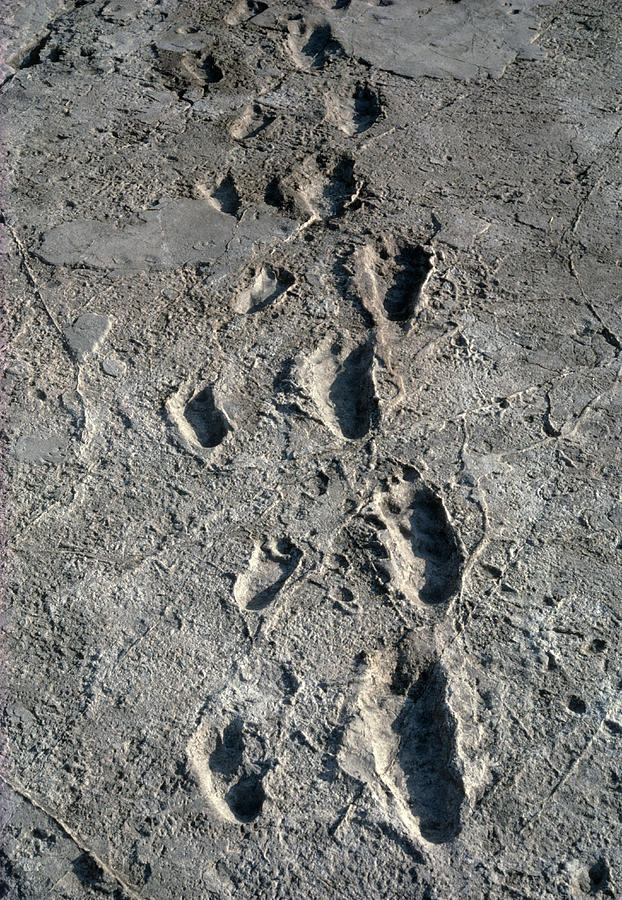
After our primate ancestors moved out of the trees, they eventually evolved for bipedal travel — walking upright on two legs.  In Tanzania, 3.6 million years ago, two bipedal ancestors left their footprints in wet volcanic ash.  In 1978, scientists discovered 70 of their fossilized footprints, in a sequence that was 88 feet long (27m).  [Image]  These ancestors were probably Australopithecus afarensis.

Today, our living primate relatives are quadrupeds, four legs.  Chimps can sprint much faster than humans, but we excel at running long distances.  Moving on two legs is more energy efficient than on four.  Evolution optimized our feet and legs for the spring-like mechanics of running, not walking.  Over time, we lost our fur coats, and developed the ability to sweat profusely, so we excelled at shedding body heat.  Standing upright gave us a better view of the surroundings.

Many game animals can move much faster than humans, for short bursts, then they must stop to cool off.  The desert is especially hot at midday.  Humans are unusual because we can run for hours in the heat of the day.  We can doggedly follow the tracks of speedy prey, not giving them a chance to rest, until heat stroke brings them down, and often kills them.  Hunters also carried spears or clubs, to finish the job, if needed.  HERE is a 7-minute video.

This is called persistence hunting, and Liebenberg was apparently the first civilized scientist to participate in this (he nearly died from heat stroke).  In other regions, this method has been used to hunt reindeer, kangaroos, deer, and pronghorn antelope.  Our ancestors have likely practiced persistence hunting for two million years or more.  It played a central role in the evolution of the person you see in the mirror.

Gorillas are vegetarians, spending long hours stuffing their faces at the salad bar.  They have evolved large guts in order to digest this bulky fibrous diet.  In addition to plant foods, chimps, bonobos, and baboons also eat meat, an excellent source of nutrients and calories.  They are good at predation, killing small animals without weapons.

In the early days, our bipedal ancestors likewise killed small critters with their bare hands.  Eventually, they became hunters.  Early hunters used pointed sticks, stones, and clubs to stun small mammals and birds.  By and by, the ancestors learned how to kill large game, via persistence hunting, javelins, spears, bows and arrows, and so on.  Meat maybe provided forty percent of their calories.

In addition to predation and hunting, our ancestors also acquired meat by scavenging.  Large carnivores often kill large game, devour as much as possible, and then abandon a partially eaten carcass.  On the Kalahari, hunters always note vultures circling in the distance.  They indicate the location of a dying animal, or a yummy carcass.  With luck, our ancestors’ running abilities sometimes enabled them to beat the hyenas to lunch.  Hyenas are not as good at shedding heat.  They periodically need to stop and pant to cool off.

Because game animals can move faster than humans, for limited distances, the success of persistence hunting largely depended on tracking skills — following the spoor of their chosen prey who might be out of sight.  Kalahari people had exceptional tracking skills.  Women were as good as men, or better, at interpreting spoor.  Everyone in a band, both men and women, could observe human tracks, and accurately identify the individual person who made them.

One time, Liebenberg asked some trackers if they could actually recognize the spoor of an individual antelope.  “They found it very amusing that I should ask them such a stupid question.  To them it is difficult to understand that some people can not do it.”  Liebenberg described three levels of tracking strategies.

(1) Simple tracking is just following the prey’s footprints, under ideal conditions, when the prints are clear and easy to follow.

(2) Systematic tracking is used when the spoor trail is less than complete.  Using reasoning and deduction (inductive-deductive reasoning), the tracker can then develop a hypothesis of what the prey was doing, and the most likely direction of its escape route.  This is solely based on real evidence.  Then, the hunter proceeds in the prey’s probable direction, in hope of picking up the track again. 

(3) Speculative tracking is the most advanced and creative.  “Anticipating the animal’s movements, by looking at the terrain ahead and identifying themselves with the animal on the basis of their knowledge of the animal’s behavior, the trackers may follow an imaginary route, saving much time by only looking for signs where they expect to find them (hypothetico-deductive reasoning).  By predicting where the animal may have been going, the trackers can leave the spoor, take a shortcut, and look for the spoor further ahead.”

Like vervets, baboons, jackals, and most other species, our ancestors learned ways of communicating with each other, via sounds and gestures.  Some birds make one warning call for lions, and a different one for snakes.  Many species, including humans, pay careful attention to the vocalizations of other species.  It’s good to know when a lion is approaching, long before it can be seen.

At some point, nobody knows when, the ancestors developed complex language.  As social animals, they lived in small bands.  Each member collected and shared information, and the group developed a body of wisdom.  Language made it easier for them to relay accumulated wisdom to the next generation.

Biological evolution (genes) moves at a snail’s pace, but cultural evolution (knowledge) can boogie like gazelles on meth.  With spears and javelins, the ancestors didn’t need to spend hundreds of thousands years evolving claws and fangs.

A few million years of scampering through the rainforest canopy, followed by a few million years of persistence hunting and tracking, fundamentally directed the evolution of our bodies and minds.  Today, we have abandoned our ancient way of life; it’s nearly extinct.  Imagine what we’d look like after 500,000 years of sitting on couches, entranced by glowing screens, chugging sugar water.

I’ve now given you a wee whiff of this book.  When I write reviews, I usually select a few subjects that especially interest me.  This one was especially interesting from one end to the other.  It carries readers off to a sacred mountaintop, where we can get a better view of the big picture.  If we want to live sustainably for hundreds of thousands of years, simple living is the only option.  What good are all our amazing gizmos if they require an insanely unsustainable flash-in-the-pan culture?

In every way, the wild people of the Kalahari were completely in tune with their ecosystem.  In my world today, I observe the opposite — a society that could not possibly be more alienated.  Recent DNA mapping strongly suggests that the hunter-gatherers of the Kalahari are the ancestors of all humans now on Earth.  You and I carry their genes.  Liebenberg pulls back the curtains of modernity and provides readers with a mind-expanding peek into distant corners of our family tree — the ancestors we have forgotten, and would be wise to remember.

In 2013, Liebenberg published The Origin of Science, which furthers his discussion of our Kalahari relatives.  My review is HERE.  There is some subject matter overlap between the two books, and my two reviews.  Sorry!  Take your anxiety meds.

Free PDFs of two Liebenberg books can be downloaded HERE.  YouTube has many Kalahari documentaries.

Liebenberg, Louis, The Art of Tracking, David Philip Publishers, Claremont, South Africa, 1990.

Sunday, March 19, 2017

Right Relationship to Reality


Reverend Michael Dowd and his wife Connie Barlow are nomadic evolutionary evangelists who have been on the road since 2002, speaking to more than 2,000 audiences.  In their reality, evolution and religion are not in conflict; both can happily sit next to each other on the same pew.  A primary goal of their mission is teaching folks about sustainability.  For them, right relationship to reality is what ultimately matters.  We must be in right relationship with the soil, water, and life of this planet.  If we don’t get right with reality, we’re going to perish.

Their Grace Limits webpage provides links to an impressive collection of information on sustainability, including books, essays, and videos.  Dowd has read a number of books and essays aloud, recording them as MP3 files (with the authors’ permission).  They are available to download, free of charge.  Some of the books he has recorded include Overshoot by William Catton, The Green History of Religion by Anand Veeraraj, Afterburn by Richard Heinberg, The Lessons of History by Will and Ariel Durant, Learning to Die in the Anthropocene by Roy Scranton, and four books by John Michael Greer.

A root issue is the rejection of science — separation from reality.  Among fundamentalist Christians, 76 percent do not believe in evolution, 58 percent do not believe in climate change, and 77 percent deny that the universe is billions of years old.  According to 41 percent, we’re now living in the End Times, so there is no point in worrying about the health of creation.  The future doesn’t matter.  Religious youth are abandoning faith in record numbers.  Rates of teen pregnancy, obesity, spouse abuse, and porn addiction are highest in the most religiously conservative, Bible-centered parts of America.

I was impressed by how far Dowd’s thinking was from the perplexing theology I struggled with in my youth.  For example, Reality Reconciles Science and Religion is an 18-minute TEDx talk he gave in 2014.  He tells us that he is an evolutionary theologian, or a big history evangelist.  He teaches the gospel of right relationship with reality — especially factual realism.  Reality is my god.  Evidence is my scripture.  Big history is my creation story.  Ecology is my theology.  Integrity is my salvation.  Ensuring a just and healthy future is my mission (for the entire family of life).

Michael Dowd’s home page is HERE. 

Connie Barlow’s home page is HERE. 

HERE is info on Dowd’s book, Thank God for Evolution: How the Marriage of Science and Religion Will Transform Your Life and Our World.

Monday, October 10, 2016

Seeing Like A State


As centuries passed, and the human herd swelled, the strains on society increased, often sparking friction.  In an effort to discourage chaos, many societies became more structured — codes of rules, conflict resolution systems, hierarchies of control and coercion.  Tribes formed alliances with others, and these confederations often merged into states.  In a shark pool of ongoing growth and overshoot, weak states were vulnerable sitting ducks.  The struggle for survival was a never-ending challenge.  It encouraged better defenses, stronger offences, technological innovation, and tough leaders.

To nourish their strength, states had to focus on maximizing tax revenues, conscripting fresh cannon fodder, and promptly smashing uprisings.  To do this effectively, they needed detailed censuses listing the names and residences of all citizens.  They needed maps that illustrated the boundaries and fields of landed property, the names of the owners, and the economic output generated on each estate.  They needed accurate street maps of cities.  The better a state understood the society it controlled and exploited, the richer and more powerful it could become.

James Scott is a political science professor at Yale.  In his book, Seeing Like A State, he presents a tragi-comical exposé of bloopers and blunders performed by a variety of ambitious states in their quest for greater efficiency, order, and prestige — modernization.

Chapter one takes readers on an illuminating visit to eighteenth century Germany.  Prior to the coal age, wood was the essential source of energy and building materials — no wood, no civilization.  Today, it’s impossible for anyone to know the actual amount of oil that remains underground, but in the forests of old Germany, the reserves of standing trees were perfectly visible to everyone, and they were getting smaller.  Yikes!  Folks having more than a few brain cells realized that if they wiped out the forests, they would wipe themselves out.

Unlike modern society, which is fatally addicted to nonrenewable energy, old Germany had better options, in theory.  Forests were renewable, in theory.  Forests were complex self-regulating ecosystems, and their long-term health was seriously harmed by persistent attacks from gangs of vicious ax murderers.  Unfortunately, the bureaucrats of the state didn’t understand this at all.  When they looked at a forest, they saw precious treasure to be taken, and they throbbed with giddy adolescent excitement.

Healthy, happy undisturbed forests included diverse communities of tree people, most of which were not valuable grade-A species, in the minds of greed-heads.  In a sparkling shower of light, a brilliant solution fell out of the sky — scientific forestry!  The treasure could be maximized by growing nothing but grade-A trees!  Simply erase the messy old forest, and replace it with plantations of Norway spruce.  These trees could be planted, evenly spaced, row after row, century after century.  Every year, the volume of wood grown would equal the volume of wood removed, in theory.  By 1900, scientific forestry had been adapted by cutting edge nations around the world.

Whoops!  Well, the first generation of plantation trees was awesome, having been planted in the fabulously fertile soil produced by thousands of years of old growth forests.  The second rotation was less than awesome, and went downhill from there.  Monocultures were always a magnet for pests and diseases.  Spruce trees become chronically depressed slackers when planted in abused and depleted soils.  Unhealthy root systems encouraged blow downs.  This inspired the birth of a new word — Waldsterben (forest death).

In other types of projects, growing states fooled around with strategies similar to scientific forestry.  Scott says that these strategies were the offspring of an accident-prone control freak mindset, which he called the high-modernist ideology.  It proclaimed that the path to utopia was lit by science, technology, and reason.  He takes readers on a breathtaking whitewater raft ride through a number of high-modernist catastrophes, designed by a mob of half-clever smarty-pants.

Vladimir Lenin, a leader in the Russian Revolution, was a devious super-ambitious control freak, determined to create a high-modernist utopia, by any means necessary.  In order to rapidly industrialize the new state, he needed to rapidly industrialize agriculture, to keep the heroic factory workers well fed.  The age of tractors had arrived, and many nations were becoming very excited about industrial agriculture.  In the twentieth century, the Industrial Revolution was having powerful orgasms, and the entire planet was ravaged by a highly contagious epidemic of drug-resistant get-rich-quick fever.

A fatal flaw in the high-modernist ideology was that it intensified civilization’s merciless war on ecological sustainability.  Yes, scientific forestry was foolish, but so was the traditional low-tech forest mining it replaced.  Scientific forestry just accelerated the wreckage.  Yes, industrial agriculture was foolish, but so was the organic low-tech soil mining it replaced.  The modernists could not comprehend the serious irreversible consequences of the well-intended mistakes they were making; they focused their full attention on utopian fantasies.

Joseph Stalin brutally collectivized Russian agriculture.  Millions of peasants were forced to work on huge mechanized farms.  They were like slaves, even more oppressed than during the bad old days of the czars.  Idiot bureaucrats, who knew almost nothing about the farms they managed, established impossible production quotas.  If factory workers didn’t meet their quotas, they were still fed.  The same was not true for farm workers.  They starved.  Folks who complained were deported or executed.  This adventure in high-modernism resulted in at least 20 million deaths.

The new Brazilian capital, Brasília, was a perfect city, in theory.  It was designed by notorious geniuses, and then built on a bulldozed forest.  It was the pinnacle of modernity, reminiscent of Albert Speer’s monumental designs for Hitler’s Berlin.  Comically, the city that dazzled the avant-garde intelligentsia was despised by the thousands of miserable government workers forced to live in it.  Life in Brasília was painfully bleak.  Eventually, they built an unplanned city around the edges of perfect hell, where they could roll their socks down and enjoy life.

Like a cat with nine lives, high-modernism refuses to die.  Today’s modernist buzzwords include sustainable agriculture, sustainable forestry, sustainable cities, sustainable development, and so on.  The ideology has thoroughly infected the cultures of the civilized world.  It’s taught in every school, so the kiddies are prepared for a soul-killing life of sustainable consuming.  In every facet of our lives, every minute of the day, the air is constantly buzzing with modernist memes.  They define the specifications for how normal, well-adjusted, planet-thrashing consumers think and behave.  Questioning is unacceptable.  Don’t!

Scott’s book is loaded with descriptions of quirky high-modernist escapades.  It’s powerful medicine for folks who are beginning to experience doubts about the sanity of our age of astonishing wonders.  No, you’re not crazy; you’re coming out of the trance.  Good job!  Welcome to reality!

A free PDF of the book can be downloaded HERE.  YouTube has an interesting 38-minute video of Scott HERE.

Scott, James C., Seeing Like A State — How Certain Schemes to Improve the Human Condition Have Failed, Yale University Press, New Haven, 1998.

Monday, November 30, 2015

One-Straw Revolutionary


Long, long ago, hip folks in the Beatles era were jabbering about Masanobu Fukuoka’s book, The One-Straw Revolution.  It explained how he grew healthy food via natural farming, a low budget, low impact approach.  On his farm in Japan, Fukuoka was growing grain, fruit, and vegetables without plowing, cultivating, chemicals, compost, fertilizer, fossil energy, erosion, pruning, or regular weeding.  He farmed like this for more than 25 years, and his yields were comparable to those at conventional farms.

The Japanese edition of his book was published in 1975, at a time when oil shocks had spurred interest in energy efficiency.  When the English version was published in 1978, it was an international smash hit, and Fukuoka became a celebrity.  Larry Korn was the book’s translator.  He’s a California lad who worked on Fukuoka’s farm for more than two years.  Now, in 2015, Korn has published One-Straw Revolutionary, which is the subject of this review.  It describes Fukuoka the man, and his philosophy, with glowing praise.

Korn detests conventional industrial farming, because it has so many drawbacks.  A bit less troublesome is organic farming done on an industrial scale.  At the positive end of the spectrum, he sees Fukuoka’s natural farming as very close to the ideal, both environmentally and philosophically.  A bit less wonderful than natural farming are permaculture and old-fashioned small-scale organic farming.

The ideal is something like the California Indians that were fondly described in M. Kat Anderson’s book, Tending the Wild.  They were wild hunter-gatherers who included wild plant seeds in their diet.  They devoted special care to the wild plant species that were important to their way of life.  Most folks would consider this to be mindful foraging — tending, not farming.

These Indians did not till the soil, and were not warlike.  Nobody owned the land.  There were no masters or servants.  There was no market system or tax collectors.  They had a time-proven method for living, and this knowledge was carefully passed from generation to generation.  The Indians were wild, free, and living sustainably — in the original meaning of the word.  When the Spanish invaders arrived, they saw these Indians as lazy, because they worked so little.

Fukuoka, on the other hand, resided in a densely populated industrial civilization, which was eagerly adapting American style industrial agriculture.  While the Indians foraged in a healthy wild ecosystem, Fukuoka worked on an ecosystem that had been heavily altered by centuries of agriculture.  He raised domesticated plants and animals.  Fukuoka was experimenting with radically unconventional methods, and had no traditions or mentors to guide him.

He practiced natural farming on one acre (0.4 ha) of grain field, and ten acres (4 ha) devoted to a mix of fruit trees and vegetables.  When Korn arrived in 1974, Fukuoka was assisted by five apprentices, who were not at all lazy, and rarely had a day off.  Cash had to be generated to purchase necessities and pay taxes, so surplus food had to be produced.  Food shipped off to cities carried away phosphorus, potassium, and other minerals that never returned to the farm’s soil.  Thus, his natural farming was quite different from California tending.

On the plus side, Fukuoka’s experiment benefitted from rich soil and generous rainfall — especially during the growing season.  Vegetables could be grown year round in the mild climate, and two crops of grain could be harvested each year.  On the down side, few succeeded in duplicating his success, even in Japan.  It took years to get the operation working, requiring extra servings of intuition and good luck.  Korn warned, “In most parts of North America and the world the specific method Mr. Fukuoka uses would be impractical.” 

In the natural farming mindset, the strategy should not be guided by intellect; nature should run the show.  Fukuoka talked to plants, asking them for guidance.  When he planted the orchard, he added a mixture of 100 types of seeds to wet clay, made seed balls, and tossed the balls on the land.  Seeds included grains, vegetables, flowers, clover, shrubs, and trees.  Nature decided what thrived and what didn’t.  Within a few years, a jungle of dense growth sorted itself out.  But sometimes nature gave him a dope slap.  In the early days, Fukuoka allowed nature to manage an existing orchard, and he was horrified to watch 400 trees die from insects and disease.

My work focuses on ecological sustainability, at a time when the original meaning of sustainability has largely been abandoned, and replaced by sparkly marketing hype.  I go on full alert when I see “sustainable agriculture.”  In my book, What is Sustainable, I took a look at what Korn calls “indigenous agriculture,” which is often imagined to be sustainable.

California tending was far different from the intensive corn farming on the other side of the Rockies, which led to soil depletion, erosion, population growth, health problems, warfare, and temporary civilizations like Cahokia.  In his book Indians of North America, Harold E. Driver estimated that less than half of North America was inhabited by farmers, but 90 to 95 percent of Native Americans ate crop foods, indicating that farm country was densely populated.  In corn country, defensive palisades surrounded many villages.

In 2015, humankind is temporarily in extreme overshoot, as the cheap energy bubble glides toward its sunset years, and the climate change storms are moving in.  Obviously, feeding seven billion sustainably is impossible.  At the same time, highly unsustainable industrial farming cannot continue feeding billions indefinitely.  It’s essential that young folks have a good understanding of ecological sustainability, and our education system is doing a terrible job of informing them.

The California Indians provide an important example of a vital truth.  When voluntary self-restraint was used to keep population below carrying capacity, people could live sustainably in a wild ecosystem via nothing more complex than hunting and foraging.  They had no need for farming, with its many headaches, backaches, and heartaches.

Korn’s book got exciting near the end.  Farming was just one facet of Fukuoka’s dream.  As a young man, he attended an agriculture college, and then endured a dreary job as a plant inspector.  His mind overloaded, his health fell apart, and he nearly died.  In 1937, he had a beautiful vision, quit his job, and went back home to the farm. 

In his vision, he suddenly realized that all life was one, and sacred.  Nature was whole, healthy, and perfect — and nothing our ambitious intellects imagined could improve this harmonious unity in any way.  Humans do not exist in a realm outside of nature, no matter what our teachers tell us.  Heaven is where your feet are standing.

The world of 1937 was a filthy, crazy, overpopulated train wreck, and this was largely thanks to science, dogmas, and philosophies.  Intellect alienated us from our “big life” home.  Civilization had created a dysfunctional world that was far too complex.  The lives of most people were no longer intimately connected to the natural world.

In agriculture, the herd of experts insisted that plowing, pruning, cultivating, chemicals, and weeding were mandatory for success.  One after another, Fukuoka abandoned these required tasks, made some needed adjustments, and didn’t crash.  His farm got simpler and healthier.

No other animals harm themselves by pursuing science.  Fukuoka realized that people should be like birds.  “Birds don’t run around carefully preparing fields, planting seeds, and harvesting food.  They don’t create anything… they just receive what is there for them with a humble and grateful heart.”  Bingo!

How can we reorient to nature?  “For most of us, that process begins by unlearning most of the things we were taught when we were young.”  The healing process requires abandoning many, many beliefs and behaviors that our culture encourages.  We need to waste less, spend less, and earn less, take only what we need, and nothing more.  “Wearing simple clothing, eating simple food, and living a humble, ordinary life elevates the human spirit by bringing us closer to the source of life.”

Korn, Larry, One-Straw Revolutionary, Chelsea Green, White River Junction, Vermont, 2015.

Thursday, May 28, 2015

Sapiens: A Brief History of Humankind


There will come a day when the consumer way of life dissolves into an embarrassing freak show episode of history.  Our descendants will struggle to survive on the devastated planet they inherited.  They will resent their crazy ancestors, and repeatedly ask, “What were they thinking?”

History professor Yuval Noah Harari provides answers to this question in his book, Sapiens: A Brief History of Humankind.  It documents common perceptions of mainstream consumer society, a culture famous for its remarkable advances in irrational exuberance and cognitive dissonance.  This culture imagines that humans are gods, our technology is miraculous, and the best is yet to come.

Readers learn how humans soared to the top of creation in three leaps — the Cognitive Revolution of 70,000 years ago, the Agricultural Revolution of 12,000 years ago, and the Scientific Revolution of 500 years ago.  Prior to this, we were “insignificant” animals, much like our closest living relatives, the bonobos and chimps, with whom we share more than 98 percent of our genes.  They have remained insignificant, living in the same place for two million years without destroying it.  What was wrong with them?

I disagree with the “insignificant” tag.  Technological innovation artificially catapulted our humble ancestors into the elite club of apex predators.  This transition was not the result of genetic evolution gradually providing us with better teeth and claws.  It was the result of bypassing the limitations of our genes.  We manufactured prosthetic teeth and claws.  This opened the gates to a joyride in tool making that has grown to staggering proportions.  Thus, our ancestors were significant ecological oddballs even before Homo sapiens appeared.

Harari is not a cheerleader for the Agricultural Revolution, which he refers to as history’s biggest fraud.  Farming was backbreaking work, not a brilliant invention.  It did not provide a way of life that was more secure.  The diet was less nutritious.  People were less healthy.  Farming spurred population growth and conflict.  The costs have exceeded the benefits.

Like the consumer culture in which it was born, the book is primarily humanist in viewpoint.  Ecology only gets brief moments on stage.  The devastating environmental impacts of agriculture are not mentioned.  Readers are not encouraged to contemplate why sustainable agriculture is an oxymoron.  Here are some words not found in a search of the book’s text: erosion, deforestation, overpopulation, sustainable, materialism, climate change, methane, dioxide, acidification, anthropocentricism.

Agriculture was an unfortunate experiment, but highly addictive.  Each generation continued marching in the same dirty rut.  By the time the game had become hopelessly miserable, there were way too many people, and nobody remembered the path of simple living.  The same is true for consumerism, a fad designed to fan the flames of perpetual economic growth.  It has become the lifeblood of our economy, and most consumers have no memory of simple living.

Consumers have been brainwashed into believing that shopping like crazy is the golden path to fulfillment and happiness.  They go deeply in debt buying unnecessary status-boosting stuff, and promptly discard it with every shift in trendy styles.  Like hamsters racing on a treadmill, they spend their lives chasing impossible expectations, whilst gobbling Prozac by the fistful.  There is no socially acceptable alternative.  Living in a frugal manner is indisputable evidence of demonic possession.

Harari is not a fan of the consumer lifestyle.  It is just the tip of an ancient iceberg that he barely mentions, the skanky duet of stuff and status — a major blunder in the human journey.  Hunter-gatherers owned almost nothing, and had zero interest in hoarding belongings.  In those days, nobody owned the aurochs, and the aurochs were free to live as they pleased.  Eventually, we reduced them into passive, half-bright domesticated cattle.  They became personal property, and the more you owned, the higher your status.

Status was more important than the health of the grassland.  This led to overgrazing and desertification.  The rustling of cattle and horses became a widespread enterprise, and the cause of countless bloody conflicts.  The emergence of private property created insanely destructive status cults.  The hunger for status turns people into idiots who stampede to the latest bonanza, eager to get rich quick via gold, gems, oil deposits, or smart phones.  Status seekers gaze at a forest of ancient redwoods and see a gold mine.

Agricultural civilization provided an unstable foundation for the turbulent centuries that followed.  Harari describes how science, empire, capitalism, and intolerant religions have brought us to the brink of both consumer utopia and ecological helter-skelter.  The benefits of our great achievements have all come at great cost.  Was it worth it?  Are consumers happier than the cave painters of 30,000 years ago?  “If not, what was the point of developing agriculture, cities, writing, coinage, empires, science, and industry?”  Wow!  Super question!

I would add more questions.  Are we happier than the bonobos who enjoy abundant food, no jobs, no money, no bosses, no governments, and have sex all the time?  What good is a happiness that requires a ridiculously destructive dead-end way of life?  Sustainability is far better proof of intelligence, wisdom, and success.

In the last five paragraphs of the book, Harari reveals his concerns about the dark side of the human juggernaut.  He concludes that we are lost, discontented eco-terrorists.  Looking back over the human journey does not make us glow with pride.

But we’re not merely a clown act.  Look at us!  We are the wealthiest generation of all!  Human genius has enabled us to consume ever-growing amounts of energy.  We have discovered “inexhaustible energy resources,” and now enjoy access to “practically limitless energy.”  Modern medicine miraculously saves lives (largely by reducing mortality from the diseases of civilization).  Humans are far less violent today, international war is nearly extinct, and large-scale famine is now rare.  Everyone joyfully celebrates demise of patriarchy.

This review began with the question, “What were they thinking?”  The book provides answers, a recognizable portrait of today’s consumer society.  This mindset is a whirlwind of human exceptionalism, acute awareness, and magical thinking.  We’re smart, and we’ve learned how to do many cool things.  Yes, there are also some serious problems, but the overall story here is one of progress, not foolish incompetence.  This is exactly what consumer society wants to hear.  The book is selling well, and reader comments are primarily praise.

The bedrock fantasy of consumer culture is that technology will solve all challenges, the future will be powered by safe, clean renewable energy, and the consumer way of life can continue on its current path, without any sacrifices, until the sun burns out.  Edward Abbey once wrote, “Where all think alike, no one thinks much.”

I wish that Harari had been raised in a sane society.  I wish that his history had documented a clear thinking culture on a far healthier trajectory — well educated, wide awake people who understood the mistakes of their ancestors, and were fully committed to a return to genuine sustainability.  We’re long overdue for a fourth revolution, a homecoming, a healing.

Harari, Yuval Noah, Sapiens: A Brief History of Humankind, Harper, New York, 2015.

Here is Harari giving a 15-minute TEDx talk.