Showing posts with label tracking. Show all posts

Wednesday, January 2, 2019

Wild Free and Happy Sample 06

[Note: This is the sixth sample from my rough draft of a far from finished new book, Wild Free & Happy.  I don’t plan on reviewing more books for a while.  My blog is home to reviews of 199 books, and you are very welcome to explore them.  The Search field on the right side will find words in the full contents of all rants and reviews, if you are interested in specific authors, titles, or subjects.] 

Bipedal Locomotion

Baboons survive today because their ancestors evolved a successful approach for living on the savannah.  They did this by organizing into powerful bad ass gangs.  Like all other non-human animals, baboons still survive by living in the manner for which evolution has fine-tuned them, free from addictions to crutches like fire or complex weapons.  They stayed in their tropical homeland, and could possibly remain there for another million years, if the human turbulence in their ecosystem mercifully mellowed out.

Unlike baboons, our ancestors took a radically different approach to surviving on tropical savannahs.  They quit knuckle walking, evolved an upright posture, and became bipedal — standing, striding, and sprinting on two legs, not four.  This transition reduced or eliminated their ability to quickly scamper up trees, where they were less vulnerable to predators.  So, a new category of primates was born: hominins — bipedal ground-dwelling primates. 

The earliest bipedal primate is the subject of controversy.  It may have lived as early as 6 million years ago.  By about 4 million years ago, our ancestors’ feet had become less useful for grasping (climbing trees), and more attuned for walking smoothly.

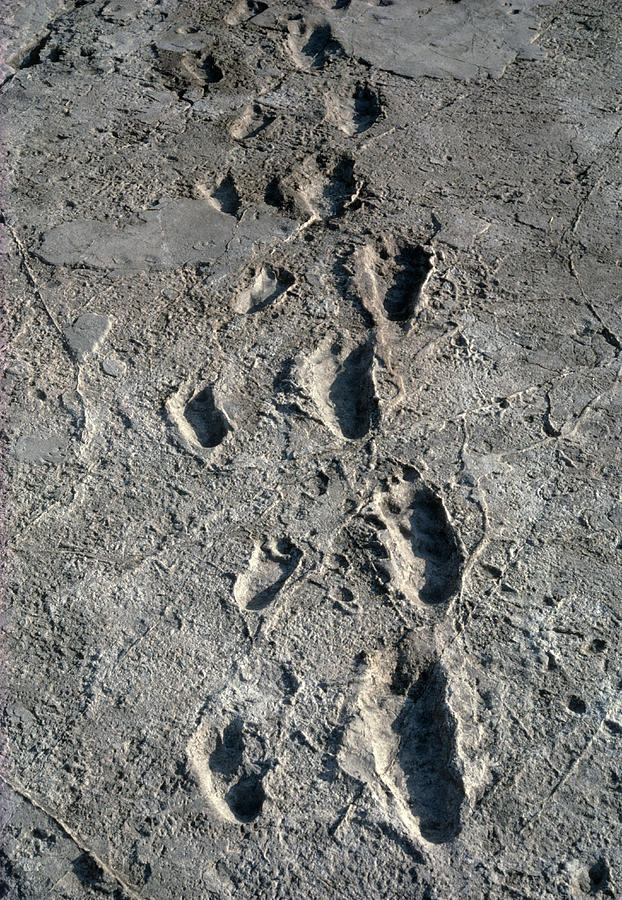
In Tanzania, 3.6 million years ago, two bipedal ancestors left their footprints in wet volcanic ash.  In 1978, at the Laetoli site, scientists discovered 70 of their fossilized footprints, in a sequence that was 88 feet long (27m).  These ancestors were probably Australopithecus afarensis.

Why the shift to bipedal travel?  Over time, as climate change expanded grassland, the distance between groves of trees increased.  Knuckle walking is OK for short trips, but striding is more comfortable and energy efficient for longer journeys.  Standing upright provided a better view of the surroundings.  It also made them more visible to hungry predators.  It freed up their hands for carrying things like food, water, infants, embers, and tools.

For brief high-speed getaways, hominins were far slower than galloping chimps.  Alfred Crosby noted that bipedal striding is like walking on stilts, and it increases the odds for falling down.  Four-legged critters (quadrupeds) like canines, cats, or horses move in a manner that is far more graceful, stable, and speedy.

On the savannah, evolution typically selected for prey animals that were better high speed escape artists.  Consequently, it also selected for the predators that were more effective at killing them.  If prey gradually got larger, predators gradually got larger.  If prey got faster, so did the predators.  If prey got too good at surviving, they would overgraze the savannah and starve.  If predators got too good at hunting, they would eliminate their prey and starve.  The ecosystem was an endless bloody evolutionary soap opera.

With regard to our ancestors, evolution advanced an unusual mutation.  Instead of size or speed, it selected for heat tolerance and long distance running.  Compared to four-legged critters, standing upright exposed less of their bodies to hot sunbeams, and their bushy hairdos provided extra heat protection.  Their nearly furless bodies, equipped with three million juicy sweat glands, allowed them to shed body heat better than other savannah mammals. 

Tree-dwelling primates enjoyed a diet majoring in fruit, which grew all around them, all year long.  On the savannah, there was less fruit, so foraging required travelling farther, and finding other things to eat.  Some believe that our ancestors became bipedal to improve their success at scavenging — beating competitors to fresh carcasses.  Bernd Heinrich wrote that at Yellowstone Park, dead animals are reduced to a pile of bones in just seven hours.  In Africa, hyenas devour the bones too.

The person you see in the mirror has a body that is optimized for running, not walking.  Your toes and heel tendons provide a bounce when your foot hits the ground, improving energy efficiency.  Your legs and spine are fine-tuned for jogging, keeping your head and eyes steady.  Skilled runners gracefully glide along, lightly skimming across the land.

The shift to bipedal locomotion resulted in some radical changes in our ancestors’ skeletons.  Notably, the pelvis got narrower, which reduced the size of the birth canal — the passageway through which fetuses pass during birth.  This challenge was dealt with in two ways.  (1) Birth occurred earlier, when brains were smaller and less mature.  This extended the duration of childhood, the spacing between births, and the need for extended parental oversight.  (2) Since bipeds no longer slept in the trees, they could grow heavier and bigger.  Increased size was an asset for hunting and defense.  Longer legs enabled longer strides, which boosted running speed.  Larger bodies retained water better, delaying dehydration.

Bipedal locomotion was an unusual evolutionary experiment.  Few if any humans still live in the manner for which evolution fine-tuned us, a practice known as persistence hunting.

Persistence Hunting

On the savannah, predators made speedy attacks, and their prey attempted quick getaways, but both soon had to find shade and chill out, because bursts of high exertion promptly led to overheating.  Consequently, predator attacks were resolved quickly.  If a charging lion failed to promptly take down its target, the attack ended, and the prey might live to see another day. 

Our ancestors gained the ability to engage in steady long distance running, hour after hour, in the oven-like midday heat of tropical savannahs.  Once a chase began, the prey animals immediately scattered.  The hunter quickly selected an animal that was less strong and speedy, and began trotting after it.  Even when the prey was miles ahead, the hunter would doggedly follow its trail, reducing its ability to rest and cool off.

Persistence hunting requires no weapons.  Hunters must possess a deep understanding of animal behavior, great skill in the art of tracking, an intuitive mind, a healthy body, and sufficient water and nutrients for a long run.  Kalahari people had exceptional tracking skills.  Women were as good as men, or better, at interpreting spoor.  At the end of a successful pursuit, the prey might collapse from exhaustion or heat stroke, or simply stop running.  If the hunter found it still alive, he could suffocate it or bonk it on the head. 

Liebenberg was maybe the first civilized person to participate in persistence hunting (he nearly died from heat stroke).  He observed a six and a half hour chase that covered 21.7 miles (35 km), on a day when the temperature ranged between 89°F and 107°F (32°C and 42°C). 

He noted that tracking encouraged wild people to develop heightened abilities for intuitive thinking, because the tracks of their prey were rarely clear and complete.  Knowledge of animal behavior helped to fill in the blanks and suggest the most likely escape route.  The mental process was fast, automatic, effortless, and often unconscious.  Intuition also enhanced social relationships.  Wild people were far more sensitive to each other than folks in the modern world, whom Liebenberg saw as being severely handicapped by shallow or dysfunctional relationships.

Maybe our ancestors learned persistence hunting from hyenas, who hunt in packs, using their super-sensitive noses to follow animals until they are exhausted.  Or, maybe they first learned by chasing small, slow moving critters.  Somehow, maybe several million years ago, our hominin ancestors learned the clever trick of using overheating and exhaustion as deadly weapons — and the keys to survival.

Every gardener who has experienced backaches or sore knees, is painfully aware that evolution did not fine tune hominins for spending long hours on their knees or bent over, engaged in tedious repetitive movements — digging, cultivating, planting, weeding, picking, threshing, grinding, and so on.  What you see in the mirror is a body optimized for long distance pursuits across hot African savannahs — a meat-loving hunter and forager.

Bears have never forgotten their identity, consequently they confidently continue to live like bears, which is why they remain perfectly sane, and have no need for psych meds.  The same can be said for all the wild animals alive today.  The glaring exception is a super large mob of modernized persistence hunters who have become extremely disoriented by memory loss.

Young children, even in the deepest darkest McMansion suburbs, are fascinated by bears, lions, horses, bunnies, piggies, and others.  They play with teddy bears, pretend to be horses, and love looking at animals in picture books.  The kids are animals, and their hominin ancestors have been fascinated by animals for six million years.  Sadly, most will spend their lives in a reality where most of the animals they’ll closely experience will be thoroughly domesticated critters purchased for companionship or status display.

Jung said that we still retain unconscious memories of our arboreal past, when falling out of trees caused big fear.  Many of us have suddenly awakened with a gasp when a dream included a sudden plunge.  Nightmares commonly involve being chased or attacked by dangerous predators.  In crowded movie theaters, when the woman is about to be stabbed by a psycho killer, the hall explodes with loud squeals and screams, like our primate ancestors in a distant rainforest.

Over the last six million years, every species of bipedal primate has gone extinct, except one — and almost all of us have abandoned persistence hunting as a routine component of basic survival.  Don’t worry.  Close your eyes and imagine what humans might become if we spent the next 200,000 years sitting on couches, staring at glowing screens, washing down greasy pizza with fizzy sugar water.

Running Goes Global

By and by, as hominins spread far beyond the savannahs of tropical Africa, so did persistence hunting.  It spread around the world, because it works, and because evolution fine-tuned us for doing it.  For almost the entire hominin saga, we lived on our feet.  Running was a key factor in our ancestors’ survival, until we got wheels, four legged slaves, and other weird and troublesome things.

Tim Flannery reported that the Aborigines of Western Australia would pursue an individual kangaroo until it was overheated and exhausted.  The chase could take several days.  Johann Kohl wrote that the Ojibway would often run down elk, especially in the winter, when deep snow soon wore out the animal.  Hunters on snowshoes could pursue the animal for hours.  Kohl also mentioned a Sioux hunter who chased a bear to exhaustion.

Bernd Heinrich wrote about the Penobscot tribe chasing down moose, and the Navajo and Paiutes wearing out pronghorn antelopes.  In Southern Africa, hunters chased steenbok, gemsbok, wildebeest, zebras, and others.  Wendell Bennett wrote about the Tarahumara people of Mexico pursuing deer and turkeys until they collapsed.  

Peter Nabokov noted that some Tarahumara lads could run 170 miles (273 km) without stopping.  Mexicans would hire them to capture wild horses, sometimes chasing them for two or three days, until the horses could run no more — while the men remained fresh.  Nabokov quoted a Hopi man: “Long ago when the Hopi had no sheep, no horses, no burros, they had to depend for game-capturing on their legs.”

Nabokov provided numerous accounts of Indian messengers traveling great distances.  One ran 50 miles in six hours.  A Mojave lad ran 200 miles (322 km) in 24 hours.  Seven days a week, a Tarahumara man ran a 70 mile (112 km) route, carrying a heavy mailbag.  After running 15 miles (24 km), Zuni runners still had a slow heart rate and no signs of fatigue.  Men in their seventies continued to have tremendous endurance, as well as low blood pressure.

For wild people in open country, running was essential for communication, warfare, hunting, ceremonies, and rituals.  Apache boys of 8 to 12 years old regularly ran to improve their endurance and pain tolerance.  They ran carrying big loads, and they ran up mountains.  Apache warriors were much stronger and braver than the U.S. Army lads sent to exterminate them.

Nabokov wrote that 4-year old Navajo boys had to get up before sunrise every day and run four miles before having breakfast.  Speed and strength were essential when attacking enemies, or being attacked.  No one will help you in this world, you must run to get strong.  Your legs are your friends.

I spent many years sitting indoors at school desks, learning reading, writing, and arithmetic, loading my brains with the ideas necessary to be an obedient, punctual, productive cog in the industrial society that’s pounding the planet to pieces.  Wild Native Americans, during the years of their youth, were being taught to be strong, brave, and extremely healthy.  They learned the skills needed to survive in their ecosystem, in a low impact manner.  During their entire lives, they sent nothing to landfills.

Wednesday, December 19, 2018

Wild Free and Happy Sample 05


[Note: This is the fifth sample from my rough draft of a far from finished new book, Wild Free & Happy.  I don’t plan on reviewing more books for a while.  My blog is home to reviews of 199 books, and you are very welcome to explore them.  The Search field on the right side will find words in the full contents of all rants and reviews, if you are interested in specific authors, titles, or subjects.] 

Savannah Pioneers

When our ancestors moved from the forest to the savannah, they began a journey into an entirely different way of life.  Critters that evolution had fine-tuned for arboreal living were poorly prepared for surviving on open grassland.  They were not big, strong, or speedy.  They didn’t have horns, fangs, or claws.  They couldn’t digest grass.  They had to adapt to different sources of food, and different threats to their survival.  It took centuries of trial and error to develop new ways of living, and hundreds of thousands of years to evolve new and improved bodies fine-tuned for their unique experiment.

In the early days, our ancestors were not apex (top level) predators, they may have been more like walking meatballs, easy prey for big cats, packs of hyenas, huge crocodiles, and other hungry carnivores.  Chris Stringer mentioned genetic research indicating that today’s Earth-pounding mob of Homo sapiens trace back to an ancestral population of about 10,000 breeding individuals.  Earlier, a million years ago, in the Homo erectus era, there were just 20,000 breeding individuals.  For a very long time, our ancestors existed not too far from the brink of extinction.  It wasn’t easy being a highly vulnerable ground-dwelling primate.

Scavenging and Primitive Hunting

Our ancestors on the African savannah were hunter-gatherers, and their diet majored in plant foods, with a regular supplement of highly nutritious animal foods.  In the early chapters of the great hominin adventure, they were not expert hunters with effective weapons.  Meat was acquired via scavenging and primitive hunting.  With bare hands, they could grab critters like grubs, grasshoppers, termites, maggots, snails, shellfish, lizards, and frogs.  They could kill animals sleeping under bushes, dig up others from their burrows, chase down slow moving aardvarks and porcupines, and snatch immature youngsters.  Large birds could be knocked down by throwing clubs.

It’s easy to forget that rocks can be lethal weapons.  Wendell Bennett wrote that the Tarahumara people of Mexico threw stones with remarkable accuracy, killing rabbits, birds, and animals up to the size of coyotes.  Some of their groups did more hunting with stones than with bows and arrows.

Alfred Crosby wrote that any human more than eight years old, male or female, can throw projectiles farther and more accurately than any other species.  This ability gave us the power to effect change from a distance.  Well-thrown projectiles could drive away hungry predators or kill a plump bunny for dinner.  Researcher Frans de Waal noted that stone throwing chimps also have “impressive long-range aim.”  (Ouch!)

Crosby noted that a few hundred years ago, Europeans visiting Samoa got a painful lesson in the superb stone-throwing skills of the natives.  Of the 61 men sent ashore, 12 were killed by well-thrown rocks.  Humans also invented the rock-throwing sling, which was even more deadly, especially when loaded with lumps of lead.  Many of the conquistadors visiting Mexico had life-changing experiences while getting stoned by the angry sling-twirling Indians.

Scavenging is getting meat from carcasses that you didn’t kill — leftovers from large carnivores, or animals that died from other causes.  In later times, as the ancestors became more skilled at hunting, scavenging was not abandoned.  Meat is treasure, no matter how it is acquired.  Scavenging was often less work and less dangerous than pursuing and killing an animal.

During the day, our ancestors paid careful attention to the skies.  When vultures flew in a specific direction, they might be en route to a fresh carcass.  Circling vultures were strong evidence of a banquet directly below.  Once you got a hot tip, it was best to move quickly, in an effort to beat other scavengers to the banquet.

Hyenas work in gangs, and can quickly strip the scraps off carcasses, leaving few leftovers, if any.  Their arrival time was sometimes delayed by their need to stop, pant, and cool off from time to time.  Our ancestors were far better at shedding heat, an important advantage.  If hyenas or jackals arrived first, it was sometimes possible to mob them and drive them off.  On lucky days, it was possible to steal lunch from a lone cheetah.

Lions were another story.  To drive them away from a kill, surprise was important.  You and your buddies should suddenly charge, waving your arms, shouting, throwing rocks, swinging clubs, or maybe start a grass fire upwind.  Smart scavengers never tried this when lions were just beginning their lunch feast, and were still very hungry.  It was best to wait until they were full and ready for a nap.  Lions rarely consume brains or marrow, and sometimes leave some meat scraps for the intrepid.

It was also important for scavengers to pay attention to trees.  When leopards didn’t completely consume a kill at one sitting, they stored the leftovers up in the branches.  Leopards are night creatures.  If you found their unguarded stash in the daytime, there was less chance of getting shredded and devoured by an angry cat.

Right now, your eyes are following a track of squiggly scratches, and your mind is comprehending meaning from them.  My thoughts and actions created those tracks, and they contain specific meaning for those who have learned how to interpret them.  The farther you are able to follow my tracks, the more you will learn about me.

Similarly, animals leave behind tracks and other signs as they move across the land.  Folks who are skilled at reading this information can accumulate pieces of a story.  They can perceive a fantastic amount of information by studying spoor — footprints, urine, feces, saliva, blood, fur bits, feeding signs, smells, sounds, and so on.  Spoor provides clues about the animal’s species, gender, size, behavior, direction of travel, time of passage, and so on. 

Fresh tracks left by a game animal indicated that it had passed through the area, and the direction it was moving — essential information for hungry hunters.  Also, spoor left by large carnivores indicated predators on the move.  Following their tracks might eventually lead to a recent kill, and a carcass to scavenge.

The San

Louis Liebenberg is a South African lad who has spent years on the Kalahari Desert with the San people (other names include Khoisan, Bushmen, !Kung).  He was not a nerdy anthropologist, he directly participated in hunts, and eventually became a skilled tracker.  He wrote two outstanding books about tracking, scavenging, and persistence hunting.

One time, Liebenberg asked some San trackers if they could actually recognize the spoor of an individual antelope.  They burst out laughing at his incredibly stupid question.  They couldn’t imagine anyone not being able to do this.  When they see a human footprint, they immediately know which individual in their band made it.  Children can identify the tracks of their parents.  Footprints are as unique and recognizable as faces.  To see the footprints of an unknown stranger was highly unusual, and would inspire caution. 

More anthropology books have been written about the San than any other wild people.  Geneticists have found that they have the oldest DNA of any living culture — it is the genetic foundation of nearly all modern humans.  Their genes are the closest to the ancient female from whom all living humans descend, known as Mitochondrial Eve.  Thus, your family tree likely leads back to ancestors similar to the San.  (Pygmies are the second oldest living culture.)

The San have been hunter-gatherers since the dawn of humankind, and they enjoyed a way of life that managed to survive into the 1970s.  Eight hundred years ago, the San homeland included all of southern Africa.  Since then, Bantu and European herders and farmers have displaced them from lands suitable for grazing and agriculture, forcing the San into the Kalahari where, on average, two of every five years are drought years, and severe droughts occur one in every four years.

There are large regions of the Kalahari that are quite flat, an endless landscape having no notable landmarks for a white boy like me, who would quickly become hopelessly lost, and turn into vulture chow.  The San, on the other hand, always know exactly where they are, across large regions, because they orient themselves by the layout of plant communities, noting their size, shape, position, and unique features.  They know the face of their land as well as they know the faces of their family.

Richard Lee wrote about the San.  Their primary food was mongongo nuts, which dropped once a year, but could be gathered all year long.  Meat was their second most desired food.  The Kalahari provided them with about 100 edible plant species, which they were careful not to overuse.  The San expected periodic times of scarcity, so they reserved some plant species for drought food.  Portions of their territory were set aside for lean times.

John Reader wrote about an extreme drought in Botswana that lasted three years, resulting in the deaths of 250,000 cattle and 180,000 people.  The San didn’t starve.  Each week they spent 12 to 19 hours foraging for their sustenance.  They lived in one of the harshest environments on Earth.  At the same time, hungry farming people had shifted to foraging during the drought, so the San lands were supporting a larger population than that of normal times.

Elizabeth Marshall Thomas has spent a lot of time with the San.  She wrote her first book on them in 1958, and her third in 2006.  Like any intelligent culture, their safety net included mindful family planning, to avoid the problems caused by overpopulation, and its trusty companions: environmental degradation, hunger, and conflict.

Because of low body fat and vigorous physical activities, San women began menstruating later.  Some did not have regular monthly periods.  Children were usually nursed for about four years, which further reduced their mom’s fertility.  Most of the women had one to four offspring.  Nomads moved frequently, and belongings and infants often had to be hauled long distances.  A woman could only carry one infant, so just one twin was kept.

When a child could not be kept, the woman gave birth alone, away from the camp, and buried the newborn before it drew breath.  In their culture, a newborn did not immediately become alive, so disposing it was OK.  Crippled or badly deformed infants were not kept, because they would be a drain on the wellbeing of the band.  To avoid unwanted pregnancies in harsh times, it was common for folks to abstain from intercourse. 

Jon Young is the star of several YouTube videos on nature connection.  He was an early student of Tom Brown, the famous author of many books on tracking and nature awareness.  Young visited a number of wild cultures to find those that remain most closely connected to nature.  He discovered that the San people were incredibly well connected.  They refuse to enter houses, because people who live indoors go insane.

Young says that with the San, you always feel safe.  They are super intelligent, super happy, super vital, and great problem solvers.  You never feel competition.  The people are in love with every aspect of the ecosystem around them, celebrating with childlike wonder through all stages of their life.  Every person in that community is committed to the flowering of every other person.  They are incredibly aware of their surroundings at all times, because a brief lapse of attention can kill you in lion country.

Wednesday, April 12, 2017

The Art of Tracking


Right now, your eyes are following a track of squiggly scratches, and your mind is comprehending meaning from them.  This morning, my mental processes created those tracks, and they contain specific meaning for those who have learned the ability to interpret them.  The farther you are able to follow my tracks, the more you will learn.

Similarly, animals leave behind tracks and other signs as they move across the land, and folks who are skilled at reading this information can accumulate pieces of a story.  The indigenous trackers of the Kalahari Desert in Botswana can perceive a fantastic amount of information by studying spoor — footprints, urine, feces, saliva, blood, fur bits, feeding signs, smells, sounds, and so on.  Spoor provides clues about the animal’s species, gender, size, behavior, direction of travel, time of passage, and so on.

There are large regions of the Kalahari that are quite flat, an endless landscape having no notable landmarks for a white boy like me, who would quickly become hopelessly lost, and turn into cat food.  Hunter-gatherers, on the other hand, always know exactly where they are, because they orient themselves by the layout of plant communities, noting their size, shape, position, and unique features.  They know the face of their land as well as they know the faces of their family.

Louis Liebenberg is a South African lad who has spent years with Kalahari trackers, learning their art.  He calls himself a citizen scientist, not a professional, and he has special gifts for thinking outside the box.  His work has impressed famous academic heavyweights at Harvard.  In 1990, he published The Art of Tracking.

After our primate ancestors moved out of the trees, they eventually evolved for bipedal travel — walking upright on two legs.  In Tanzania, 3.6 million years ago, two bipedal ancestors left their footprints in wet volcanic ash.  In 1978, scientists discovered 70 of their fossilized footprints, in a sequence that was 88 feet long (27m).  [Image]  These ancestors were probably Australopithecus afarensis.

Today, our living primate relatives are quadrupeds, four legs.  Chimps can sprint much faster than humans, but we excel at running long distances.  Moving on two legs is more energy efficient than on four.  Evolution optimized our feet and legs for the spring-like mechanics of running, not walking.  Over time, we lost our fur coats, and developed the ability to sweat profusely, so we excelled at shedding body heat.  Standing upright gave us a better view of the surroundings.

Many game animals can move much faster than humans, for short bursts, then they must stop to cool off.  The desert is especially hot at midday.  Humans are unusual because we can run for hours in the heat of the day.  We can doggedly follow the tracks of speedy prey, not giving them a chance to rest, until heat stroke brings them down, and often kills them.  Hunters also carried spears or clubs, to finish the job, if needed.  HERE is a 7-minute video.

This is called persistence hunting, and Liebenberg was apparently the first civilized scientist to participate in this (he nearly died from heat stroke).  In other regions, this method has been used to hunt reindeer, kangaroos, deer, and pronghorn antelope.  Our ancestors have likely practiced persistence hunting for two million years or more.  It played a central role in the evolution of the person you see in the mirror.

Gorillas are vegetarians, spending long hours stuffing their faces at the salad bar.  They have evolved large guts in order to digest this bulky fibrous diet.  In addition to plant foods, chimps, bonobos, and baboons also eat meat, an excellent source of nutrients and calories.  They are good at predation, killing small animals without weapons.

In the early days, our bipedal ancestors likewise killed small critters with their bare hands.  Eventually, they became hunters.  Early hunters used pointed sticks, stones, and clubs to stun small mammals and birds.  By and by, the ancestors learned how to kill large game, via persistence hunting, javelins, spears, bows and arrows, and so on.  Meat maybe provided forty percent of their calories.

In addition to predation and hunting, our ancestors also acquired meat by scavenging.  Large carnivores often kill large game, devour as much as possible, and then abandon a partially eaten carcass.  On the Kalahari, hunters always note vultures circling in the distance.  They indicate the location of a dying animal, or a yummy carcass.  With luck, our ancestors’ running abilities sometimes enabled them to beat the hyenas to lunch.  Hyenas are not as good at shedding heat.  They periodically need to stop and pant to cool off.

Because game animals can move faster than humans, for limited distances, the success of persistence hunting largely depended on tracking skills — following the spoor of their chosen prey who might be out of sight.  Kalahari people had exceptional tracking skills.  Women were as good as men, or better, at interpreting spoor.  Everyone in a band, both men and women, could observe human tracks, and accurately identify the individual person who made them.

One time, Liebenberg asked some trackers if they could actually recognize the spoor of an individual antelope.  “They found it very amusing that I should ask them such a stupid question.  To them it is difficult to understand that some people can not do it.”  Liebenberg described three levels of tracking strategies.

(1) Simple tracking is just following the prey’s footprints, under ideal conditions, when the prints are clear and easy to follow.

(2) Systematic tracking is used when the spoor trail is less than complete.  Using reasoning and deduction (inductive-deductive reasoning), the tracker can then develop a hypothesis of what the prey was doing, and the most likely direction of its escape route.  This is solely based on real evidence.  Then, the hunter proceeds in the prey’s probable direction, in hope of picking up the track again. 

(3) Speculative tracking is the most advanced and creative.  “Anticipating the animal’s movements, by looking at the terrain ahead and identifying themselves with the animal on the basis of their knowledge of the animal’s behavior, the trackers may follow an imaginary route, saving much time by only looking for signs where they expect to find them (hypothetico-deductive reasoning).  By predicting where the animal may have been going, the trackers can leave the spoor, take a shortcut, and look for the spoor further ahead.”

Like vervets, baboons, jackals, and most other species, our ancestors learned ways of communicating with each other, via sounds and gestures.  Some birds make one warning call for lions, and a different one for snakes.  Many species, including humans, pay careful attention to the vocalizations of other species.  It’s good to know when a lion is approaching, long before it can be seen.

At some point, nobody knows when, the ancestors developed complex language.  As social animals, they lived in small bands.  Each member collected and shared information, and the group developed a body of wisdom.  Language made it easier for them to relay accumulated wisdom to the next generation.

Biological evolution (genes) moves at a snail’s pace, but cultural evolution (knowledge) can boogie like gazelles on meth.  With spears and javelins, the ancestors didn’t need to spend hundreds of thousands years evolving claws and fangs.

A few million years of scampering through the rainforest canopy, followed by a few million years of persistence hunting and tracking, fundamentally directed the evolution of our bodies and minds.  Today, we have abandoned our ancient way of life; it’s nearly extinct.  Imagine what we’d look like after 500,000 years of sitting on couches, entranced by glowing screens, chugging sugar water.

I’ve now given you a wee whiff of this book.  When I write reviews, I usually select a few subjects that especially interest me.  This one was especially interesting from one end to the other.  It carries readers off to a sacred mountaintop, where we can get a better view of the big picture.  If we want to live sustainably for hundreds of thousands of years, simple living is the only option.  What good are all our amazing gizmos if they require an insanely unsustainable flash-in-the-pan culture?

In every way, the wild people of the Kalahari were completely in tune with their ecosystem.  In my world today, I observe the opposite — a society that could not possibly be more alienated.  Recent DNA mapping strongly suggests that the hunter-gatherers of the Kalahari are the ancestors of all humans now on Earth.  You and I carry their genes.  Liebenberg pulls back the curtains of modernity and provides readers with a mind-expanding peek into distant corners of our family tree — the ancestors we have forgotten, and would be wise to remember.

In 2013, Liebenberg published The Origin of Science, which furthers his discussion of our Kalahari relatives.  My review is HERE.  There is some subject matter overlap between the two books, and my two reviews.  Sorry!  Take your anxiety meds.

Free PDFs of two Liebenberg books can be downloaded HERE.  YouTube has many Kalahari documentaries.

Liebenberg, Louis, The Art of Tracking, David Philip Publishers, Claremont, South Africa, 1990.

Thursday, March 9, 2017

Nature Connection


Stalking Wolf was a tracker raised in a wild, free Apache community.  His people never surrendered to the barbarian invaders, and some still continue living in freedom, as undocumented Americans, in remote desert regions.  Later in life, he spent time with his son in New Jersey, where he happened to meet an 8-year old boy named Tom Brown.  He mentored Tom and his buddy Rick for nine years, giving them an excellent education in tracking, survival, and respect for the family of life.  When it was time for him to return west, and end his life’s journey, he told Tom to teach someone else all that he had learned.

In 1971, when Tom was 18, he met a 10-year old boy named Jon Young, and trained him for eight years.  Tom went on to write 17 books, and launch his famous tracking school.  Young went to college, where he was a freak — a highly skilled tracker with a deep understanding of wild ecosystems, and enormous respect for the family of life.  Weirdo!

Young grew up in an era when there were only three channels on TV, so he and his buddies spent a lot of time outdoors, playing unsupervised in the woods, taking risks, and forming close bonds with children of different ages.  This is how well adjusted young animals are supposed to grow up, feeling at home in nature, connected.

He would have made a perfect poster boy for Richard Louv’s book, Last Child in the Woods.  It described the rapidly growing epidemic of Nature Deficit Disorder (NDD) — separation sickness.  Today’s kids have far more distractions, like 500 TV channels, the internet, cell phones, and video games.  They typically have intrusive “helicopter parents” who micromanage them, constantly protecting them from dirt, danger, creativity, and freedom.

Every newborn that squirts out of the womb is a wild animal fine-tuned for thriving on tropical savannahs, fully connected to nature, acutely intelligent, and highly aware.  Even today, some are able to preserve nature connection during their childhood years, but it tends to suffocate in their teen years, due to a nonstop barrage of loony balderdash from the nightmare world of Sustainable Growth™.  A lucky few manage to maintain their connection into adulthood, and strengthen it as they go — maybe one in a thousand, according to Young.

In 1979, Tom Brown published his first masterpiece, The Tracker, a book that blew my mind.  In that year, Young asked his life question, “Who are the most connected to nature and how did they get that way?  Why are some folks deeply connected, and others not?”  In search of answers, he spent years visiting a number of indigenous cultures.  He discovered that the San Bushmen of the Kalahari in Botswana were incredibly well connected.  They refuse to enter houses, because people who live indoors go insane.

Young says that with the San, you always feel safe.  They are super intelligent, super happy, super vital, and great problem solvers.  You never feel competition.  People are in love with every aspect of the ecosystem around them, celebrating with childlike wonder through all stages of their life.  Every person in that community is committed to the flowering of every other person.  They are incredibly aware of their surroundings at all times, because a brief lapse of attention can kill you in lion country.

Today, using the techno-juju of DNA mapping, it’s looking like the San are the common ancestors of all humankind.  For two million years, our ancestors lived like they still do.  We have their genes and instincts, but our culture lost its nature connection centuries ago.  Culture is a whirlwind of beliefs.  Stupid beliefs can have deep roots and powerful momentum, but they are not invincible, especially when they are destabilizing society.  Never forget that there was a time when our culture, and its belief system, did not exist.  It’s a spooky mutant, and it has no long-term future.

Richard Louv compiled years of reputable research on the harms associated with NDD.  Complications of disconnection include drug addiction, autism, homelessness, attention deficit disorder, depression, suicide, obesity, anxiety, and on and on.  Kids who grew up as Young did were strikingly healthier, happier, and smarter.  They were more creative, well adjusted, spiritually grounded, and centered.

In 2011, the popular talk show celebrity Oprah Winfrey read Louv’s book, The Nature Principle, and added it to her influential summer reading list.  Suddenly, news of the NDD epidemic went viral.  Millions of mothers gasped in horror!  My God!  What have we done to our precious little couch potatoes?  Everyone wanted their children to be connected, because the benefits were obviously huge.  In the book, Louv mentioned that Young was an expert on nature connection.

Since 1983, Young has been developing mentoring projects, striving to help youths move beyond the soul-killing void of disconnection.  For a long time, he was seen as a last resort, a place to dump emotional basket cases that the experts could not fix, kids close to blinking out.  He had an impressive record of hitting home runs with high-risk youths, because he gave them what they desperately needed, connection.  There are three facets of connection: connection with others, connection with self, and connection with nature.

Consumer culture excels at disconnecting people from self, others, and nature.  Many adults fail to develop healthy connections with their husbands, wives, children, and friends.  Many don’t know the folks who have been their neighbors for years.  Many are only capable of forming connections with their dogs and cats.

Anyway, in recent years, awareness of the importance of nature connection has increased significantly, but so has the teen suicide rate.  Indeed, the NDD epidemic continues to spread.  Participation in nature conservation groups is declining, while connection to glowing screens has grown explosively.  The ecosystem is not getting the love and respect it so desperately needs.

Young points out that there is no miraculous silver bullet cure for NDD.  A weekend camping trip is not enough.  Youths attend his mentoring projects once or twice a week.  Most attendees develop connection in two years, on average.  He says that their values are significantly changed.  Connection opens up their empathy and their concern for others.  It causes them to seek meaning, and meaningful service to others, and to future generations.  Great!

When you meet a cool weasel, or find a bird nest, you want to share the exciting discovery.  The path to healing requires being with folks who will give you a listening ear, nonjudgmental story catchers.  Story catching is a life-giving connective experience.  It’s about giving full attention to listening, without interrupting, or projecting your thoughts.  Young says that grownups usually talk at each other, semi-listening, mostly waiting for a space in the conversation where they can cut in — intersecting monologues.

As a wordsmith, I can communicate knowledge about environmental history or ecological sustainability, but my connection to nature is hard to convey via words.  The Tracker blew my mind, but I know that many others say the book had little or no value for them.  I was lucky to preserve my nature connection into adulthood.

Young points out that you can’t succeed at bodybuilding by reading books.  You have to engage in actual exercise.  Similarly, nature connection is not acquired from books.  Book learning is education modeling.  Equally ineffective is recreation modeling, engaging in health and fitness activities.  The correct tool for this job is connection modeling, the mode of mentoring to which Young has devoted his life.

Modern societies have inherited a stupendous mess, a bloody pileup of thousands of years of trauma.  Magical thinking is not the answer.  Young optimistically estimates that the healing process will take 200 years.  He says we need to think of ourselves as foundation builders.  Our task is to begin the long and difficult journey home.  Live well!

Videos of Jon Young lectures:


Nature Connection Books:

Young, Jon; Evan McGown, and Ellen Haas, Coyote’s Guide to Connecting to Nature, 2nd ed., Owlink Media, Shelton, Washington, 2010.

Young, Jon, What the Robin Knows: How Birds Reveal the Secrets of the Natural World, Houghton Mifflin Harcourt, Boston, 2012.

Louv, Richard, Last Child in the Woods: Saving Our Children from Nature-Deficit Disorder, Algonquin Books, Chapel Hill, 2008.

Louv, Richard, The Nature Principle: Reconnecting With Life in a Virtual Age, 2nd ed., Algonquin Books, Chapel Hill, 2012.

Nature Connection Organizations:

Jon Young founded the 8 Shields Institute, which has been training nature connection mentors for 30 years.  It runs over 300 programs worldwide.  More info is HERE.

Richard Louv founded the Children and Nature Network, an organization that is influencing policy in Washington, via 122 grassroots campaigns.

Monday, April 30, 2012

The Tracker

Tom Brown fascinates me.  He grew up in the sparsely populated Pine Barrens region of southern New Jersey.  When he was eight years old, he met Rick in the woods, and the two boys became the best of friends.  Rick’s father was stationed at a nearby base, and his grandfather was Stalking Wolf, an old Apache tracker.  The Tracker was the first of Tom’s many books, and it introduced us to the amazing world that he was blessed to experience.
Stalking Wolf was one of the last Apaches to be trained in the old ways, by elders who were still wild and free.  The wilderness was his home, church, and school.  He could follow tracks on a dark night — by blind touch.  He could perceive the trail of a mouse across dry gravel.  His stalking skills allowed him to sneak up on deer and touch them, an ability that some modern hunters no longer have.  He earned his name by touching a wolf, a nearly impossible feat.  He could read the patterns of the land — the smells, the snapping twigs, the alarm calls of animals, or the sudden silence of the bird music.  He was completely in tune with the land, both physically and spiritually.
Stalking Wolf taught Tom and Rick for eight years.  “He taught us to make use of everything, to live with the least disruption of the earth, to revere what we took from the woods, to master our fear, to hone our special skills sharper and sharper, to expand our senses and our awareness, to live in the space of the moment and to understand eternity.”  The boys learned tracking, stalking, awareness, self-control, survival skills, and spiritual consciousness.  They spent all their free time outdoors, studying nature, and practicing their skills.  They rarely saw their parents on weekends or summer vacations.
Tom became completely at home in the wilderness.  He could go into the woods, naked and empty handed, and spend the whole summer living off the land — confidently, comfortably, fearlessly, and joyfully.  He could catch a deer and kill it with a knife.  Often he would wander far beyond familiar places, and not be sure where he was, but being “lost” was never a cause for fear or panic.  “Everything I could want was immediately at hand.  If I was lost, I seemed better off than a lot of people who weren’t.  I was always at home, wherever I was.  Only when I came out of the forest did I find out how easy it is to get lost.”
Stalking Wolf taught the boys that there were no greater or lesser spirits.  The spirit of an ant had no less significance than that of a bear or a brother.  He loathed all aspects of the civilized world, and he avoided contact with it, to the best of his ability.  Despite what white people had done to his land and his people, he did not hate them, because they were lost, unhappy, and didn’t know any better.  But he did hate their way of thinking and living — “they killed their grandchildren to feed their children.”
The boys absorbed his love for the land and the wild ones who lived there.  Like Stalking Wolf, they could not comprehend the mentality of people who brought in bulldozers, or dumped their trash, or drove through the woods.  Outsiders were like space aliens, displaying no respect for the place.  “True lostness is when you have forgotten the spiritual center of your life, when your values have gotten so warped with time that you do not remember what is truly important.”
One day, Tom discovered a number of dead deer in the woods.  Their shoulders and hindquarters had been removed, and everything else was left on the ground to rot.  New York restaurants would pay good money for prime cuts of fresh venison.  Tom was horrified.  He followed the tire tracks to an old cabin, and found the four poachers.  In a blind rage that he barely remembered, he attacked them, beat them up, bent or smashed their guns, destroyed the cabin, and burned their truck.  He took bold action to defend the land.  “The woods were my life and still are.”
The Tracker is a treasure.  It reminds me of my boyhood years, when we spent our days in the woods and fields, swamps and lakes, in a beautiful rural countryside that has since been erased by a cancer of strip plazas and McMansions.  I developed a strong bond with nature.  Only later in life did I realize that most folks never had this experience.  So many grow up in manmade environments, and many of them never experience anything else.  Tom’s bond with nature went far deeper than my own, because he was lucky to find a wise elder to guide him.  I grew up in a community of General Motors factory rats. 
Despite being raised in consumer society, and despite submitting to a public school education, Tom was able to remain detached from the civilized mindset and follow a healthier path.  It wasn’t easy.  He had to straddle two totally different realities.  He was routinely mocked and ridiculed for displaying his intense respect for nature and spirit, for not going to college, for not pursuing a corporate career.  The civilized crowd could not comprehend what he valued and loved, because they had no spiritual connection to life.
When we envision a healthy, sustainable future, it’s going to be a world where people have remembered how to live with the land and the community of life.  Throughout his journey, Stalking Wolf was frustrated by the difficulty of finding people to teach.  Almost no one was interested in learning the old ways, because this knowledge had no value in the modern world.  His elders encouraged him to keep trying:  “The things of truth and spirit will never pass away.  Our ways will not die.  In the final days, man will seek again the things that we know.”  Tom established a wilderness school, and he has spent his adult life teaching the old ways to eager students.  The story continues. 
Brown, Tom, The Tracker, Berkeley Publishing Group, New York, 1979.