Showing posts with label fire suppression. Show all posts

Monday, November 26, 2018

California: A Fire Survey


Stephen Pyne is among the world’s foremost experts on fire, and the author of many books.  California: A Fire Survey presents a blazing discussion on how fire has perplexed and bedeviled the Golden State.  One of every nine Americans lives in California.  Thanks to the arrival of industrial civilization, 170 years of rapid growth, and a culture devoted to the hardcore pursuit of wealth and excess, the state’s ecosystems resemble the smashed up cars at the end of a demolition derby.

Throughout the colonization process, the newcomers were possessed with a burning desire for prosperity.  The madness shifted into high gear as the nation industrialized, and created the infrastructure for mowing down ancient forests, exterminating millions of buffalo, eliminating vast numbers of fish, and extracting valuable minerals with fanatical zeal.

When it reached the Pacific, the culture of furious greed collided with an unusually flammable ecosystem.  “An estimated 54 percent of California ecosystems are fire dependent, and most of the rest are fire adapted.”  The land has been burning for thousands of years, because of natural wildfire, and human caused burns.  This has displaced numerous fire intolerant species.  Under ideal conditions, once ignited, a California fire can burn and expand for weeks or months.  The potential for expansion depends on three things: fuel, terrain, and weather.  Of these, the availability of fuel is something that humans can influence.

There are two main types of fuel, forests (mostly in the north) and chaparral (mostly in the south).  Chaparral is grassland dotted with brush.  Much of its vegetation is flammable, and chamise is especially so.  Once it is older than 25 years, it burns with intensity, and then reseeds and resprouts.

“Malibu Canyon is to wildfire what the Red River is to flooding.”  Pyne called it a fire bellows.  It often provides an ideal combination of excellent fuel, fire friendly terrain, Santa Ana winds, and human foolishness.  It burns explosively.  Many celebrities have built mansions in the canyon, because it offers fantastic views of the ocean.  Malibu had major fires in 1956, 1993, 2003, 2007, and 2018.  While mansions come and go, taxpayer anger grows at spending millions of dollars on fire control to protect the property of the superrich.

Native Americans limited the buildup of fuel by deliberately setting fires.  When little fuel was available, fires burned with less intensity.  In regularly burned forests, fires stayed close to the ground, and were less likely to become serious crown fires.  This kept the forest more open, easier to travel in, and provided better habitat for game animals.  Regular burning thwarted the sacred sequoia’s competitors — fir, cedar, and pine.  The competitors, especially white fir, deposited thick layers of flammable debris that prevented sequoia regeneration, and encouraged intense fires that could kill the giants.  Fire made the majestic sequoia groves possible.

The newcomers to America had a very different perspective.  In their minds, fire destroyed precious timber, sending enormous potential profits up in smoke — horror!  And so, the cult of aggressive fire suppression was born.  Fight fires like crazy, in every possible way, and send the huge bills to taxpayers.  The unintended consequence of this brilliant strategy was an enormous buildup of unburned fuel over time, which set the stage for major conflagrations.  Oops!

Southern fires arrive like Godzilla.  Northern fires arrive like a flash flood or blizzard — in late August 1987, lightning ignited 4,161 fires in Northern California, destroying 755,475 acres (305,729 ha) and 42 homes.  Firefighters worked furiously to extinguish every ignition, but some escaped and spread out of control.  By and by, a few wise guys began reconsidering their self-defeating strategy, and contemplated using regular prescriptive burns to control fuel buildup.  After many decades of fire suppression, the forests had become severely clogged with fuel.  Mechanically removing fuel buildup from vast areas of forest is a huge and enormously expensive project.

Southern California fires were violent, frequent, and unavoidable.  In addition to forests and chaparral, a new major source of fuel was growing — suburbs.  Wildfires happily reduced wooden structures to ashes.  So, the wise guys created fuel breaks — strips of vegetation 100 feet (30 m) wide were cleared to separate the McMansions from the chaparral.  This often worked to stop the spread of flames, but not airborne sparks.  Regularly maintaining fuel breaks was expensive, and taxpayers bleated about the cost of prevention.

As the sprawl monster expanded, there was less and less space for fuel breaks in new developments, at which point fuel reduction implied suburb reduction, an unpopular idea.  Many, many suburbanites, for decades, with astonishing ignorance, stubbornly resisted replacing their extremely flammable wood shingled roofs with fire resistant material.  A number of local governments did not ban development in fire prone locations where the landscape was a wind tunnel.

Reducing the fuel load via prescribed burns was possible, in theory, but fire creates smoke, and smoke annoys suburbanites, especially the palace dwelling celebrities.  Smoke does not readily blow out of the bowl-like Los Angeles Basin, home to 17 million.  By 1947, the air in L.A. County was so filthy that the herd got uppity.  Numerous regulations were created, but the wildfires laughed at them.  So, the only remaining option was expensive and intensive fire suppression.

Whenever the Santa Ana winds blow, and there is adequate fuel, ignition requires no more than a spark.  In one Southern California national forest, 37 percent of fires were caused by bulldozers, chainsaws, and other equipment, vehicles caused 2 percent, power lines 2 percent, miscellaneous 14 percent, smokers 5 percent, campfires 4 percent, kids with matches 5 percent, lightning 2 percent, car crashes 2 percent, arson 8 percent, and unknown 19 percent.

In 1849, when the Gold Rush began, a city of canvas tents suddenly appeared along San Francisco Bay.  By 1906, it had rapidly grown into a major city, in which 90 percent of the structures were still wood framed.  As many other U.S. cities had already discovered, this was a recipe for catastrophic fire.  Plus, the city was unluckily nestled close to the San Andreas Fault and the Hayward Fault. 

On April 18, 1906, an earthquake sent waves across the land surface, ripping apart streets, water mains, and gas pipes.  Numerous fires soon appeared and quickly spread.  Hot air rose so fast that it sucked more heat upward, creating a chimney through the atmosphere.  Four days later, 28,188 structures had gone up in smoke, and 2,000 to 3,000 people perished.  On the outskirts of the city, only a fringe of houses remained standing.

Many homeless refugees fled across the bay to Oakland, and many stayed there.  Prior to settlement, about 2 percent of the Oakland region was woods.  As the city grew, grassland fires above the town burned often and harmlessly.  But a new gold rush was emerging — real estate development.  Suburbs were expanding up the hillsides.  Wealthy elites built their mansions where the views were stunning.

Rapid growth in the bay region increased the demand for lumber, which accelerated deforestation elsewhere.  A super ambitious developer in the Oakland story was Frank Havens.  One of his schemes was to plant fast growing eucalyptus trees from Australia, and make megabucks selling lumber and firewood.  Too late, he tearfully learned that his trees were worthless until they were 75 to 100 years old.  He discovered this after he had planted up to eight million trees along a 14 mile (22 km) strip from Berkeley to Oakland.  These trees drop lots of highly flammable bark strips as they grow, and when hard frosts kill the trees, they dump loads of highly flammable leaves.

By and by, the East Bay hills became the Malibu of the north.  Seasonal Diablo winds frequently howled in from the east, rushing through the dangerous fuel buildup.  A 1923 inferno burned 584 homes.  This was followed by fires in 1946, 1970, 1980, and finally, the Tunnel Fire of October 1991.  That year, a frost had killed eucalyptus trees, boosting the fuel load.  A record heat wave followed a summer of drought.  Many homes in Oakland were jammed close together, and many had wooden roof shingles.

The Oakland Hills firestorm began as a grassfire, which then exploded as winds gusted up to 65 miles per hour (100 km/h).  Power lines got zapped, disabling 17 water pumping stations.  Oakland had nonstandard fire hydrants, which could not be used by assisting fire departments.  In just one hour, 790 structures were destroyed.  Eventually, 3,354 houses, and 456 apartments and condos burned.

And so, dear reader, I wonder if treating an ecosystem like a treasure chest, and looting it as fast as possible, with complete disregard for future generations, using all the latest gizmos invented by mad scientists — “progress” — is truly a healthy path.  I wonder why our schools are still preparing youngsters for a life of mindless hardcore looting.  That seems a bit odd.  It isn’t even fun.

One thing missing in the book is the Big History perspective.  Fire was domesticated in Mother Africa, and the hot idea eventually spread everywhere.  Siberian hunters originally brought fire-making knowledge into the Americas.  What was California like when they arrived?  Did thousands of years of Indian burning displace fire intolerant species, and actually create a fire prone ecosystem?   

Bill Gammage described the scale of Aboriginal burning in Australia.  Most of the continent was burnt about every 1 to 5 years.  Just 40 years after the British colonists banned burning, the site of a tidy dairy farm could be replaced by dense rainforest.  This suggests that the hunter-gatherers radically altered the ecosystem.  In another book, Fire: A Brief History, Pyne described how domesticated fire altered many ecosystems.

Pyne, Stephen, California: A Fire Survey, University of Arizona Press, Tucson, 2016.

There are several Pyne videos on YouTube, running from 15 minutes to an hour.  He is articulate and well informed.  Many of his fire books are available on Amazon.

Thursday, May 12, 2016

Burning an Empire


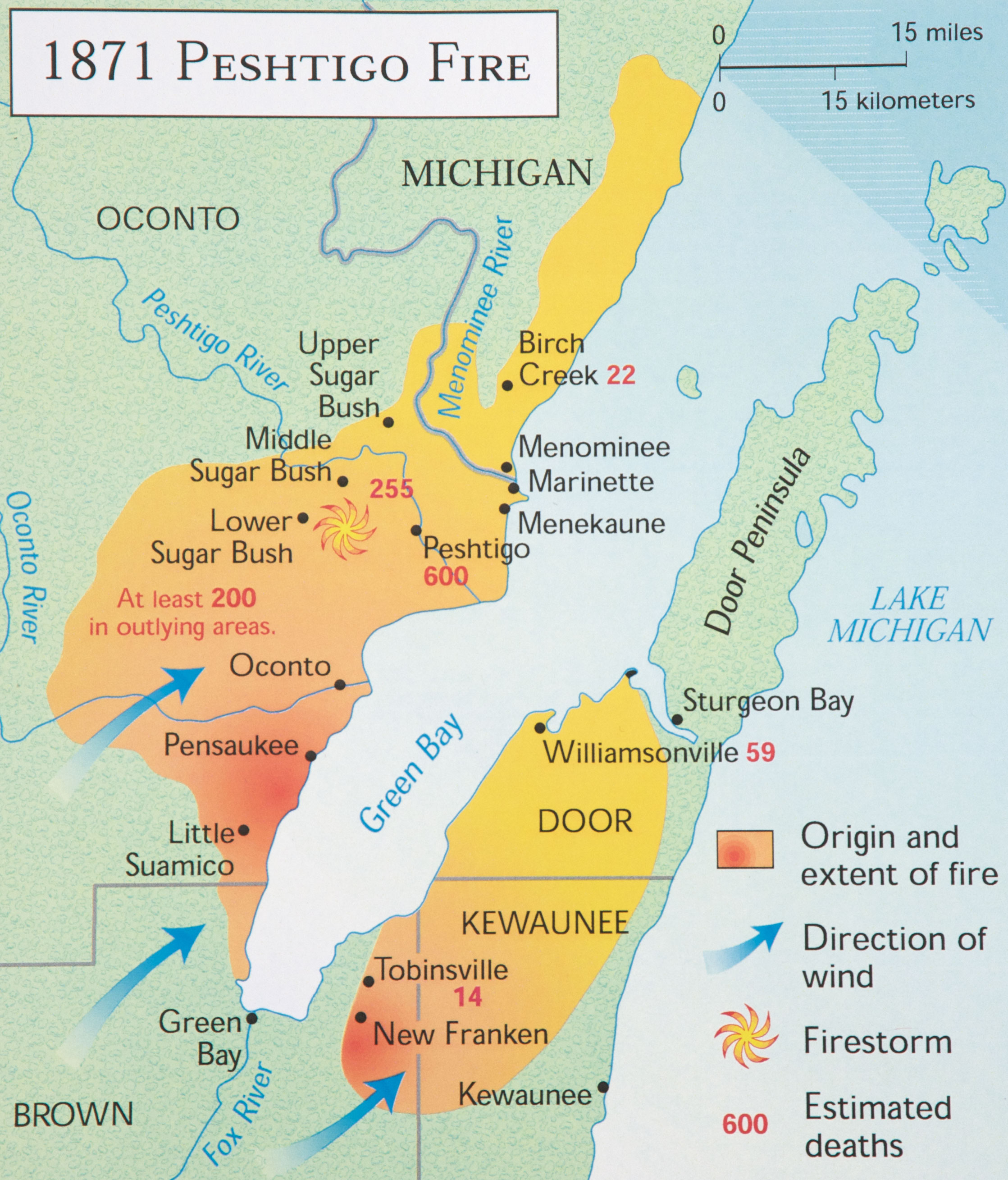
Long, long ago, around 1910, writer Stewart Holbrook met John Cameron, an old logger who had many stories to tell.  Cameron had witnessed the great fire at Peshtigo, Wisconsin (map) which began on October 8, 1871.  The town was a booming metropolis of 2,000 souls on the banks of the mighty Peshtigo River, and a hub for enterprises related to forest mining and wood products.

There had been little snow the previous winter, and just one rain between May and September.  Streams were shallow, and swamps were drying up.  Logging operations left large amounts of slash in the woods (piles of discarded limbs and branches).  Slash piles were eliminated by burning, even when it was very hot, dry, windy, and stupid.  Sparks and cinders would float off the huge bonfires onto a tinder dry landscape, where they frequently ignited other fires.  At Peshtigo, there had been small forest fires in the area during the preceding weeks, but these were commonplace, nobody worried.

The morning of October 8 was hotter than anyone could remember, and the air was deadly still.  At noon, the sun disappeared.  By nightfall the horizon was red, and smoke was in the air, making their eyes run.  At 9 P.M., Cameron heard an unusual roaring sound.  The night sky was getting lighter by the minute.  A hurricane force wind howled through.  Suddenly, swirling slabs of flames were hurtling out of nowhere and hitting the dry sawdust streets.

In a flash, Peshtigo was blazing — maybe five minutes.  The firestorm roared like Niagara Falls.  It was a seething, searing hell.  Forty people sought shelter in a (wooden) company boarding house, where they were promptly incinerated.  Others ran to the bridge, where they met a mob fleeing from the other side, as the bridge burst into flames.

Holbrook wrote that Cameron and others “saw things they never forgot.  Never.  They saw horses and cattle, yes, and men and women, stagger a brief moment over the smoking sawdust streets, then go down to burn brightly like so many flares of pitch-pine.  Forty years afterward, [Cameron’s] voice choked as he told of watching pretty Helga Rockstad as she ran down a blazing sidewalk, her blond hair streaming, and of seeing the long blond hair leap into flame that stopped Helga in her tracks.  Looking at the spot the next morning, he found two nickel garter buckles and a little mound of white-gray ash.”

The river was the safest place that night.  People kept their heads underwater as much as possible, so the great sheets of flame wouldn’t set their heads on fire.  Flaming logs floated down the river into the crowd.  Within an hour, the town was vaporized.  Big lumberjacks were reduced to streaks of ash, enough to fill a thimble.  At least 1,150 died, and 1,280,000 acres (518,000 ha) went up in smoke.

This is a condensed version of how Holbrook described the Peshtigo firestorm in his book, Burning an Empire.  In 1942, Holbrook met an old man who had lived in Peshtigo in 1871.  Before the fire, enormous pines grew close to the tracks between the town and the harbor.  But now there was nothing along the tracks except some brush and reeds.  The fire had erased the ancient forest, and the subsequent fires had destroyed the soil.

Holbrook’s book is a collection of stories describing the great forest fires of North America, from the Miramichi River valley in New Brunswick, Canada in 1825, to the Bandon, Oregon fire of 1936.  Readers learn about other big fires in Minnesota, Wisconsin, Michigan, Oregon, Idaho, and Montana.

The Peshtigo fire gets little attention in our history, because October 8, 1871 was also the date that Mrs. O’Leary’s cow knocked over a lantern, igniting the great fire of Chicago, a city made of wood.  Five times more people died in the Peshtigo fire, but Chicago was a major U.S. town.  Its fire destroyed more than 17,000 structures.  Also on October 8, 1871, numerous big fires raged across the state of Michigan, where it had not rained in two months.  These fires destroyed 2.5 million acres (1 million ha) — three times more timberland than Peshtigo.

Nobody knows how the Peshtigo fire started.  The sparks that ignited the firestorm may have come from twenty different fires.  While loggers were often blamed for triggering infernos, settlers were equally careless, and lit far more fires.  The Homestead Act provided land to anyone who would clear it and build a shack.  The quick and easy way for a settler to clear the trees was to start a fire.  Billions of feet of timber were simply burned.

Year after year, across the nation, clearing fires burned unattended throughout every summer and fall, causing far more damage than the mighty firestorms — “these friendly little blazes were burning an empire.”  Not surprisingly, this was an era of countless forest fires.  For example, in just the state of Wisconsin, tremendous fires destroyed huge areas in 1871, 1880, 1891, 1894, 1897, 1908, 1910, 1923, 1931, 1936.

The granddaddy of ecology was George Perkins Marsh.  In his 1864 masterpiece, Man and Nature*, he described how forests kept the land cooler in summer and warmer in winter.  Forests absorbed and conserved moisture.  When they were cleared, springs dried up, water tables fell, and rivers became more shallow and narrow.  Today, the Amazon Basin is painfully discovering the link between deforestation and severe drought.

Holbrook was an outstanding storyteller, a joy to read.  But he was the son of a logger, and he worked as a logger when young.  He witnessed the great fire at Tillamook, Oregon in 1933, and he later oversaw fire prevention efforts in the state of Washington.  I doubt he read Marsh.  Holbrook noted that during the logging binge in Minnesota, water tables dropped, and lake levels were up to eight feet lower.  He thought that this was the result of excessive swamp draining.

He didn’t understand that deforestation and drought are directly related.  He blamed the great fires on human carelessness.  Between 1933 and 1937, fires burned an average of 36 million acres (14m ha) each year in the U.S., and only eight percent were caused by lightning.  Today, progress, carelessness, and arson continue to be, by far, the primary cause of fires.

Holbrook was a proud American.  He admired growth and prosperity.  The timber industry was cool, except for its fire booboos.  He didn’t think like an environmental historian, who would perceive deforestation itself to be an act of carelessness.  He wrote, “Cutting a forest does not destroy it.”  Twenty-first century ecologists would never say that, because forests are far more complex than just a bunch of trees.  Nor would they endorse aggressive fire suppression, as Holbrook did.

Importantly, Holbrook reminds us about what life was like in simpler times.  At Peshtigo, there was no railroad line to the outer world, only a six-mile track from town to the harbor.  Prior to the fire, the telegraph line to the outer world had been cut by an earlier fire.  They had no radio, telephones, or internet.  They had no automobiles, fire engines, or water bomber airplanes. 

In the coming decades, as we move beyond the cheap energy bubble, the world is going to return to a similar state of simplicity, one way or another.  At the same time, climate change and foolishness are going to weaken or eliminate many of the forests alive today.  We live in interesting times.  Be careful with matches!

Holbrook, Stewart H., Burning an Empire, Macmillan Company, New York, 1943.

*George Perkins Marsh’s book, Man and Nature, is a free download away.  A scanned version (huge file) can be downloaded from here.  Amazon offers a free Kindle download (tiny file) of the 1874 edition, The Earth as Modified by Human Action, here.  Free software for reading Kindle books on your computer, tablet or phone can be downloaded (click the link below the book cover).

Thursday, January 15, 2015

The Dying of the Trees


Long, long ago, before the 1970s, thousands of people would make a springtime pilgrimage to the Catoctin woods of Maryland to enjoy the flowering dogwood trees.  Today, the tourists no longer come, because 79 percent of the dogwoods are dead, and the rest are dying.  A mystery fungus created a rapidly spreading blight, which penetrated the bark and blocked the flow of water and nutrients.  It killed new dogwood seedlings.  The experts were puzzled.  Could the trees have been weakened by acid rain, smog, increased UV radiation, or a changing climate?

The dogwood die-off captured the attention of Maryland resident Charles Little, a conservationist and writer.  It inspired him to spend three years visiting 13 states, observe dying trees, interview experts, and read papers and reports.  Then he wrote The Dying of the Trees.  It was a heartbreaking project, because everything he learned was grim, and worsening.

On one trip, he visited Hub Vogelmann, in the Green Mountains of Vermont, a region downwind from the industrial Midwest.  Three-quarters of the spruce trees were dead, and there was no evidence of insects or disease.  In tree ring studies, vanadium, arsenic, and barium began appearing in the wood around 1920.  Following World War II, the wood also contained copper, lead, zinc, and cadmium.  Aluminum is commonly found in forest soils, but acid rain breaks down aluminum silicates, enabling the metal to be absorbed by plants.  It kills the roots.  Vogelmann was sharply criticized for suggesting that the problem was related to acid rain, an emerging issue by 1979.

Acid rain was killing forests in Germany and Eastern Europe.  It was killing the sugar maples in New England, Ontario, and Quebec.  In the Appalachian region of Quebec, 91 percent of the maples were in decline by 1988.  The rain was ten times more acidic than normal.  It was leaching the phosphorus, potassium, and magnesium out of the soil — essential nutrients.  In some places, the livers and kidneys of moose and deer contained so much cadmium that the Canadian government issued health warnings.  In glaring defiance of the evidence, the U.S. Forest Service reported that the maples were healthy and improving.

Little visited Rock Creek, near Beckley, West Virginia.  It was home to a remnant of the mesophytic forest, bits of which are spread across several states.  This ecosystem may be 100 million years old.  It was never submerged by rising seas, or erased by glaciers.  It was the mother forest for the trees now living in eastern North America. 

Sadly, mature trees at Rock Creek, in full foliage, were falling over, their trunks hollowed out by rot.  Fungi, supercharged by excess nitrogen, were now able to penetrate the bark.  Trees were producing up to 80 percent fewer seeds.  John Flynn was among the pioneers in reporting the acid rain story to the national media.  He was harshly criticized by both industry and the U.S. Forest Service.

Once, on a visit to England, Little met an elderly sailor who had visited Oregon as a young man.  The immense virgin forests had amazed him.  Little did not tell the old fellow that those ancient forests were mostly gone now, and that industry was eager to destroy the ten percent that remained.  It took the Brits a thousand years to exterminate their ancient forest.  Americans largely did it in one generation, thanks to better technology and mass hysteria.

The vast white pine forests that once stretched from Maine to Minnesota never recovered.  Deciduous trees took their place.  Ancient forests are not renewable resources.  “In clear-cutting such forests, then, we not only kill the trees that are cut, but we annihilate the possibility of such trees for all time.”  Forests are incredibly complex ecosystems, and logging disrupts a state of balance that took eons to develop.  Many wildlife species cannot survive on cutover lands.  A monoculture tree plantation is not a forest, and is more vulnerable to cold, drought, pests, and diseases.

Little visited Colorado, where many forests were brown and dead.  The original forest was exterminated about 100 years ago.  The second growth that replaced it was a different mix of species, mostly shade-tolerant, which were more vulnerable to spruce budworms.  These trees were densely packed together, thanks to a strategy of fire suppression — promptly extinguishing every wildfire.  The dense growth was attractive to budworms, which weakened the trees.  Then the bark beetles were able to finish them off.  Dead forests loaded with fuel invite fire.

Native Americans controlled fuel buildup with periodic low-level burns, but this is impossible today, because of the massive accumulations of fuel.  There is no undo button for a century of mistakes.  The government cannot afford to thin overgrown forests and remove the excess fuel from many millions of acres, so the stage is set for catastrophic fires.  There will come a day when the cost and availability of oil makes modern high-tech firefighting impossible.

Forests often die in slow motion.  A speedy decline might take 25 years, and be invisible to casual observers.  Forest death increased in the twentieth century, following the extermination of ancient forests.  It worsened after World War II, as pollution levels increased.  Climate change is likely to cause additional harm.

A vital lesson in this book is to never automatically believe anything.  Master the art of critical thinking, and always question authority.  Our culture is out of its mind, and many of its deeply held beliefs are bull excrement.  Each generation innocently passes this load of excrement to the next, because it’s all they know.

Here’s my favorite passage: “A hand will be raised at the back of the room.  ‘But what can we do?’ the petitioner will ask.  Do?  What can we do?  What a question that is when we scarcely understand what we have already done!”

In a series of stories, Little’s book informs readers that industrial civilization and healthy forests do not mix.  But it barely scratches the surface of the harms caused by the logging industry, or the many other industries.  When I proudly received my golden meal ticket from the university, I was dumber than a box of rocks.  I was well trained to spend the rest of my days striving for respect and status by shopping the planet to pieces.

Today, as the clock is running out on industrial civilization, it’s essential to better understand what we have already done.  We won’t discover every fatal defect, because our way of life is overloaded with them, but the ones that we can see are more likely to be addressed.  We are on a dead end path.  We would be wise to outgrow our habits and illusions, and remember how to live.

Little recommends the obvious — sharply reverse population growth, end the extermination of forests, plant billions of trees, and stop industrial pollution.  He cautions readers that we’re well beyond the point where the damage can be repaired.  Our task today is damage control — learning, growing, teaching, and mindfully reducing the harm we cause each day.  The book does not conclude with the traditional slop bucket of magical thinking.  His straight talk is refreshing.

Little, Charles E., The Dying of the Trees, Viking, New York, 1995.