Showing posts with label forest mining. Show all posts

Monday, September 26, 2016

The Hidden Life of Trees


As a young lad in Germany, Peter Wohlleben loved nature.  He went to forestry school, and became a wood ranger.  At this job, he was expected to produce as many high quality saw logs as possible, with maximum efficiency, by any means necessary.  His tool kit included heavy machinery and pesticides.  This was forest mining, an enterprise that ravaged the forest ecosystem and had no long-term future.  He oversaw a plantation of trees lined up in straight rows, evenly spaced.  It was a concentration camp for tree people.

Wohlleben is a smart and sensitive man, and over the course of decades he got to know the tree people very well.  Eventually, his job became unbearable.  Luckily, he made friends in the community of Hümmel, and was given permission to manage their forest in a less destructive manner.  There is no more clear-cutting, and logs are removed by horse teams, not machines.  In one portion of the forest, old trees are leased as living gravestones, where families can bury the ashes of kin.  In this way, the forest generates income without murdering trees.

Wohlleben wrote The Hidden Life of Trees, a smash hit in Germany.  It will be translated into 19 languages.  The book is built on a foundation of reputable science, but it reads like grandpa chatting at fireside.  He’s a gentle old storyteller explaining the wondrous magic of beautiful forests to befuddled space aliens from a crazy planet named Consume.  He teaches readers about the family of life, a subject typically neglected in schools.

Evergreen trees have been around for 170 million years, and trees with leaves are 100 million years old.  Until recently, trees lived very well without the assistance of a single professional forest manager.  I’m serious!  Forests are communities of tree people.  Their root systems intermingle, allowing them to send nutrients to their hungry children, and to ailing neighbors.  When a Douglas fir is struck by lightning, several of its close neighbors might also die, because of their underground connections.  A tribe of tree people can create a beneficial local climate for the community.

Also underground are mycelium, the largest organisms yet discovered.  One in Oregon weighs 660 tons, covers 2,000 acres (800 ha), and is 2,400 years old.  They are fungi that send threads throughout the forest soil.  The threads penetrate and wrap around tree roots.  They provide trees with water, nitrogen, and phosphorus, in exchange for sugar and other carbohydrates.  They discourage attacks from harmful fungi and bacteria, and they filter out heavy metals.

When a limb breaks off, unwelcome fungal spores arrive minutes later.  If the tree can close off the open wound in less than five years, the fungi won’t survive.  If the wound is too large, the fungi can cause destructive rot, possibly killing the tree.  When a gang of badass beetles invades, the tree secretes toxic compounds, and sends warnings to other trees via scent messages, and underground electrical signals.  Woodpeckers and friendly beetles attack the troublemakers.

Forests exist in a state of continuous change, but this is hard for us to see, because trees live much slower than we do.  They almost appear to be frozen in time.  Humans zoom through life like hamsters frantically galloping on treadmills, and we blink out in just a few decades.  In Sweden, scientists studied a spruce that appeared to be about 500 years old.  They were surprised to learn that it was growing from a root system that was 9,550 years old.

In Switzerland, construction workers uncovered stumps of trees that didn’t look very old.  Scientists examined them and discovered that they belonged to pines that lived 14,000 years ago.  Analyzing the rings of their trunks, they learned that the pines had survived a climate that warmed 42°F, and then cooled about the same amount — in a period of just 30 years!  This is the equivalent of our worst-case projections today.

Dinosaurs still exist in the form of birds, winged creatures that can quickly escape from hostile conditions.  Trees can’t fly, but they can migrate, slowly.  When the climate cools, they move south.  When it warms, they go north, like they are today — because of global warming, and because they continue to adapt to the end of the last ice age.  A strong wind can carry winged seeds a mile.  Birds can carry seeds several miles.  A beech tree tribe can advance about a quarter mile per year (0.4 km).

Compared to trees, the human genome has little variation.  We are like seven-point-something billion Barbie and Ken dolls.  Tree genomes are extremely diverse, and this is key for their survival.  Some trees are more drought tolerant, others are better with cold or moisture.  So change that kills some is less likely to kill all.  Wohlleben suspects that his beech forest will survive, as long as forest miners don’t wreck its soil or microclimate.  (Far more questionable is the future of corn, wheat, and rice, whose genetic diversity has been sharply reduced by the seed sellers of industrial agriculture.)

Trees have amazing adaptations to avoid inbreeding.  Winds and bees deliver pollen from distant trees.  The ovaries of bird cherry trees reject pollen from male blossoms on the same tree.  Willows have separate male trees and female trees.  Spruces have male and female blossoms, but they open several days apart.

Boars and deer love to devour acorns and beechnuts.  Feasting on nuts allows them to put on fat for the winter.  To avoid turning these animals into habitual parasites, nuts are not produced every year.  This limits the population of chubby nutters, and ensures that some seeds will survive and germinate.  If a beech lives 400 years, it will drop 1.8 million nuts.

On deciduous trees, leaves are solar panels.  They unfold in the spring, capture sunlight, and for several months manufacture sugar, cellulose, and other carbohydrates.  When the tree can store no more sugar, or when the first hard frost arrives, the solar panels are no longer needed.  Their chlorophyll is drained, and will be recycled next spring.  Leaves fall to the ground and return to humus.  The tree goes into hibernation, spending the winter surviving on stored sugar.  Now, with bare branches, the tree is far less vulnerable to damage from strong winds, heavy wet snows, and ice storms.

In addition to rotting leaves, a wild forest also transforms fallen branches and trunks into carbon rich humus.  Year after year, the topsoil becomes deeper, healthier, and more fertile.  Tree plantations, on the other hand, send the trunks to saw mills.  So, every year, tons of precious biomass are shipped away, to planet Consume.  This depletes soil fertility, and encourages erosion.  Plantation trees are more vulnerable to insects and diseases.  Because their root systems never develop normally, the trees are more likely to blow down.

From cover to cover, the book presents fascinating observations.  By the end, readers are likely to imagine that undisturbed forests are vastly more intelligent than severely disturbed communities of radicalized consumers.  More and more, scientists are muttering and snarling, as the imaginary gulf between the plant and animal worlds fades away.  Wohlleben is not a vegetarian, because experience has taught him that plants are no less alive, intelligent, and sacred than animals.  It’s a wonderful book.  I’m serious!

Wohlleben, Peter, The Hidden Life of Trees — What They Feel, How They Communicate, Greystone Books, Berkeley, 2016. 

Thursday, May 12, 2016

Burning an Empire


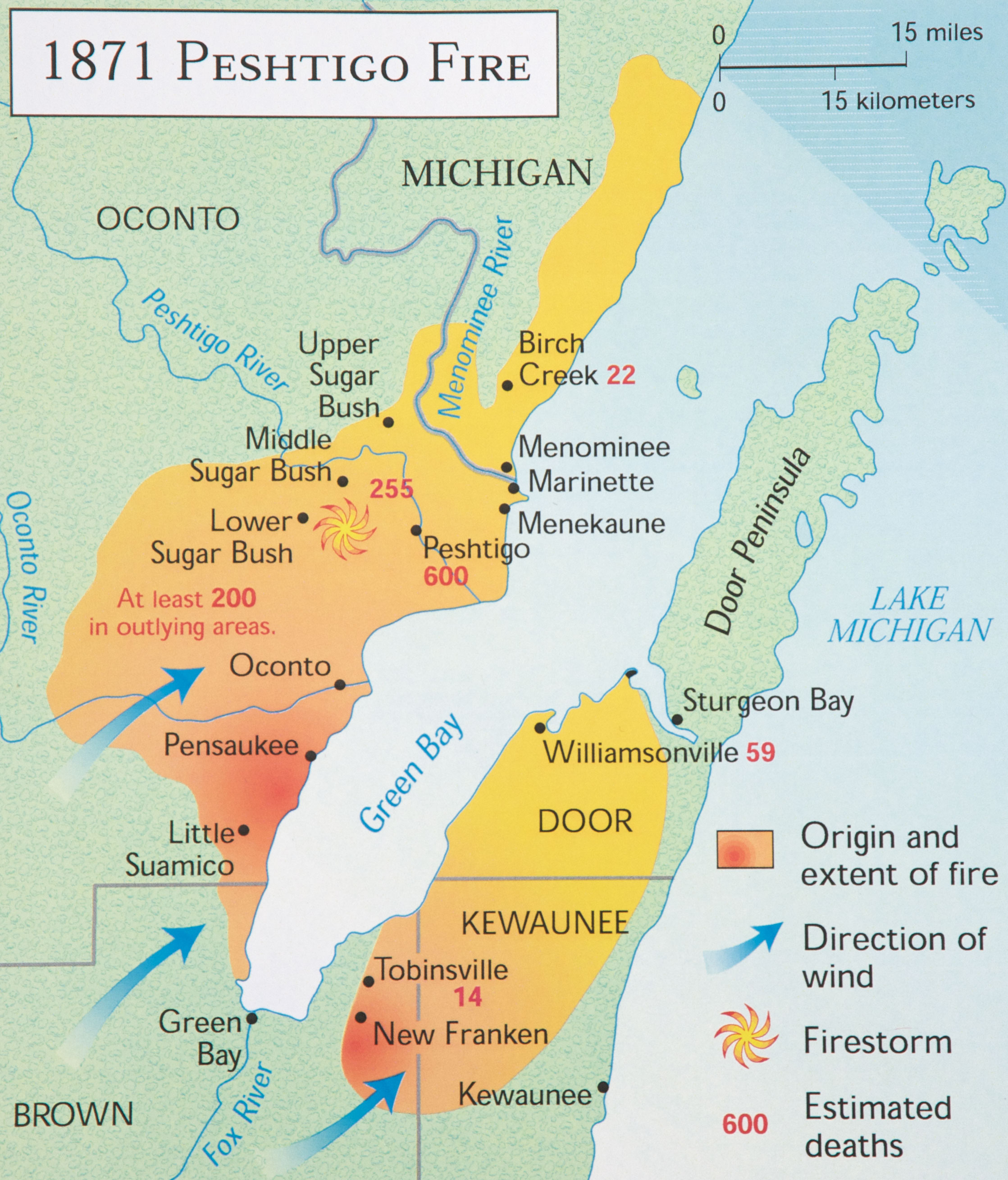
Long, long ago, around 1910, writer Stewart Holbrook met John Cameron, an old logger who had many stories to tell.  Cameron had witnessed the great fire at Peshtigo, Wisconsin (map) which began on October 8, 1871.  The town was a booming metropolis of 2,000 souls on the banks of the mighty Peshtigo River, and a hub for enterprises related to forest mining and wood products.

There had been little snow the previous winter, and just one rain between May and September.  Streams were shallow, and swamps were drying up.  Logging operations left large amounts of slash in the woods (piles of discarded limbs and branches).  Slash piles were eliminated by burning, even when it was very hot, dry, windy, and stupid.  Sparks and cinders would float off the huge bonfires onto a tinder dry landscape, where they frequently ignited other fires.  At Peshtigo, there had been small forest fires in the area during the preceding weeks, but these were commonplace, nobody worried.

The morning of October 8 was hotter than anyone could remember, and the air was deadly still.  At noon, the sun disappeared.  By nightfall the horizon was red, and smoke was in the air, making their eyes run.  At 9 P.M., Cameron heard an unusual roaring sound.  The night sky was getting lighter by the minute.  A hurricane force wind howled through.  Suddenly, swirling slabs of flames were hurtling out of nowhere and hitting the dry sawdust streets.

In a flash, Peshtigo was blazing — maybe five minutes.  The firestorm roared like Niagara Falls.  It was a seething, searing hell.  Forty people sought shelter in a (wooden) company boarding house, where they were promptly incinerated.  Others ran to the bridge, where they met a mob fleeing from the other side, as the bridge burst into flames.

Holbrook wrote that Cameron and others “saw things they never forgot.  Never.  They saw horses and cattle, yes, and men and women, stagger a brief moment over the smoking sawdust streets, then go down to burn brightly like so many flares of pitch-pine.  Forty years afterward, [Cameron’s] voice choked as he told of watching pretty Helga Rockstad as she ran down a blazing sidewalk, her blond hair streaming, and of seeing the long blond hair leap into flame that stopped Helga in her tracks.  Looking at the spot the next morning, he found two nickel garter buckles and a little mound of white-gray ash.”

The river was the safest place that night.  People kept their heads underwater as much as possible, so the great sheets of flame wouldn’t set their heads on fire.  Flaming logs floated down the river into the crowd.  Within an hour, the town was vaporized.  Big lumberjacks were reduced to streaks of ash, enough to fill a thimble.  At least 1,150 died, and 1,280,000 acres (518,000 ha) went up in smoke.

This is a condensed version of how Holbrook described the Peshtigo firestorm in his book, Burning an Empire.  In 1942, Holbrook met an old man who had lived in Peshtigo in 1871.  Before the fire, enormous pines grew close to the tracks between the town and the harbor.  But now there was nothing along the tracks except some brush and reeds.  The fire had erased the ancient forest, and the subsequent fires had destroyed the soil.

Holbrook’s book is a collection of stories describing the great forest fires of North America, from the Miramichi River valley in New Brunswick, Canada in 1825, to the Bandon, Oregon fire of 1936.  Readers learn about other big fires in Minnesota, Wisconsin, Michigan, Oregon, Idaho, and Montana.

The Peshtigo fire gets little attention in our history, because October 8, 1871 was also the date that Mrs. O’Leary’s cow knocked over a lantern, igniting the great fire of Chicago, a city made of wood.  Five times more people died in the Peshtigo fire, but Chicago was a major U.S. town.  Its fire destroyed more than 17,000 structures.  Also on October 8, 1871, numerous big fires raged across the state of Michigan, where it had not rained in two months.  These fires destroyed 2.5 million acres (1 million ha) — three times more timberland than Peshtigo.

Nobody knows how the Peshtigo fire started.  The sparks that ignited the firestorm may have come from twenty different fires.  While loggers were often blamed for triggering infernos, settlers were equally careless, and lit far more fires.  The Homestead Act provided land to anyone who would clear it and build a shack.  The quick and easy way for a settler to clear the trees was to start a fire.  Billions of feet of timber were simply burned.

Year after year, across the nation, clearing fires burned unattended throughout every summer and fall, causing far more damage than the mighty firestorms — “these friendly little blazes were burning an empire.”  Not surprisingly, this was an era of countless forest fires.  For example, in just the state of Wisconsin, tremendous fires destroyed huge areas in 1871, 1880, 1891, 1894, 1897, 1908, 1910, 1923, 1931, 1936.

The granddaddy of ecology was George Perkins Marsh.  In his 1864 masterpiece, Man and Nature*, he described how forests kept the land cooler in summer and warmer in winter.  Forests absorbed and conserved moisture.  When they were cleared, springs dried up, water tables fell, and rivers became more shallow and narrow.  Today, the Amazon Basin is painfully discovering the link between deforestation and severe drought.

Holbrook was an outstanding storyteller, a joy to read.  But he was the son of a logger, and he worked as a logger when young.  He witnessed the great fire at Tillamook, Oregon in 1933, and he later oversaw fire prevention efforts in the state of Washington.  I doubt he read Marsh.  Holbrook noted that during the logging binge in Minnesota, water tables dropped, and lake levels were up to eight feet lower.  He thought that this was the result of excessive swamp draining.

He didn’t understand that deforestation and drought are directly related.  He blamed the great fires on human carelessness.  Between 1933 and 1937, fires burned an average of 36 million acres (14m ha) each year in the U.S., and only eight percent were caused by lightning.  Today, progress, carelessness, and arson continue to be, by far, the primary cause of fires.

Holbrook was a proud American.  He admired growth and prosperity.  The timber industry was cool, except for its fire booboos.  He didn’t think like an environmental historian, who would perceive deforestation itself to be an act of carelessness.  He wrote, “Cutting a forest does not destroy it.”  Twenty-first century ecologists would never say that, because forests are far more complex than just a bunch of trees.  Nor would they endorse aggressive fire suppression, as Holbrook did.

Importantly, Holbrook reminds us about what life was like in simpler times.  At Peshtigo, there was no railroad line to the outer world, only a six-mile track from town to the harbor.  Prior to the fire, the telegraph line to the outer world had been cut by an earlier fire.  They had no radio, telephones, or internet.  They had no automobiles, fire engines, or water bomber airplanes. 

In the coming decades, as we move beyond the cheap energy bubble, the world is going to return to a similar state of simplicity, one way or another.  At the same time, climate change and foolishness are going to weaken or eliminate many of the forests alive today.  We live in interesting times.  Be careful with matches!

Holbrook, Stewart H., Burning an Empire, Macmillan Company, New York, 1943.

*George Perkins Marsh’s book, Man and Nature, is a free download away.  A scanned version (huge file) can be downloaded from here.  Amazon offers a free Kindle download (tiny file) of the 1874 edition, The Earth as Modified by Human Action, here.  Free software for reading Kindle books on your computer, tablet or phone can be downloaded (click the link below the book cover).

Saturday, March 28, 2015

Deforesting the Earth


Michael Williams’ book, Deforesting the Earth, describes humankind’s 10,000 year raid on the planet’s forest cover.  Readers are taken on a world tour of deforestation through the ages.  Ports of call include Greece, Rome, China, India, the Amazon, and others.  We discover the regional variations of forest mining, from the first frontier clearings to the lumber guzzling industrial societies.

The saga of the forest molesters begins in the Stone Age, on an embryonic scale.  Many imagine that all Native Americans lived in perfect harmony from the dawn of time.  Compared to the white colonists, they indeed lived far lighter, but many tribes altered their ecosystems over time via periodic burning, which prevented forest regeneration.  They left some footprints on the land.

In the Old World, the experiment in agriculture had been thrashing soils and forests for centuries.  But in America, many imagine that similar slash-and-burn techniques somehow caused no injuries.  Williams disagreed.  He described extensive deforestation and soil depletion in corn country.  Note that large-scale agriculture in the eastern U.S. was just 500 years old in 1492, and they lacked metal axes, plows, and draft animals.  In Mexico, where large-scale farming existed since 2000 B.C., there was abundant evidence of serious damage — bigger footprints.

Our dependence on wood makes Homo sapiens an unusual species.  Without the warmth provided by burning wood, our ancestors could have never left the tropics.  Deforestation was civilization’s shadow.  Until the temporary blip of fossil energy, wood was our oil.  Wood enabled the manufacture of metals, bricks, mortar, glass, and ceramics.  It enabled long-term survival in snow country.

The Mayans, Aztecs, and Incas developed big bloody empires without plows, iron tools, or domesticated herd animals — but deforestation kept them on life support.  Gold, silver, diamonds, and iron were not necessary for becoming victorious conquerors, but the march to domination required food, water, and wood.

In medieval Europe, the new religion had driven a wedge between humans and nature.  Earth was created for us.  We were partners with God, and our job was to put the finishing touches on creation.  “A wild landscape not hallowed by prayer and asceticism was said to be in a state of original sin, but once it has become fertile and purposeful, it was transformed.”  So, the forests had to go, along with the savages and outlaws that lurked within them.

In theory, wood is renewable.  Societies with light footprints didn’t kill trees; they gathered dead wood instead.  For rising civilizations, on the other hand, wood was more like pure crystal meth.  When you had access to it, life was a fantastic amazing rush.  You built ships, cities, fortresses, temples, trade networks.  But when the wood was gone, you were a burned out, toothless, walking dead tweaker.

Wood addiction was a vicious cycle.  Deforestation led to expanded cropland and pasture, which led to growing population, which led to further deforestation, and so on.  Eventually, the Ponzi scheme encountered limits.  Endless growth is impossible.  Simple societies that saw their forest as sacred were helpless sitting ducks for loony societies possessed by an insatiable addiction to wood and wealth.  Why practice enlightened self-restraint when you can grow like crazy?

Forests are finite.  Perpetual deforestation is impossible, as they discovered on Easter Island.  Today, it’s growing at an exponential rate.  Listen to this: we’ve cleared more forest since 1950 than in all previous time, and the extermination continues.  Consumers encourage rainforest destruction by buying pet food, fast food burgers, soy-based products, foods containing palm oil, and so on.

Williams mentioned the winter of 1695, when the king of France sat at his dinner table, bundled in furs, his glass filled with frozen wine.  Before iron stoves, heating was extremely inefficient.  The metropolis of Paris was importing firewood from up to 200 kilometers away (124 miles).  In the winter of 1709, wood was scarce, and “people died like flies.”

At about this time, folks began seriously fooling around with coal, a nonrenewable source of energy.  Before long, coal became the new meth.  It threw open the doors to the Industrial Revolution, and a new vicious cycle of exponential growth and resource depletion.  Two hundred years later, we slipped into the petroleum nightmare, civilization went viral, and we are now skyrocketing toward bad juju oblivion.

Previously, I thought that the biggest impact of riding the downslope from Peak Energy was the transition to muscle-powered agriculture, a massive shift that we are entirely unprepared for.  But what about heating?  In 1695, when the king’s wine froze, the planet’s population was just 600 million.  Today, there is far less forest and far more people.  Today, almost half of humankind uses wood for heating and cooking, and they are burning twice as much as 20 years ago.  Imagine the day when wood is the only source of heat for Boston or Chicago, and the chainsaws, trucks, and trains are rusting in the snow.

Williams’ book is a grand banquet of information.  Readers get to spend many hours studying charts, graphs, and tables of statistics, observing reality through the mind of a geographer.  He described how, why, and when the long process of deforestation has proceeded, but paid little attention to the ecological impacts of forest clearing.  He advocated conservation, based on wise management.  The rate of cutting should not exceed the rate at which new wood grows.  Therefore, efforts to preserve old growth ecosystems were dumb, because mature trees grow slower than young ones.

Williams disliked critics of deforestation.  Those youngsters were feeble-minded alarmists who spewed exaggerated hysteria — obnoxious eco-fascists determined to make our lives miserable.  For him, deforestation was a necessary evil, “In fact, the clearing of the forest… over much of western and central Europe was one of the most dramatic changes made to human landscapes anywhere and can be regarded as one of the great achievements of the medieval age.”

Williams was born in 1935, and grew up during the zenith of the British Empire, the petroleum blip, the high tech revolution, and the population explosion — an era of staggering chaos.  Yes, deforestation was a bummer, but it was a sacrifice required for our joyride to wonderland.  Like the worldview of the dominant culture in which he was raised, the book vibrates with cognitive dissonance.  Our advanced standard of living must be preserved, at any cost, for as long as possible, by any means necessary.

Reading the book with ecology-tinted glasses is most illuminating.  It describes a chain reaction of catastrophic mistakes, made with good intentions, spanning thousands of years — mistakes that continue to multiply at a head spinning rate.  We are given a detailed map of the path we took to disaster, including the wrong turns.  We can never comprehend genuine sustainability until we identify and understand the mistakes.  We must discover our history.

Immense imagination is needed to elevate our consciousness far above the reeking cesspool of pathological illusions.  There may come a day, after the storms, when we have a chance to start over again.  How could we do it differently — and wisely — next time around?  It’s time for good people with hearts and creative gifts to contemplate these issues.  It’s time for new lessons, stories, songs, and paintings.  It’s time to remember who we are, and come home.

Williams provided a vital clue.  “If sustainable societies existed, then they depended on very low population densities, abundance of land, and little or no involvement in a market economy, local or regional, all of which were rare.”  I agree.

P.S., I also recommend John Perlin’s book, A Forest Journey.

Williams, Michael, Deforesting the Earth — From Prehistory to Global Crisis, University of Chicago Press, Chicago, 2006.