Showing posts with label logging. Show all posts

Monday, November 7, 2022

Finding the Mother Tree


Suzanne Simard wrote an unforgettable book, Finding the Mother Tree.  She was born and raised in the rainforests of British Columbia, and is now a professor of forest ecology.  Her grandfather was a logger who worked back in the low-tech days, when the industry ran on manpower, horsepower, and waterpower. 

At age 20, Simard’s first job was with a logging company.  By that time, the industry was using fossil powered machines — chainsaws, bulldozers, skidders, loaders, trucks, etc.  Selective cutting was being replaced by devastating clear-cuts.

At age 23, she was hired to do research for the British Columbia Forest Service.  They wanted to determine the most effective way to plant seedlings on a clear-cut site.  Government regulations required “free to grow” stocking.  So, prior to planting, herbicides were sprayed to exterminate natural plant life.  Only the moneymaking seedlings were free to grow.

In those days, much of what is now known about forest biology had not yet been discovered.  Consequently, standard industry practices were often based on a blind faith in unproven assumptions.  This wasted a lot of money, and unnecessarily damaged the ecosystem.  The most important business goal was to maximize short-term profits. 

Simard preferred critical thinking to blind faith, and she asked questions that the good old boys never considered.  Vital clues can often be very hard to see.  She paid close attention to the incredibly intricate ways in which forests function.  “My instinct has always been to listen to what living things were saying.”

One of her assignments was to investigate a mysterious situation.  A number of clear-cut sites had been planted with seedlings, and none were healthy.  Plantation after plantation was dying.  She found that all of them had been planted exactly as the rules required.  Seedling roots had to be inserted in mineral soil (sand, silt, clay) because it retained more water and supposedly boosted survival.  Rules prohibited inserting seedling roots in humus.  Humus is a nutrient-rich component of topsoil in old growth forests.  It’s loaded with fungi, worms, bugs, and decomposed organic material. 

Simard noticed that in the dying plantations, seedlings were failing to produce healthy root systems.  On the other hand, in nearby uncontrolled natural woodland, mature trees dropped seeds from which young trees sprouted.  The youngsters grew in humus, and they developed fantastically extensive root systems, intertwined with dense mats of yellow, white, and pink fungi.  This was a crucial discovery! 

So, she created an experimental plantation.  Half of the seedlings were planted in mineral soil (all died), and the other half in humus (all thrived).  Ongoing research confirmed her suspicion that healthy fungi networks were essential for the survival of healthy forests.  Very important!

Industry traditions perceived that the fundamental force of nature was competition — survival of the fittest.  So, industrial forestry was a game of nurturing the most valuable trees, and obliterating everything else.  The downside of this belief was that it was remarkably counterproductive in the real world.

Industry traditions believed that low value alders could reduce the vitality of high value lodgepole pines.  So, alders were chopped down.  Actually, pines loved alder, because alders transformed nitrogen into ammonium, a potent fertilizer that pine roots absorbed via the fungal networks.  Pines not growing near alders were more vulnerable to pine beetles that bored into their bark.  A fungus carried on beetle legs infected the pines, and it prevented water from flowing upward in the trees.  Countless pines died of thirst.

Industry traditions declared birches to be low value junk trees, because they were thought to slow the growth of high value Douglas firs.  Large birch leaves performed more photosynthesis than fir needles, so they were able to convert more sunbeam energy into chemical energy — sugar and other carbs.  As birch foliage expanded, fewer sunbeams could reach the firs.

Birches stored surplus carbs in their roots, where networks of fungi allowed fir trees to tap into it.  The more shade the birch cast, the more sugar it shared with the fir.  Simard eventually realized that this relationship was not a problem.  It was beneficial.  They were working together, like a system.  Healthy birches promoted healthy firs.

She wrote, “Fir can’t survive without birch due to the high risk of infection from Armillaria, and birch can’t survive in the long run without fir because too much nitrogen would accumulate in the soil, causing the soil to acidify.”  When firs are grown alone, up to a third are killed by a root disease. 

In one experiment, Simard grew birch and fir trees together in some stands.  In other stands, firs were grown without birches.  Twenty-one years later, the forest where birch and fir had been grown together had almost twice the productivity of stands with no birches.

The findings of Simard’s research inspired doubts about the validity of some traditions.  She began to suspect that the real life force of forest ecosystems was more like cooperation.  Over time, diverse communities of forest dwelling species apparently coevolved ways of establishing mutually beneficial win/win relationships.  Year after year, her experiments confirmed these suspicions.

She suspected that networks of fungi played a major role in this magic act.  Seeking evidence, she designed experiments to discover how nutrients and moisture were transferred from one tree to another.  This involved using carbon isotopes as tracers, unique identification tags.

The C-12 isotope is natural, C-13 is unnatural but not radioactive, and C-14 is unnatural and radioactive.  Simard inserted C-14 into birch leaves, expecting to find that it flowed into Douglas firs.  It did!  She inserted C-13 into the firs to see if nutrients also flowed from fir to birch.  They did!

When trees are able to intermingle with neighboring trees, they develop lots of beneficial fungi interconnections.  There may be more than 100 species of fungi in a forest.  Some retrieve phosphorus from humus.  Others retrieve nitrogen from decaying wood.  Some carry water.  Others send or receive sugar.  The function of most fungi is unknown.

Simard found that giant trees played an especially important role in healthy forests.  She called them Mother Trees because they nurtured others.  Fires generally roasted understory vegetation, while the taller overstory trees were more likely to survive.  Their bigger crowns captured more sunbeams and produced more carbs.  Larger trees shared their surplus carbs with nearby smaller trees, including those of other species.  Young trees might grow for decades in the shadows. 

Some of the seeds dropped by Mother Trees remain nearby, germinate, and emerge as young trees.  Mothers seem to recognize their genetic offspring, and give them top priority when sharing nutrients.  Unrelated trees, and trees of different species, also receive gifts from Mother Trees.  There seemed to be something like tree to tree communication.  Simard studied a stand of Douglas fir.  Fungi networks connected the older trees to all of the younger trees around them.  Some were as far as 20 meters away (22 yards). 

Simard’s book is a chatty discussion of her life, work, and family.  Its target audience is forestry students, and industry professionals.  Her unconventional ideas remained controversial for a number of years.  Today, her work has been peer reviewed, and is widely accepted.

General readers (like me) will stumble into the unfamiliar names of many plant and fungi species.  I didn’t know the meanings of “mycorrhiza” and “mycelium.”  Both are important categories of fungi species. 

The relationship between mycorrhizal fungi and living trees enabled the survival of both.  Fungi contributed water and soil nutrients to the tree roots.  In return, tree roots provided the fungi with carbs produced by photosynthesis.

Peter Wohlleben fondly described mycelium, the largest living organisms yet discovered.  One in Oregon weighs 660 tons, covers 2,000 acres (800 ha), and is 2,400 years old.  They provide trees with water, nitrogen, and phosphorus — in exchange for sugar and other carbs.

Around the world today, relentless industrial scale forest mining is causing far more catastrophic destruction than ever before.  The global economy has no plans to slam on the brakes.  Humankind demands unlimited lumber, paper products, firewood, etc.  We will eventually win the War on Forests — an idiotic Pyrrhic victory.  My short overview on the history of deforestation is HERE.

Simard, Suzanne, Finding the Mother Tree, Random House, New York, 2021.  


Monday, March 29, 2021

Bright Green Lies


In an era when the info stream is running heavy on conspiracy theories, fake news, and balderdash, it’s not unusual to come across stories of green energy miracles.  For example, we might see that a progressive country somewhere overseas is now almost entirely running on wind or solar energy.  Oh, really?  In this era of deceptive “news” releases, truth can be a slippery rascal.

Bright green environmentalism is a mindset that has big hopes for a brighter future, and strongly advocates renewable energy.  Their primary interest is preserving our luxurious high-impact lifestyle and mega-profitable economy, while (hopefully) lightening our eco-footprint a wee bit, allowing us to feel slightly less uncomfortable.

The cat is out of the bag with regard to approaching fossil energy limits and the Climate Crisis.  The bad old-fashioned way of living has become unhip and embarrassing.  It has to go.  Bright green is a brilliant marketing strategy.  Look!  Here’s a new and improved way of living in the fast lane that’s friendly to the birds and trees!  It’s great for the economy, and it’s great for the planet!  Imagine that!  How totally cool!  (Um, the inconvenient truth here is that, no matter how hard we wish, we can’t have both industrial civilization and a living planet.)

Derrick Jensen, Lierre Keith, and Max Wilbert are the authors of Bright Green Lies, which enthusiastically reveals all the kinky and creepy aspects of the bright green cult.  The three wordsmiths are apostles of a gospel called Deep Green Resistance, which passionately advocates defending the living world, to the highest degree possible, without delay.  (“No, that doesn’t mean killing all humans.  That means changing our lifestyle dramatically.”)  OK!

Once I made it across the border into chapter three, I suddenly became extremely excited!  I found myself exploring a fascinating, in-depth “birds and bees” discussion of the unfortunate realities, drawbacks, and limitations of alternative energy — lots of stuff they never taught me in school (and I wish they were teaching now).

My Admiral TV was made in 1946.  It doesn’t have a screen the size of a barn door.  I’ve never seen it work.  Watching a dead TV is boring.  Reading is a lot more interesting.  When you spend 25 to 30 years studying ecology, anthropology, and environmental history, you can learn a lot of stuff that mainstream folks don’t know — stuff more important than football scores, soap operas, game shows, celebrity shenanigans, and so on.

Folks who have working TVs, and thousands of channels, are often very well informed about countless subjects that are not especially important.  They are unlikely to be up to date on difficulties of lithium recycling, or why Big Mama Nature loathes and despises notorious bright green billionaires, or why the electric grid is so poorly designed for effectively distributing renewable energy that is intermittent, unpredictable, hard to control, and a pain in the ass.

They are likely to be blissfully ignorant about most of the countless eco-impacts of their consumer lifestyles.  The view outside their picture window is not strip mines, clear-cuts, forest fires, methane craters, oil fields, toxic spills, chemical plants, and landfills.  Out of sight, out of mind.  Most importantly, they are unlikely to understand why running today’s industrial civilization entirely on renewable energy is absolutely impossible, and why attempting a transition would provide little or no benefit — but a lot more damage to the planet.

Of course, everyone remembers William Jevons, who discovered something very strange in 1865.  In those days, the steam engine industry was making big gains in efficiency.  More work could be done with less coal.  Instead of reducing coal mining, demand for coal increased, because it was the greedy and profitable thing to do.  Jevon’s Paradox asserts, “Increased efficiency not only doesn’t generally reduce demand, but instead increases it.”

Bright greens still dance to the Jevon’s boogie.  Richard York, a University of Oregon wizard, studied data from 128 nations, and found that for every unit of “green” power brought online, only one-tenth as much fossil fuel was taken offline.  “Industrial civilization requires industrial levels of energy, and fossil fuel is functionally irreplaceable.”  Electric cars can’t be made without it.  Nor can wind turbines, solar panels, planes, ships, concrete, cell phones, etc.  Oil is incredibly energy dense.

Solar power pauses for sunset or clouds, sometimes for days.  Wind turbines take a nap when it’s calm, sometimes for days.  Meanwhile, demand for electricity expects the grid to always provide our every need immediately, and demand can surge without warning.  This means that a conventional generation system (typically fossil powered) must constantly be kept running on standby, to immediately feed the grid when clouds pass, breezes calm, or demand suddenly spikes.  Brilliant, eh?

While coal or oil is energy that can be stored for millions of years, the grid delivers alternating current (AC) electricity, which is impossible to store — use it or lose it.  Batteries can store direct current (DC) electricity, but high capacity utility-scale batteries are not in common use.  There are other ways of storing energy, like hydro-electric dams, pumped hydro, compressed air, thermal, etc.  These can be used in unique locations, not everywhere.  Bottom line: “The grid was not built for renewables.”  Therefore, a new fantastically expensive state of the art grid is needed.

No storage systems are made of harmless green fairy dust.  All require a fossil energy powered industrial civilization.  In the world of batteries, lithium-ion is the most efficient.  Elon Musk is working hard to design and build lithium batteries for cars, homes, and industrial scale power storage.  Exponential growth in demand for lithium is predicted into the late 2020s and 2030s. 

Some fear that staggering demand for lithium could drive prices into the stratosphere, and close the gate to a beautiful green utopia.  Even worse, some predict that “not enough economically recoverable lithium exists to build anywhere near the number of batteries needed in a global electric-vehicle economy.”  This also applies to other gizmos that require lithium.  Oh-oh!

As a special bonus, readers are also taken on a naughty and exciting tour behind the curtains, to get a shocking peek at the steamy world of hardcore geology porn.  In addition to a long list of conventional minerals, “green” energy hardware requires exotic minerals, like lithium and rare earth metals, which are found in limited locations, and are not easy or “green” to mine.  The mining industry excels at creating enduring, toxic, eco-catastrophes.

The book explores a number of other subjects — power distribution grids, hydropower, recycling, green cities, biofuels, geothermal, and so on.  Near the end are 28 pages of “solutions,” all of which consumer society has zero interest in.  Consumer society wants to survive and grow until the planet can no longer breathe.  The authors suggest a more interesting path.

Put the plows away forever and bring back the grasslands, via holistic management (beneficial grazing).  Before long, the recovery of healthy wild vegetation will suck the excess carbon out of the air, and turn some of it into organic grass-fed meat.  Grass will save our ass!  Deal with overpopulation and extinctions.  Eliminate carbon emissions in five years.  Remove five dams per day and stop building new ones.  End logging.  And on and on.  In short, end the destruction, let the Earth heal.  Make America Walk Again.

Jensen has spoken to many audiences over 20+ years.  He asks each group the same question.  “Do you think this culture will undergo a voluntary transformation to a sane and sustainable society?”  No one has ever said yes.  This is exactly the point of his extreme recommendations.  There is no solution that leaves our way of life intact.  Our way of life has some really big issues.  This book will help you better understand some of them.  I liked it.


Jensen, Derrick, Lierre Keith, and Max Wilbert, Bright Green Lies, Monkfish Publishing, Rhinebeck, New York, 2021.  


Monday, September 26, 2016

The Hidden Life of Trees


As a young lad in Germany, Peter Wohlleben loved nature.  He went to forestry school, and became a wood ranger.  At this job, he was expected to produce as many high quality saw logs as possible, with maximum efficiency, by any means necessary.  His tool kit included heavy machinery and pesticides.  This was forest mining, an enterprise that ravaged the forest ecosystem and had no long-term future.  He oversaw a plantation of trees lined up in straight rows, evenly spaced.  It was a concentration camp for tree people.

Wohlleben is a smart and sensitive man, and over the course of decades he got to know the tree people very well.  Eventually, his job became unbearable.  Luckily, he made friends in the community of Hümmel, and was given permission to manage their forest in a less destructive manner.  There is no more clear-cutting, and logs are removed by horse teams, not machines.  In one portion of the forest, old trees are leased as living gravestones, where families can bury the ashes of kin.  In this way, the forest generates income without murdering trees.

Wohlleben wrote The Hidden Life of Trees, a smash hit in Germany.  It will be translated into 19 languages.  The book is built on a foundation of reputable science, but it reads like grandpa chatting at fireside.  He’s a gentle old storyteller explaining the wondrous magic of beautiful forests to befuddled space aliens from a crazy planet named Consume.  He teaches readers about the family of life, a subject typically neglected in schools.

Evergreen trees have been around for 170 million years, and trees with leaves are 100 million years old.  Until recently, trees lived very well without the assistance of a single professional forest manager.  I’m serious!  Forests are communities of tree people.  Their root systems intermingle, allowing them to send nutrients to their hungry children, and to ailing neighbors.  When a Douglas fir is struck by lightning, several of its close neighbors might also die, because of their underground connections.  A tribe of tree people can create a beneficial local climate for the community.

Also underground are mycelium, the largest organisms yet discovered.  One in Oregon weighs 660 tons, covers 2,000 acres (800 ha), and is 2,400 years old.  They are fungi that send threads throughout the forest soil.  The threads penetrate and wrap around tree roots.  They provide trees with water, nitrogen, and phosphorus, in exchange for sugar and other carbohydrates.  They discourage attacks from harmful fungi and bacteria, and they filter out heavy metals.

When a limb breaks off, unwelcome fungal spores arrive minutes later.  If the tree can close off the open wound in less than five years, the fungi won’t survive.  If the wound is too large, the fungi can cause destructive rot, possibly killing the tree.  When a gang of badass beetles invades, the tree secretes toxic compounds, and sends warnings to other trees via scent messages, and underground electrical signals.  Woodpeckers and friendly beetles attack the troublemakers.

Forests exist in a state of continuous change, but this is hard for us to see, because trees live much slower than we do.  They almost appear to be frozen in time.  Humans zoom through life like hamsters frantically galloping on treadmills, and we blink out in just a few decades.  In Sweden, scientists studied a spruce that appeared to be about 500 years old.  They were surprised to learn that it was growing from a root system that was 9,550 years old.

In Switzerland, construction workers uncovered stumps of trees that didn’t look very old.  Scientists examined them and discovered that they belonged to pines that lived 14,000 years ago.  Analyzing the rings of their trunks, they learned that the pines had survived a climate that warmed 42°F, and then cooled about the same amount — in a period of just 30 years!  This is the equivalent of our worst-case projections today.

Dinosaurs still exist in the form of birds, winged creatures that can quickly escape from hostile conditions.  Trees can’t fly, but they can migrate, slowly.  When the climate cools, they move south.  When it warms, they go north, like they are today — because of global warming, and because they continue to adapt to the end of the last ice age.  A strong wind can carry winged seeds a mile.  Birds can carry seeds several miles.  A beech tree tribe can advance about a quarter mile per year (0.4 km).

Compared to trees, the human genome has little variation.  We are like seven-point-something billion Barbie and Ken dolls.  Tree genomes are extremely diverse, and this is key for their survival.  Some trees are more drought tolerant, others are better with cold or moisture.  So change that kills some is less likely to kill all.  Wohlleben suspects that his beech forest will survive, as long as forest miners don’t wreck its soil or microclimate.  (Far more questionable is the future of corn, wheat, and rice, whose genetic diversity has been sharply reduced by the seed sellers of industrial agriculture.)

Trees have amazing adaptations to avoid inbreeding.  Winds and bees deliver pollen from distant trees.  The ovaries of bird cherry trees reject pollen from male blossoms on the same tree.  Willows have separate male trees and female trees.  Spruces have male and female blossoms, but they open several days apart.

Boars and deer love to devour acorns and beechnuts.  Feasting on nuts allows them to put on fat for the winter.  To avoid turning these animals into habitual parasites, nuts are not produced every year.  This limits the population of chubby nutters, and ensures that some seeds will survive and germinate.  If a beech lives 400 years, it will drop 1.8 million nuts.

On deciduous trees, leaves are solar panels.  They unfold in the spring, capture sunlight, and for several months manufacture sugar, cellulose, and other carbohydrates.  When the tree can store no more sugar, or when the first hard frost arrives, the solar panels are no longer needed.  Their chlorophyll is drained, and will be recycled next spring.  Leaves fall to the ground and return to humus.  The tree goes into hibernation, spending the winter surviving on stored sugar.  Now, with bare branches, the tree is far less vulnerable to damage from strong winds, heavy wet snows, and ice storms.

In addition to rotting leaves, a wild forest also transforms fallen branches and trunks into carbon rich humus.  Year after year, the topsoil becomes deeper, healthier, and more fertile.  Tree plantations, on the other hand, send the trunks to saw mills.  So, every year, tons of precious biomass are shipped away, to planet Consume.  This depletes soil fertility, and encourages erosion.  Plantation trees are more vulnerable to insects and diseases.  Because their root systems never develop normally, the trees are more likely to blow down.

From cover to cover, the book presents fascinating observations.  By the end, readers are likely to imagine that undisturbed forests are vastly more intelligent than severely disturbed communities of radicalized consumers.  More and more, scientists are muttering and snarling, as the imaginary gulf between the plant and animal worlds fades away.  Wohlleben is not a vegetarian, because experience has taught him that plants are no less alive, intelligent, and sacred than animals.  It’s a wonderful book.  I’m serious!

Wohlleben, Peter, The Hidden Life of Trees — What They Feel, How They Communicate, Greystone Books, Berkeley, 2016. 

Thursday, May 12, 2016

Burning an Empire


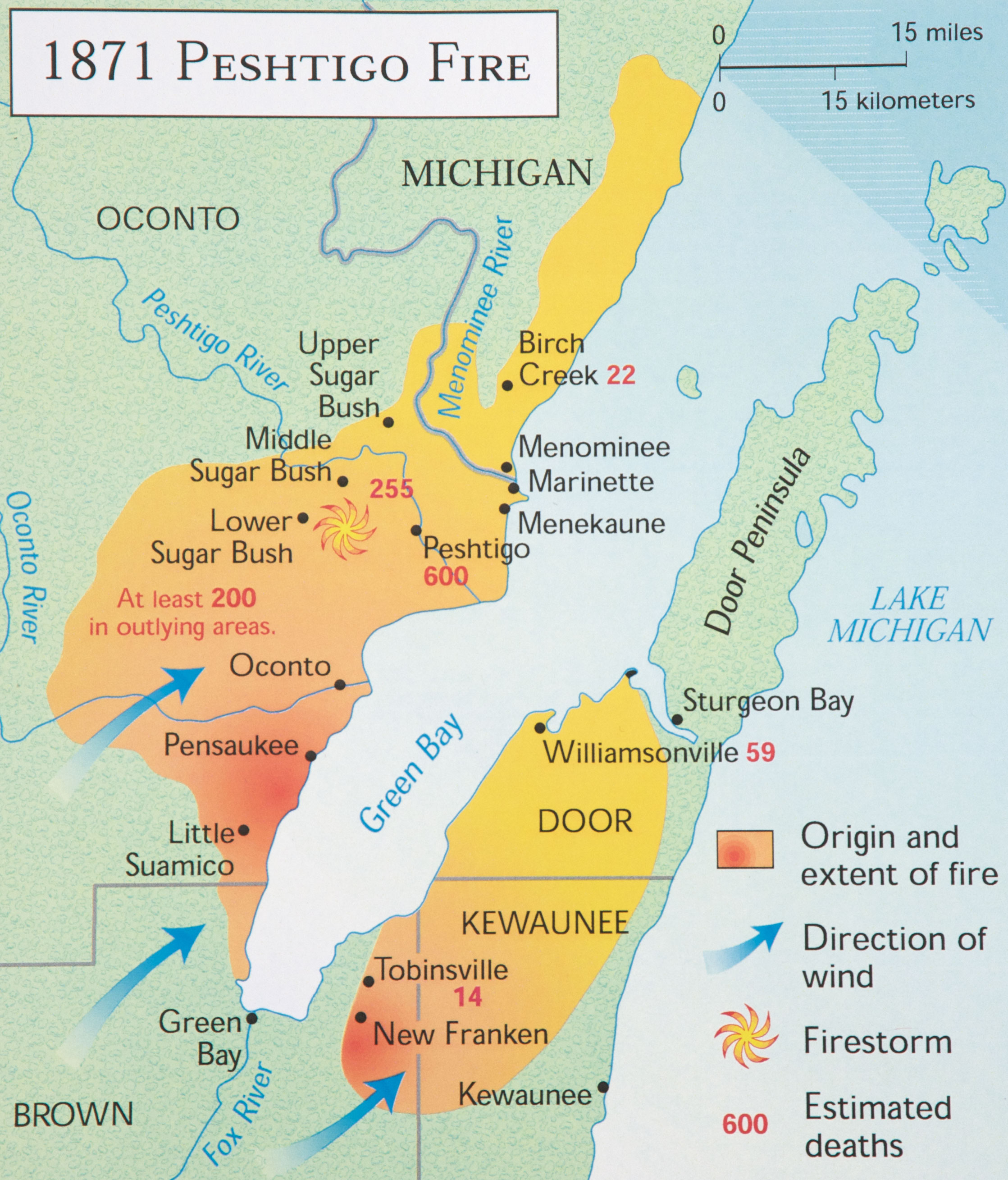
Long, long ago, around 1910, writer Stewart Holbrook met John Cameron, an old logger who had many stories to tell.  Cameron had witnessed the great fire at Peshtigo, Wisconsin (map) which began on October 8, 1871.  The town was a booming metropolis of 2,000 souls on the banks of the mighty Peshtigo River, and a hub for enterprises related to forest mining and wood products.

There had been little snow the previous winter, and just one rain between May and September.  Streams were shallow, and swamps were drying up.  Logging operations left large amounts of slash in the woods (piles of discarded limbs and branches).  Slash piles were eliminated by burning, even when it was very hot, dry, windy, and stupid.  Sparks and cinders would float off the huge bonfires onto a tinder dry landscape, where they frequently ignited other fires.  At Peshtigo, there had been small forest fires in the area during the preceding weeks, but these were commonplace, nobody worried.

The morning of October 8 was hotter than anyone could remember, and the air was deadly still.  At noon, the sun disappeared.  By nightfall the horizon was red, and smoke was in the air, making their eyes run.  At 9 P.M., Cameron heard an unusual roaring sound.  The night sky was getting lighter by the minute.  A hurricane force wind howled through.  Suddenly, swirling slabs of flames were hurtling out of nowhere and hitting the dry sawdust streets.

In a flash, Peshtigo was blazing — maybe five minutes.  The firestorm roared like Niagara Falls.  It was a seething, searing hell.  Forty people sought shelter in a (wooden) company boarding house, where they were promptly incinerated.  Others ran to the bridge, where they met a mob fleeing from the other side, as the bridge burst into flames.

Holbrook wrote that Cameron and others “saw things they never forgot.  Never.  They saw horses and cattle, yes, and men and women, stagger a brief moment over the smoking sawdust streets, then go down to burn brightly like so many flares of pitch-pine.  Forty years afterward, [Cameron’s] voice choked as he told of watching pretty Helga Rockstad as she ran down a blazing sidewalk, her blond hair streaming, and of seeing the long blond hair leap into flame that stopped Helga in her tracks.  Looking at the spot the next morning, he found two nickel garter buckles and a little mound of white-gray ash.”

The river was the safest place that night.  People kept their heads underwater as much as possible, so the great sheets of flame wouldn’t set their heads on fire.  Flaming logs floated down the river into the crowd.  Within an hour, the town was vaporized.  Big lumberjacks were reduced to streaks of ash, enough to fill a thimble.  At least 1,150 died, and 1,280,000 acres (518,000 ha) went up in smoke.

This is a condensed version of how Holbrook described the Peshtigo firestorm in his book, Burning an Empire.  In 1942, Holbrook met an old man who had lived in Peshtigo in 1871.  Before the fire, enormous pines grew close to the tracks between the town and the harbor.  But now there was nothing along the tracks except some brush and reeds.  The fire had erased the ancient forest, and the subsequent fires had destroyed the soil.

Holbrook’s book is a collection of stories describing the great forest fires of North America, from the Miramichi River valley in New Brunswick, Canada in 1825, to the Bandon, Oregon fire of 1936.  Readers learn about other big fires in Minnesota, Wisconsin, Michigan, Oregon, Idaho, and Montana.

The Peshtigo fire gets little attention in our history, because October 8, 1871 was also the date that Mrs. O’Leary’s cow knocked over a lantern, igniting the great fire of Chicago, a city made of wood.  Five times more people died in the Peshtigo fire, but Chicago was a major U.S. town.  Its fire destroyed more than 17,000 structures.  Also on October 8, 1871, numerous big fires raged across the state of Michigan, where it had not rained in two months.  These fires destroyed 2.5 million acres (1 million ha) — three times more timberland than Peshtigo.

Nobody knows how the Peshtigo fire started.  The sparks that ignited the firestorm may have come from twenty different fires.  While loggers were often blamed for triggering infernos, settlers were equally careless, and lit far more fires.  The Homestead Act provided land to anyone who would clear it and build a shack.  The quick and easy way for a settler to clear the trees was to start a fire.  Billions of feet of timber were simply burned.

Year after year, across the nation, clearing fires burned unattended throughout every summer and fall, causing far more damage than the mighty firestorms — “these friendly little blazes were burning an empire.”  Not surprisingly, this was an era of countless forest fires.  For example, in just the state of Wisconsin, tremendous fires destroyed huge areas in 1871, 1880, 1891, 1894, 1897, 1908, 1910, 1923, 1931, 1936.

The granddaddy of ecology was George Perkins Marsh.  In his 1864 masterpiece, Man and Nature*, he described how forests kept the land cooler in summer and warmer in winter.  Forests absorbed and conserved moisture.  When they were cleared, springs dried up, water tables fell, and rivers became more shallow and narrow.  Today, the Amazon Basin is painfully discovering the link between deforestation and severe drought.

Holbrook was an outstanding storyteller, a joy to read.  But he was the son of a logger, and he worked as a logger when young.  He witnessed the great fire at Tillamook, Oregon in 1933, and he later oversaw fire prevention efforts in the state of Washington.  I doubt he read Marsh.  Holbrook noted that during the logging binge in Minnesota, water tables dropped, and lake levels were up to eight feet lower.  He thought that this was the result of excessive swamp draining.

He didn’t understand that deforestation and drought are directly related.  He blamed the great fires on human carelessness.  Between 1933 and 1937, fires burned an average of 36 million acres (14m ha) each year in the U.S., and only eight percent were caused by lightning.  Today, progress, carelessness, and arson continue to be, by far, the primary cause of fires.

Holbrook was a proud American.  He admired growth and prosperity.  The timber industry was cool, except for its fire booboos.  He didn’t think like an environmental historian, who would perceive deforestation itself to be an act of carelessness.  He wrote, “Cutting a forest does not destroy it.”  Twenty-first century ecologists would never say that, because forests are far more complex than just a bunch of trees.  Nor would they endorse aggressive fire suppression, as Holbrook did.

Importantly, Holbrook reminds us about what life was like in simpler times.  At Peshtigo, there was no railroad line to the outer world, only a six-mile track from town to the harbor.  Prior to the fire, the telegraph line to the outer world had been cut by an earlier fire.  They had no radio, telephones, or internet.  They had no automobiles, fire engines, or water bomber airplanes. 

In the coming decades, as we move beyond the cheap energy bubble, the world is going to return to a similar state of simplicity, one way or another.  At the same time, climate change and foolishness are going to weaken or eliminate many of the forests alive today.  We live in interesting times.  Be careful with matches!

Holbrook, Stewart H., Burning an Empire, Macmillan Company, New York, 1943.

*George Perkins Marsh’s book, Man and Nature, is a free download away.  A scanned version (huge file) can be downloaded from here.  Amazon offers a free Kindle download (tiny file) of the 1874 edition, The Earth as Modified by Human Action, here.  Free software for reading Kindle books on your computer, tablet or phone can be downloaded (click the link below the book cover).

Wednesday, November 25, 2015

Grizzly Years


Doug Peacock grew up in rural northern Michigan.  As a boy, he spent a lot of time alone outdoors, exploring the woods, swamps, and streams.  Later, he fell in love with the West, especially the Rockies.  He enjoyed fishing and rock climbing.  His plan was to become a geologist, so he could wander around in the great outdoors and get paid for it.  But one day he realized that his dream career would likely involve working for oil and mining companies, “whose rape of wild country repelled me.”  Sadly, he abandoned the plan, and volunteered for an exciting job with the U.S. government.

Peacock loved the central highlands of Vietnam.  It was a gorgeous region, inhabited by good people.  Then, the war spread there.  He was employed as a medic in the Green Berets, an elite combat unit.  His job was to provide first aid to injured soldiers and villagers, and the fighting kept him very busy.  He witnessed far too much senseless death, destruction, and suffering, far too many dead children.

By and by, he came down with a devastating case of war rage, which he has been struggling with for most of his life.  Back in American society, it was no longer possible to blend into the crowd, and feel at home.  He couldn’t talk to his family.  He spent a lot of time in the woods, trying to pickle his demons with cheap wine.  Finally, he bought a jeep, and headed west, to pursue two powerful medicines: solitude and wildness.

For American soldiers, Vietnam was not as safe and secure as strolling through a shopping mall.  There were tigers, vipers, snipers, booby traps, and Vietcong.  The odds for survival were boosted by good luck, common sense, being with experienced warriors, remaining as silent and invisible as possible, and maintaining a state of heightened awareness.  Survivors slept lightly, easily awakened by snapping twigs and other irregular sounds.  Survivors developed an acute sense of smell, because an odd whiff could warn of danger.  Survivors frequently stopped, looked, and listened.

Similar skills were useful when moving through grizzly bear country, where Peacock spent many post-war years.  Near the beginning of his wilderness quest, he hiked around a corner and discovered that a large brown grizzly was approaching, and it was not at all happy to see him.  The bear’s head was swinging back and forth, jaws gnashing, ears flattened, hair standing up on his hump — the ritual that precedes charging, mauling, and a bloody hot lunch.

Peacock slowly pulled out his large caliber handgun, had second thoughts, and lowered it.  His shooting days were over.  He was ready to die.  Something happened, the energy changed.  “The grizzly slowly turned away from me with grace and dignity and swung into the timber at the end of the meadow.”  It was a life-changing experience.  He became a grizzly tracker.  He acquired a movie camera and began filming them.  He did winter lecture tours, wrote about bears, and told his story in Grizzly Years.

Importantly, the book reminds us of a forgotten reality, living in wild country amidst man-eating predators — the normal everyday reality for our wild ancestors, whose genes we inherited.  Outside my window each morning, the blue jays stop by for a pumpkin seed breakfast.  Before they glide down from branch to porch, they look in every direction for winged predators and pussy cats.  They don’t live in a constant state of fear and paranoia, they simply live with prudent caution, look before leaping, and never do stupid things.

In grizzly country, Peacock stayed away from animal trails, and slept in concealed locations.  He tried to remain invisible and silent.  He tried to approach bears from downwind, so his scent would not alert them.  He spent years studying bear behavior, and the quirks of individual animals.  He was charged many times, but never mauled.  He learned how to behave properly during close encounters.  Never run, climb trees, make loud noises, move suddenly, or look weak and fearful.  Instead, act dignified, and display peaceful intentions without appearing docile.  Calmly talk to the bear, while keeping your head turned to the side.

Peacock’s tales are precious, because they encourage readers to imagine wilderness as their true home, and to contemplate the normal everyday tactics used by our wild ancestors to avoid being eaten.  Grizzly country was one place where humans were not the dominant critter.  The bears could kill you and eat you whenever they wished.  This ongoing possibility freed Peacock from wasting hour after hour in self-indulgence — thinking, analyzing, daydreaming.  It demanded that he always pay acute attention to the here and now.

Americans expect wilderness to be as safe as a mall.  We don’t want to be killed and eaten when visiting a national park, yet parks foolishly build trails and campgrounds in high-risk locations.  If a hiker is mauled, bears are killed.  Now, if a cat kills a blue jay, we don’t kill the cat.  In automobile country, the streets are lined with busy enterprises selling chunks of dead animals.  So, why are government bureaucrats so uptight about what God-fearing American bears choose to have for dinner in the privacy of their own homes?  Why do delicious primates from Chicago expect to be safe in grizzly country?

I’ve never seen a “Save the Grizzlies” bumper sticker.  To maintain a pleasant Disneyland experience, and avoid lawsuits, the Park Service kills aggressive bears, and bears that beg for snacks.  Backcountry outfitters kill them.  Ranchers kill them.  Violators get light punishment from judges in redneck country.  Bear numbers are in decline, and this infuriates Peacock.

In Vietnam, he had a ringside seat at a contest between a full-blown industrial civilization and a society that practiced muscle-powered subsistence farming.  He witnessed the indiscriminant massacre of countless innocent villagers and children.  Back in the U.S., he saw that the same monster was obliterating western ecosystems, from mines in the Rockies, to developers in Tucson.  He had escaped from the Vietnam War, but there was no escape from the American war on America, where “greedy scumsuckers” were raping and desecrating “the last refuge of sanity on the planet.”

Peacock wasn’t the only Vietnam vet with war rage who found sanctuary in the mountains.  Other vets were equally pissed at the scumsuckers.  They had lost many friends while defending the freedom and democracy of God’s most cherished nation.  And so, in those mountains, angry American vets defended the sacred American ecosystem against the atrocities of the “syphilization” they had been trained to serve.  When loggers built bridges that had not been authorized by the angry vets, the bridges were mysteriously demolished.  So were helicopters used for oil exploration.

Peacock did not become a corporate geologist, and spend the rest of his life shopping with the herd.  It was a great gift to live so many years outside the walls.  He was able to observe the insane monster that lurks behind the cartoonish façade of the American Dream, and he was able to explain the horrors that so many folks inside the walls were unable to see, feel, or imagine.  In wild country, Peacock was careful to never be seen, or reveal his plans.  “If I got into serious trouble, I didn’t want to be rescued.  My considerable carcass could feed the bears.”

Lots of additional information can be found at his website.  He’s also the star of numerous YouTube lectures and interviews.

Peacock, Doug, Grizzly Years — In Search of the American Wilderness, Henry Holt and Company, New York, 2011.  [Originally 1990]

Wednesday, September 30, 2015

The Destruction of California


Raymond Dasmann (1919–2002) was a professor of conservation biology, and the author of many books.  The poor fellow suffered from a devastating mental disturbance known as rationality, a condition that affects dozens of people in the civilized world.  He frequently experienced painful attacks of foresight and common sense.  Living in California, he was on the front line of the world war against the planet, an ecological blitzkrieg.  “When this war is finally won, the consequences will be as severe and irreversible as though we had fought a nuclear war,” he said.

Dasmann was born in San Francisco, in an era when there were few cars, the neighborhoods were pleasant, and men, women, and children felt perfectly safe, day or night, almost everywhere.  He was cursed to be born whilst the fossil energy blip was skyrocketing toward its climax, creating a bewildering whirlwind of immense change.  Young folks perceived the whirlwind to be normal, while older folks remembered better times, and were sickened by the senseless destruction, and the profound decay of society.

He wrote The Destruction of California when he was 45.  During his lifetime, the state’s population had grown six fold, spurred by a tsunami of immigration.  This was not good.  In the book, he described the various crises that were propelling the state toward disaster.  He wanted people to better understand the consequences of perpetual growth.  The book was published in 1965, 50 years ago.

Before colonization, California had been a cool scene for thousands of years.  Over time, the native hunter-gatherers learned how to live in a careful and respectful manner, and the ecosystem enjoyed jubilant health.  Their children were lucky to receive superb educations, which inspired them to live mindfully, in balance with the land.  The lasting marks that tribes left on the land were mostly mounds of discarded shells.

Later, the Spanish arrived, built missions, enslaved the Indians, introduced contagious diseases, and forced the natives to accept a foreign religion obsessed with world domination.  With the invaders came livestock and shipments of hay, which included the seeds of Spanish weeds.  The weeds were mostly annuals, and they were well adapted to thriving in a Mediterranean climate similar to California.  The grasses indigenous to California were primarily robust perennials that provided an excellent source of nutrition.

During drought times, there was less vegetation for the Spanish livestock to eat, leading to overgrazing.  The weed seeds sat patiently in the dust, waiting for a year when the rains returned.  Sadly, the weeds won.  The indigenous grasses are nearly extinct now.  Decade by decade, the quality of rangeland declined.  “In some places all that was left was worthless tarweed, star thistle, or cheat grass.”  Today, few people cruising through ranch country are capable of perceiving this glaring ecological train wreck.

Eighty years after the Spanish settled, a swarm of Americans rumbled into California, and they were out of their minds with Gold Fever.  They didn’t enslave Indians; they shot them.  Indians had been known to trade gold for glass beads, because gold was not super-big juju in their culture.  But gold made white folks crazy.  They would kill for it.  Gold was a magical rock that gave crazy people enormous illusions of grandeur.  With hydraulic mining, they channeled flowing streams through high-pressure nozzles and washed away entire mountains to extract the shiny rocks.

Early visitors to California were overwhelmed by the incredible abundance of wildlife.  Portions of the Central Valley looked like the Serengeti — herds of tule elk, pronghorn antelope, and black-tailed deer.  There were many wetlands.  “Here were birds in the tens of millions that darkened the sky when migrations sent them winging northward.”  In 1852, a man in Humboldt sat on a hill and observed 40 grizzly bears below.  The swarm of gold digging crazy people inspired other crazy people to get into the meat business via full-scale industrial hunting.  By 1910, the wildlife was in tatters.

Crazy people also became giddy with greed at the sight of 4,000 year old redwoods, 27 feet (8m) in diameter.  They sharpened their axes and went wacko.  Profits were invested in technology that enabled them to cut more and more.  There was no plan to leave anything for future generations.  The plan was to make as much money as possible, as fast as possible.  Floods washed away highways, bridges, and entire communities.  Fish perished in the silt-choked streams.  When Dasmann was writing, it looked like the old growth would be gone in 16 years.  At the same time, the community of Arcata was fiercely resisting the proposed creation of Redwood National Park.

Hordes of well-educated elites, who did not suffer from rationality, were delighted to get rich quick promoting the rapid growth of ghastly megacities in arid regions having minimal freshwater resources.  As the consumer mobs swelled in size, more streams were dammed, new aqueducts were built, rivers were pumped over mountains, and ancient water was removed from aquifers.  Nobody questioned this.  “Since growth is by definition progress, and progress is by definition good, this is deemed to be answer enough for any but a fool.”

Dasmann was driven out of his wits by this highly contagious pandemic of Get Rich Quick Fever.  Yet he was not an eco-revolutionary who recommended turning the clock back 400 years.  He didn’t preach the gospel of ecological sustainability.  His dream was quite modest; stop making things worse — think!  He worried about environmental destruction, the growing populations of people and automobiles, and the ongoing threat of water shortages.  Today, we can add to this list climate change, economic collapse, and growing limits on energy and other resources.  It’s 50 years later, and the crazy growth has not stopped.

The Indians lived in the same land for thousands of years without destroying it.  This is called “primitive.”  If whites had never arrived, the land would still be incredibly healthy.  But the blitzkrieg arrived in 1769, and the destruction has been accelerating at an exponential rate.  This is called “progress.”  The root problem here is not genes, but culture.  During the pilgrimage from womb to grave, every human floats in the currents of culture, like fish swim in water.

Indian children received superb educations because they lived in rational cultures that were mindful about not rocking the ecological boat.  Today’s kids are taught to work hard, shop like there’s no tomorrow, and leave the bill for their descendants.  Those who rock the boat the hardest earn the highest social status.  This screwy ritual is reinforced by teachers, preachers, peers, parents, the media — everywhere, all the time.  To break out of this toxic trance, a cultural meltdown is required.  Maybe we’ll be rescued by a beneficial calamity.

It’s difficult to question the madness.  We have a hard time comprehending how destructive and irrational our society is.  It’s nearly impossible to wrap our heads around the notion that the Indians enjoyed a way of life that had a long future.  It’s very hard for us to understand ecological intelligence, and desire it.  Thinking outside the box requires us to summon our inner power and leap into the unknown.  We have nothing to lose.

Dasmann, Raymond F., The Destruction of California, The MacMillan Company, New York, 1965.

Saturday, March 28, 2015

Deforesting the Earth


Michael Williams’ book, Deforesting the Earth, describes humankind’s 10,000 year raid on the planet’s forest cover.  Readers are taken on a world tour of deforestation through the ages.  Ports of call include Greece, Rome, China, India, the Amazon, and others.  We discover the regional variations of forest mining, from the first frontier clearings to the lumber guzzling industrial societies.

The saga of the forest molesters begins in the Stone Age, on an embryonic scale.  Many imagine that all Native Americans lived in perfect harmony from the dawn of time.  Compared to the white colonists, they indeed lived far lighter, but many tribes altered their ecosystems over time via periodic burning, which prevented forest regeneration.  They left some footprints on the land.

In the Old World, the experiment in agriculture had been thrashing soils and forests for centuries.  But in America, many imagine that similar slash-and-burn techniques somehow caused no injuries.  Williams disagreed.  He described extensive deforestation and soil depletion in corn country.  Note that large-scale agriculture in the eastern U.S. was just 500 years old in 1492, and they lacked metal axes, plows, and draft animals.  In Mexico, where large-scale farming existed since 2000 B.C., there was abundant evidence of serious damage — bigger footprints.

Our dependence on wood makes Homo sapiens an unusual species.  Without the warmth provided by burning wood, our ancestors could have never left the tropics.  Deforestation was civilization’s shadow.  Until the temporary blip of fossil energy, wood was our oil.  Wood enabled the manufacture of metals, bricks, mortar, glass, and ceramics.  It enabled long-term survival in snow country.

The Mayans, Aztecs, and Incas developed big bloody empires without plows, iron tools, or domesticated herd animals — but deforestation kept them on life support.  Gold, silver, diamonds, and iron were not necessary for becoming victorious conquerors, but the march to domination required food, water, and wood.

In medieval Europe, the new religion had driven a wedge between humans and nature.  Earth was created for us.  We were partners with God, and our job was to put the finishing touches on creation.  “A wild landscape not hallowed by prayer and asceticism was said to be in a state of original sin, but once it has become fertile and purposeful, it was transformed.”  So, the forests had to go, along with the savages and outlaws that lurked within them.

In theory, wood is renewable.  Societies with light footprints didn’t kill trees; they gathered dead wood instead.  For rising civilizations, on the other hand, wood was more like pure crystal meth.  When you had access to it, life was a fantastic amazing rush.  You built ships, cities, fortresses, temples, trade networks.  But when the wood was gone, you were a burned out, toothless, walking dead tweaker.

Wood addiction was a vicious cycle.  Deforestation led to expanded cropland and pasture, which led to growing population, which led to further deforestation, and so on.  Eventually, the Ponzi scheme encountered limits.  Endless growth is impossible.  Simple societies that saw their forest as sacred were helpless sitting ducks for loony societies possessed by an insatiable addiction to wood and wealth.  Why practice enlightened self-restraint when you can grow like crazy?

Forests are finite.  Perpetual deforestation is impossible, as they discovered on Easter Island.  Today, it’s growing at an exponential rate.  Listen to this: we’ve cleared more forest since 1950 than in all previous time, and the extermination continues.  Consumers encourage rainforest destruction by buying pet food, fast food burgers, soy-based products, foods containing palm oil, and so on.

Williams mentioned the winter of 1695, when the king of France sat at his dinner table, bundled in furs, his glass filled with frozen wine.  Before iron stoves, heating was extremely inefficient.  The metropolis of Paris was importing firewood from up to 200 kilometers away (124 miles).  In the winter of 1709, wood was scarce, and “people died like flies.”

At about this time, folks began seriously fooling around with coal, a nonrenewable source of energy.  Before long, coal became the new meth.  It threw open the doors to the Industrial Revolution, and a new vicious cycle of exponential growth and resource depletion.  Two hundred years later, we slipped into the petroleum nightmare, civilization went viral, and we are now skyrocketing toward bad juju oblivion.

Previously, I thought that the biggest impact of riding the downslope from Peak Energy was the transition to muscle-powered agriculture, a massive shift that we are entirely unprepared for.  But what about heating?  In 1695, when the king’s wine froze, the planet’s population was just 600 million.  Today, there is far less forest and far more people.  Today, almost half of humankind uses wood for heating and cooking, and they are burning twice as much as 20 years ago.  Imagine the day when wood is the only source of heat for Boston or Chicago, and the chainsaws, trucks, and trains are rusting in the snow.

Williams’ book is a grand banquet of information.  Readers get to spend many hours studying charts, graphs, and tables of statistics, observing reality through the mind of a geographer.  He described how, why, and when the long process of deforestation has proceeded, but paid little attention to the ecological impacts of forest clearing.  He advocated conservation, based on wise management.  The rate of cutting should not exceed the rate at which new wood grows.  Therefore, efforts to preserve old growth ecosystems were dumb, because mature trees grow slower than young ones.

Williams disliked critics of deforestation.  Those youngsters were feeble-minded alarmists who spewed exaggerated hysteria — obnoxious eco-fascists determined to make our lives miserable.  For him, deforestation was a necessary evil, “In fact, the clearing of the forest… over much of western and central Europe was one of the most dramatic changes made to human landscapes anywhere and can be regarded as one of the great achievements of the medieval age.”

Williams was born in 1935, and grew up during the zenith of the British Empire, the petroleum blip, the high tech revolution, and the population explosion — an era of staggering chaos.  Yes, deforestation was a bummer, but it was a sacrifice required for our joyride to wonderland.  Like the worldview of the dominant culture in which he was raised, the book vibrates with cognitive dissonance.  Our advanced standard of living must be preserved, at any cost, for as long as possible, by any means necessary.

Reading the book with ecology-tinted glasses is most illuminating.  It describes a chain reaction of catastrophic mistakes, made with good intentions, spanning thousands of years — mistakes that continue to multiply at a head spinning rate.  We are given a detailed map of the path we took to disaster, including the wrong turns.  We can never comprehend genuine sustainability until we identify and understand the mistakes.  We must discover our history.

Immense imagination is needed to elevate our consciousness far above the reeking cesspool of pathological illusions.  There may come a day, after the storms, when we have a chance to start over again.  How could we do it differently — and wisely — next time around?  It’s time for good people with hearts and creative gifts to contemplate these issues.  It’s time for new lessons, stories, songs, and paintings.  It’s time to remember who we are, and come home.

Williams provided a vital clue.  “If sustainable societies existed, then they depended on very low population densities, abundance of land, and little or no involvement in a market economy, local or regional, all of which were rare.”  I agree.

P.S., I also recommend John Perlin’s book, A Forest Journey.

Williams, Michael, Deforesting the Earth — From Prehistory to Global Crisis, University of Chicago Press, Chicago, 2006.

Friday, May 16, 2014

Changes in the Land


Historian William Cronon was one of a group of scholars that pioneered a new and improved way of understanding the past.  Environmental history put the spotlight on many essential issues that were ignored by traditional history, and this made the sagas far more potent and illuminating.

His book, Changes in the Land, is an environmental history of colonial New England.  It documents the clash of two cultures that could not have been more different, the Indians and the settlers.  It describes the horrific mortality of imported diseases, and two centuries of senseless warfare on the fish, forests, soils, and wildlife.

The prize at the bottom of the box is a mirror.  The patterns of thinking that the colonists brought to America are essentially our modern insanity in its adolescent form.  We are the unfortunate inheritors of a dysfunctional culture.  It helps to know this.  It helps to be able to perceive the glaring defects, things we have been taught to believe are perfectly normal.

Cronon was the son of a history professor, and his father gave him the key for understanding the world.  He told his son to carry one question on his journey through life: “How did things get to be this way?”  Schoolbook history does a poor job of answering this question, because it often puts haloes on people who caused much harm, folks who faithfully obeyed the expectations of their culture and peers.

In Cronon’s book, alert readers will discover uncomfortable answers to how things got to be this way.  We have inherited a dead end way of life.  In the coming decades, big challenges like climate change, peak oil, and population growth seem certain to disrupt industrial civilization, as we know it.

We can’t return to hunting and gathering anytime soon, nor can we remain on our sinking ship.  To continue our existence on Earth, big changes are needed, new ideas.  This presents a fabulous opportunity to learn from our mistakes, to live slower, lighter, and better.  Cronon’s book reveals important lessons — what worked well, and what failed.

In the 5,000 years before the Pilgrims landed at Plymouth Rock, Europe had been transformed from a thriving wilderness to a scarred and battered land, thanks to soil mining, forest mining, fish mining, mineral mining, and a lot of crazy thinking.  During the same 5,000 years, the Indians of northern New England kept their numbers low, and didn’t beat the stuffing out of their ecosystem, because it was a sacred place, and they were well adapted to living in it.

In southern New England, the Indians regularly cleared the land by setting fires.  This created open, park-like forests, which provided habitat attractive to game.  Burning altered the ecosystem.  One early settler noted a hill near Boston, from which you could observe thousands of treeless acres below.  This was not a pristine ecosystem in its climax state.

In the north, the Indians did not clear the land with fire.  The trees in that region were too flammable, so the forests were allowed to live wild and free.  Indians travelled more by canoe.

In the south, where the climate was warmer, Indians practiced slash and burn agriculture.  Forests were killed and fields were planted with corn, beans, and squash.  Corn is a highly productive crop that is also a heavy feeder on soil nutrients.  After five to ten seasons, the soil was depleted, and the field was abandoned.  The Indians had no livestock to provide manure for fertilizer.  Few used fish for fertilizer, because they had no carts for hauling them.

This digging stick agriculture was soil mining, unsustainable.  Corn had arrived in New England just a few hundred years earlier, too recently to produce civilization and meltdown, as it did in Cahokia on the Mississippi.  Corn spurred population growth, which increased the toll on forests and soils.  (Other writers have noted that corn country was not a land of love, peace, and happiness.  Most Iroquois villages were surrounded by defensive palisades, because more people led to more stress and more conflict.)

The colonists imported an agricultural system that rocked the ecological boat much harder.  Their plows loosened the soil more deeply, encouraging erosion.  Their pastures were often overgrazed, which encouraged erosion.  They aggressively cut forests to expand pastures, cropland, and settlements, and this encouraged erosion.  Harbors were clogged with eroded soil.  Their cattle roamed the countryside, so little manure was collected for fertilizer.  They planted corn alone, so the soil did not benefit from the nitrogen that beans could add.  They burned trees to make ash for fertilizer.

Cronon devotes much attention to the eco-blunders of the settlers.  A key factor here is that their objective was not simple subsistence.  They had great interest in accumulating wealth and status, and this was achieved by taking commodities to market, like lumber and livestock.  The more land they cleared, the more cattle they could raise.  It was impossible to be too rich.

This silly hunger for status has a long history of inspiring idiotically reckless behavior.  When a colonist gazed on the land, his mind focused on the commodities, the stuff he could loot and sell.  He noticed the enormous numbers of fish, the millions of waterfowl, the unbelievable old growth forests, the furbearing animals — all the things that his kinfolk in Europe had nearly wiped out.

Indians hunted for dinner, not for the market.  They did not own the deer, elk, and moose that they hunted, so nobody freaked out if a wolf ate one.  These wild animals had coevolved with wolves, so a balance was maintained.  Colonists introduced domesticated animals that had not coevolved with wolves.  The slow, dimwitted livestock were sitting ducks for predators, which boosted wolf populations, which led infuriated settlers to launch wolf extermination programs.

Indians were not chained to private property.  When their fields wore out, they cleared new fields.  Colonists owned a fixed piece of land, which narrowed their options.  In the winter months, Indians moved to hunting camps, selecting sites with adequate firewood available.  They had nice fires and stayed warm, while the colonists shivered in their fixed villages, where firewood was scarce.

Colonists suffered from an insatiable hunger for wealth and status, which drove them to spend their lives working like madmen.  Instead of belongings, the Indians had a leisurely way of life, and this was their source of wealth.  They thought that the workaholic settlers were out of their minds.  Indians were mobile, so hoarding stuff made no sense.  By having few wants, the path to abundance was a short one.  Even the least industrious wanted nothing.

Liebig’s Law says “populations are not limited by the total annual resources available, but by the minimum amount available at the scarcest time of the year.”  So, despite the seasonal fish runs and bird migrations, life was not easy in February and March, when the game was lean and hard to hunt.  Indians stored little fish and meat.  In rough winters, they could go ten days without food.  They didn’t breed like colonists.

In the south, the Indians were engaged in a high-risk experiment by growing corn, because agriculture is almost never harmless, and it often opens the floodgates to numerous troublesome consequences.

In the north, the Indians were lucky that their home was unsuitable for farming.  They adapted to their ecosystem and lived like genuine conservatives, not looters.  This was a path with a future, until the looters arrived.

Cronon, William, Changes in the Land, Hill and Wang, New York, 1983.